[Most Recent Entries] [Calendar View]
Wednesday, July 27th, 2016
| Time | Event | ||||||||||||||||||||||||||||||||||||||||||||||||||||||||||||||||||||||||||
| 7:00a | Project Tango Demoed with Qualcomm at SIGGRAPH 2016
Project Tango at this point is probably not new to anyone reading this as we’ve discussed it before, but in the past few years Google has been hard at work making positional tracking and localization into a consumer-ready application. While there was an early tablet available with an Nvidia Tegra SoC inside, there were a number of issues on both hardware and software. As the Tegra SoC was not really designed for workloads that Project Tango puts on a mobile device, much of the work was done on the GPU and CPU, with offloading to dedicated coprocessors like ST-M’s Cortex M3 MCUs for sensor hub and timestamp functionality, computer vision accelerators like a VPU from Movidius, and other chips that ultimately increased BOM and board area requirements.
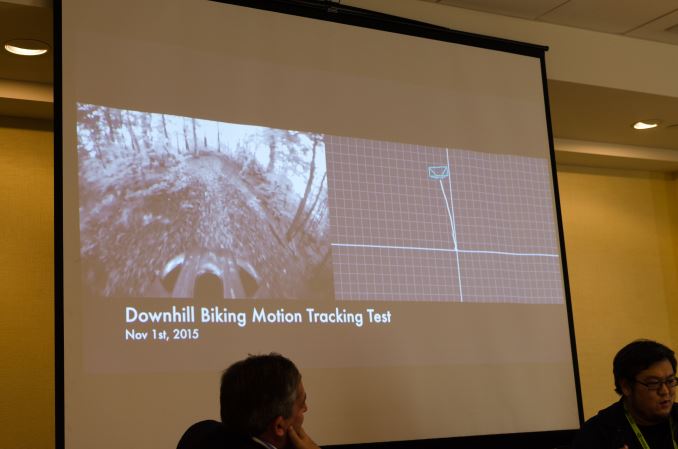
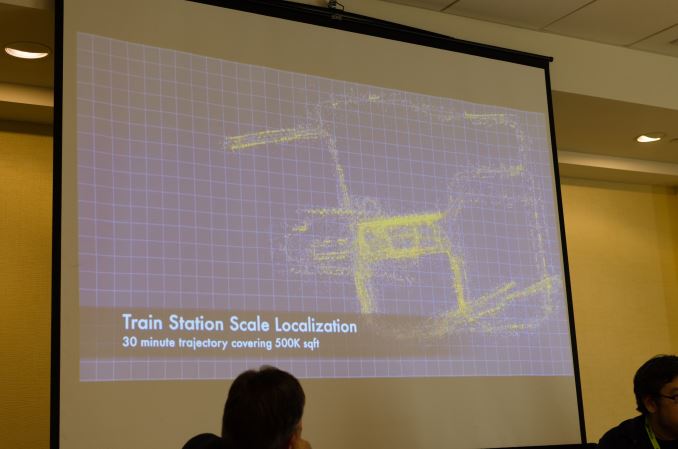
At SIGGRAPH today Google recapped some of this progress that we’ve seen at Google I/O as far as algorithms go and really polishing the sensor fusion, feature tracking, modeling, texturing, and motion tracking aspects of Tango. Anyone that has tried to do some research into how well smartphones can act as inertial navigation devices will probably know that it’s basically impossible to avoid massive integration error that makes the device require constant location updates from an outside source to avoid drifting.
With Tango, the strategy taken to avoid this problem works at multiple levels. At a high level, sensor fusion is used to combine both camera data and inertial data to cancel out noise from both systems. If you traverse the camera tree, the combination of feature tracking on the cameras as well as depth sensing on the depth sensing camera helps with visualizing the environment for both mapping and augmented reality applications. The combination of a traditional camera and a fisheye camera also allows for a sort of distortion correction and additional sanity checks for depth by using parallax, although if you’ve ever tried dual lens solutions on a phone you can probably guess that this distance figure isn’t accurate enough to rely completely on. These are hard engineering problems, so it hasn’t been until recently that we’ve actually seen programs that can do all of these things reliably. Google disclosed that without using local anchor points in memory that the system drifts at a rate of about 1 meter every 100 meters traversed, so if you never return to previously mapped areas the device will eventually have a non-trivial amount of error. However, if you return to previously mapped areas the algorithms used in Tango will be able to reset its location tracking and eliminate accumulated error.
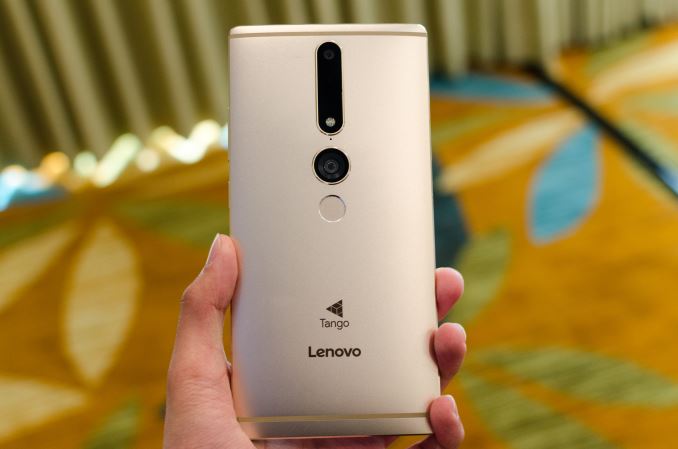
With the Lenovo Phab 2 Pro, Tango is finally coming to fruition in a consumer-facing way. Google has integrated Tango APIs into Android for the Nougat release this fall. Of course, while software is one part of the equation, it’s going to be very difficult to justify supporting Tango capabilities if it needs all of the previously mentioned coprocessors in addition to the depth sensing camera and fisheye camera sensors.
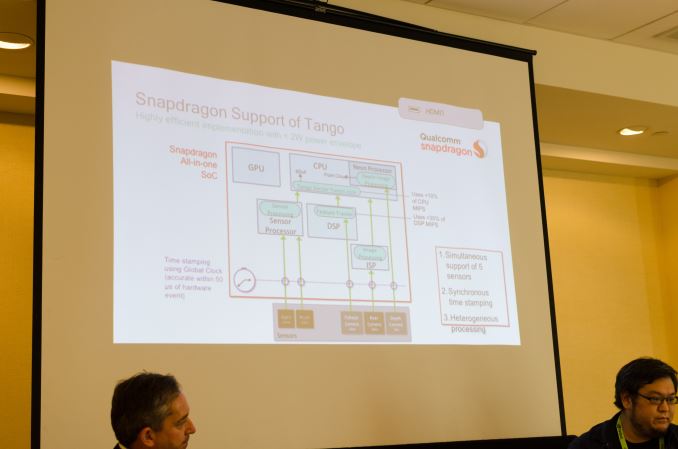
In order to enable Tango in a way that doesn’t require cutting into battery size or general power efficiency, Qualcomm has been working with Google to make the Tango API run on the Snapdragon SoC in its entirety rather than on dedicated coprocessors. While Snapdragon SoCs generally have a global synchronous clock, Tango really pushes the use of this to its full extent by using this clock on multiple sensors to enable the previously mentioned sensor fusion. In addition to this, processing is done on the Snapdragon 652 or 820’s ISP and Hexagon DSP, as well as the integrated sensor hub with low power island. The end result is that there enabling the Tango APIs requires no processing on the GPU and relatively minimal processing on the CPU such that Tango-enabled applications can run without hitting thermal limits and allowing for more advanced applications using Tango APIs. Qualcomm claimed that less than 10% of cycles on the S652 and S820 are used on the CPU and less than 35% of cycles on the DSP are needed as well. Qualcomm noted in further discussion that the use of Hexagon Vector Extensions would further cut down on CPU usage, and that much of the current CPU usage was on the NEON vector units. To see how all of this translates Qualcomm showed off the Lenovo Phab 2 Pro with some preloaded demo apps like a home improvement application from Lowe's which supports size measurements and live preview of appliances in the home with fairly high level of detail. The quality of the augmented reality visualization is actually shockingly good to the extent that the device can differentiate between walls and the floor so you can’t just stick random things in random places, and the placement of objects is static enough that there’s no strange floatiness that often seems to accompany augmented reality. Objects are redrawn fast enough that camera motion results in seamless and fluid motion of virtual objects, and in general I found it difficult to see any real issues in execution. While Project Tango still seemed to have some bugs to iron out and some features or polish to add, it looks like as it is now the ecosystem has progressed to the point where Tango API features are basically ready for consumers. The environment tracking for true six degree of freedom movement surely has implications for mobile VR headsets as well, and given that only two extra cameras are needed to enable Tango API features it shouldn’t be that difficult for high-end devices to integrate such features, although due to the size of these sensors it may be more targeted towards phablets than regular smartphones. | ||||||||||||||||||||||||||||||||||||||||||||||||||||||||||||||||||||||||||
| 10:30a | Ten Year Anniversary of Core 2 Duo and Conroe: Moore’s Law is Dead, Long Live Moore’s Law Today marks a full 10 years since the first Core 2 processors, and hence Intel’s 64-bit Core microarchitecture, were made officially available. These included a number of popular dual-core processor parts, including the seemingly ubiquitous E6400 and the Core 2 Extreme X6800. These were built on Intel’s 65nm process, and marked a turning point in the desktop processor ecosystem. To quote Anand in our launch review: ‘you’re looking at the most impressive piece of silicon the world has ever seen’. Today’s anniversary is somewhat bittersweet, as this week saw the official launch of the ‘final’ biannual International Technology Roadmap for Semiconductors report which predicts the stalling of smaller silicon manufacturing nodes and the progression of new design paradigms to tackle the next 10-15 years of semiconductor innovation. | ||||||||||||||||||||||||||||||||||||||||||||||||||||||||||||||||||||||||||
| 12:35p | Xiaomi Unveils Mi Notebook Air, from $525
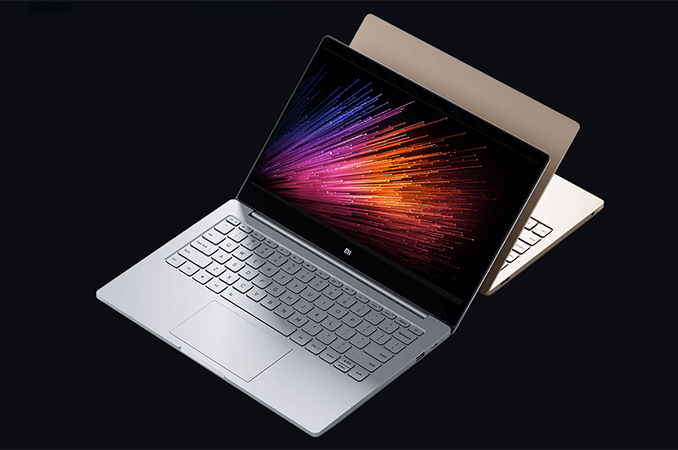
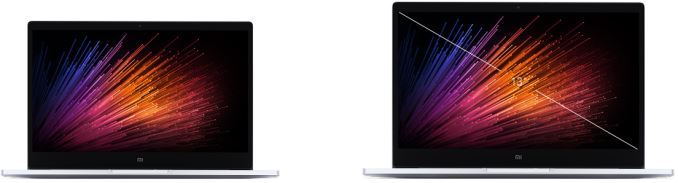
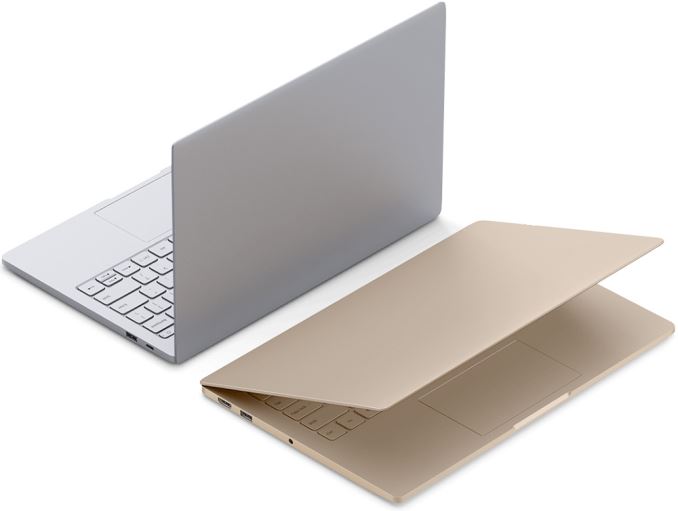
Today Xiaomi has introduced its first pair of notebooks and unvieled the Mi Notebook Air family. As the name suggests, these are aimed head first into Apple's Air line of notebooks, albeit at a very different price point. The laptops feature 12.5” and 13.3” full HD displays and are based on Intel’s Core M as well as Core i5 microprocessors. The price of the ultra-thin all-metal notebooks starts from 3499 CNY ($525, although Xiaomi usually quotes prices including China tax, so $446 perhaps), which could make them very competitive in various markets. As with most Xiaomi products, they will be available in China first. Xiaomi, which is known primarily for its smartphones business and superstar VP, Hugo Barra, positions its laptops as integrated parts of its Mi Ecosystem (which includes smartphones, an Android TV STB, tablets, power banks, headphones, a wrist band and even an air purifier). Their design resembles that of other devices from Xiaomi and uses all-metal silver and gold enclosures. Both notebooks are made by Tian Mi, a partner of Xiaomi, and will run Microsoft Windows 10 Home.
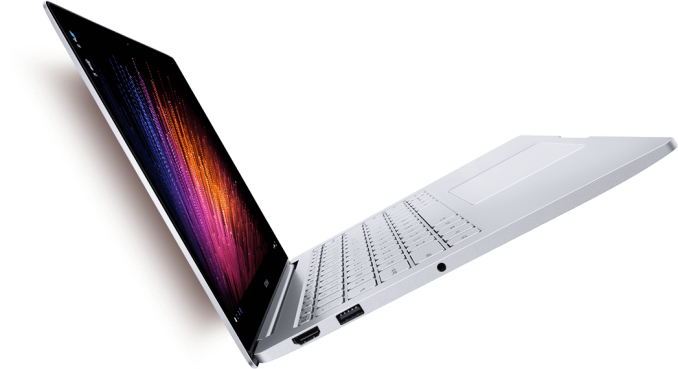
The entry-level laptop from Xiaomi is the Mi Notebook Air 12.5”, which is powered by the dual-core Intel Core m3-6Y30, featuring the Skylake microarchitecture as well as the ninth-generation of Intel's integrated graphics (Gen 9, HD Graphics 515 with 24 EUs). The CPU is rated at a 1.1/2.2 GHz core frequency (base/turbo), 4 MB of last level cache, and a 7W thermal design power (normally this CPU is rated at 4.5W, but the 1.1 GHz in the spec sheet implies that it is running in its 7W cTDP Up mode - this isn't a surprise given the size of the device. The laptop comes with 4 GB of LPDDR3-1866 RAM, 128 GB SATA SSD, 802.11ac 2x2 Wi-Fi, Bluetooth, 1 MP webcam, two microphones, custom AKG speakers and so on. It's not stated if the design uses dual channel memory at this point, and it would be interesting to find out. The system sports one USB Type-C port for charging and display output, one USB 3.0 Type-A port as well as one HDMI connector. The Mi Notebook Air 12.5” features a display panel with 1920x1080 resolution, 170° wide viewing angle, 300 nit brightness as well as 600:1 contrast ratio. Despite the low memory, the main advantage of the Mi Notebook Air 12.5” over its bigger brother is its 11.5 hours rated battery life and low weight of 1.07 . From many points of view, the 12.5” laptop from Xiaomi attempts to combine the key advantages of Apple’s MacBook and MacBook Air (at least, from hardware perspective). It comes with Intel Core M, a common resolution screen, long battery life as well as thin-and-light form factor (like the MacBook). However, the system costs starting from 3999 yuan ($525), which means that it is more affordable than Apple’s MacBook Air.
The next up is the more powerful Xiaomi Mi Notebook Air 13.3”, which is based on the dual-core Intel Core i5-6200U (2.3/2.8 GHz, 3MB LLC, 15 W TDP, Intel HD Graphics 520, etc.) and is equipped with NVIDIA’s GeForce 940 MX discrete GPU featuring a 1 GB GDDR5 memory buffer. Xiaomi says that by equipping its 13.3” laptop with a standalone graphics processor it enables higher performance in games when compared with iGPU. The notebook sports 8 GB of DDR4-2133 memory, a 256 GB NVMe SSD with PCIe 3.0 x4 interface (with up to 1500 MB/s read speed, which means that they are running the PCH in low-power mode and reduce PCIe clock-rates), dual band 802.11ac 2x2 Wi-Fi, Bluetooth, a 1 MP webcam, two microphones, custom AKG speakers and so on. The laptop uses USB-C for charging and display output, two USB-A 3.0 ports and one HDMI connector. The larger laptop from Xiaomi features a better display panel than the smaller model. Despite the similar resolution, viewing angles and brightness, the 13.3” notebook has a rated 800:1 contrast ratio as well as 72% NTSC color gamut (vs 50% on the 12.5” model). However, the bigger and improved screen comes at a price: the Xiaomi Mi Notebook Air 13.3” is 14.8 mm thick and it weighs 1.28 kilograms. The laptop is equipped with a 40 Wh battery (compared to 37 Wh on the smaller model), which gives it up to 9.5 hours of rated battery life. The faster CPU, discrete GPU, faster RAM, speedier SSD and better display effect the pricing of Xiaomi’s 13.3” notebook: the model costs 4999 yuan, or $750 (or $640, if that original CNY price includes China tax).
Xiaomi will only sell its initial family of laptops in China at this time, similar to its smartphone strategy. | ||||||||||||||||||||||||||||||||||||||||||||||||||||||||||||||||||||||||||



| << Previous Day |
2016/07/27 [Calendar] |
Next Day >> |