[Most Recent Entries] [Calendar View]
Friday, July 29th, 2016
| Time | Event | ||||||||||||||||||||||||||||||||
| 8:00a | The SilverStone ST60F-TI Strider Titanium 600W PSU Review SilverStone joined the 80Plus Titanium PSU bandwagon with three new units recently, all with reasonable outputs and interesting specifications. In this review we are having a look at the one of the new set, the 600W Strider Titanium ST60F-TI PSU with 80PLUS Titanium certification. | ||||||||||||||||||||||||||||||||
| 10:00a | AMD Releases Radeon Software Crimson Edition 16.7.3
AMD's Radeon Technologies Group has released another driver update with a healthy list of fixes. On the list today are fixes for CrossFire, flickering in both rendering and the display, and some general stability and bugs. Along with fixes we also see a hefty performance bump in Tomb Raider on AMD’s latest Radeon RX 480. Radeon Software Crimson Edition 16.7.3 brings us up to driver version 16.30.2311, which indicates that this is likely a new driver branch for AMD. Accordingly, despite the deceptive Radeon Software version number, this release contains a relatively large number of performance improvements nad bug fixes. First up, AMD has provided more fixes for Crossfire users. These include a fix for Overwatch crashing in some RX 480 configurations while using Crossfire, and some flickering in both Rise of the Tomb Raider and Need for Speed. A number of flicker fixes have also been made, including a fix for DiRT Rally for terrain flickering when advanced blending is enabled, and some general flickering issues when launching/exiting games on an RX 480 + Freesync display setup. The rendering fixes are not over yet though. A graphical corruption issue with Hitman in DX12 mode has been fixed, as has texture corruption with Total War: Warhammer on a Radeon R9 380. An occasional shadow rendering issue when using DOTA 2 with the Vulkan API has been fixed as well, as has a texture issue with Doom in OpenGL mode on an Eyefinity display setup.. To wind up the list of fixes this time around, AMD has also fixed some bugs in their control panel. This includes an issue where Vukan information in Radeon Settings could display an incorrect version number, and a bug where Radeon Wattman could retain settings of an overclock even after it had failed. For performance improvements we get to see a 10% improvement in performance for Rise of the Tomb Raider on the Radeon RX 480. According to AMD's notes, this test was done on a system running an Intel i7-5960X at 1080p, resulting in the score climbing from 78.73 to 86.53. Of course, a grain of salt should be served with benchmarks from a vendor. On the other hand, 10% is far enough beyond margin of error that many configurations, at least those running an RX 480, should see at least some noticeable benefit. As always, those interested in reading more or installing the updated hotfix drivers for AMD’s desktop, mobile, and integrated GPUs can find them either under the driver update section in Radeon Settings or on AMDs Radeon Software Crimson Edition download page. | ||||||||||||||||||||||||||||||||
| 4:00p | Patriot Adds Two Dual-Channel DDR4-3733 Memory Kits into Lineup
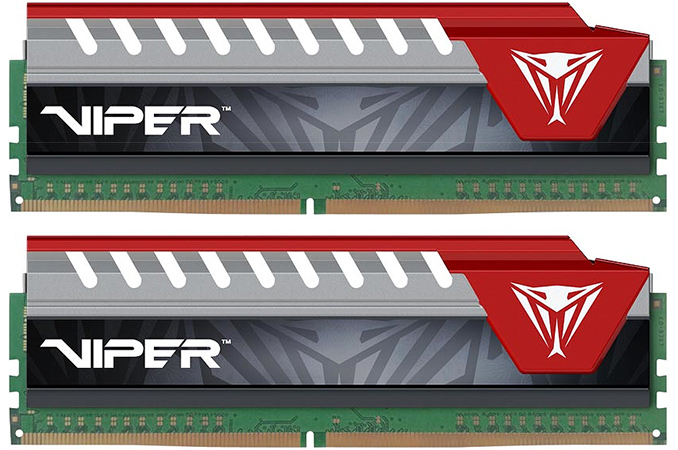
Patriot this week unveiled two new DDR4 kits rated to run at DDR4-3733. The dual-channel kits are designed for Intel’s latest platforms and belong to Patriot’s Viper Elite and Viper 4 families. The new DDR4-3733 memory modules will be the fastest in Patriot’s lineup. Patriot’s new Viper Elite and Viper 4 dual-channel memory kits are rated to run at 3733 MT/s with CL17 19-19-39 timings at 1.35 V. The sets consist of two 8 GB modules, which use modern 8 Gb memory ICs (integrated circuits) from an undisclosed manufacturer. The new modules are designed for Intel’s 100-series platforms and come with XMP 2.0 profiles to make it easier for end-users to run them at their rated specifications with the right timings and voltage.
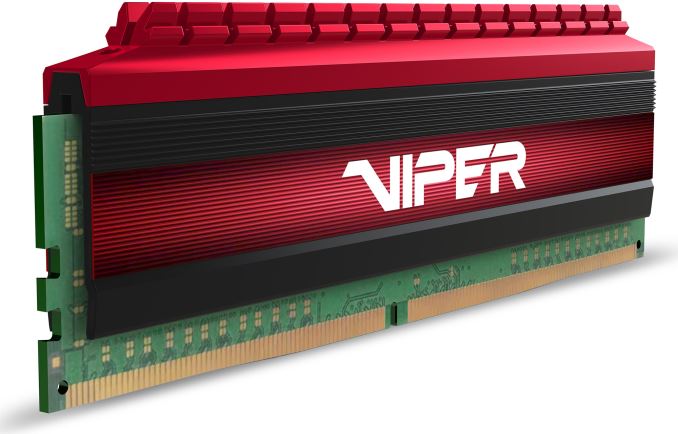
The difference between the Viper Elite and the Viper 4 modules in all in the look. Typically, Patriot positions its Viper Elite products below the Viper 4, and aims them at modders. These modules come with heatsinks of three different colors (red, blue and grey). The Viper 4 family typically focuses on the faster segments and features red extruded aluminum heatsinks. Nonetheless, in this particular case both the Viper Elite DDR4-3733 devices also come only with silver and red heatsinks. Therefore, the difference between two types of DDR4-3733 solutions from Patriot lies only in aesthetics and dimensions. Patriot’s Viper 4 and Viper Elite 16 GB (2 x 8GB) DDR4-3733 dual-channel memory kits will be available for purchase online and in stores starting from August 3 for the recommended price of $159.99.
Only a few memory module makers offer DDR4 sticks rated to run above 3400 MT/s speeds because it requires sufficient binning, as well as an appropriate volume of sales to make it worthwhile. It gets rather tricky to cherry pick a sufficient amount of such ICs to build appropriate products. The fact that Patriot rolled out two DDR4-3733 kits indicates that the company is willing to compete for very high-end systems featuring fast memory as well as showing the ability of mass-produced DDR4 chips to run at higher frequencies. | ||||||||||||||||||||||||||||||||
| 5:00p | Samsung’s PM1633a Now Available: $10k for 15 TB, $6k for 7 TB
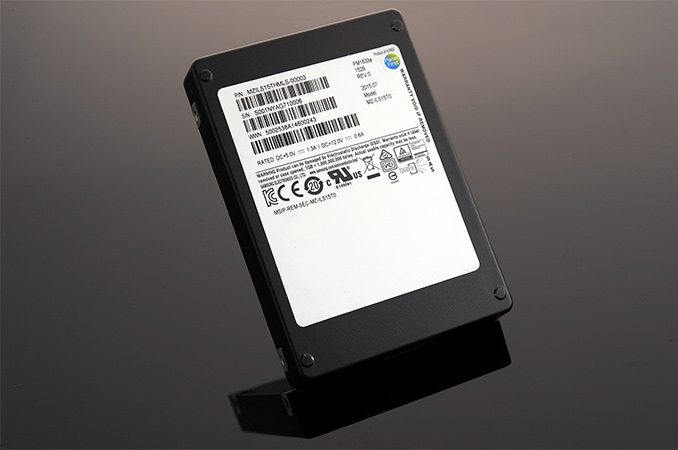
Samsung started to ship its PM1633a SSD with 15.36 TB capacity to select customers in March and recently it began to supply the drive to select resellers as well. The enterprise-class SSD is now offered by two U.S.-based retailers and can be purchased for ~$10,000, which makes it one of the world’s most expensive commercial solid-state drives. Meanwhile, Samsung officially expanded its PM1633a family of SSDs with many lower-capacity models and has begun to ship the 7.68 TB version to at least one reseller. The Samsung PM1633a drives are based on the company’s third-generation 256 Gb TLC 3D V-NAND memory chips introduced last year. Samsung stacks 16 of such ICs to form a single 512 GB package and then uses 32 of them to build its flagship 15.36 TB SSD, leaving about 1 TB of NAND flash for overprovisioning. Typically, high-capacity SSDs do not provide very high performance, because of peculiarities of their internal architecture and limitations of contemporary controllers (which cannot simultaneously access many high-density chips, or multiple controllers in a RAID-0 stripe configuration). To speed up its most spacious PM1633a drive, Samsung had to develop a new proprietary controller that can concurrently access large amounts of high-density NAND flash with the help of a special firmware. For its flagship PM1633a 15.36 TB SSD, the manufacturer declares sequential read performance up to 1200 MB/s as well as sequential write performance up to 900 MB/s using the SAS-12Gbps interface. As for random read and write operations, the 15.36 TB SSD can deliver up to 195,000 and 31,000 IOPS respectively (which is slightly lower than the company advertised back in March). When Samsung announced its PM1633a SSD earlier this year, it only introduced one model with 15.36 TB capacity. Since then, the company has officially expanded the PM1633a family with 480 GB, 960 GB, 1.92 TB, 3.84 TB and 7.68 TB models (see flyer for details). The expansion of the lineup demonstrates Samsung’s confidence that its third-generation V-NAND TLC memory is reliable enough for enterprise usage scenarios. In fact, the PM1633a series consists of six SKUs, whereas the PM1633 family based on the second-gen 32-layer V-NAND includes only four configurations (up to 3.8 TB capacity, but they are faster than the PM1633a). Both lineups are aimed at enterprise storage applications with SAS 12Gbps interface.
Back in March, Samsung only began to ship its PM1633a to select clients. We suspect that these clients are those that run large cloud data centers, and require such drives to run their specific workloads. Now,the manufacturer has started to ship its flagship SAS SSD to a broader range of customers. For example, the Samsung PM1633a 15.36 TB drive (MZILS15THMLS) is now offered by CDW for $10,311.99 as well as by SHI for $9,690 on preorder. Both retailers ask to contact them for actual availability, depending on when stock is available (which is not surprising, given the price of the SSD as well as its very special positioning). In addition, CDW also offers the PM1633a 7.68 TB (MZILS7T6HMLS) drive for $5,729.99, which ships within 11–13 days. The price of Samsung’s PM1633a 15.36 TB SSD may seem excessive, but for large cloud data centers (which always try to maximize their storage capacity) as well as mission-critical storage applications such drives make a lot of sense. For example, Supermicro has 2U machines that can fit in 48 SAS3/12G storage devices (1, 2). Each of such servers can store 737.28 TB of data (if fully populated with Samsung’s 15.36 TB SSDs), whereas storage capacity of a 42U cabinet featuring 21 of such servers will be 15482 TB (15.4 PB). By contrast, a standard 42U storage rack featuring 360 3.5” 10 TB hard drives can store around 3600 TB. Moreover, given very high sequential and random read/write performance of the PM1633a, just one such device can substitute many 10K or 15K mission-critical HDDs (each of which can cost $400 – $700). Hence, there will be numerous customers interested in buying the Samsung PM1633a 15.36 TB for its price-point. Other Reading:The Samsung 850 EVO 4TB SSD Review
| ||||||||||||||||||||||||||||||||


| << Previous Day |
2016/07/29 [Calendar] |
Next Day >> |