[Most Recent Entries] [Calendar View]
Thursday, August 11th, 2016
| Time | Event | ||||||||||||||||||||||||||||||||||||||||||||||||||||||||||||||||||||||||||||||||||||||||||||||||||||||||||||||||||
| 5:30a | Samsung at Flash Memory Summit: 64-layer V-NAND, Bigger SSDs, Z-SSD
At Flash Memory Summit, Samsung announced their fourth generation of 3D NAND and several of the more obvious SSD upgrades it enables. Taking a page from Intel and Micron's strategy book, they also announced a new memory type and corresponding SSD product while saying essentially nothing about what the new memory actually is. Gallery: Samsung 4th Generation V-NAND
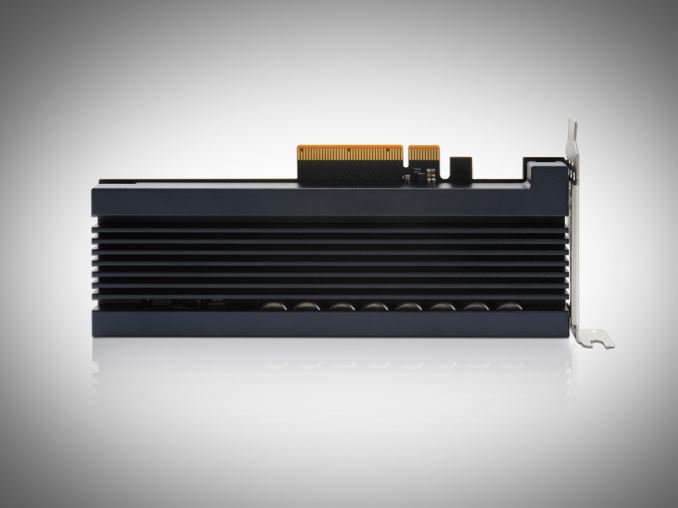
      The fourth generation 3D NAND bumps the layer count up to 64, compared to the 48-layer design used by the third generation V-NAND that was announced last fall and has been slowly rolling out to their SSD products over the course of this year. So far Samsung has talked about a 512Gb TLC part, and at least initially the MLC parts will probably be made from the same die and thus have two thirds the capacity. (Samsung's second generation 3D NAND was initially available as 128Gb TLC or 86Gb MLC, with 128Gb MLC parts introduced later.) The new NAND also supports an increased interface speed of 800Mbps, which is key to reducing the performance penalty that comes from consolidating more flash onto fewer independent chips. With a per-die capacity of 512Gb (64GB), Samsung can now put 1TB of TLC flash in a single package. This means most product lines will be seeing an increase in capacity at the high end of the range. Their BGA SSD products will be offering 1TB capacity even in the 11.5mm by 13mm form factor. The 16TB PM1633a SAS SSD will be eclipsed by the new 32TB PM1643. Likely to be further out, the PM1725 PCIe add-in card SSD will be succeeded by the PM1735 with a PCIe 4 x8 host interface. Complementing the NAND update will be a new non-standard oversized M.2 form factor 32mm wide and 114mm long, compared to the typical enterprise M.2 size of 22mm by 110mm. A little extra room can go a long way, and Samsung will be using it to produce 8TB drives. These will be enterprise SSDs and Samsung showed a diagram of these enabling 256TB of flash in a 1U server. Samsung will also be producing 4TB drives in standard M.2 sizing. Gallery: Samsung Z-NAND and Z-SSD
     In what is likely a bid to steal some thunder from 3D XPoint memory before it can ship, Samsung announced Z-NAND memory technology and a Z-SSD product based around Z-NAND and a new SSD controller. They said nothing about the operating principles of Z-NAND, but they did talk about their plans for the Z-SSD products. Samsung Z-SSD is being marketed as addressing the performance gap between DRAM and SSDs. Samsung's slides during their keynote showed some performance comparisons against the PM963 NVMe TLC SSD and against an unnamed "PRAM based" solution that may be a stand-in for the expected performance of NVMe drives using 3D XPoint memory. The Z-SSD ties or comes out ahead on every benchmark Samsung showed, but NVMe NAND flash SSDs were missing from the power consumption comparison. The slides stated that there will be a 1TB Z-SSD this year and 2TB and 4TB Z-SSDs next year, while the press release issued later states that more generally that the Z-SSD is expected to be released next year. The press release also states that Z-NAND "shares the fundamental structure of V-NAND and has a unique circuit design and controller that can maximize performance". Given that, the launch timeframe and capacities that are only a little lower than NAND flash SSDs, it seems that Z-NAND isn't drastically different from existing memory technologies and it may even be little more than SLC flash in disguise, trying for a comeback. | ||||||||||||||||||||||||||||||||||||||||||||||||||||||||||||||||||||||||||||||||||||||||||||||||||||||||||||||||||
| 9:00a | The BitFenix Pandora ATX Case Review BitFenix owes a lot of their recent success as a company to the Pandora. It is a case that was loved for its design and price to performance ratio. However, the Pandora was compact and could only take up to Micro ATX motherboards, with limited expandability and cooling options. In this review we are having a look at a newer version of the Pandora, the Pandora ATX, which shares the aesthetic design of the original Pandora but is both much larger and comes with extensive support for liquid cooling systems. | ||||||||||||||||||||||||||||||||||||||||||||||||||||||||||||||||||||||||||||||||||||||||||||||||||||||||||||||||||
| 5:45p | Maxiotek Unveils MK8115: Low-Cost SSD Controller for 3D NAND SATA SSDs
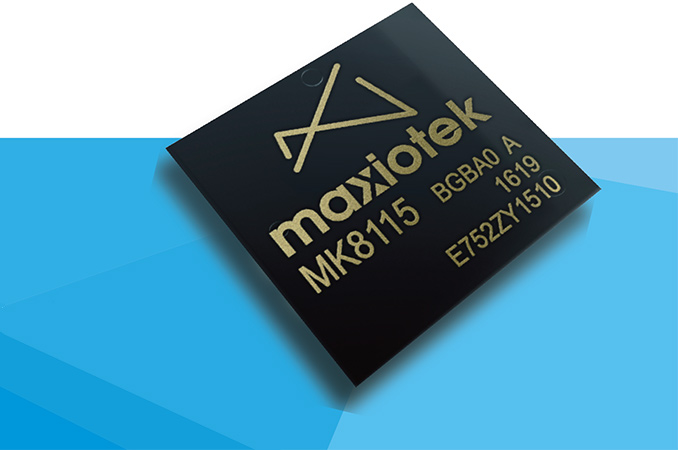
Maxiotek this week introduced its first SSD controller designed for affordable SSDs with an SATA interface, which is meant to be paired with new types of NAND flash memory, including chips with 3D architecture as well as ICs made using thin fabrication processes. The company is working with various makers of SSDs as well as OEMs, so actual drives based on the MK8115 will hit the market in the foreseeable future. In fact, one of the first drives featuring the chip is ADATA’s SU700, which was demonstrated back at Computex. The Maxiotek MK8115 is a quad-channel controller that supports a SATA 3.2 host interface as well as various types of SLC, MLC, 3D MLC, and 3D TLC NAND flash memory. Internally, Async, Toggle, and ONFi NAND interfaces are supported, with up to 400 MT/s transfer rates. The MK8115 controller supports the developer’s AgileECC error correction (with programmable ECC parity that supports 1 KB code-word length correctable up to 76 bits, something that implies on BCH method) with virtual parity recovery; modern security capabilities like AES-256, SM4, TCG-OPAL 2.0, IEEE1667; low-power modes (Slumber/Device Sleep, etc.); advanced static/dynamic wear-leveling and so on. One of the key features that Maxiotek advertises about its MK8115 is the fact that it does not require DRAM, thus allowing to build very affordable SSDs.
When it comes to compatibility with actual memory, the MK8115 supports SLC NAND produced using 20 nm-class fabrication processes, MLC NAND made using all three iterations of 10 nm-class manufacturing technologies (1x, 1y, 1z) as well as IMFT’s 3D MLC and 3D TLC NAND flash. The controller can support up to 1536 GB of memory (when coupled with IMFT’s 384 Gb 3D TLC ICs), which should be enough for low-cost SATA SSDs for at least a couple of years. Performance-wise, the MK8115 is on par with other SATA 3.2 devices: it can handle up to 560 MB/s sequential read speed and up to 530 MB/s sequential write speed. As for random operations, the new SSD controller is rated to perform up to 100K random read IOPS as well as up to 75K random write IOPS. In a bid to boost writing performance of 3D TLC NAND-based SSDs, the MK8115 can also use a part of the NAND in pseudo-SLC mode, which is what other controllers do these days as well. Maxiotek claims that the upcoming DRAM-less SSDs powered by the MK8115 will perform just like drives featuring DRAM cache (to store LBA tables) in typical workloads.
The Maxiotek MK8115 chip is available in 12×12 mm2 288-ball TFBGA package and use 3.3V/1.8V/1.2V power supply, which make it compatible with SSDs in M.2 and mSATA. Since SATA 2.5” form-factors require +5V and +12V rails, to build such SSDs featuring the MK8115, manufacturers will have to integrate a basic VRM into the package, which should not be too hard. Maxiotek may not be a household name, but the company is basically a spin-off from JMicron, whom focuses solely on SSD controllers. The two companies are still based in the same building in Hsin-Chu, Taiwan, but we have no idea whether they share any resources. Nonetheless, a good news is that Maxiotek will not start to build itself from scratch, but will continue from where JMicron stopped. At least, the company says it has an experienced team of engineers as well as relations with partners, which include all major makers of SSDs as well as PC OEMs. | ||||||||||||||||||||||||||||||||||||||||||||||||||||||||||||||||||||||||||||||||||||||||||||||||||||||||||||||||||
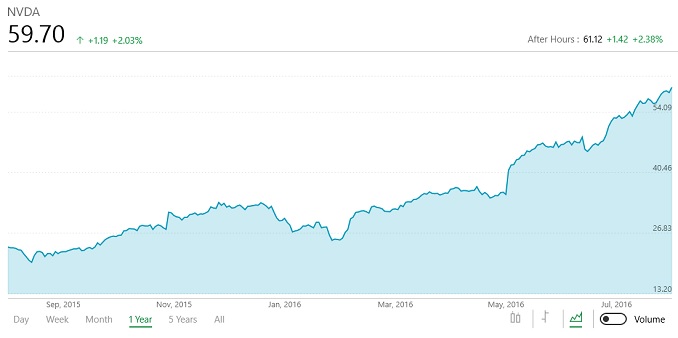
| 10:15p | NVIDIA Announces Record Revenue For The Second Quarter Of Fiscal Year 2017
This afternoon, NVIDIA announced their quarterly earnings for the second quarter of their 2017 fiscal year, which ended July 31. NVIDIA had record revenues for the quarter, coming in at $1.43 billion, which is up 24% from a year ago. Gross margin for the quarter was 57.9%, up 2.9% from a year ago, while operating expenses fell 9% to $509 million. Operating income for the quarter was $317 million, up 317% from Q2 2016 where it was just $76 million due to a write-down of the Icera modem division. This also impacted net income, which was up 873% to $253 million, and earnings per share of $0.40 was up 700% compared to the Q2 2016 results.
NVIDIA also released Non-GAAP measures, which “exclude stock-based compensation, legal settlement costs, product warranty charge, acquisition-related costs, contributions, restructuring and other charges, gains from non-affiliated investments, interest expense related to amortization of debt discount, and the associated tax impact of these items, where applicable” and therefore don’t factor in the Icera write-down. In Non-GAAP measures, revenue was the same $1.428 billion, and gross margin was 58.1% which was up 1.5% from the Q2 2016 Non-GAAP results. Operating income was up 65% to $328 million, and net income was up the same 65% to $313 million. Earnings per share were up 56% to $0.53 compared to last year’s Non-GAAP results.
At the heart of this is NVIDIA’s GPU business, which has diversified quite a bit over the last several years. For Q2 2017, NVIDIA’s GPU business brought in $1.196 billion in revenue, up 18% from last year and up 14% over last quarter. NVIDIA’s Tegra platform, which is primarily automotive now, but still powering a couple of consumer devices like the SHIELD Tablet K1 and the SHIELD Android TV, brought in revenues of $166 million, which is up 30% from a year ago. NVIDIA’s “other” category is the $66 million they report per quarter for the payment from Intel for licensing. Broken down by market, gaming is still the largest market for NVIDIA, with revenues of $781 million attributed to gaming, which is up 18% year-over-year. This has been spurred by the recent releases of their latest Pascal GPUs for the desktop, which hold the current performance crown with the move to a new FinFET node. Professional Visualization brought in $214 million, up 22% from a year ago, and NVIDIA just announced Pascal based Quadro cards as well, so I would expect this growth to continue if Quadro matches GeForce. The Datacenter revenue had the biggest jump, up 110% year-over-year to $151 million, and NVIDIA has put a lot of effort and marketing into deep learning to achieve this kind of growth. Automotive accounted for $119 million in revenue, up 68% from a year ago, and NVIDIA’s OEM and IP market was the only one to see a small loss of 6% revenue compared to last year, down to $163 million.
For next quarter, NVIDIA is expecting revenues of $1.68 billion, plus or minus 2%, with GAAP margins of 57.8% and non-GAAP margins of 58.0%, plus or minus 0.5%. With record revenue, a more diversified platform, and the current GPU performance crown, NVIDIA has been easily outperforming the PC market with their strong focus on one of the few bright spots in the PC market – gaming. We’ve seen several companies transition to practically only selling gaming computers, and that is because of the higher margins and strong sales they’ve seen. NVIDIA has been riding this wave with successful launches of it’s Maxwell products, and now Pascal. Source: NVIDIA Investor Relations | ||||||||||||||||||||||||||||||||||||||||||||||||||||||||||||||||||||||||||||||||||||||||||||||||||||||||||||||||||

| << Previous Day |
2016/08/11 [Calendar] |
Next Day >> |