[Most Recent Entries] [Calendar View]
Tuesday, August 16th, 2016
| Time | Event |
| 12:00a | NVIDIA’s GeForce GTX 10-Series for Notebooks Unveiled, Launching Today Although no two GPU launches are ever exactly alike, I think this year’s launch of the FinFET generation GPUs really drives that point home. Over the last 3 months we have seen an incredibly compact launch schedule from NVIDIA, having started with the GeForce GTX 1080 and GP104 in May, and adding another 3 cards and 2 GPUs since then. At least on the desktop side, this is the most aggressive launch schedule we’ve seen out of NVIDIA in nearly a decade. On the mobile side however, things have moved at a different pace. In the most recent years, NVIDIA has launched at least parts of their mobile stack either directly alongside their desktop series launch (e.g. GTX 600M series), or shortly thereafter in the case of the GTX 900M series. So there has been a great deal of interest in when the mobile GTX 10-Series would launch, both due to overall booming gaming laptop market, and because laptops in general are the ultimate litmus test for power efficiency, and stand to gain the most from the move to FinFET transistors. To that end, we finally have an answer to the mobile question. Skipping any pre-release fanfare like on the desktop side, NVIDIA and its partners are going straight to launch, hard launching the GeForce GTX 10-Series lineup for notebooks today. And while it’s been a bit longer of a wait than in past years, NVIDIA is launching a full 3-part stack at once, from GTX 1060 to GTX 1080, meaning the notebook video card is now fully caught-up with desktop lineup. There’s a lot to cover here, so let’s dive right in. |
| 7:00a | NVIDIA Releases 372.54 WHQL Game Ready Driver
Yesterday NVIDIA unveiled the GeForce GTX 10 Series for notebooks. Following through they have sent out the new 372.54 driver update with support for the new notebooks and in the process moved us to a new driver branch with Release 370. This new branch gives us a host of other fixes, feature additions, and some game ready support for a few new game releases this month. We start off with some small SLI fixes. First off there was an issue with shadow darkness randomly changing during gameplay in The Witcher 3. It also appears that if one wanted to run an auxiliary third GTX 1080 that SLI could not be turned on for the first two cards, which would be helpful if one wanted a hefty gaming rig and a card to run compute jobs on the side. Last on the SLI front, there is a new SLI profile for space engineers. Moving on there is also a corrected high DPC latency issue for GP104 cards, which includes the GTX 1080 and GTX 1070. In software stability issues we see fixes for stuttering in the Netflix windows Store app and crashing in Call of Duty: Black Ops III, and in the hardware compatibility department NVIDIA has resolved an issue with high idle clock speeds while using two DisplayPort displays. For the list of game ready support that typically comes with these driver updates we have last weeks No Man’s Sky, Next week’s releases of Deus Ex: Mankind Divided and Obduction, with Codemasters F1 2016 and Epic Game’s Paragon open beta capping off the list with their release this week. Out of the games recieving support, No Man's Sky is recieving a Bete SLI profile and Deus Ex: Mankind Divided will have a DX11 SLI profile. Finishing off with this week’s driver update, we have a list of new features. On the list is support for an updated version of NVIDIA’s BatteryBoost technology, lower power consumption for multi-monitor 144Hz G-Sync display setups, and some developer related updates. These last updates include support for OpenGL VR SDK 1.4 in Windows, and also a Windows cross-API interop between Vulkan and DX11, meaning Vulkan app compatibility with existing DX11 HMD runtimes. NVIDIA additionally lists driver support for DXGI 2 VR, and of course, this driver update provides support for the new GeForce GTX 10-series GPU powered notebooks. Anyone interested can download the updated drivers through GeForce Experience or on the NVIDIA driver download page. More information on this update and further issues can be found in the 372.54 release notes. |
| 8:00a | AMD Releases Radeon Software Crimson Edition 16.8.2 Hotfix In very short order AMD has dropped another driver update in response to the latest. The 16.8.2 hotfix gives the driver version a minor bump to 16.30.2511.1001. With only a few days between updates it’s unsurprising to see a short list of fixed issues this time around. Starting the fixes is a crash in Overwatch, which happened intermittently when browsing the hero gallery. Those with a Freesync display and Freesync enabled may have experienced flickering on the desktop while the system is idle, and some windows 10 Anniversary Edition systems may have seen install issues when secure boot is enabled. There is a healthy list of known issues that shows what AMD is aware of, and presumably working on. There are a few issues following themes we’ve seen in past updates, and some that have been lingering for a few updates. Flickering issues are still found while playing on some non Freesync 144Hz monitors or when playing Rocket League with Crossfire enabled. There are also still some issues with RX 400 series cards with intermittent stuttering in The Division on the RX 480 with high game settings and vsync enabled, or application hangs while playing Grand Theft Auto 5 at 4K in story mode. Following suit with Rocket League’s Crossfire struggles, World of Tanks may experience stuttering after performing a task switch with Crossfire turned on. Along with receiving fixes and acknowledgement of issues, we of course get game ready support for the latest gaming developments. On the list today is support for both No Man’s Sky which saw a lukewarm release last week, and alongside we have support for the Paragon Open Beta from Epic Games which will be available starting today. As always, those interested in reading more or installing the updated hotfix drivers for AMD’s desktop, mobile, and integrated GPUs can find them either under the driver update section in Radeon Settings or on AMDs Radeon Software Crimson Edition download page. |
| 9:00a | The Samsung Galaxy Note7 (S820) Review This year has been difficult for smartphones, which is a bit of a paradox when you consider just how much better things have gotten compared to last year. With Snapdragon 820, 650, 652, and 625 we’ve finally moved past the shadow of the Snapdragon 810, 808, and 617/615. While there were Android devices that shipped with the Exynos 7420, they were often paired with a modem that was not necessarily the most power efficient. Despite all of this, there seems to be a general disappointment with smartphones. People are increasingly finding it hard to justify phones like the HTC 10 or Galaxy S7 with competition from OnePlus, Xiaomi, and even Apple with their iPhone SE. In this context the Galaxy Note7 brings much of the flavor of the Galaxy S7 edge, but blends it with the S-Pen of the Note line and a few new features like the iris scanner. If you were paying attention to the industry with the launch of the Galaxy S6 and Galaxy Note5, it’s very much more of the same rather than the major redesigns that we saw moving from the Galaxy S5 to the Galaxy Note 4. To see how it performs, read on for the full review. |
| 11:56a | IDF 2016: Keynote Live Blog We're here at Intel's IDF 2016 Keynote talk! |
| 2:00p | Intel Optane And 3D XPoint Updates From IDF
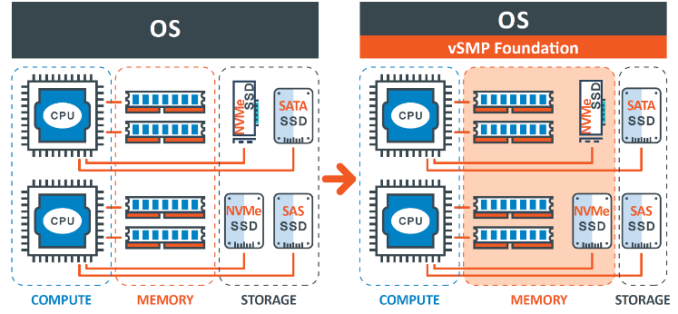
At Intel Developer Forum this week in San Francisco, Intel is sharing a few more details about its plans for their Optane SSDs using 3D XPoint memory. The next milestone in 3D XPoint's journey to being a real product will be a cloud-based testbed for Optane SSDs. Intel will be giving enterprise customers free remote access to systems equipped with Optane SSDs so that they can benchmark how their software runs with 3D Xpoint-based storage and optimize it to take better advantage of the faster storage. By offering cloud-based access before even sampling Optane SSDs, Intel can keep 3D XPoint out of the hands of their competitors longer and perhaps make better use of limited supply while still enabling the software ecosystem to begin preparing for the revolution Intel is planning. However, this won't do much for customers who want to integrate and validate Optane SSDs with their existing hardware platforms and deployments. The cloud-based Optane testbed will be available by the end of the year, suggesting that we might not be seeing any Optane SSDs in the wild this year. But at the same time, the testbed would only be worth providing if its performance characteristics are going to be pretty close to that of the final Optane SSD products. Having announced the Optane testbed like this, Intel will probably be encouraging their partners to share their performance findings with the public, so we should at least get some semi-independent testing results in a few months time. In the meantime, Intel and ScaleMP will be demonstrating a use that Optane SSDs will be particularly well-suited for. ScaleMP's vSMP Foundation software family provides virtualization solutions for high performance computing applications. One of their specialities is providing VMs with far more virtual memory than the host system has DRAM, by transparently using NVMe SSDs—or even the DRAM and NVMe storage of other systems connected via Infiniband—to cache what doesn't fit in local DRAM. The latency advantages of 3D XPoint will make Optane SSDs far better swap devices than any flash-based SSDs, and the benefits should still be apparent even when some of that 3D XPoint memory is at the far end of an Infiniband link.
ScaleMP and Intel have previously demonstrated that flash-based NVMe SSDs can be used as a cost-effective alternative to building a server with extreme amounts of DRAM, and with a performance penalty that can be acceptably small. With Optane SSDs that performance penalty should be significantly smaller, widening the range of applications that can make use of this strategy. Intel will also be demonstrating Optane SSDs used to provide read caching for cloud application or database servers running on Open Compute hardware platforms. |
| 5:59p | Intel Teases Mobile Kaby Lake: HEVC Main10 Profile Support, Coming This Autumn
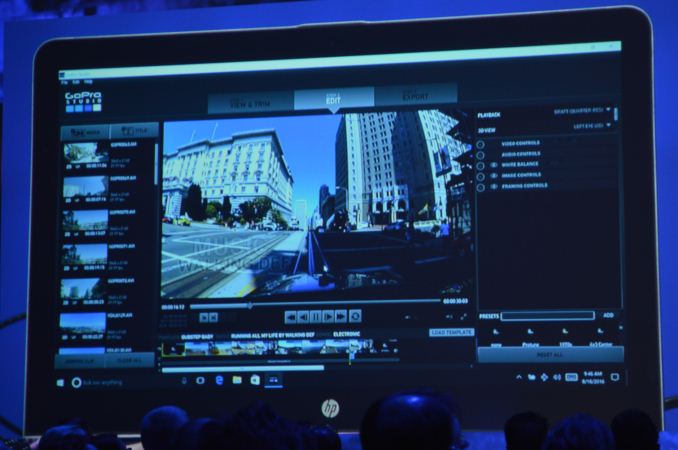
During the Intel Keynote presentation today at IDF Brian Krzanich, CEO of Intel, demonstrated several upcoming Kaby Lake 2-in-1 prototypes from HP and Dell. While no concrete details about the 7th Generation of Intel Core products lines were given, we were offered a couple of bits of information to tide the hype until a full launch. On the stage, support for HEVC Main10 Profile was announced with 7th Gen, although it was unclear if this was decode only or encode as well. This is still a step up from Skylake support, where Main10 required hybrid hardware/software decoding acceleration. Moving it into hardware for Kaby Lake will help with performance and power consumption, particularly of 4K content where HEVC vs. H.264 differences are bigger than Full-HD. The demo on stage showed GoPro software taking 4K data from six cameras and being able to switch between the content of each camera without stuttering or delay, on a 2-in-1 mobile device.
For gaming, we were treated to a demonstration of Overwatch being run off of the 7th Gen IGP. That being said, it was not mentioned what the resolution or quality the game was running at, and V-Sync was not enabled. Intel clarified that the demos on the stage were from their highest performance CPUs, but the fact that only 2-in-1s were on display demonstrates that Kaby Lake will be focused on mobile first. The HP and Dell prototypes also add to the ASUS prototypes we saw at Computex earlier in the year. Intel stated that 7th Gen CPUs are already in the hands of partners, ready for production devices, and we should expect to see them in the hands of consumers this autumn. Again, given the focus, it seems we will encounter Kaby Lake in mobile form factors (4W and 15W) before anything on desktop. |
| 7:55p | Intel Announces Project Alloy: Untethered Augmented Reality in a VR Headset with RealSense
During the Keynote today at IDF, Intel showed off the next play into the Virtual Reality design space. In an interesting twist, their new Project Alloy headset was demonstrated on stage and marketed as a fully untethered VR device that uses dual RealSense cameras to monitor location and position of objects around the user. The headset stills needs a PC for data transmission, such as the Skull Canyon NUC with Iris Pro graphics, but the idea to have a headset without wires is interesting but offers up a number of questions. On top of this, the Real Sense cameras will have full five-finger recognition, allowing the software to adjust the appearance of the users hands or other figures as appropriate (this is where the Augmented Reality comes in).
Intel mentioned that the headset has good weight distribution, as well as an SoC inside for the processing. There was no indication as to the power consumption of that SoC, but I can imagine it being under 10W otherwise it would heat up the users face over time. The back of the headset also has a compartment, which I would assume is battery, which gives another question on the battery life of such a headset.
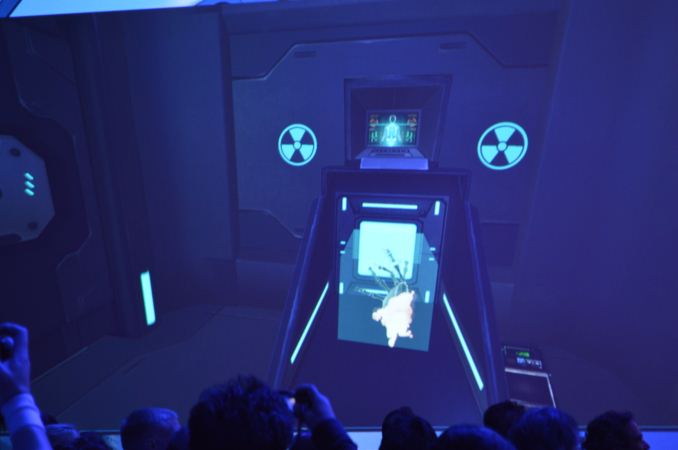
The VR + AR concept is being marketed as ‘mixed reality’ – the ability to use your hands in a VR environment which also adjusts the visuals of your hands based on what is happening in the scene. In the demo on stage, Intel showed a hand turning into a skeleton hand when placed in front of an X-Ray scanner in the scene. There was also discussion that this sort of mixed reality (MR) allows full roaming capabilities that mean a user won’t easily bump into objects around their home (or walls).
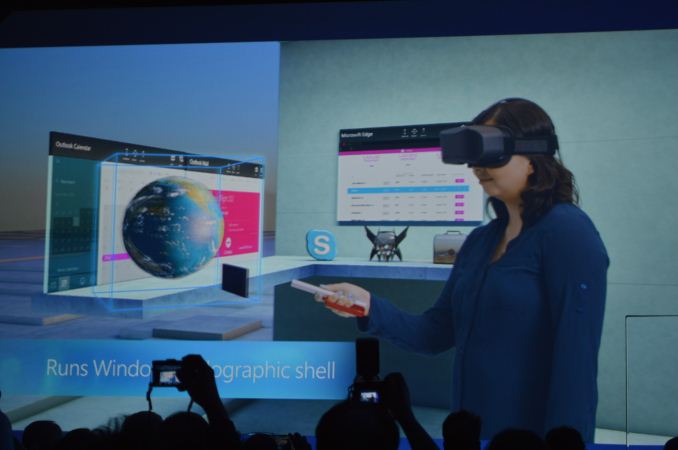
The demo was also projected onto a large screen, and it was clear this is still a prototype as we could see dropped frames. It was mentioned that Holo-Lens used Cherry Trail, and this is more powerful. Another element of use was a mix of 2D/3D environments, such as the eponymous ‘unlimited desktop’ for working and consuming content. The use of RealSense will be similar to at least one other headset with an external camera, but the rendered video on screen showed a person manipulating 2D interfaces projected onto walls with a remote control.
Project Alloy will require a Windows PC with Windows Holographic Platform, which will come to Windows 10 PCs next year as part of the regular updates. V1 of the device will be available to partners in December, and the hardware will be open sourced in the second half of 2017. The RealSense APIs will be opened up as well. Chances are we will see more demos this time next year.
|
| 10:57p | honor Press Event Live Blog We're in the California Academy of Sciences in SF awaiting a press event for Honor. |




| << Previous Day |
2016/08/16 [Calendar] |
Next Day >> |