[Most Recent Entries] [Calendar View]
Monday, August 22nd, 2016
| Time | Event |
| 4:37a | ARM Announces ARM v8-A with Scalable Vector Extensions: Aiming for HPC and Data Center
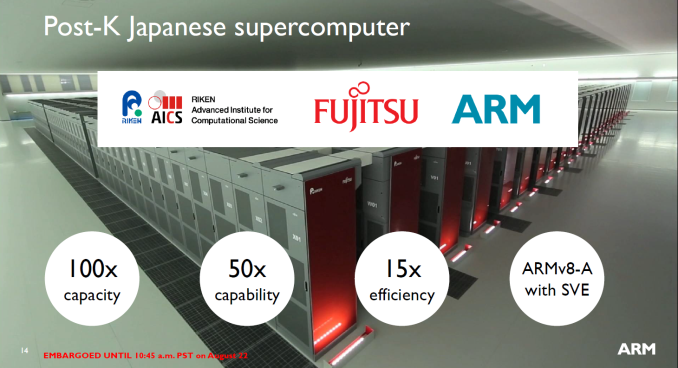
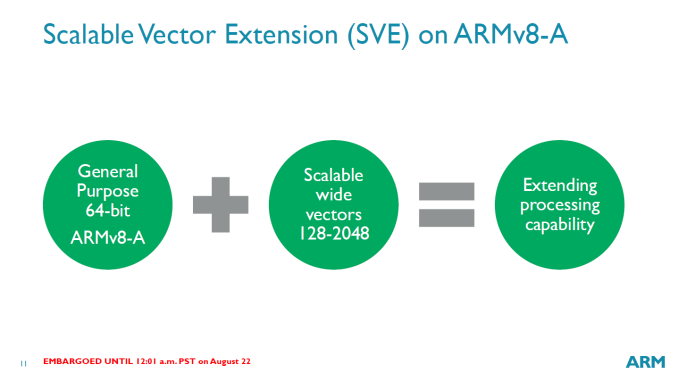
Today ARM is announcing an update to their line of architecture license products. With the goal of moving ARM more into the server, the data center, and high-performance computing, the new license add-on tackles a fundamental data center and HPC issue: vector compute. ARM v8-A with Scalable Vector Extensions won’t be part of any ARM microarchitecture license today, but for the semiconductor companies that build their own cores with the instruction set, this could see ARM move up into the HPC markets. Fujitsu is the first public licensee on board, with plans to include ARM v8-A cores with SVE in the Post-K RIKEN supercomputer in 2020.
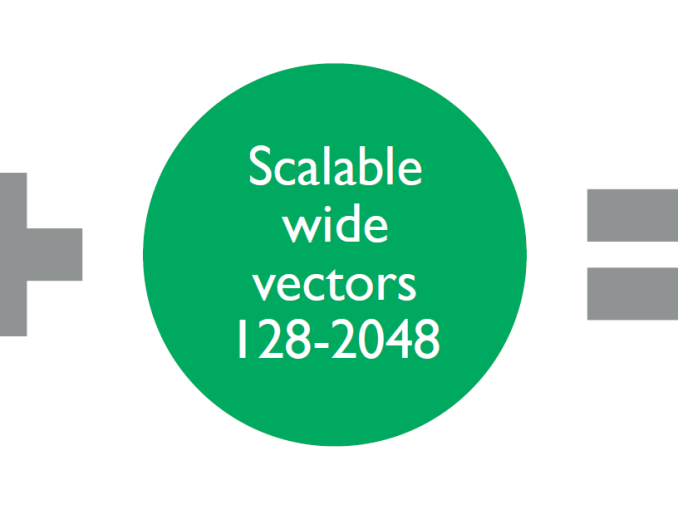
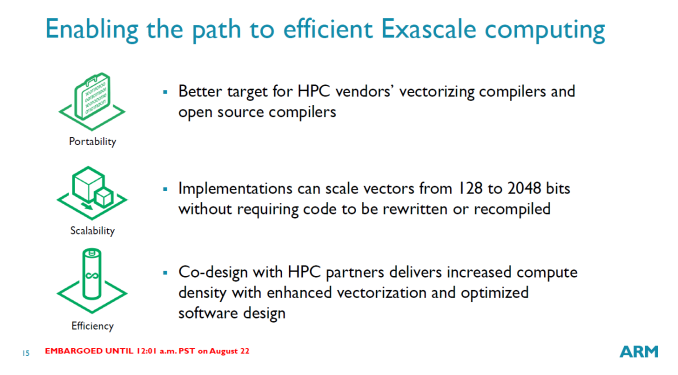
Scalable Vector Extensions (SVE) will be a flexible addition to the ISA, and support from 128-bit to 2048-bit. ARM has included the extensions in a way that if included in the hardware, the hardware is scalable: it doesn’t matter if the code being run calls for 128-bit, 512-bit or 2048-bit, the scheduler will arrange the calculations to compensate for the hardware that is available. Thus a 2048-bit code run on a 128-bit SVE core will manage the instructions in such a way to complete the calculation, or a 128-bit code on a 2048-bit core will attempt to improve IPC by bundling 128-bit calculations together. ARM’s purpose here is to move the vector calculation problem away from software and into hardware.
This is different to NEON, which works on 64-bit and 128-bit vectors. ARM is soon submitting patches to GCC and LLVM to support the auto-vectorization for VSE, either by directives or detecting applicable command sequences. Performance metrics performed in ARMs labs show significant speed up for certain data sets already and expect that over time more code paths will be able to take advantage of SVE. ARM is encouraging semiconductor architecture licensees that need fine-grained HPC control to adopt SVE in both hardware and code such that as the nature of the platform adapts over time both sides will see a benefit as the instructions are scalable.
|
| 8:00a | The Tesoro Gram Spectrum Low Profile Mechanical Keyboard Review Today we are taking our first look at a “low-profile” mechanical keyboard, the Tesoro Gram Spectrum. The Gram Spectrum features RGB lighting and full programmability, but its highlight are the new Kailh Agile switches and low profile keycaps, which significantly reduce the overall key height and travel. |
| 3:40p | Android 7.0 Nougat Released
Google has completed its five month beta program and is officially releasing Android 7.0 Nougat today. The company will begin rolling it out to select Nexus devices, including the Nexus 5X, Nexus 6P, Nexus 6, Nexus 9, Nexus Player, the Pixel C tablet, and the General Mobile 4G (Android One phone), as an OTA over the next few weeks. The Nexus 5 and 7 (2013) are not eligible for the update. The LG V20 will be the first new device to ship with Nougat installed. Manufacturers and carriers have not committed to a specific timeline for rolling out updates for existing devices, however. Samsung’s President of Mobile, Koh Dong-jin, revealed in an interview with The Korea Times that the recently released Galaxy Note7 should receive an update perhaps in the next 2-3 months. HTC stated that the HTC 10, HTC One A9, and HTC One M9 will all be receiving Nougat updates, but did not provide any dates, only stating that timing and any additional eligible devices will be announced later. We took our first look at some of Nougat’s features when we got our hands on the first developer beta back in March. Since then, Google has continued to refine the OS and add new features. The new Split-Screen mode, which provides a native API for using two apps side by side, should provide a boost for multitasking. This will be more useful for tablets, but phablet phones should benefit too. There’s also many smaller tweaks, such as double-tapping the overview button to switch between the two most recently used apps, that improve usability and productivity. Nougat also includes the ability for apps to bundle notifications, reducing clutter on the lock screen or in the notification shade. The bundles can be expanded for more detailed information about each specific notification, and you can even reply to notifications directly from the notification shade without launching an app first. Performance and battery life should also improve with Nougat. The updated JIT compiler claims to improve the runtime performance of apps while also reducing the amount of storage space they require. Android 7.0 also includes official support for the new Vulkan graphics API. Similar to Apple’s Metal, it’s a low-level API that dramatically improves 3D performance by reducing the overhead of draw calls. The changes to Android’s Doze feature, first introduced in Android Marshmallow, promise a small boost to battery life by allowing the phone to go into a lower power state when it’s being carried around with the screen locked. Android has been plagued with security issues, and while this will remain a topic of concern for the foreseeable future, Nougat does bring some new security enhancements. Perhaps the biggest change is the hardening of Android’s Stagefright mediaserver library—a combination of better code sanitization to eliminate buffer overflows and splitting the library into several sandboxed components with more restricted permissions. Nougat also adds file-based encryption, a more secure boot process, and behind-the-scenes OS updates. Nougat provides too many improvements to fully cover here, but even the visible and not so visible changes mentioned above should prove to be welcome additions to Android. |


| << Previous Day |
2016/08/22 [Calendar] |
Next Day >> |