[Most Recent Entries] [Calendar View]
Wednesday, September 7th, 2016
| Time | Event | ||||||||||||||||||||||||||||||||||||||||||||||||||||||||||||
| 6:45p | Apple Announces iPhone 7 & iPhone 7 Plus: A10 Fusion SoC, New Camera, Wide Color Gamut, Preorders Start Sept. 9th
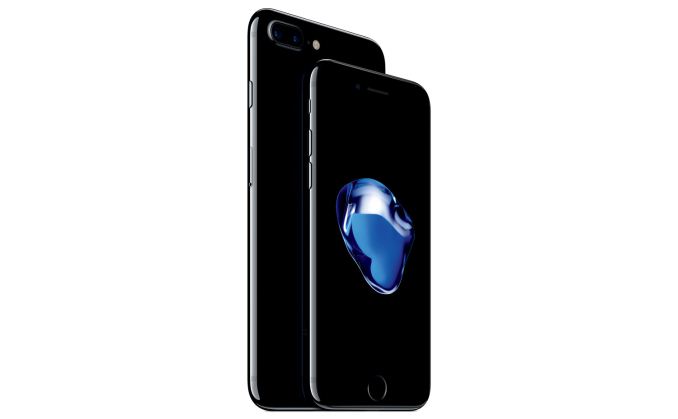
Today at Apple’s annual iPhone event held in San Francisco’s Bill Graham Civic Auditorium, the company announced their next generation of iPhones: the iPhone 7 and the iPhone 7 Plus. As you might expect from Apple’s history, the two phones incorporate a number of new features and feature upgrades compared to their immediate predecessors. This includes a new SoC – the A10 Fusion – new camera options, IP67 water resistance, and top-to-bottom support for both wide color gamut (DCI-P3) displays and photography.
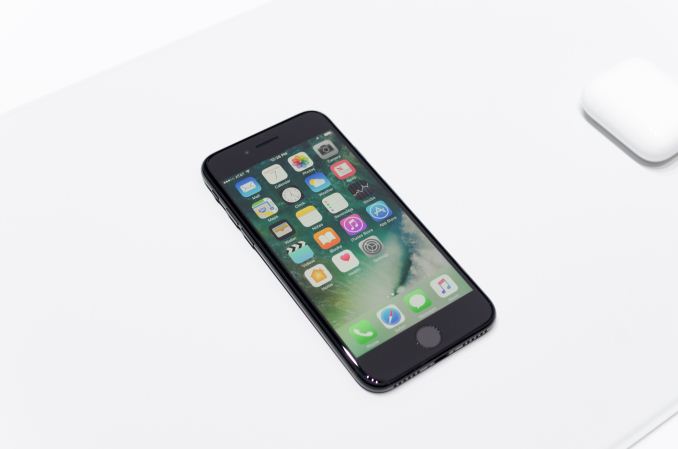
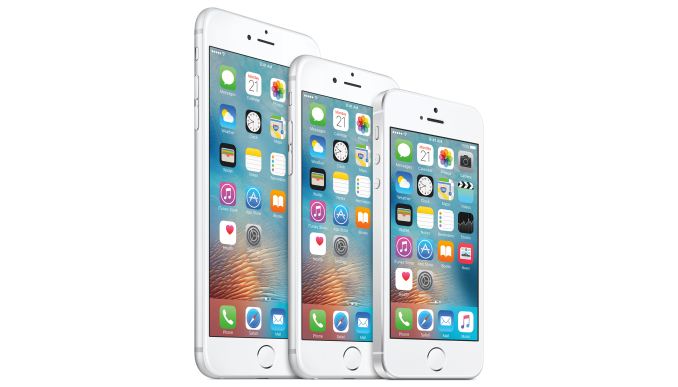
Jumping right into the heart of matters, in previous years Apple has alternated their upgrades between the overall design of the phone and focusing on the internal processors, resulting in the usual iPhone (X) and iPhone (X)s cadence we’ve seen over the past several years. For the iPhone 7, Apple has kept with this general development process, however relative to the iPhone 6 and 6s generations, the iPhone 7 isn’t quite as significantly a departure as past designs. Design & FeaturesThe overall body of the iPhone 7 series is rather similar to the iPhone 6 series. Both the regular and the Plus phones have virtually the same dimensions as their 6s predecessors, so the size of the phones is unchanged. Button placement also hasn’t changed, with volume and power buttons on the left and right sides of the phones respectively. The curved design of the iPhone series has also been retained.
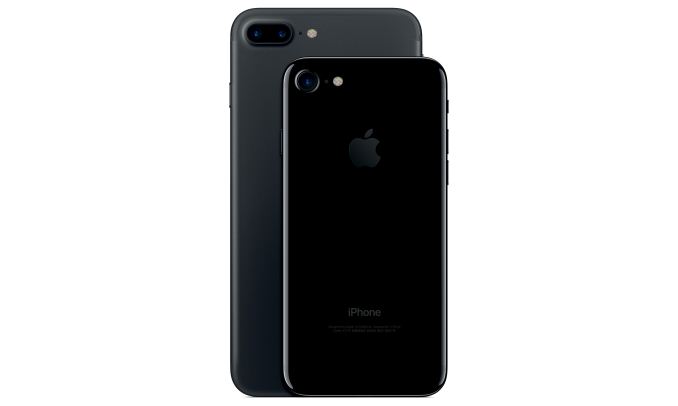
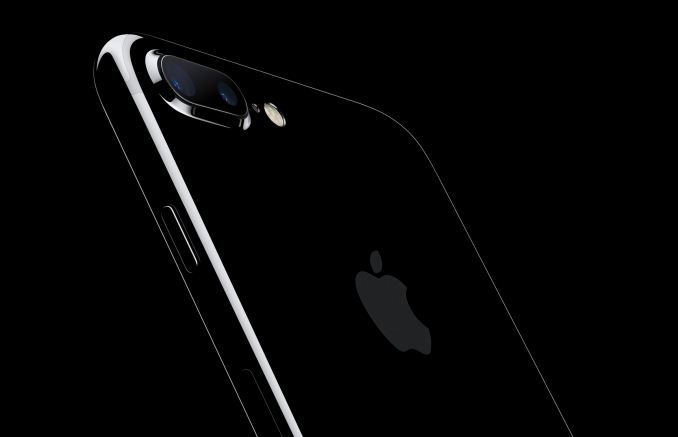
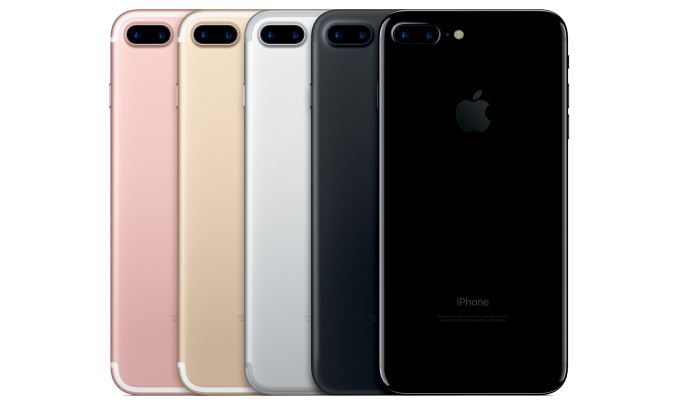
So what is new for the iPhone design? In short, water resistance and a lot of polish. Apple has finally added more complete water resistance into the iPhone design for the iPhone 7 series, and the latest phones are IP67 rated for water resistance. Like we’ve seen with other IP67 phones, it should be noted that water “resistance” is the key word there; this level of protection is designed to resist water damage to the phone in the case of accidents, and it’s not meant for long-term submersion (swimming and the like). Meanwhile on the polish side, for this generation Apple has further refined the overall design of the iPhone. Apple has taken a particular interest in going “seamless” this generation, further reducing the presence of seems in the phone where the glass meets the case and along the antenna bands. Apple has also introduced some new color options here: a matte black finish (seemingly replacing Space Grey), and a glossy “jet black” finish, the latter of which literally involves a polishing process. Apple is treating the jet black finish is this generation’s premium finish option, and as a result it is only available on the more expensive 128GB and 256GB phone models.
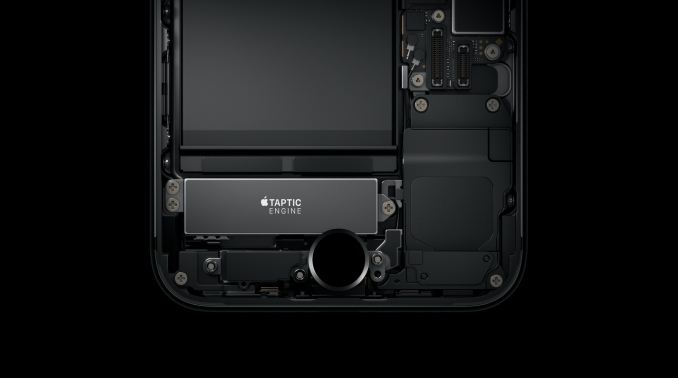
However the biggest change here is probably the home button, which is now entirely solid state. Apple has integrated their force touch technology previously used for the iPhone 6s screen and the MacBook trackpads into the home button, removing the mechanical aspects of it. Instead, like the aforementioned devices, what you’re looking at is a pressure-sensitive surface with the taptic engine being used to simulate the necessary feedback. The home button was one of the last few mechanical parts in the iPhone, and Apple is touting this as improving the reliability of the button. At the same time I wouldn’t be surprised if it was also part of the work that went into making the phone water resistant. It will also be interesting to see what Apple eventually does with the pressure sensitivity, given that they’ve tried to make it an important part of the user experience with the iPhone 6s and its force touch screen.
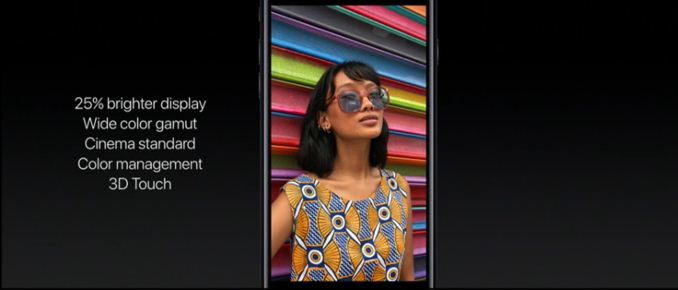
On the display side of matters, Apple has taken a page from this year’s 9.7” iPad Pro launch and upgraded the iPhone for DCI-P3 wide color gamut support. Apple has increasingly been going DCI-P3 capable throughout its entire product lineup, and P3 is quickly becoming by far the most commonly supported of the wide gamut standards across the industry. In the case of the iPhone 7, this is part of a larger upgrade to implement top-to-bottom wide color gamut support, with the phone’s cameras also getting a similar upgrade. The advantage of the larger color gamut, as we’ve seen with the iPad, is that it allows for representation of “deeper” colors that can’t be covered by the traditional sRGB color space, ultimately getting closer to reproducing the full spectrum of what humans can see. As pointed out by our own Brandon Chester however, these new phones don’t include the iPad’s True Tone capability, which allow the display’s white point with the color temperature of the surrounding lighting.
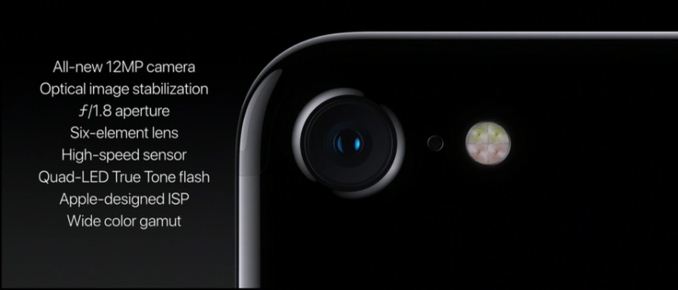
Along with the addition of wide color gamut support, the panels in the new iPhones are also 25% brighter according to Apple, with a typical max brightness of 625 nits (for reference, we measured the max brightness of the iPhone 6s at 567 nits, compared to an official spec of 500 nits). What hasn’t changed however is resolution; these are still Retina HD displays, meaning we’re looking at 1334x750 pixels for the 4.7” iPhone 7, and 1920x1080 pixels for the iPhone 7 Plus. At the other end of the spectrum then are the iPhone 7 series’ new rear and front facing cameras. Starting with the iPhone 7, Apple has retained a 12MP sensor (sensor manufacturer unknown), however they have significantly improved the feature set available. The new camera module is capable of taking wide color gamut photos to go along with the WCG-capable display. Furthermore, in a rarity for a sub-5” phone, the iPhone 7 now includes optical image stabilization (OIS) for both photos and video recording, a feature that was previously only available on the larger Plus phones. The new camera is composed of a six element lens, and along with its other improvements, the sensor is said to be 60% faster and 30% more energy efficient than the previous-generation sensor in the iPhone 6s. Also augmenting the new camera is an updated true tone flash light; the new module is composed of 4 LEDs, allowing for what Apple says is 50% more illumination than the iPhone 6s.
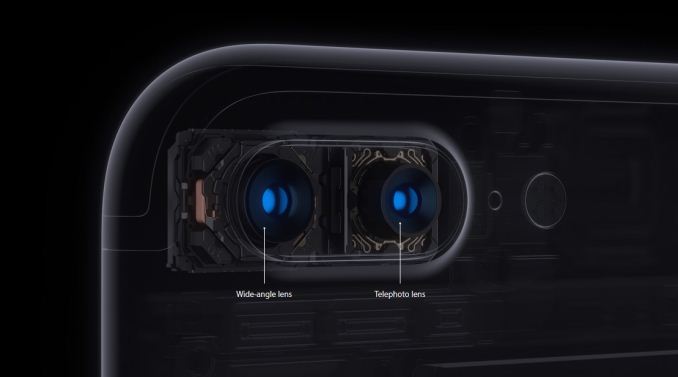
Meanwhile for the iPhone 7 Plus, Apple has added a second 12MP camera. What sets this second camera apart from the first is the lens; complementing the normal wide-angle lens on the primary camera, the second camera uses a 56mm, f/2.8 telephoto lens, offering a tighter picture with an effective 2x optical zoom over the primary camera. Apple has been pushing the camera aspect of the iPhone for many years now, and with the latest iPhone they are branching out into one of the few things most smartphone cameras haven’t been able to address with optical zoom. Besides allowing for closer photos, the second camera will also be used to do depth measurements, allowing the iPhone 7 Plus to do depth of field effects.
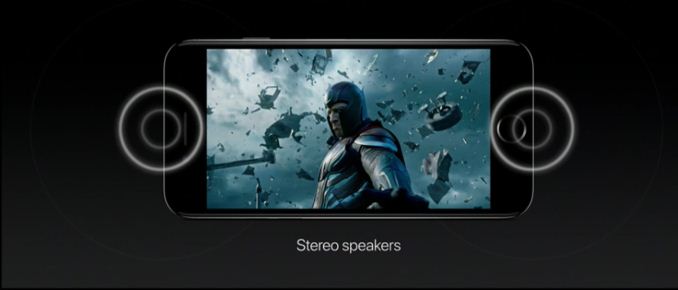
Finally, both phones have also received a new front facing camera. This new camera is 7MP, and like its rear facing counterparts supports wide color gamut photos. As for audio capabilities, Apple has taken both a step forward and a step back. Moving forward, the headset speaker towards the top of the phone has been upgraded to be a full-fledged, full volume speaker. As a result, the iPhone can now play back stereo sound when in landscape mode by combining this with existing speaker at the bottom of the phone. Apple says the new speaker system is 2x louder – though it’s not clear if this is just adding up the output of the two speakers – and we’re told that the iPhone 7’s speakers support a greater dynamic range.
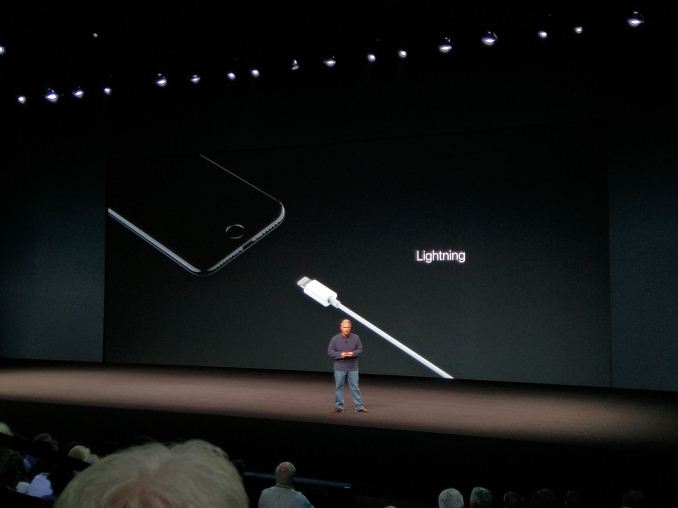
However taking a step back, as rumors have previously indicated, Apple has removed the 3.5mm audio jack on the phone. For external audio, Apple is now telling users and accessory manufacturers alike to use the Lightning port. Of note, this necessitates putting a Digital to Analog Converter (DAC) in headphones and other devices that directly connect via Lightning, which is going to have interesting ramifications on audio quality differences between products and how they are priced. Otherwise for existing 3.5mm devices, Apple is also including a Lighting to 3.5mm audio adapter, which of course also integrates the necessary DAC.
Given that they’re removed the audio jack, Apple has upgraded their EarPod earbuds for the new iPhone. The new models are lightning based, though otherwise apparently unchanged from their predecessors. A bit farther down the line, Apple will be releasing a wireless earbud product, the AirPods, with which they intend to do away with concerns about wired connections entirely by going wireless.
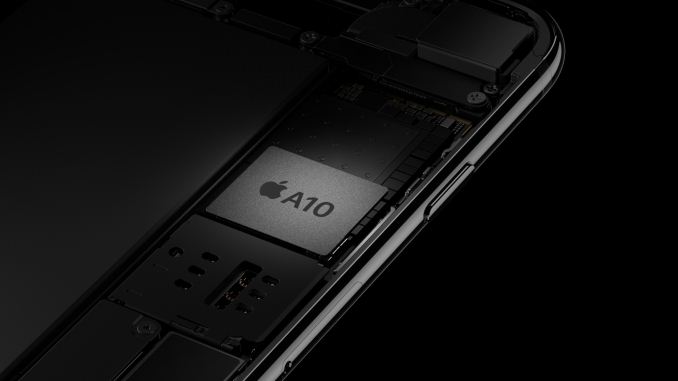
A10 Fusion: The Next Apple SoCFinally, last but certainly not least is the heart of the iPhone 7 and 7 Plus: the SoC. While Apple has traditionally focused on bigger improvements in the off-year s-generation updates, they have made something of an exception for the iPhone 7 with the A10 Fusion SoC.
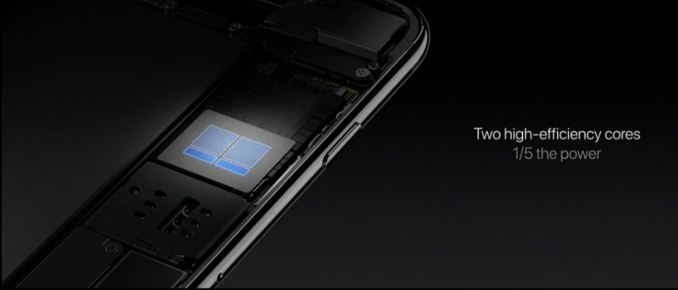
The major change here is that with the A10, Apple has embraced the concept of multiple types of CPUs, each with different power/performance characteristics. This is something that has been prevalent in SoCs based around ARM Cortex-A CPU designs used in most Android phones, but Apple had (until now) opted to stay with a single cluster of two CPU cores. There’s a lot of information to chew here, and a product announcement isn’t nearly enough to cover everything, but the basic theory behind a multi-type/multi-cluster design is to further min/max power efficiency by developing a set of high performance, high power cores for tasks that need maximum performance, and a second set of low performance, low power cores for simpler tasks that need only a small amount of computational time. By not sending the latter tasks to the high power cores, in theory you save on power consumption. This is the basis behind ARM’s big.LITTLE design philosophy.
The trade-off with this philosophy is that you now have to manage migrating tasks between the CPU clusters, which itself has a power cost. So while it’s a more efficient route in theory, in practice it can be difficult to implement, especially in a performant manner. Apple has previously stuck with their single cluster design, using the same CPU cores to run the gamut from low power to high performance, and while we may never get a full answer, I am very curious what happened behind the scenes at Apple and what they found to get to this point. In any case, the A10 implements two types of cores; a pair of high performance cores, and a pair of low power cores. The slower cores are said to consume one-fifth the power of the high performance cores, though Apple has not indicated what performance is like. As is traditional for Apple, they haven’t said anything about the CPU cores themselves, but it’s a safe bet that the high performance cores are a direct descendant of the Twister cores used in the A9. More curious will be what the low-power cores are – given Apple’s fondness for developing their own ARM CPU cores and various technical considerations (such as the core interfaces), it may very well be that these are also Apple-designed cores, as opposed to an off-the-shelf solution like ARM’s Cortex-A53. One thing Apple has emphasized in talking about the A10 is that their design uses a custom designed performance controller to manage the CPU cores and migrate tasks between them. This revelation of a hardware controller does imply that Apple is using some form of cluster or CPU migration – that is, only ever using 2 cores at once and not using all 4 cores at the same time in a heterogeneous manner – but all of this is speculation and subject to confirmation. Either way, this is the biggest change to the structure of Apple’s CPU subsystem since A6 and the Cyclone CPU core in 2012, and given Apple's habit of throwing us curveballs on the SoC side, I suspect the answer is not as simple as what we currently believe.
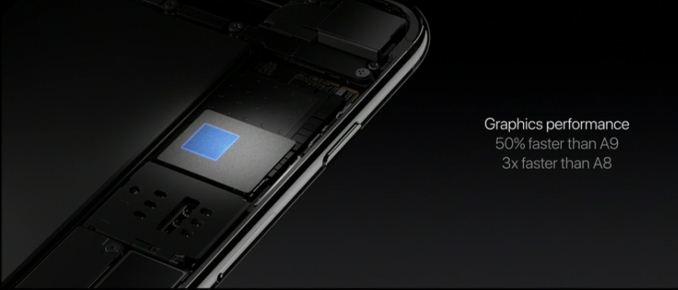
Meanwhile on the GPU side, Apple has uncharacteristically confirmed that A10 implements a “6 cluster” GPU design. This removes a good bit of guessing work here, as the significant scalability of GPUs has always made it difficult to pin down the number of GPU clusters. A good bet here is that Apple is using another PowerVR design – either a higher clocked version of the PowerVR GT7600 used in the A9, or perhaps a six cluster design based on the more recent PowerVR Series7XT Plus architecture – but that’s something that remains to be seen. From a performance standpoint Apple is once again touting significant performance gains versus the A9 and previous SoCs. CPU performance (of the high power cores) is said to be 40% better than the A9 and its dual 1.85GHz Twister CPU cores. Meanwhile GPU performance is said to be 50% higher than A9’s PowerVR GT7600 GPU. Obviously we’ll have to see how well performance holds up in our benchmarks, but if Apple can actually deliver on these claims then this would be a significant gain for a non-s generation product, and one made all the more impressive as Apple will not have received the advantages of a die shrink with this generation. Finally, no information about the RAM paired with the A10 is available at this time. However we’re very happy to see that the traditionally conservative Apple has finally given the iPhone line a bump in NAND capacity. The entry-level model is now 32GB, and the higher capacity tiers have been bumped to 128GB and 256GB respectively.
Final WordsAs for battery life, Apple has not released any hard details on the capacity of the batteries being used in the iPhone 7 and the 7 Plus. However they are claiming yet another increase in average battery life. Overall Apple says the average increase for the iPhone 7 over the 6s is 2 hours, and a smaller 1 hour increase for the iPhone 7 Plus over the iPhone 6s Plus. Curiously, Apple’s official 3G talk time numbers are the same (or have regressed) compared to the iPhone 6s, at 14 hours for both the iPhone 6s and iPhone 7. Instead Apple’s metric of choice is LTE internet use, which on the same phones has increased from 10 hours to 12 hours. So at first glance, assuming Apple hasn’t regressed on modem power usage, these power gains would seem to come from improvements to the A10 SoC and possibly the display. Wrapping things up, Apple is going to be bringing the new iPhones to market rather quickly. Pre-orders for the phones open up on the 9th, and they’ll begin shipping one week later on the 16th. Phone pricing for the iPhone 7 is unchanged from the iPhone 6s, with the base 32GB model starting at $649 and each capacity bump going up $100 from there. Meanwhile the iPhone 7 Plus is just a bit more expensive, seeing a price bump at all capacities of $20, putting the starting price at $769.
| ||||||||||||||||||||||||||||||||||||||||||||||||||||||||||||
| 7:15p | Apple Announces Apple Watch Series 2
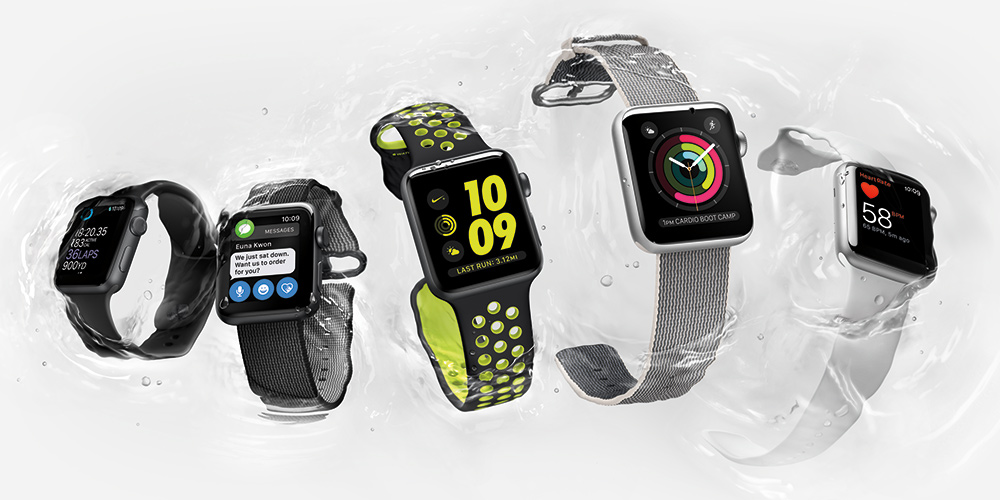
In addition to announcing the new iPhone 7 and iPhone 7 Plus today, Apple introduced Apple Watch Series 2. Like all first-generation products, the original Apple Watch had some serious shortcomings. First, without cellular connectivity or even GPS, the Apple Watch could not stray beyond the Wi-Fi range of an iPhone without losing much of its functionality. The second major issue was performance: a combination of hardware efficiency concerns and limitations with the software SDK. And while it offered basic protection from water splashes, it was not officially water resistant, an important feature for a fitness-oriented device. The original Apple Watch came out nearly 1.5 years ago, so it was due for an update. Despite this passage of time, the new Watch is not radically different from the original, but does improve upon it in several key areas. Unfortunately, it still does not have cellular connectivity, so it’s not a completely independent device; the watch will still need to be on the same Wi-Fi network as an iPhone to receive notifications, for example. There were rumors of prototypes with cellular radios, and it would certainly be surprising if Apple was not looking into this, but for now it appears power, space, and cost constraints are still prohibitive. Apple Watch Series 2 does add GPS, though, which means you can take it for a walk, jog, or bike ride and still view distance, speed, and location information without having to carry an iPhone too. Apple also mentioned in its presentation that it can obtain a GPS lock almost instantly, so you can start your workout immediately.
Apple is addressing the performance issues in two different ways. First, watchOS 3, which is available for all Apple Watch versions, brings a number of improvements meant to give instant access to information, including the ability to keep favorite apps loaded in RAM and allowing apps to fetch information in the background so it’s available right when you need it. Apple Watch Series 2 also includes a second-generation S2 SiP (System in Package), which further improves performance. The S1 SiP in the original Apple Watch uses a single-core CPU (likely an ARM Cortex-A7 or something very similar) running at up to 520MHz. The S2 adds a second CPU core and improves performance by 50%, according to Apple. It’s not clear if this gain is from a frequency bump, improvements to the microarchitecture, the addition of the second core, or some combination thereof, but considering how slow the original Apple Watch is, any improvement here is welcome. Along, with the now dual-core CPU is an updated GPU that improves graphics performance by a factor of two, again according to Apple.
Water resistance is an important feature for a fitness-oriented wearable, and Apple Watch Series 2 takes a step forward here by adding a rating of 50 meters (that’s 164 feet for the three countries that do not use metric units) based on ISO standard 22810:2010. This means the case will not allow water to leak in while performing an activity like swimming in a pool or in the ocean. It does not guarantee water resistance while scuba diving (this is covered by ISO 6425) or when subjected to high-velocity jets of water like when water skiing, though. Speaking of swimming, Apple has added two new workout options: pool and open water. When using one of these options, the new watch can count laps and keep track of your pace. Apple has also done a significant amount of research to develop new algorithms that will automatically detect stroke type and calculate calorie burn. Apple Watch Series 2 comes with a new display too. It primarily bumps maximum brightness up to 1,000 nits, about twice as bright as the previous display. This is likely similar to the auto-brightness boost feature we see with smartphone AMOLED displays, which improve viewability outdoors.
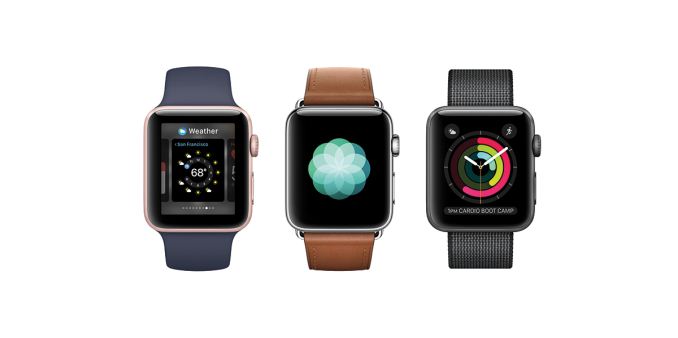
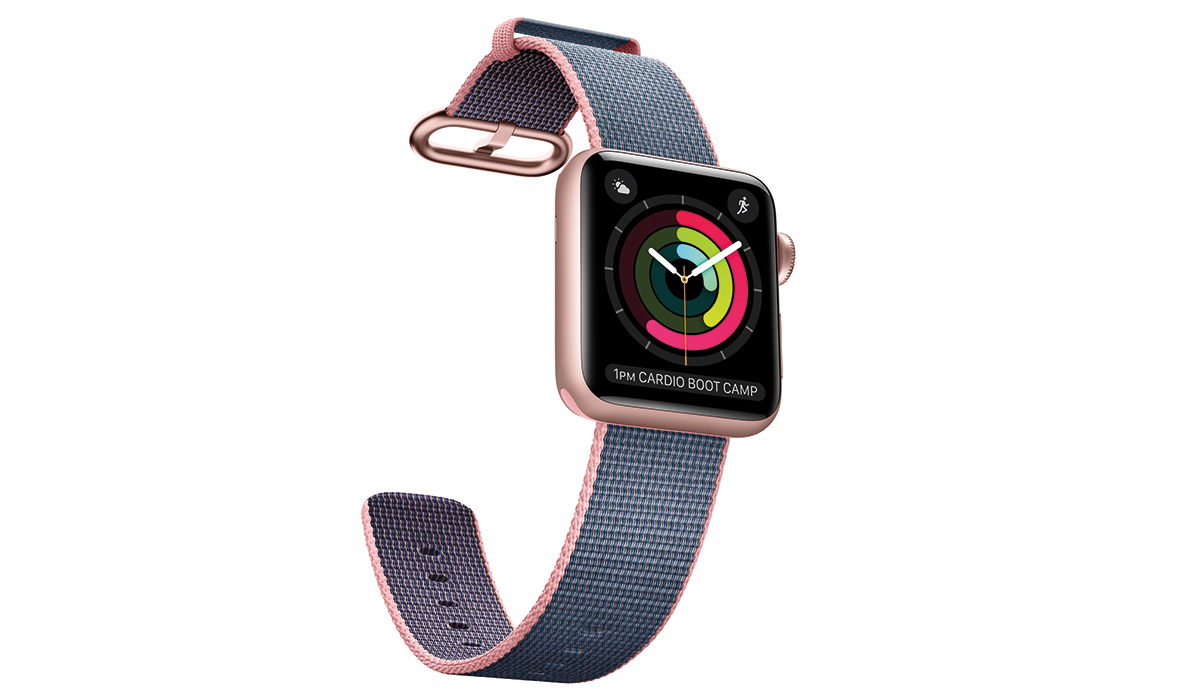
Apple is keeping the same design and dimensions for this generation, but there are now three different versions in two different case sizes, 38mm and 42mm, to choose from. The new Apple Watch Series 1 adds the new S2 SiP to the original Apple Watch and comes with an aluminum case in gold, rose gold, silver, or space gray. It starts at $269 when paired with a Sport Band. The all new Apple Watch Series 2 comes with either an aluminum case in the same colors as Series 1 or a stainless steel case in silver or space black and starts at $369. The new Apple Watch Edition, which is based on the Apple Watch Series 2, starts at $1249 and comes with a white ceramic case that’s four times harder than stainless steel, making it more resistant to scratching. Finally, there’s the Apple Watch Nike+ that starts at $369. This version was co-developed with Nike and has features that cater to people who enjoy running (so not me) and fitness oriented bands.
The Apple Watch Series 1, Apple Watch Series 2, and Apple Watch Edition will be available for pre-order beginning September 9 and will appear in stores on September 16 in the US and 26 other countries, expanding to 20 more countries on September 23, and finally arriving in India and Mexico on October 7. The Apple Watch Nike+ can also be pre-ordered on September 9, but will not be available until “late October.” Note that Apple Watch Series 2, Apple Watch Edition, and Apple Watch Nike+ all require an iPhone 5 or later running iOS 10, which will be available September 13. | ||||||||||||||||||||||||||||||||||||||||||||||||||||||||||||
| 7:30p | Hands On with the iPhone 7 and 7 Plus
As the iPhone 6’s design turned 2 years old the iPhone 7 was launched to continue the two year cadence for their smartphone designs. As you might expect from a phone like this, rather than maintaining the same industrial design that we saw with the iPhone 6s instead we’re looking at a new, more refined design.
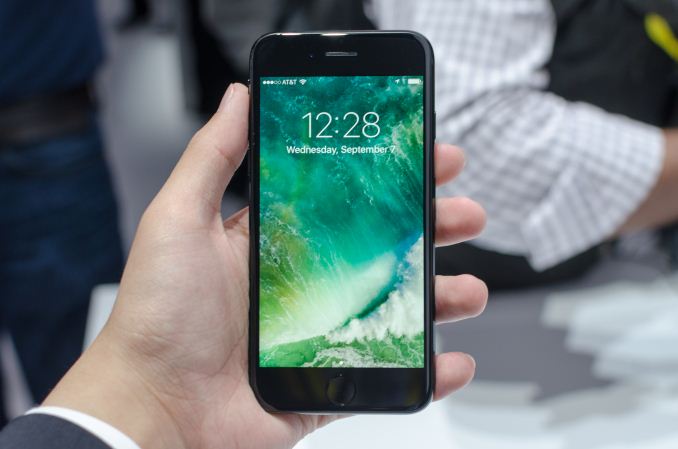
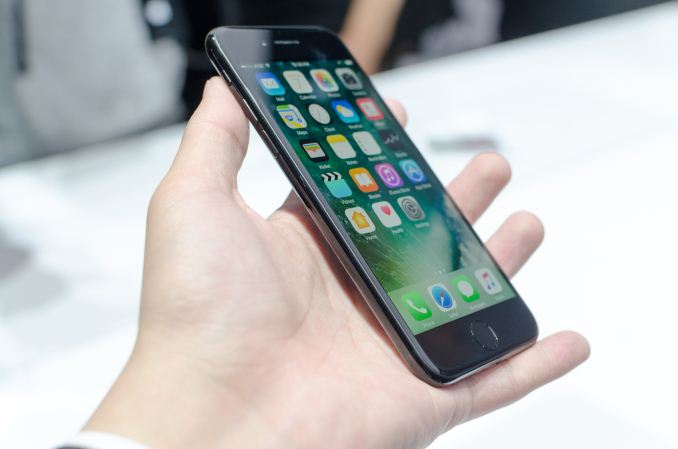
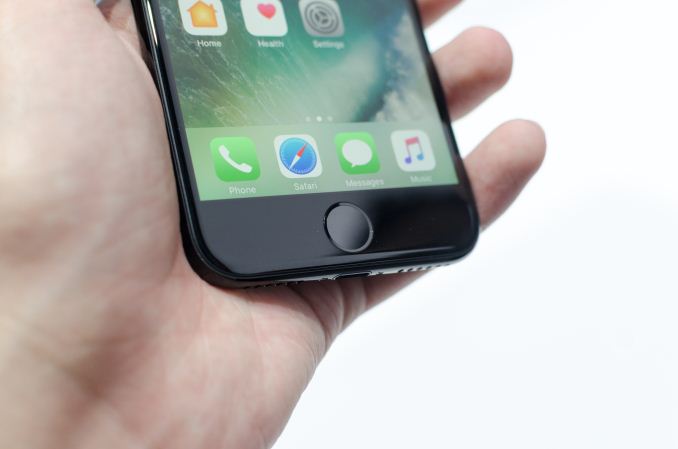
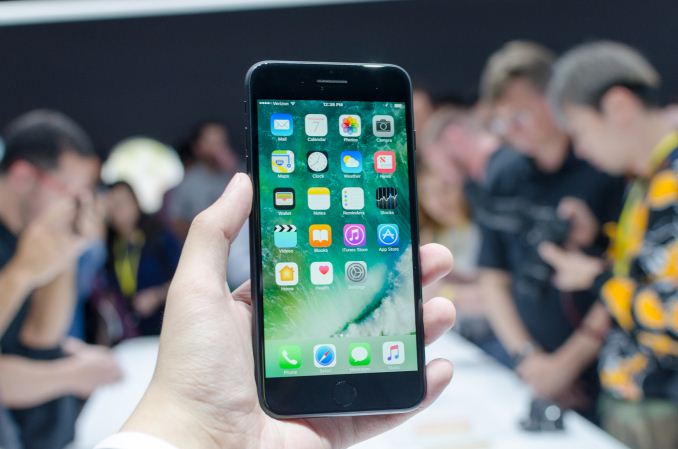
To get what I’m talking about, we can start with the iPhone 7 proper, which is the 4.7 inch variant. Broadly speaking if you were to only look at the shape of the phone there isn’t a ton that has changed, but if you look at all of the design elements together it’s clear that the design has changed in a fairly meaningful way. From the front, looking at the display you still get a familiar design as far as the earpiece, front-facing camera, and other sensors on the top, with a single home button on the bottom. However, unlike previous iPhones the button is solid state. I’ll have some more thoughts on this soon, but the home button still looks like previous iPhones because the fingerprint scanner isn’t placed underneath the cover glass. It also looks like the fingerprint scanner still uses different materials as the reflectance is clearly different, so this should still be a sapphire crystal.
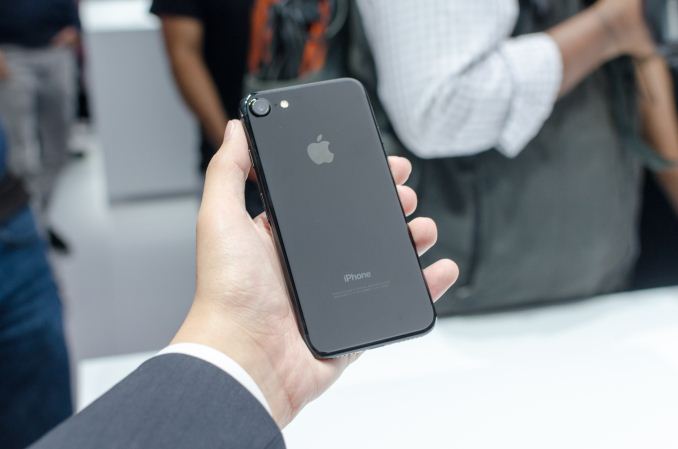
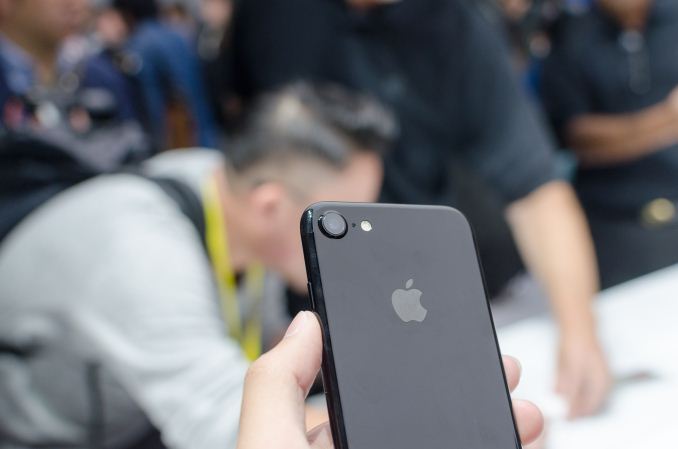
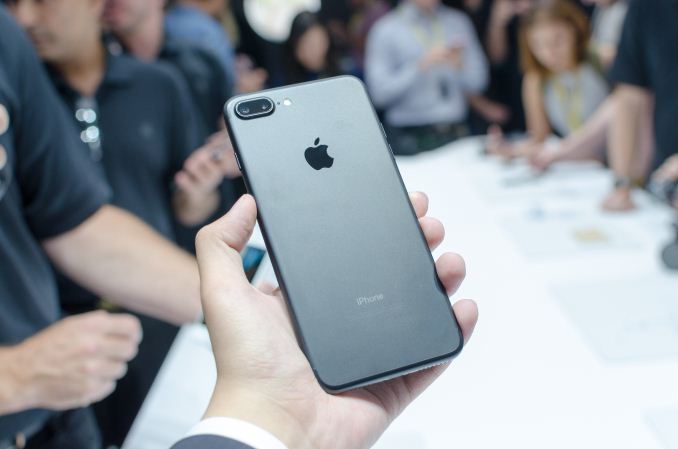
Moving on to the back cover of the phone the Jet Black version of the phone is clearly finished to a high gloss, despite using an aluminum back cover which usually have a sandblasted finish. This finish looks pretty nice for about the 3-4 seconds that it remains glossy, as unless you subject your hands to a bath of isopropyl alcohol I find it unlikely that you won’t immediately cover the phone in fingerprints. The high gloss finish honestly wouldn’t feel that different in the hand from hyperglaze in the Galaxy S3 other than the noticeably different heat conductivity of aluminum. Interestingly enough the new antenna demarcation lines are now running along the edges if you look at the phone from the back. When it comes to the jet black version, it’s much harder to notice the antenna lines because the color matching is fairly close and the plastic feels hard and glossy to the touch much like the aluminum itself. Of course, any other color is going to be more obvious in this regard but this phone is probably the closest Apple has gotten to replicating the monolith from 2001: A Space Odyssey.
As far as design goes, it feels like either Apple’s ID team has collectively gotten over the whole idea of trying to hide the camera hump as rather than an extremely thin aluminum surround to hold the small cover glass of the camera, the lens has become larger and the hump itself is now integrated into the chassis itself. It’s much more obvious than the iPhone 6s, but I personally think this makes a lot more sense than continuing to pretend that phones don’t have camera humps as this kind of design makes it less likely that the phone will rock around when it’s placed on a flat table.
Along the left and right sides of the iPhone 7 we continue to have the same button layout, with power on the right and volume buttons on the left. The silent toggle switch remains identical to the one seen in previous iPhones. The main point of interest, and I suspect controversy is going to be along the bottom of the phone.
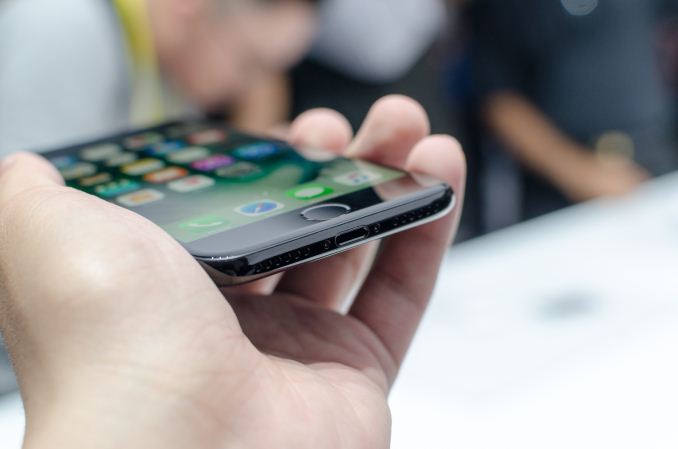
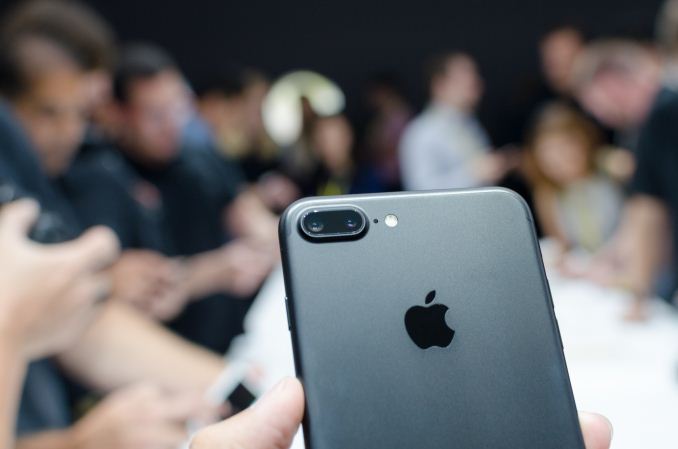
Along the bottom edge, there’s a set of speaker holes, a Lightning port, and another speaker port. I suspect at least some of these holes house a microphone rather than just being two speakers, but I guess this makes more sense as far as visual balance goes and helps distract from the space left by the missing 3.5mm headphone jack. There’s too much to be said here to just have a single sentence, so we’ll cover this later. As far as the design of the iPhone 7 Plus goes, it’s really just more of the same. However, the iPhone 7 Plus has a significantly changed camera housing to allow for dual cameras. I got to spend some time with the matte black version for the iPhone 7 Plus though, and I think this traditional sand-blasted finish is just clearly superior. The antenna lines are more obvious but the finish is less susceptible to scratches and doesn’t show fingerprints nearly as much.
As far as usability goes, it’s hard to make any snap judgments of performance, so I’m going to restrain from any commentary here until I actually get some time to sit and stare at two different phones side by side to give any thoughts here. I didn’t see any noticeable frame drops, but when you’re mostly using system applications it’s usually almost impossible to notice these things unless something is seriously wrong.
Things like the new solid-state home button are a huge step forward as far as feel and reliability goes, but in some sense knowing that this is ultimately a capacitive touch sensor with some force sensing was somewhat confusing at first because I touched the home button the way I would an HTC 10 and expected it to work off of almost no actuation pressure. If you treat this home button like a physical home button though it works just as expected, and feels just like a real button. Unlike a real button it’s unlikely that you’ll ever break this home button though, so with time I’ll probably see less people using on-screen buttons to compensate for broken home buttons.
In the case of the iPhone 7 Plus, the dual camera works well within the functionality implemented. At this time it looks like the only feature available is zooming, and it’s definitely possible to see much more detail from the zoom lens than with the wide angle lens, but I’m not really able to say much else at the time because without the ability to test the camera in a room with dim lighting or the ability to walk around with the phone at night with a tripod means that I can’t provide any meaningful commentary on the performance of the camera at this time. Similarly, things like the front-facing camera and IP67 resistance cannot be tested reasonably in the context of a hands-on lasting less than 20 minutes.
What is worth mentioning here is that the stereo speakers work quite well. Although the demo room was loud with the sound of multiple journalists trying to film and talk into a camera, it was actually possible to hear something from the speakers which is honestly quite impressive. I can’t tell whether the top speaker has a different frequency response than the bottom speaker, but I wouldn’t be surprised to know that the setup here is similar to the HTC 10’s design in that regard. The final point of interest here is going to be the 3.5mm jack, and for better or worse it’s been removed. I’m still trying to get details on the specifics of this implementation, but if you have earbuds that use the 3.5mm jack you’ll have to use an adapter that comes with the phone that plugs into the Lightning port. Really though, it's obvious that Apple is trying to push people towards using wireless headphones of some shape or form, as there were quite a few AirPods available for demonstration. Pairing of the AirPods was shown to just be done by holding them near the device and pressing the connect button whenever it popped up. Once paired the earbuds go into the ear, with automatic playback through the earbuds if the proximity sensor is tripped and pausing if it detects removal once playback starts. Double tapping the earbuds will cause it to activate Siri, and it looks like the microphones do some noise cancellation in order to enable better calls and voice commands. However I didn't really see any evidence that active noise isolation is active in these earbuds so they won't really isolate you from the environment. Overall, the iPhone 7 and 7 Plus look to be interesting to say the least. There are a lot of things that a hands-on can't cover like the new SoC, whether the loss of a 3.5mm jack really matters, and whether the phone represents a major upgrade overall. Regardless, the iPhone 7 and 7 Plus go on pre-order on September 9th, and will be available for sale on the 16th and will be available in Jet Black, Black, Silver, Gold, and Rose Gold. | ||||||||||||||||||||||||||||||||||||||||||||||||||||||||||||
| 8:25p | Apple Adjusts iOS Device Storage Tiers and Prices
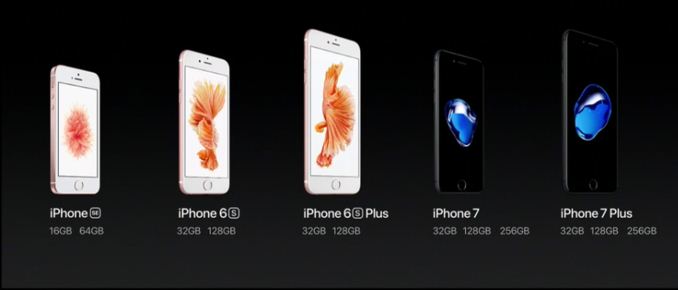
Today Apple made a number of announcements, including the year's major update to the iPhone in the form of the iPhone 7, and the second generation Apple Watch, known as the Apple Watch Series 2. One of the smaller announcements of the day was a shake-up of the prices and storage tiers on iOS devices. To a large extent this addresses one of the major criticisms of Apple's devices, which is that they've kept the base model at 16GB of internal storage for much longer than competing devices. I've compiled the changes that Apple has made to storage capacities and pricing across the iPhone and iPads lines in the charts below:
There are two parts to the changes made today. The first is that Apple has eliminated the 16GB storage tier on every device except for the iPhone SE. It would have been really great to see 16GB removed from the whole lineup, but I suspect that the iPhone SE's margins are already lower than Apple would like. However, to keep the upgrade pricing in line with the other devices, the 64GB iPhone SE now only has a $50 premium over the 16GB model. On every other device, the 16GB storage tier has become 32GB, and 64GB has become 128GB, with prices being kept at the same point. The second change pertains to the iPad Pro devices, where the storage already started at 32GB and had upgrade tiers of 128GB and 256GB which each required an additional $150 on top of the starting price. With these Apple has maintained the same base price and storage tiers, but the upgrade price has dropped to $100 to bring it in line with the rest of Apple's iOS devices. While none of these changes are anything groundbreaking, it does address a longstanding problem with the iPhone and iPad. Even with cloud storage for music and other media, with new features like Live Photos and 4K video recording, the storage pressure on iOS devices has become much greater while storage capacities remained constant. Dropping prices on iPad storage upgrades also makes the larger capacity models more accessible, and bumping up capacities on the iPad Air 2 and iPad Mini 4 make them more useful as media devices. | ||||||||||||||||||||||||||||||||||||||||||||||||||||||||||||



| << Previous Day |
2016/09/07 [Calendar] |
Next Day >> |