[Most Recent Entries] [Calendar View]
Wednesday, October 5th, 2016
- The evolution of planar NAND has stalled at 14 nm or 16 nm nodes and we are hardly going to see any newly designed 2D NAND ICs suitable for SSDs. Manufacturers are not going to build new fabs to produce 2D NAND. Without geometry scaling and new production facilities, supply of 2D NAND will not grow. In fact, companies like Samsung are already mulling about cutting-down 2D capacities, thus reducing supply. There are talks about planar QLC NAND memory, however the feasibility of this technology is currently limited, with manufacturers discussing 'write once, ready many' applications only at this time.
- 3D NAND yields and manufacturing volumes are gradually improving. In the meantime, demand for non-volatile memory is skyrocketing.
- NAND flash makers have long-term supply agreements with large smartphone vendors (Apple, Samsung, etc.), who recently increased storage capacities of their flagship devices. Hence, manufacturers have to meet demand from such partners first.
- China-based makers of smartphones now install 64 or 128 GB of NAND flash into their handsets and someone has to supply them the memory. Companies like Huawei, Oppo, Nubia and others sell hundreds of millions of smartphones every quarter and the amount of NAND they consume is gargantuan.
| Time | Event | |||||||||||||||||||||||||||||||||||||||||||||||||||||||||||||||||||||||||||||||||||||||||||||||||||||||||||||||||
| 2:41a | Hands On With the New Google Pixel Phones
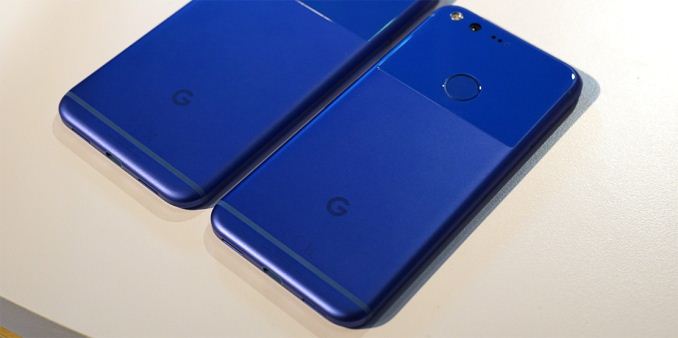
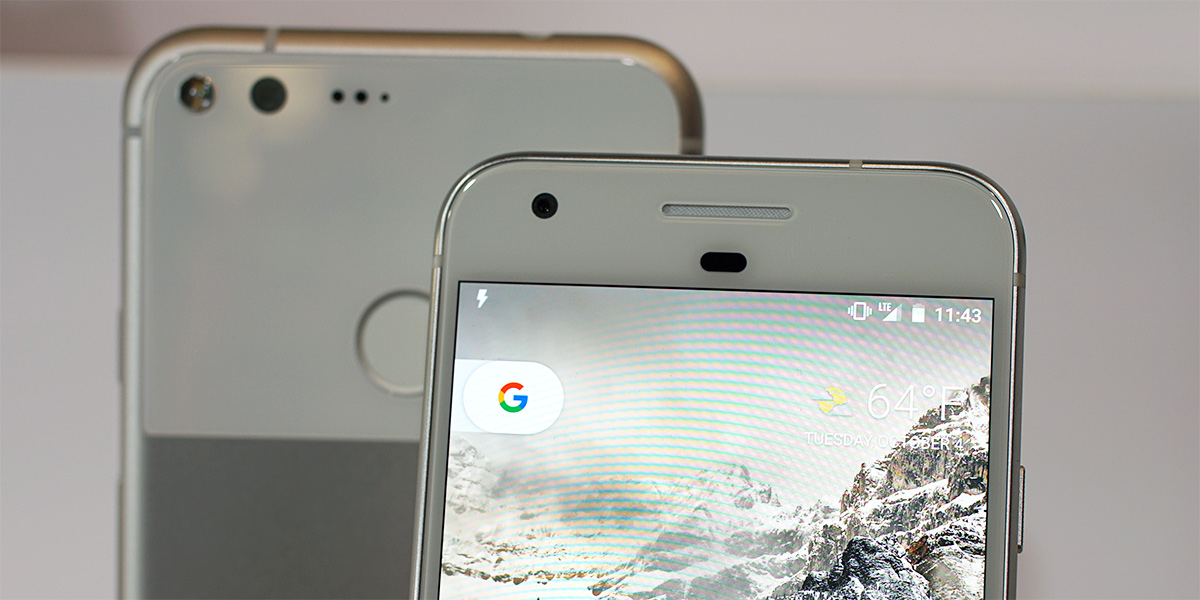
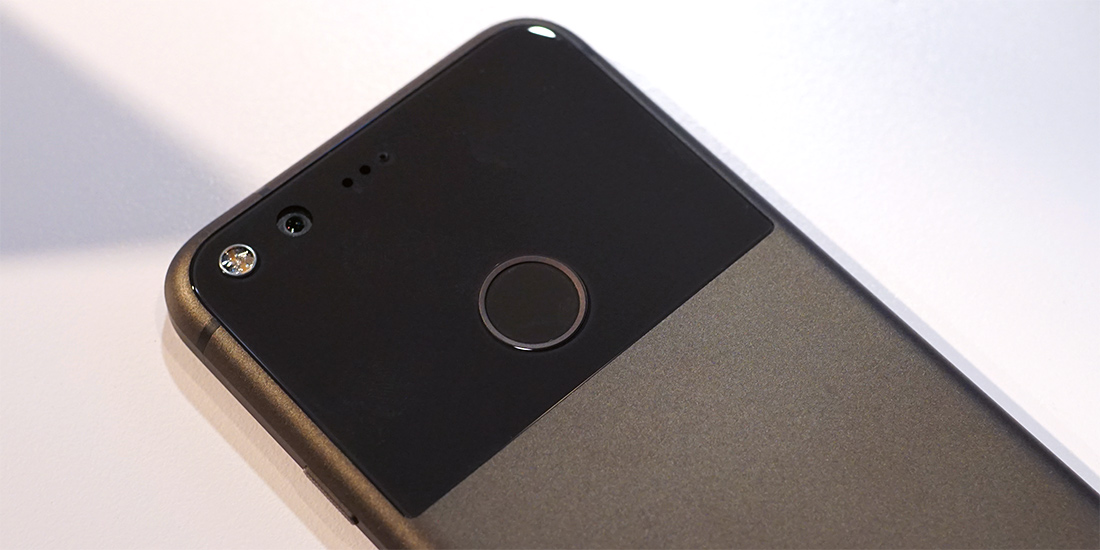
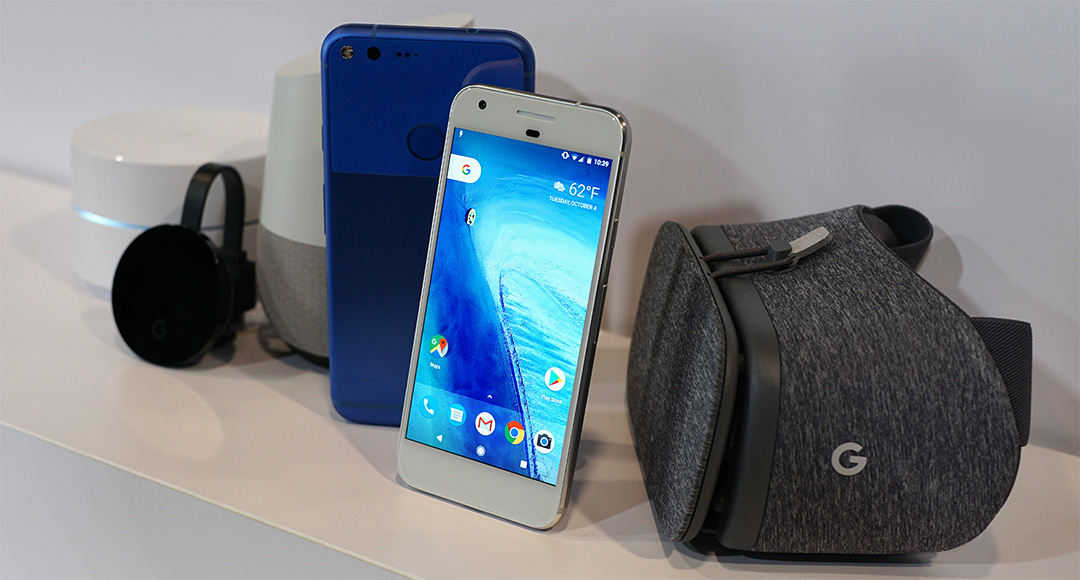
After Google’s launch event today in San Francisco, I had an opportunity to get my hands on its new Pixel and Pixel XL phones. My initial impression is that they are decent-looking, well-made phones. Google took a more active role in creating these phones than previous Nexus devices, taking the lead not just in hardware selection, but design as well. Using quality displays and not having a camera bump on the back were decisions driven by Google, for example. The phones share the same design and internal hardware, so my observations apply to both the Pixel and Pixel XL. The aluminum chassis has a sandblasted finish and rounded corners that do not dig into the palm. The back has a distinctive design, with glass covering the top third. This functions as an RF window for the various antennas, but its size seems more cosmetic. I would prefer more aluminum on the back, both for aesthetic and durability reasons, but the partial glass back does help the Pixel stand out from other aluminum phones. The recessed fingerprint sensor sits within the glass region and is easy to locate. The rear camera, dual-color LED flash, laser autofocus module, and a noise cancelling microphone are lined up in the top-left corner similar to the iPhone. The Pixel’s camera, however, sits flush with the back and is covered by the rear glass.
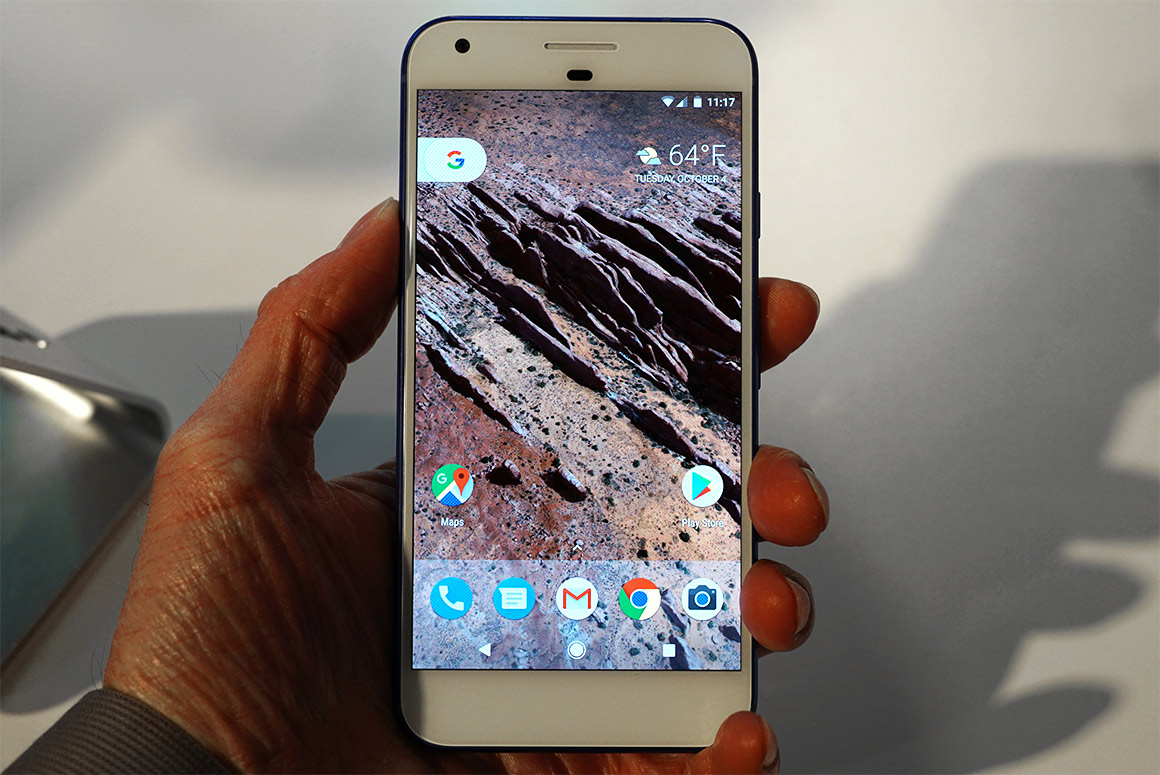
The front is edge-to-edge glass and nondescript. The upper and lower bezels are needlessly large, and there’s a lot of wasted space in the lower bezel, which does nothing but serve as a place to rest your thumb. Instead of using the space for capacitive buttons, or just making the bezel smaller, Google commits two fouls by making the bezel large and then using onscreen navigation buttons. The upper bezel is sized to match, with another curious design choice. The Pixel’s ambient light and proximity sensors are located below the earpiece instead of next to it. It’s possible the large upper bezel is necessary to fit the rear camera above the screen, which is necessary to avoid a camera bulge, but we will not know for sure until we see a teardown.
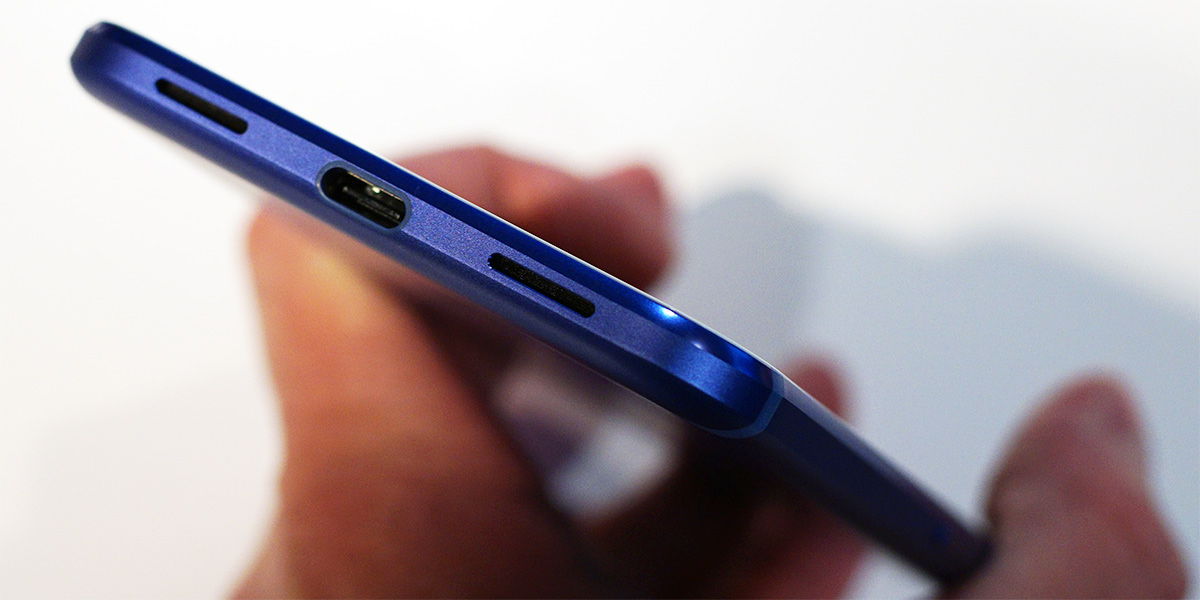
With so much room above and below the display, front-facing stereo speakers would have been nice. Instead, there’s only a single downward-firing speaker. While there are two symmetric grilles flanking the centered USB Type-C port, the second covers only a microphone. At least there’s still a 3.5mm headphone jack located on the top edge. The SIM tray slides into the left side, and both the nicely-textured power button and single-piece volume rocker are on the right side. One thing that really bothers me about the Nexus 6P is the button placement; every time I touch it I inadvertently press the power button, turning it on when I want it to stay turned off or vice versa. The button placement is better with the Pixel phones, with the power button closer to the top, so this should be less of an issue now.
The edges are rounded on the back, eliminating another pressure point, and chamfered on the front, the only place we see a hint of HTC 10 styling. The sides are still flat, which makes it easier to hang on to than an iPhone, but not quite as comfortable. I did not have too much time to play with the Pixel’s camera, but its autofocus worked quickly and accurately within the confines of the demo room, even when I covered the laser module. The rear camera includes 1080p30, 1080p60, and 4K video recording modes, along with 120fps slow-motion video at 1080p and 240fps at 720p. Electronic image stabilization (EIS) for video recording (the camera still does not have OIS) was one of the highlight features mentioned in Google’s presentation. While testing the camera, I noticed that EIS is used for video modes up to 1080p60 but not when shooting 4K video. There’s still a processing/power hurdle to clear.
I also spoke with Qualcomm and learned that Google optimized its HDR+ algorithm to run on Snapdragon 821’s Hexagon 680 DSP, taking advantage of vector instructions to enable HDR processing with zero shutter lag. Qualcomm also said this approach consumes less power than running the algorithm on the CPU. The Pixel phones also use Qualcomm's Aqstic audio codec that's capable of 192kHz/24bit playback, but does not use Qualcomm's Quick Charge 3.0 technology. Instead, it adheres to the USB Power Delivery specification, delivering up to 18W of power.
Both Pixels use wide-color gamut AMOLED displays, with Google claiming 100% NTSC coverage. Unfortunately, while poking around in the display settings panel, I did not see any options to adjust white point or change the display to sRGB mode. It's possible this option is hidden again in the developer settings.
With prices starting at $649 for the 32GB, 5-inch version, Google is positioning its Pixel phones to compete with Apple’s and Samsung's flagships. This will no doubt disappoint Nexus fans who were hoping for a more affordable option. It's also a questionable strategy, considering the lack of brand awareness around Nexus/Pixel among the general public and Google's lack of retail exposure. Its alignment with Verizon should help, but I imagine it will be difficult to convince someone looking to buy an iPhone or Galaxy phone to buy a Pixel instead, especially when its premiere feature, the one advantage it has over every other Android phone, is timely software and security updates—not exactly a sexy selling point. For those who do value up-to-date software, and who do not want to tinker with custom ROMs, the new Pixel phones are the new price of admission. | |||||||||||||||||||||||||||||||||||||||||||||||||||||||||||||||||||||||||||||||||||||||||||||||||||||||||||||||||
| 8:00a | Zotac ZBOX CI523 nano Fanless Skylake-U mini-PC Review Passively cooled computing systems are popular amongst consumers worried about noise from fans and their associated maintenance requirements (particularly, for industrial use-cases). Traditionally, fanless high-performance PCs have come with a high price tag. However, with the focus on low-power Core-series CPUs by Intel, we have many vendors targeting this market segment with affordable models. Zotac started a new lineup of passively cooled ultra-compact form factor (UCFF) machines in the C-series back in mid-2014. Initially, the members of the series utilized either Atom-class or -Y series CPUs (with a sub-10W TDP). With Skylake, Zotac has re-engineered the design to accommodate 15W Skylake-U CPUs. Today, we are taking a look at the Zotac ZBOX CI523 nano, a passively-cooled alternative to the Intel Skylake NUC NUC6i3SYH. | |||||||||||||||||||||||||||||||||||||||||||||||||||||||||||||||||||||||||||||||||||||||||||||||||||||||||||||||||
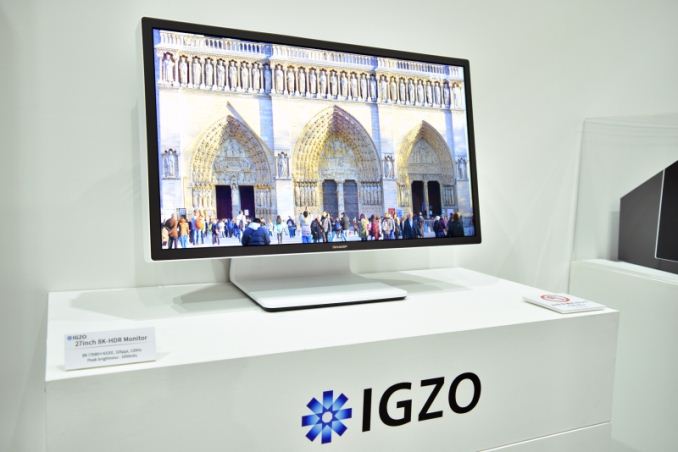
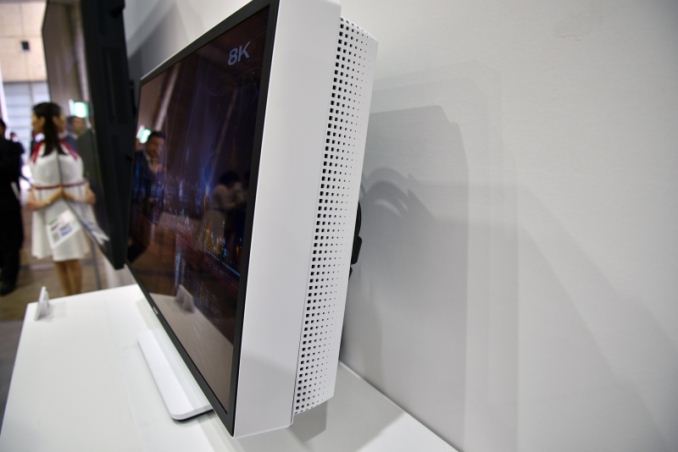
| 10:15a | CEATIC 2016: Sharp Showcases 27-inch 8K 120Hz IGZO Monitor with HDR, also 1000 PPI for VR
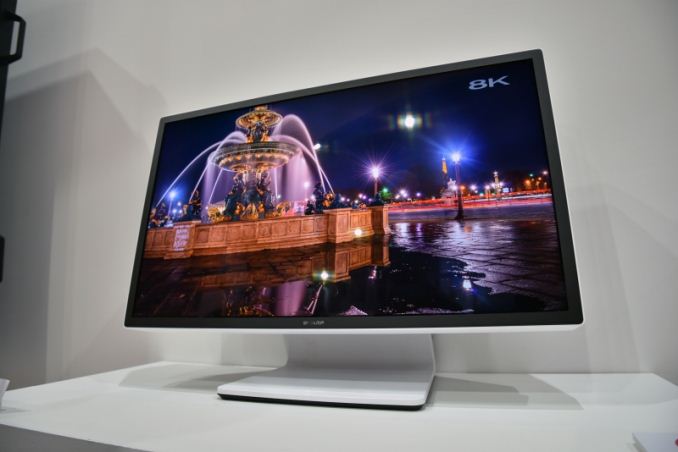
While we’re not CEATIC, a Japanese technology show, news has come via PC Watch regarding a new publicly announced milestone in monitor production. For any journalist that has attended either IFA, Computex, CES or MWC over the past year, it would be hard going to miss one of the super large (80-inch plus) 8K monitors doing the rounds. While highly impressive in their own right, current 8K displays on show typically have a low pixel-per-inch value in order to achieve a good panel off the production line. So despite the fact we can get 4K panels on smartphones (Sony Xperia Z5 Premium is 4K in 5.5-inch, or 806 PPI), expanding the size at that pixel density is difficult with panel yields. Also, moving 8K down to a 'monitor size' has been hidden at the panel companies internal research divisions until now.
So this is where the Sharp monitor on display at CEATIC gets interesting. The IGZO display is down at 27-inches, marking a 326 PPI, just hitting at the door of large FHD smartphone displays. The panel is also listed at 1000 nit brightness. But to double down on specifications, the stand listed the display as supporting 120 Hz while in 8K mode, and also supporting High Dynamic Range, or HDR. This requires a large amount of data to be pumped into the display, and as a result a photograph of the rear shows eight separate DisplayPort cables being used in order to give the display the data it needs. 8K120 with HDR is no easy task, suggesting 7680x4320 at 10 bits per color channel (so 30-bit for RGB) at 120 times a second would suggest needing 120 gigabits per second of bandwidth at a minimum (or 15 GB/sec). That's even before you discuss overhead, which will push that higher.
Needless to say, this is a prototype panel. Businesses with large enough checkbooks are free to try and estimate a figure for such a display, because it will be a while before a device of these specifications hits commercial availability.
Also in the display was a 2.87-inch display, offering 1920x2160 resolution and rolling in at over 1000 pixels per inch (1008 PPI). This was described as ‘4K to both eyes’, affording a combined display suitable for head-mounted units or virtual reality headsets. Compare this to the HTC Vive, which uses a 1200x1080 screen per eye at 3.62 inches per panel, making it 447 PPI. This gives the Sharp panel a specification of over double the amount of pixels in a given area. Of course, with that comes cost and the ability to feed that display with enough data either over cable or other means. Still, it’s an interesting prospect.
| |||||||||||||||||||||||||||||||||||||||||||||||||||||||||||||||||||||||||||||||||||||||||||||||||||||||||||||||||
| 11:00a | Market Trends Q2 2016: SSD Shipments Up 41.2% YoY, PC Sales Up on Q1
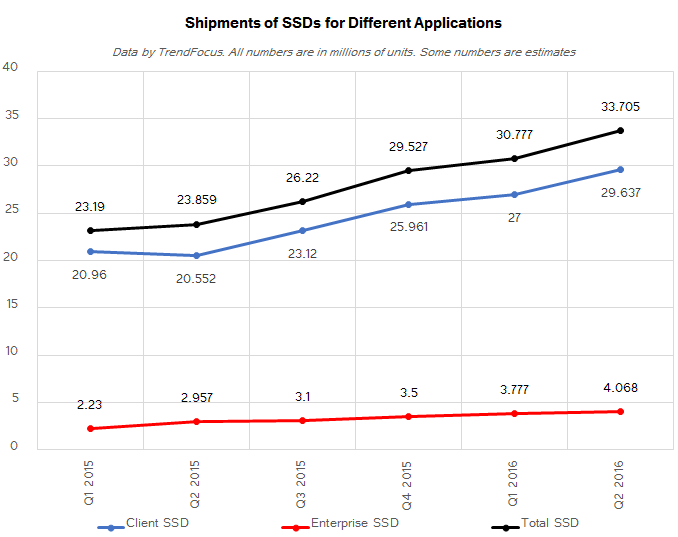
Sales of SSDs in the first quarter of 2016 were up 41.2% year-over-year, based on findings from TrendFocus*, a storage market tracking company. Shipments of all types of SSDs, including drives for client and server systems, were up sequentially and year-over-year, which again proves that NAND-based storage devices are taking the place of traditional hard drives both inside client PCs and enterprise machines. SSD Sales now above 33.7 Million UnitsShipments of SSDs in the second quarter hit 33.705 million units, which is nearly 10 million units higher than in the same period a year ago and up 9.5% from the previous quarter, according to TrendFocus. According to IDC and Gartner, sales of PCs were also relatively strong in Q2 compared to Q1: the industry sold 62.4-64.3m units, which is flat or slightly up (depending on who you take numbers from). Meanwhile, the SSD market for client PCs and servers has been growing rapidly for many quarters, therefore, and all-time high shipment units in Q2 came as no surprise.
There are multiple industrial trends that help to accelerate adoption of SSDs by both client PCs as well as servers: Firstly, price. Entry-level SSDs are getting cheaper thanks to rapid per-GB price declines of TLC and 3D TLC NAND flash memory. This is combined through competition among vendors as well as the adoption of multiple module form-factors. In the second quarter, average contract prices of 128 and 256 GB SSDs dropped to $37.20 and $60.80 per unit, respectively, according to DRAMeXchange. For example, 120/128 GB SSDs for $35-$38 are easy to find at Amazon. Moreover, there are plenty of drives with 240 GB or 256 GB capacities that cost less than $60 at Amazon. Secondly, rapid performance improvements brought by NVMe protocol and new controllers supporting PCIe 3.0 bus stimulate strong demand for newer SSDs by enthusiasts and boutique PC makers. Thirdly, new technologies (3D NAND, stacking, etc.) enable companies like Samsung and Toshiba to build SSDs that challenge HDDs not only in terms of performance but also in terms of capacities, thus stimulating demand from datacenters.
Average SSD Capacity Hits 368 GBThe total capacity of all SSDs sold in the second quarter achieved 12.47 Exabytes, up 93% year-over-year and 24.1% quarter-over-quarter, based on estimations from TrendFocus. The company believes that the whole industry produced 29 EB of NAND flash (up 17% sequentially) and SSDs consumed 42.5% of that output. The major increase of NAND flash bit supply was driven by the ramp up of 3D NAND and TLC NAND memory by leading manufacturers. This is due to the growing demand for non-volatile storage from many applications and industries. While this fast growth of NAND supply looks impressive, several industry insiders are indicating that demand is outpacing supply, which would drive up prices. However larger chips help mitigate this issue, keeping cost/GB down. Meanwhile, the average capacity of an SSD, combining consumer and enterprise, increased such that: - 325 GB to 368 GB from Q1 2016 (a 13.2% QoQ growth) and, The recent declines of NAND flash memory pricing made SSDs with 240/256 GB and higher capacities considerably more popular than they were a year ago in the PC segment, driving average client SSD capacity to 278 GB. Moreover, companies like Samsung and Toshiba introduced enterprise-class SSDs that can store 8 TB or even 15 TB of data, which helped average capacity of a datacenter-class SSD to increase to just over 1 TB for the first time in Q2 2016.
Strong demand for high-capacity datacenter-class SSDs in the recent quarters, as well as shift for high-end models, has helped a number of companies increase the average SSD capacity per unit of their sales significantly in the second quarter both sequentially and year-over-year (the combination of HGST and SanDisk shipments under Western Digital brand somewhat distorts the picture, but it still is in line with general trends). Meanwhile, short supply of NAND and focus on unit sales triggered declines of average SSD capacities for companies like Kingston, Lite-On and some others. Samsung Retains Leadership Amid Slight Drop of Unit SalesSamsung controlled about 36.3% of the global NAND flash production in Q2 2016 based on revenue, according to DRAMeXchange. Moreover, its NAND bit shipments were up 15% sequentially, the same company reports. Nonetheless, when it comes to SSDs, the quarter was a mixed bag for the company.
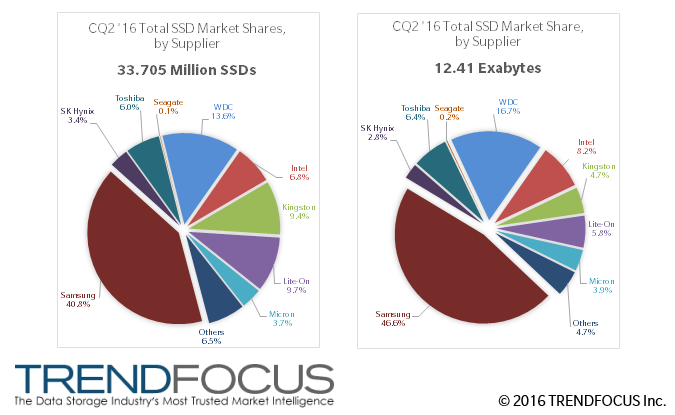
Sales of Samsung SSDs in Q2 totaled 13.75 million units, up from 10.45 million in the same period a year before (an increase of 31.5%), but slightly down from 14.16 million units in Q1 (a decrease of 2.9%). Meanwhile, the total capacity of Samsung’s SSDs in the second quarter increased to 5.78 EB, up from 2.96 EB in Q2 2015 (up 51.2%, slower than the industry) and 5.1 EB in Q1 2016 (+12%, slower than the industry). Due to a slight drop in unit sales, Samsung’s market share decreased to 40.2%. While the company is still well ahead of everyone else, its SSD unit shipments and market share have been decreasing for two straight quarters now. The reasons for that are more or less clear: the company is gradually increasing average capacities of its SSDs, boosting their average selling prices (average capacity of a Samsung SSD in Q2 was 420 GB), but the amount of NAND flash it can use for SSDs seems to be somewhat limited (we will discuss this issue below). As a result, Samsung focuses on more lucrative high-capacity drives, sacrificing market share and unit shipments for higher per-unit selling prices.
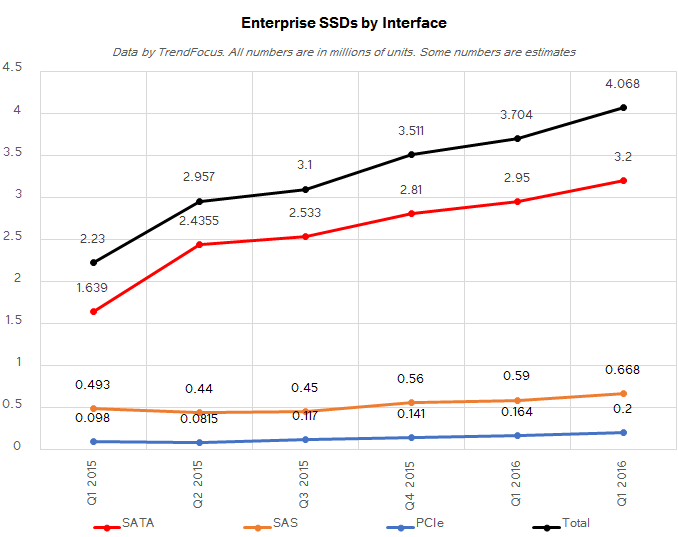
Western Digital’s SanDisk retained #2 position in the SSD market for Q2: it shipped 4.58 million drives (up 106% YoY and 6.2% QoQ) and increased its market share to 13.6% in Q2 2016. What is even more important is that the company doubled the amount of NAND flash memory it used for its SSDs from the previous quarter (2.07 EB vs 0.98 EB) and nearly quadrupled it from the same period a year ago (0.54 EB). The average capacity of a SanDisk SSD in the second quarter was 452 GB, according to TrendFocus, the highest in the industry. Despite the fact that SanDisk lost a part of its OEM SSD business lately, its performance on the SSD market in the recent quarters was rather impressive. Important notice: When analyzing historical data for SanDisk, keep in mind that starting from the second quarter of 2016 sales of SanDisk and HGST are combined under the Western Digital name. HGST does not sell a lot of drives (in 1H 2015 it controlled roughly 1.0%-2.6% of the global SSD market, so its shipments were 200-600 thousand units per quarter at best), but it sells a lot of high-end high-capacity SAS SSDs. Therefore, the addition of HGST’s product mix to SanDisk’s has a strong impact on average SSD capacities of Western Digital. Lite-On, which sells SSDs under Lite-On and Plextor trademarks, maintained its third place in the rankings of SSD makers with 9.7% market share, based on data from TrendFocus. The company sold 3.27 million drives (up 131% YoY, but down 14.9% QoQ) with a total capacity of 0.72 EB (up 100% YoY, but down 19% QoQ). Since Lite-On only serves the client PC market, the average capacity of its SSDs was 220 GB, down both sequentially and year-over-year. This happened because in the recent quarters Lite-On introduced a number of inexpensive drives (particularly, under its Plextor brand), which attracted consumers with budget constraints that typically focus on smaller drives anyway. One of the reasons why Lite-On released such Plextor drives was timing (the M8Pe-series high-end SSDs are hitting the market only now), but another was the short supply of NAND in general. As a result, the company managed to increase its unit sales, but at the cost of average capacities and ASPs. Kingston managed to boost its SSD shipments slightly to 3.17 million units (up 24.3% YoY and 1.2% QoQ) in the second quarter and increased its market share to 9.4%. Its total data (exabyte) shipments remained flat sequentially but are +61% compared to the same period a year ago. Since Kingston serves the entry-level segment of the client PC market, the average capacity of its SSDs is among the lowest in the industry at ~183 GB. Intel’s positions as a supplier of SSDs has not been particularly strong in recent quarters, but in Q2 2016 the company managed to increase sales of its SSDs to 2.29 million units (up 18.6% YoY and 83% QoQ) and overtook Micron and Toshiba. The total capacity of Intel’s SSDs shipped in the second quarter was around 1.02 EB, a 59% growth over the same period a year ago and 183% more than in the previous quarter. The average capacity of an Intel SSD also increased to 445 GB, which signals that the company was particularly successful with its high-capacity enterprise-class drives introduced in April. Toshiba also managed to amplify shipments of its SSDs in Q2 2016. The company sold 2.02 million drives (up 122% YoY and 54.2% QoQ) and its Exabyte shipments totaled 0.79 EB (up 243.4% YoY and 113.5% QoQ). Toshiba’s average SSD capacity also increased significantly compared to previous quarters. Keep in mind that Toshiba supplies NAND memory to Phison (who sells it with its controllers) as well as to companies like Lite-On. Therefore, despite the relatively small market share (6%), Toshiba is not an underdog when it comes to SSDs. Micron and SK Hynix, who both the other NAND flash producing fabs, commanded 3.7% and 3.4% of the SSD market in Q2 2016 with shipments of 1.25 and 1.15 million units respectively. Micron has a strategy to become a vertically integrated maker of NAND-based devices and it expects sales of own-brand SSDs to get higher over time. Client SSDs: Modules Are Gaining MomentumOf the 33.7 million SSDs that various manufacturers shipped in Q1 2016, roughly 29.6 million of the solid-state drives sold were aimed at client PCs, compared to ~4 million were designed for servers. Sales of SSDs in the PC space increased 44% year-over-year, outpacing general market trends. The total available market of enterprise-grade SSDs hit 4.068 million units and grew healthy 37% YoY.
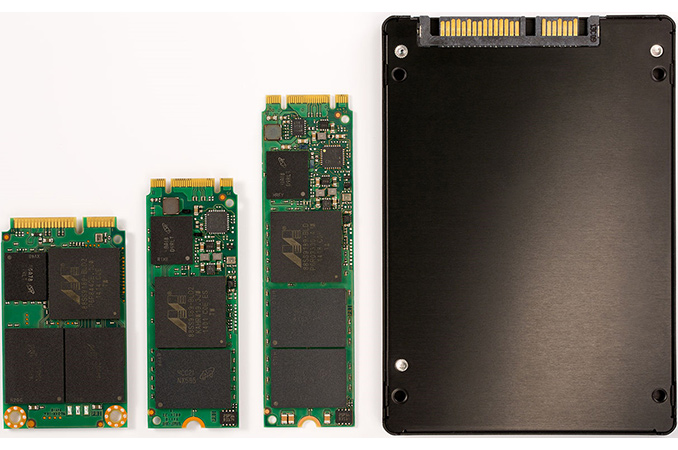
When it comes to SSDs for client computers, it is noteworthy that modules are gaining traction. In Q2, approximately 13 million of SSDs in M.2 or mSATA form factors were shipped, TrendFocus estimates. Growing popularity of SSD modules is conditioned by increasing market share of ultra-thin laptops (which modern 2.5-inch HDDs are reducing in importance) and adoption of PCIe-based drives by higher-end models. Shipments of solid-state drives in module form-factors are still behind sales of SSDs in traditional drive form-factors (i.e., M.2/ vs. 2.5”/7 mm), such that ~13 million M.2/mSATA units compared to 16.637 million units. Nonetheless, as PC form factors continue to shrink and performance of mainstream SSDs is getting higher, it is expected that modules with a PCIe interface will become more widespread in the client PCs. Some people even say that next year PCIe/NVMe SSDs in M.2 form-factor will go beyond module sales for 2.5” drives with a SATA interface. Enterprise SSDs: SATA Is Still King of the HillVarious data centers across the globe continued to replace their 10K/15K HDDs for mission-critical applications with SAS or even PCIe SSDs in the second quarter of the year. To hit performance targets (both in terms of IOPS and bandwidth), operators of data centers do not need a lot of such drives, which is why cumulative shipments of SAS and PCIe SSDs only hit ~870 thousand of units (668K SAS, 200K PCIe) in the aforementioned period. By contrast, with 3.2 million units shipped, SSDs with SATA interface remained the choice for the majority of enterprises.
TrendFocus believes that they key suppliers of enterprise-grade SSDs are Samsung, Intel and Western Digital (HGST). All three companies increased average capacities of their SSDs quite tangibly during the quarter, which may be an indicator that sales of their server drives were on rather high levels. Demand for SSDs Poised to Rise, But Supply of NAND Remains Major ConcernSolid-state drives are becoming more widespread these days and in many cases they capture market share from traditional hard drives. The current demand for SSDs is healthy and shipments are growing, but there is a great concern about supply of NAND flash memory for SSDs. In fact, there are several factors which limit the amount of NAND flash memory available for solid-state drives: Some readers will notice that both production and consumption-related factors have already impacted Samsung. The company was the first to stop expanding its planar NAND manufacturing facilities and the first to start high-volume shipments of 3D NAND. At present, the company’s SSD sales are growing slower than the market due to tight supply of NAND. Other makers are barely expanding 2D production and yet have to transit to 3D NAND. As a result, we would not expect them to improve their output of flash memory significantly in the coming quarters. The exponential growth of the demand for NAND flash memory amid a linear growth of its supply will ultimately have an impact on NAND and SSD pricing (the pace of depreciation of prices, to be precise). As a result, per-GB prices of SSDs may remain at the current levels for quite some time. In the coming months we are going to find out how stable pricing environment affects demand for SSDs. *Please note that the numbers mentioned in this news story were determined from a combination of press releases and previous announcements from TrendFocus, or estimates based on previously released numbers and relationships by the company. If you need precise numbers for business decisions, you should acquire the full report from TrendFocus. Recent Storage ReviewsThe Toshiba OCZ VX500 Review: 256GB, 512GB and 1024GB
| |||||||||||||||||||||||||||||||||||||||||||||||||||||||||||||||||||||||||||||||||||||||||||||||||||||||||||||||||
| 11:15p | AMD Releases Radeon Software Crimson Edition 16.10.1 Hotfix - Support for GoW 4 and Mafia III
As the new games continue to roll in I’m sure the driver developers are hard at work keeping up with all the big release. With AMD Radeon Software Crimson Edition 16.10.1 bringing us driver version 16.40.2715 we have a solid handful of CrossFire fixes with a few others following along, and support for two more titles being released across the next week. Starting us off we have some game related fixes all centered around CrossFire. Both Battlefield 1 and Overwatch received fixes for issues with flickering graphics that were seen while running the game with CrossFire enabled, and Paragon shared in the flickering issue when FreeSync was used in conjunction with CrossFire. Deus Ex: Mankind also has received a fix for issues with stuttering while using CrossFire. Moving away from Crossfire we have a fix for random or sudden FPS drops while playing The Crew, and the Pixel Format option is no longer missing for some Radeon RX 400 series products in Radeon Setting. Shifting gears (or should I say cogs) to the motivator for this release we have preparations for the release of two games in the next week. The open world action game Mafia III will arrive October 7th, or Friday. Next Tuesday the 11th we’ll see Gears of War 4 released. (ed: I guess ten years isn’t long enough to remove a locust infestation) Alongside the game optimizations we are also given a CrossFire Profile for Shadow Warrior 2. As always, those interested in reading more or installing the updated hotfix drivers for AMD’s desktop, mobile, and integrated GPUs can find them either under the driver update section in Radeon Settings or on AMDs Radeon Software Crimson Edition download page. | |||||||||||||||||||||||||||||||||||||||||||||||||||||||||||||||||||||||||||||||||||||||||||||||||||||||||||||||||






| << Previous Day |
2016/10/05 [Calendar] |
Next Day >> |