[Most Recent Entries] [Calendar View]
Wednesday, October 19th, 2016
| Time | Event | |||||||||||||||||||||||||||||||||||||||||||||||||||||||||||||||||||||||
| 1:51a | Huawei announces the HiSilicon Kirin 960: 4xA73 + 4xA53, G71MP8, CDMA
Last year we had the opportunity to attend HiSilicon's launch event of the Kirin 950. The 950 SoC was the first to employ ARM's Cortex A72 in a smartphone, and the big.LITTLE 4x4 A72/A53 configuration of the 950 powered most of Huawei's flagships for 2016. It also marked a significant jump both in performance as well as efficiency compared to previous Kirin chipsets. The CPU part especially made such a good impression in our review of the Mate 8, and at the time we estimated that it would easily trade blows with Qualcomm and Samsung's own custom ARM microarchitecture designs, Kryo and Exynos M1, in their respective SoCs and flagship smartphones. Ultimately the Kirin 950 exceeded our expectations, in part due to the rather lackluster showing of this year's custom-CPU powered Android devices. The Kirin 950 was initially launched in the Huawei Mate 8, their new flagship smartphone. The SoC then followed into the Huawei P9, P9 Max, and the Honor 8 over the course of 2016 - essentially all the premium devices for Huawei and Huawei's sub-brands, and contributing to the 106 million smartphone sales Huawei recorded in 2016 (30% of which were devices over $450). This is the success that Huawei wants to emulate with the Kirin 960. Earlier this year, ARM announced their next generation microarchitecture IP in the form of the Cortex-A73 general-purpose core and the Mali-G71 graphics core. The A73 is a departure from the design of the A72 - the A72 was related to the A57 and A15 (Austin µarch family), whereas the A73 is a successor to the little-used Cortex A17 of the Sophia µarch family. Notable differences between the A73 to the A72 include a reduction of the decode-width from 3 to 2, but don't let this change fool you as the new micro-architecture is supposed to be both faster and smaller (and efficient) than that of the A72. On the GPU side, the Mali G71 is an even bigger upgrade for ARM as it marks the first IP of the Bifrost architecture which brings beyond a nomenclature change from the Mali-Txxx series also significant performance and efficiency improvements. Back in May we said that we would expect SoCs and devices with these new IPs by the end of the year, and indeed, the new Kirin 960 SoC from Huawei's semiconductor subsidiary HiSilicon combines these two new technologies, promising the first commercial device to use them in due course.
While more details of the Kirin 960 will come forth over time as it makes its way into various devices, the official launch in Shanghai reiterated the partnership between HiSilicon and TSMC, using the new 16FFC process as the primary technology to enable the new SoC. As a reminder, the new process brings lower manufacturing cost thanks to lower mask count as well as better density due to new cell libraries.
The Kirin 960 features the same 4x4 big.LITTLE design implementation as the Kirin 950, but using four Cortex A73 cores at 2.4 GHz (by contrast, the Cortex A72 cores in the 950 were at 2.3GHz, and 2.5 GHz in the Kirin 955). The little cores remain of the Cortex A53 micro-architecture and at the same 1.8 GHz configuration.
Performance for the Kirin 960, as presented in Huawei's announcement, is +10% single core performance and +18% on the multi-CPU performance compared to the Kirin 950. (This isn't quite as much as we would have hoped from an A73 design, though.) HiSilicon presented GeekBench 4 scores for the new chipset and the K960 seems to benchmark around 2000 for single-core and 6400 for multi-core. The single-core scores slightly beat other Android SoCs in the market, however isn't a too drastic improvement. We don't have more exact sub-scores yet but one we know about is the vastly improved memory bandwidth of the new design that seems to beat all other SoCs at the moment. This is surely a result of both the Cortex A73's strong memory subsystem as well as new use of the CCI-550 in the Kirin 950 that also promised an increase in effective memory bandwidth over the preceding CCI-400 design. Initially we expected A73 designs to use the improved power envelope to drive up the clock frequencies higher, however in the case of the Kirin 960 the A73 is merely 100MHz above the Kirin 950 and actually 100MHz slower than the 955's A72. The Kirin 950 already had the best sustainable CPU power envelope among this year's SoCs so it would be surprising if HiSilicon decided to limit performance lower power even more, however we have confirmation that that is exactly what happened as we've been told the CPU's power envelope has been lowered in favour of the GPU. This matches ARM's philisophy about the new A73 that was presented back at TechDay, so the Kirin 960 seems to put this philosophy into practice. While there wasn't talk about power efficiency we expect it to improve given that performance has gone up while power is supposed to have gone down.
A Bigger, Faster, More Powerful GPUAs mentioned earlier, the GPU sees a significant shift as we move from a Mali T880MP4 to a Mali-G71MP8, which essentially doubles the number of shader cores employed. HiSilicon decision to go with a wider GPU on the same process node was undoubtedly made much easier by the new G71's much better die area efficiency. The new GPU runs at 900 MHz, the same as the older SoC. The combination of doubling the shader cores over the 950 and moving to a new architecture over the 950 results in a 180% increase in the GPU's performance compared to the Kirin 950. As a result, Huawei is positioning the Kirin 960 directly above the other high-end SoCs launched this year (though we expect the other SoC vendors to also have respective increases with new generations soon). GFXBench Manhattan 3.0 and T-Rex Offscreen scores were showing the performance of the G71MP8 in above both the Snapdragon 820 and the Exynos 8890, but a tad under the new A10.
One of the popular criticisms of previous Huawei SoCs is the lack of graphics horsepower, with designs often opting for a four-core 'MP4' configuration despite using the high-performance graphics cores available from ARM. An MP4 configuration kept the die size of the SoC small and easier to implement. The downside of this is typically efficiency, suggesting that high graphics loads with fewer cores run at a worse point of the power efficiency curve to get an acceptable result. Arguably most graphics scenarios on a smartphone, apart from extreme gaming titles and VR, can easily be provided by an MP4 configuration, and that was HiSilicon's main rationale for past GPU configurations. However as Huawei devices mature and get more premium, there is also the fact that when buying a device above $450, the user should expect something performing near the best in the market, and it was clear that an MP4 design could not do that. The fact that the Kirin 960 moves to an MP8 design, while increasing die area and maximum power consumption, means that a Kirin SoC moves up to compete with larger GPU configurations such as Samsung's large Mali designs in Exynos SoCs, Qualcomm's Adreno in the Snapdragons, or the 6-cluster PowerVR GPU in Apple's A-series. The mention of higher maximum power consumption comes with rather mixed feelings as the reasonably low GPU power was one of the aspects of the Kirin 950 that we especially praised when compared to other SoC designs, so we'll have to wait to see real devices to see if this improvement isn't a double-edged sword that introduces more severe GPU thermal throttling to the Kirin lineup. Nevertheless, the improvement paves the way for things like VR, especially given Google's recent announcement of Daydream VR (starting with the Snapdragon 821 in the Google Pixel smartphone). With the right software support and display, we would expect all future devices using the Kirin 960 to support Daydream VR. With API support, the Kirin 960 will be promoted with Vulkan. New Category 12/13 Modem with a Custom CDMA ImplementationThe Kirin 960 also features a new HiSilicon based modem, allowing up to LTE UE Category 12/13 connectivity for up to 600 Mbps transfers, equaling the specifications of Qualcomm's Snapdragon 820 or Samsung's Exynos 8890 modems. The modem is being promoted as the first commercial SoC to provide quad carrier aggregation to meet that speed, although it will obviously require carrier support in the region in order to do so. The modem supports 4x4 MIMO (at only 2xCA) as well as up to 256QAM spatial stream modulation.
One of the more interesting announcements from the Kirin briefing was the implementation of CDMA in the modem. Currently three smartphone modem providers have CDMA solutions (Qualcomm in integrated and discrete modems, Intel with discrete, Mediatek with VIA-based integrated), and we spoke with HiSilicon to confirm that this is a brand new custom CDMA solution, rather than a licensed platform. The value of CDMA is mixed, although a required element with certain carriers in China and the US, such that Huawei can now offer devices with the Kirin 960 can compete. It should be pointed out that CDMA certification for the US via the FCC takes 18-24 months, and I was unable to confirm when the process was started, so we may have to wait another year for a US-focused CDMA devices. We noticed that previous Kirin modem designs were made under the 'Balong' name, however the name is dropped for this model. We were told that Balong is an old brand, and it was being dropped at this performance level, although it is unclear if the modem in the Kirin 960 or future SoCs will be branded. This may be related to the fact that when asked about the presence of CEVA LTE IP in the modem similar to previous models, we were told that the LTE design in the new modem is a custom internal design without CEVA.
The multimedia capabilities of the new SoC have also seen a great improvement as we finally see 4K recording made possible. The new chipset supports 4K30 HEVC/H.265 decoding and encoding. The camera ISP is improved as well and brings new features natively supporting dual-sensor RGB/Monochrome configurations such as found on the Huawei P9 and Honor 8. Previously these had relied on an additional external ISP chipset to make use of the new monochrome sensor. A Good ShowingNaturally we expect Huawei's next generation flagships to implement the Kirin 960 and variants over the next few months, especially as we move more towards Mobile World Congress in February. Similarly, updates to Kirin such as clock speed increases (the 955 is +200 MHz over the 950) moving into the middle of next year, along with an Honor device or two as time goes on. Huawei still keeps its HiSilicon SoC portfolio purely in-house, such that other smartphone OEMs do not have access to it, and given Huawei's current success in unit sales and revenue, we would expect the continue the status quo on this front. As perhaps was to be expected, when we asked Huawei about competitor's 10nm plans (especially in light of recent news), no official statement was made. It's very hard to not try to theorise comparisons between the Kirin 960 and next year's Exynos and Snapdragons, while the former does bring substantial improvements to the table, it'll be a hard fight competing against the new generation. Given Huawei and HiSilicon's semiconductor product cycles, we might expect to hear more when TSMC's foundry business starts making more public noise about the availability of future nodes and silicon mass production (or even Intel, depending on relationships). We will probably have to tune in next year, perhaps at a similar time, and there may be more concrete news about chipset roadmaps. We expect the first devices to use the Kirin 960 to come out shortly. Further ReadingAndrei's Analysis of the ARM Cortex-A73 'Artemis' CPU Microarchitecture | |||||||||||||||||||||||||||||||||||||||||||||||||||||||||||||||||||||||
| 8:30a | Netgear Launches 802.11ad-Enabled Nighthawk X10 (R9000) Wi-Fi Router
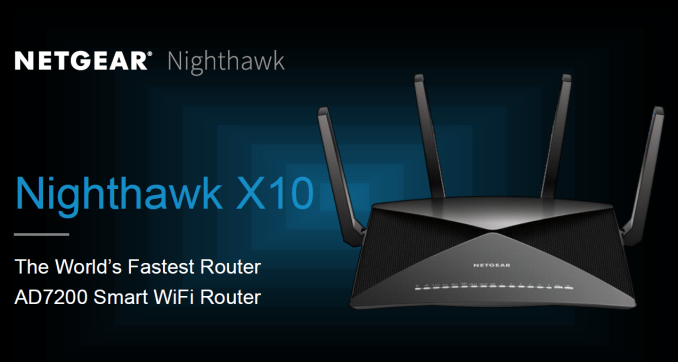
The Wi-Fi router market has seen a yearly cadence of flagship releases since the first 802.11ac routers came into the market in early 2012. Starting with 3x3 solutions, the market moved on to 4x4 and MU-MIMO-enabled Wave 2 solutions. We also saw Broadcom taking the lead with a dual 5 GHz radio solution (that has now been adopted by Qualcomm Atheros also). Many networking equipment vendors introduced solutions based on this. The recent mesh networking craze is also an offshoot of this dual radio solution - a dedicated 'invisible' channel is used to link the satellite to the main router (a discussion for another day). At CES earlier this year, the TP-Link Talon announcement indicated that tri-band Wi-Fi was getting traction in the market. Tri-band Wi-Fi involves radios operating in 2.4 GHz (802.11n), 5 GHz (802.11ac) and 60 GHz (802.11ad) bands. Today, Netgear is launching their first tri-band Wi-Fi solution - the flagship Nighthawk X10. It will be marketed as an AD7200-class router and will carry the R9000 model number.
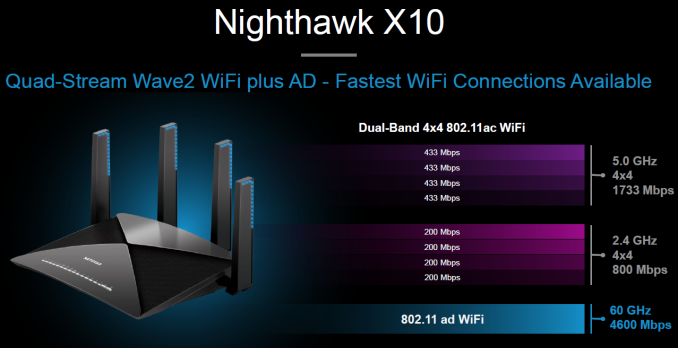
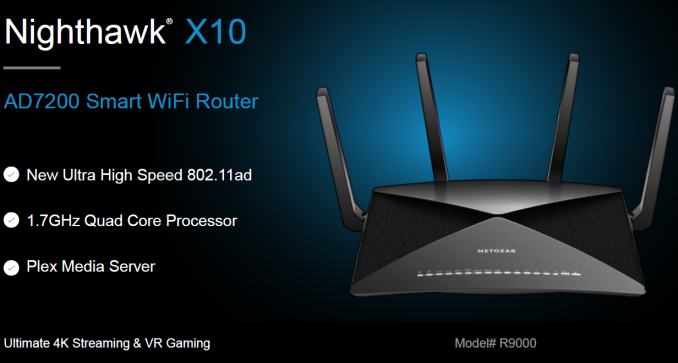
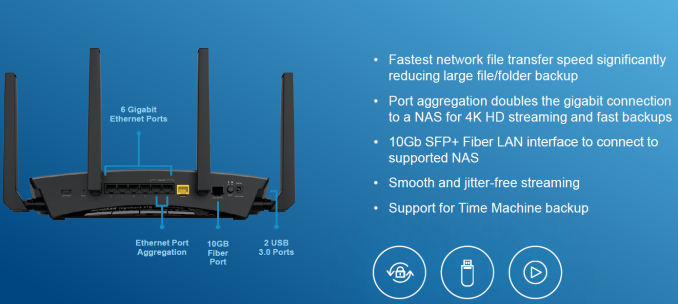
Similar to the other AD7200 routers in the market, the Nighthawk X10 adopts a dual band 4x4 802.11ac solution for (1733 Mbps + 800 Mbps) and a 1x1 802.11ad solution for 4600 Mbps to justify the AD7200 tag. There are currently two 802.11ad routers in the market, the Acelink BR-6774AD and the TP-LINK AD7200 (Talon). Both models are pure Qualcomm solutions (i.e, the radios, switches and network processor are all from Qualcomm). The Nighthawk X10 aims to differentiate itself from the existing solution by integrating first-to-market features - both in terms of hardware and software. It is the first consumer router to sport a 10G network interface, and it is the first router capable of running Plex with transcoding capabilities in a standalone manner.
Qualcomm's IPQ solutions are pure network processors and do not have a video processing engine to enable the Plex capabilities that Netgear wanted to integrate in the Nighthawk X10. Therefore, Netgear decided to go with Qualcomm only for the radios (and, likely, the switches too). The network processing as well as the media capabilities are handled by a quad-core Annapurna Labs SoC running at 1.7 GHz. While Netgear didn't officially confirm the SoC model number, the specifications point to the Annapurna Labs
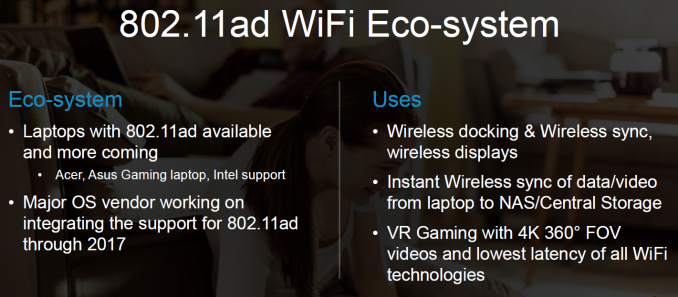
Netgear introduced their active antenna design (moving the TX power amplifiers from the board onto the detachable antennas) in the Nighthawk X8. In the X10, the RX power amplifiers are also moved out of the main board, further reducing noise concerns and improving robustness. In addition to the obvious bandwidth advantages, 802.11ad also brings about a significant reduction in latency compared to 802.11ac. The 60 GHz band is not subject to interference like the 2.4 GHz and even the 5 GHz band now. These aspects makes the technology ideal for a number of use-cases that were simply not a good fit for traditional Wi-Fi. VR gaming and 4K streaming are being promoted by Netgear as ideal applications for the Nighthawk X10.
Unlike 802.11ac, where USB WLAN adapters were available for purchase when the first routers came into the market, the 802.11ad ecosystem is just getting started. There is an existing install base in terms of dedicated docking solutions, and Intel's newer vPro-enabled platforms have Wi-Gig support. However, it is not clear whether all existing Wi-Gig products in the market will be interoperable with the AD7200 routers. It must also be remembered that 802.11ad is a short-range line-of-sight technology - this means that the AD7200 routers can't be tucked away out of sight in a closet. The industrial design of the R9000 is similar to previous routers, and I am not entirely sure the market appreciates that in the living room (often cited as the reason for the attractively designed mesh routers becoming popular). The other strange feature is the 10G SFP+ fiber port. My market research revealed no consumer NAS models with that network interface. A 10G BASE-T port would have been nice, but, that increases the BOM cost. Consumers must note that the real-world performance of 802.11ad, like all other Wi-Fi technologies, is nowhere near the theoretical numbers. Under ideal conditions, real-world TCP throughputs of the order of 1.7 Gbps can be expected. Netgear is also aiming to simplify setup and operation of the unit with a new 'Netgear Up' router installation app for both iOS and Android. Various housekeeping tasks will also be supported in that app.
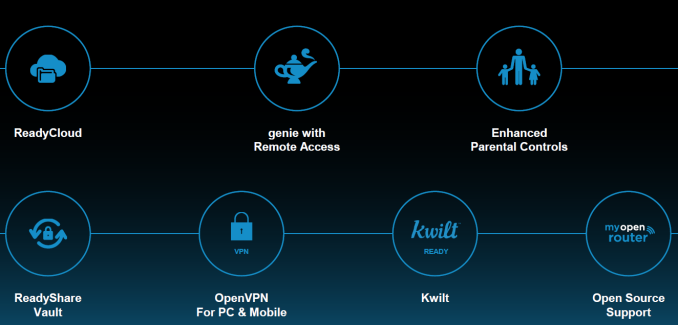
In addition, the usual set of Nighthawk features such as ReadyCloud, OpenVPN etc. are also supported. The R9000 will also be supported by the My Open Router Netgear open source community. However, installation of the open source firmware will result in loss of value-add features such as Plex. The Netgear R9000 Nighthawk X10 is now available for purchase in retail as well as e-tail stores for $500. Update: Netgear clarified that the R9000's 10G SFP+ port is compatible with a wide variety of transceivers (including direct-attached copper ones such as the Netgear AXC761). We were also provided with a list of tested / compatible transceivers (and they will go into a KB article on the Netgear site very soon). | |||||||||||||||||||||||||||||||||||||||||||||||||||||||||||||||||||||||
| 3:30p | Acer Begins Selling 9.98-mm Swift 7 Kaby Lake Laptop in the U.S.: Starts at $1100
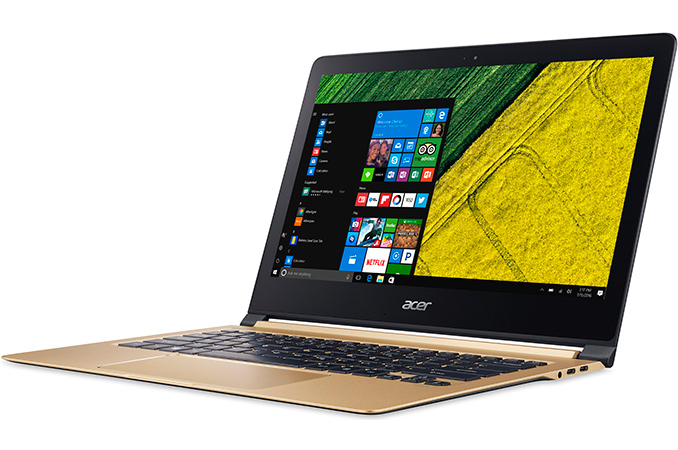
This week Acer has started to sell its first Swift 7 notebook in the U.S. The black and gold Swift 7 laptop is based on Intel’s Kaby Lake-Y-series CPU, and with an FHD display is the industry’s first clamshell PC that is thinner than one centimeter. The system is available now for $1099 from a number of retailers. The Acer Swift 7 (SF713-51-M90J) comes in a black and gold aluminum unibody to emphasize that the device is one of the premium products in the manufacturer’s lineup. The thickness of the laptop with a 13.3” FHD display covered with Corning Gorilla Glass 4 is 9.98 mm (0.39”), which is thinner than Apple’s MacBook as well as Dell’s Adamo XPS, both of which are renowned for their thin form factors. As for mass, the device weighs 1.12 kilograms (2.48 lbs), which is a tad heavier than the MacBook. Inside the Acer Swift 7 ultra-thin notebook there is an Intel Core i5-7Y54 processor (2C/4T, 1.2GHz/3.2GHz frequency, HD Graphics 615, 4.5 W), 8 GB of LPDDR3 RAM as well as a 256 GB SSD (the manufacturer does not specify whether it is an AHCI or NVMe). The laptop uses an 802.11ac Wi-Fi + BT 4.0 wireless adapter to communicate with the outside world wirelessly. The laptop also has a 720p webcam and two 5 Gbps USB 3.1 Type-C ports to connect peripherals, a display as well as for charging. Moving on to audio sub-system, we see a TRRS connector for headsets as well as two stereo speakers that are Dolby Audio certified.
Since the Swift 7 is powered by Intel’s Kaby Lake, expect significantly improved video encoding/decoding capabilities, better GPU performance, as well as Speed Shift v2 technology. This should make the new machine to be generally faster and snapper than ultra-thin notebooks based on previous-gen CPUs. When it comes to battery life, Acer claims that the Swift 7 (SF713-51-M90J) has a 4-cell Li-Ion battery with 2770 mAh of capacity, which enables it to work for up to nine hours on one charge. Do note however that Acer does not specify conditions or workloads for that number. The Acer Swift 7 (SF713-51-M90J) notebook is available directly from Acer as well as from leading retailers (Amazon, Newegg, etc.) for $1099.99. It comes with a one-year warranty. Finally, keep in mind that Acer plans to release a family of Swift 7 notebooks, as it revealed at IFA. So expect to see further models of the Swift 7, including a more affordable version based on Intel’s Core i3 at $1000, as well as a more advanced system featuring Intel’s Core i7-7Y75 and a higher price. | |||||||||||||||||||||||||||||||||||||||||||||||||||||||||||||||||||||||
| 5:00p | Quantenna Announces 802.11ax Draft 1.0-Compliant Wi-Fi Chipset
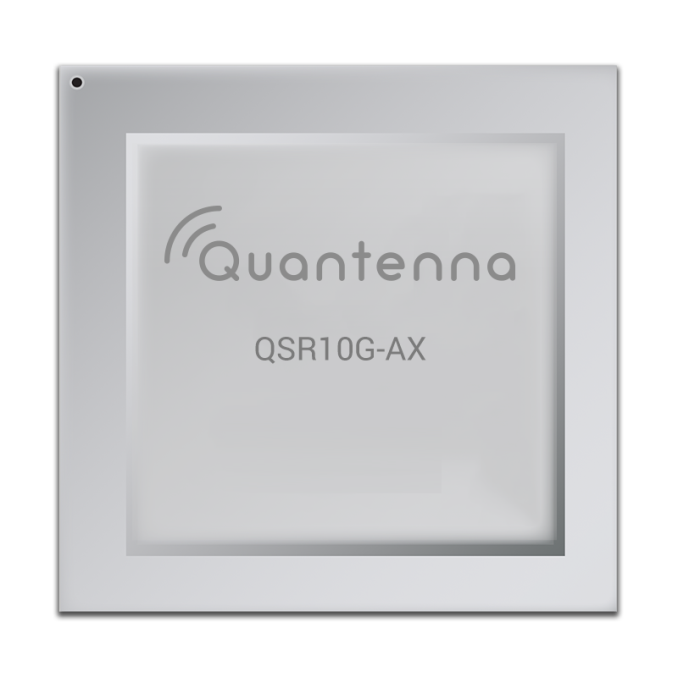
Quantenna this week introduced the industry’s first 802.11ax Draft 1.0-compliant Wi-Fi chipset for access points. The QSR10G-AX is pin-to-pin compatible with Quantenna’s commercial QSR10G Wave 3 802.11ac-compliant Wi-Fi platform and can thus be easily integrated into existing APs (e.g., routers). The next-gen 802.11ax Wi-Fi standard promises to improve spectral efficiency of Wi-Fi operation in dense deployments and also to increase maximum theoretical bandwidth of Wi-Fi networks to around 10 Gbit/s. Wi-Fi nowadays is a pervasive technology that is used by loads of different devices. Every office or residential building has tens of Wi-Fi APs visible and many people carry two or more of Wi-Fi-enabled devices with themselves (a smartphone, a laptop, most recently, smart watches). As a result, the number of connections that every AP needs to handle is getting higher every year, which requires higher spectral efficiency and more channels to connect devices. In the recent years the 802.11 standard introduced multiple ways to improve spectral efficiency of Wi-Fi, including multiple-input multiple-output antennas (MIMO), multi-user MIMO (MU-MIMO), higher order modulation and so on. The next-gen 802.11ax will add OFDMA (Orthogonal Frequency-Division Multiple Access) to allow different devices to be served by one channel, by dedicating different sub-carriers for individual client devices.
Quantenna’s QSR10G-AX is one of the industry's first 802.11ax Draft 1.0-compliant Wi-Fi chipsets, and supports the major features of the upcoming standard (including OFDMA, 1024-QAM and so on). Furthermore, to simplify deployment, it can be installed into existing designs due to pin-compatibility with the current QSR10G chipset. From a physical standpoint, devices based on the QSR10G-AX will use Quantenna’s 12-stream Wave 3 802.11ac dual-band Wi-Fi platform, which offers 8 streams in the 5 GHz band and a further 4 streams in the 2.4 GHz band. This essentially means that manufacturers using the QSR10G can simply throw in a more advanced chip and build an 802.11ax Draft 1.0-compliant router. Right now, Quantenna does not specify the speeds that devices based on its QSR10G-AX will be able to provide, primarily because a lot will depend on actual client equipment. In the best case scenario with the currently available devices we are looking at 1733 and 2167 Mbps using four 802.11ac streams with 600, 800 and 1000 Mbps per stream. Nonetheless, keep in mind that the whole point of the 802.11ax is not to skyrocket maximum bandwidth (even though, maximum bandwidth remains important and does improve), but to ensure the ability to robustly serve the greatest number of clients using a single AP. Meanwhile, the availability timeframe for such routers is unknown. Quantenna plans to make the QSR10G-AX chip available to its partners in early 2017. Then, it is going to take them some time to ensure that everything operates as planned (an uneasy thing to do due to lack of 802.11ax-compliant client equipment) and only then actual devices are set to hit the market. | |||||||||||||||||||||||||||||||||||||||||||||||||||||||||||||||||||||||
 Main_575px.jpg)


 Main_thumb.jpg)
 User Feedback_thumb.jpg)
 Startup Time_thumb.jpg)
 GB4 CPU_thumb.jpg)
 GB4 DRAM_thumb.jpg)
 andro4 Storage_thumb.jpg)





| << Previous Day |
2016/10/19 [Calendar] |
Next Day >> |