[Most Recent Entries] [Calendar View]
Tuesday, October 25th, 2016
| Time | Event | ||||||||||||||||||||||||||||||||||||||||||||||||||||||||||||||||||||||||||||||||||||||||
| 9:00a | Intel Announces Atom E3900 Series - Goldmont for the Internet of Things & More
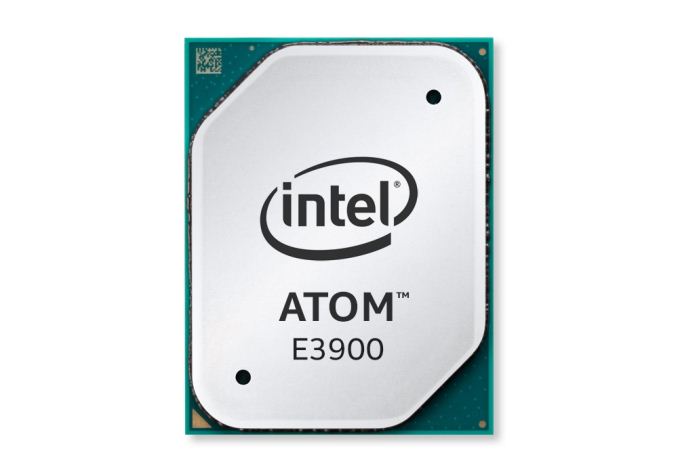
Kicking off a busy day for the Internet of Things market, Intel this morning is announcing the Atom E3900 series. Based upon the company’s latest generation Goldmont Atom CPU core, the E3900 series will be Intel’s most serious and dedicated project yet for the IoT market. We’ve talked about Intel’s IoT efforts off and on over the past couple of years. Having largely missed the boat on mobile, the company decided it wouldn’t miss IoT as well, and as a result they’ve been making significant investments into the IoT market, treating it as a fourth pillar of their business. Their efforts have not gone unrewarded, as IoT revenue has continued to quickly grow over the years, and as of Q3’16, IoT is now Intel’s third largest business by revenue, ahead of non-volatile memory and behind only client and data center revenue. Furthermore with 19% year-over-year growth, IoT still looks like a growing market for the company. Overall the company offers a number of IoT products, ranging from the tiny Curie to the relatively powerful Atom E-series. However to date, the company has never built a dedicated, high-end IoT die. The Atom E3800 series were Bay Trail, and the recently announced Joule devices use Broxton, Intel’s canceled-for-mobile Atom SoC. However today that will be changing, as the launch of the Atom E3900 series brings with it Intel’s first custom silicon targeting the roughly 6W to 12W market of more powerful IoT devices.
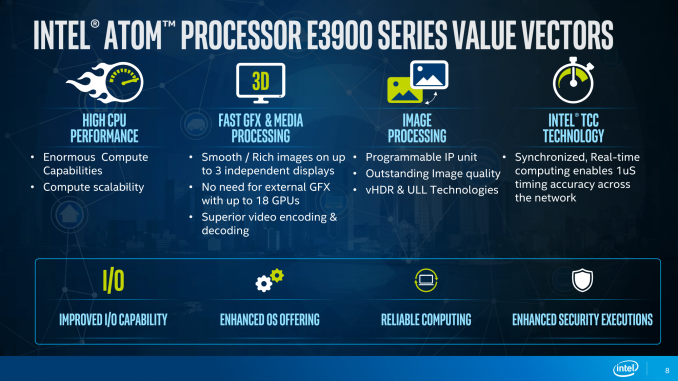
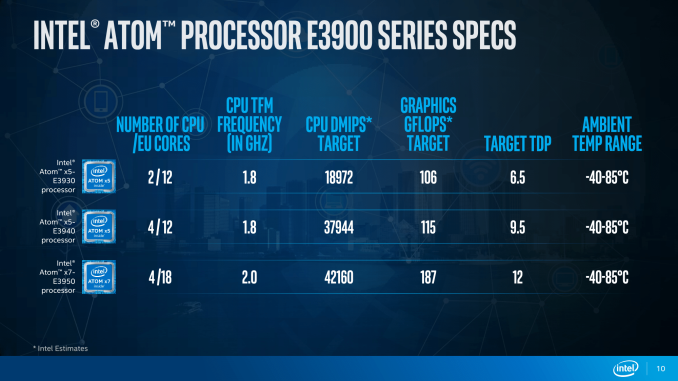
So what does an IoT-centric Atom look like? By and large, it’s Broxton and more. At its core we’re looking at 2 or 4 Goldmont CPU cores, paired with 12 or 18 EU configurations of Intel’s Gen9 iGPU. However this is where the similarities stop. Once we get past the CPU and GPU, Intel has added new features specifically for IoT in some areas, and in other areas they’ve gone and reworked the design entirely to meet specific physical and technical needs of the IoT market.
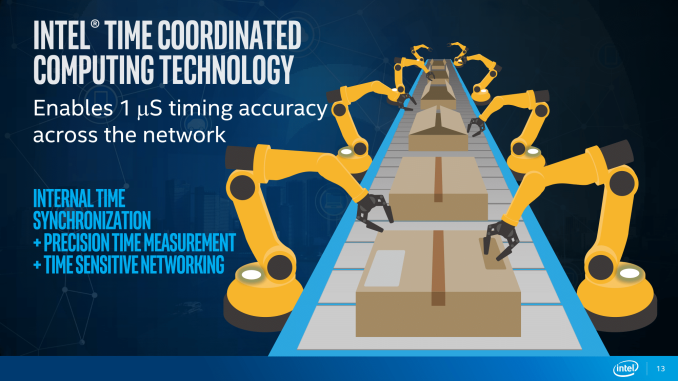
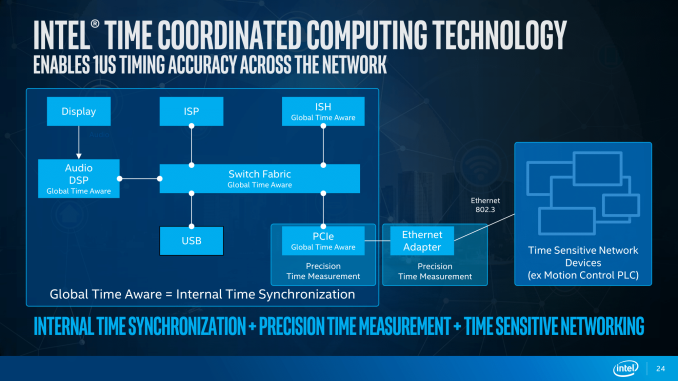
The big changes here are focused on security, determinism, and networking. Security is self-evident: Intel’s customers need to be able to build devices that will go out into the field and be hardened against attackers. Bits and pieces of this are inerieted from Intel’s existing Trusted Execution Technology, while other pieces, such as boot time measuring, are new. The latter is particularly interesting, as Intel is measuring the boot time of a system as a canary for if it’s been compromised. If the boot time suddenly and unexpectedly changes, then there’s a good chance the firmware and/or OS has been replaced. Meanwhile also new to the E3900 series is what Intel is calling their Time Coordinated Computing Technology. This high precision timing mechanism is to allow multiple Atom E3900s to be tightly synchronized, down to 1 microsecond. We’re told that this feature is of particular interest to Intel’s manufacturing partners, as a means to improve accuracy and synchronization between devices on a manufacturing line.
Finally, a bit more nebulous, the E3900 die also includes some changes specifically to improve determinism. What Intel is pitching here isn’t hard determinism, but a higher level of determinism for devices that need better guarantees about how soon an action will be completed. Apparently a big part of implementing this is at the cache level, with Intel noting that polling loops in particular were greatly impacted by this change. All told, Intel will be offering 3 SKUs of the E3900, ranging from 6.5W to 12W. As relatively high power processors these aren’t meant for wearables and such, but rather primarily devices on mains power where additional intelligence is needed. In Intel terminology, the E3900 is focused on “edge” devices as opposed to “core” devices. The idea being that Intel wants to move out data processing to the edge of an IoT network – into sensors and such devices – as opposed to having to use a dumb sensor that sends data back for processing.
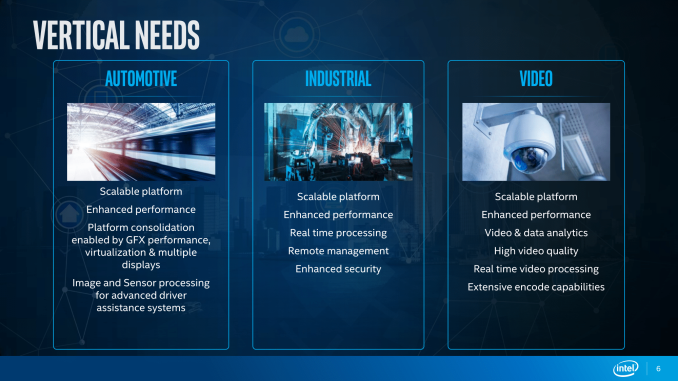
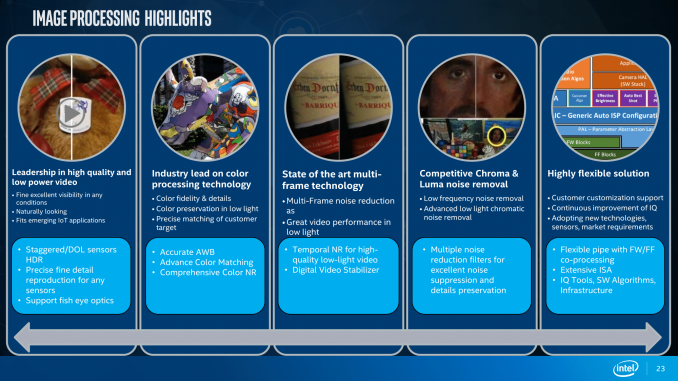
Intel’s 3 big markets here are the video/sensor, industrial, and automotive market. The first and last in particular are areas that the previous E3800 couldn’t readily compete in, due to a lack of processing power for image processing and video encoding. Thanks in big part to the Gen9 GPU and some E3900-specific Image Processing Unit (IPU) changes – the chip can support 15 1080p30 video inputs – Intel can now go after these markets. And that may be the biggest part of this story here for Intel: they haven’t had a part like the E3900 before. The Bay Trail based E3800 had a decent enough CPU, but it’s the E3900 where GPU computing and computer vision become viable, and this is the cornerstone of a lot of new functionality.
Of course, hardware is only part of the picture. Along with the E3900 itself, Intel will also be shipping a number of software libraries to help developers take better advantage of the hardware, and really, bootstrap the whole process. A good deal of this is on the image processing side, providing functions that tap into the hardware’s new image processing capabilities. Finally, in the first-half of next year, the E3900 series will be joined by the A3900 series. This is an automotive-specific SKU that is rated for higher operational temperatures; 110C versus 85C for the E3900. As we mentioned before automotive is a big part of Intel’s efforts here, and that means matching automotive tolerances. Given the performance of these chips, we don’t get the impression that Intel’s entering the fully autonomous car market right now, but they are hoping to go after some lower hanging fruit with driver assistance and in-car entertainment systems. | ||||||||||||||||||||||||||||||||||||||||||||||||||||||||||||||||||||||||||||||||||||||||
| 6:43p | Xiaomi Announces the Mi Note 2 (Snapdragon 821, 6GB RAM) and Mi MIX Concept Phones
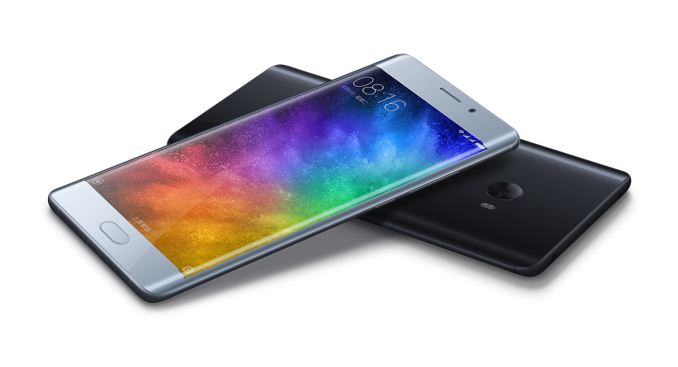
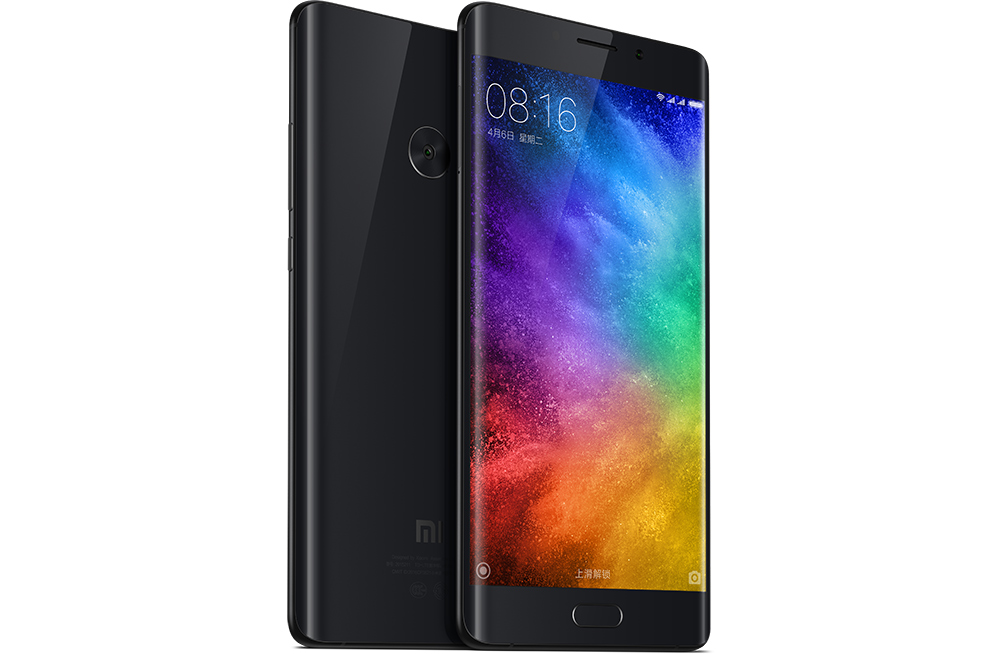
Xiaomi has added two new phones to its lineup: the Mi Note 2 and the Mi MIX. Both are flagship phones with large screens that emphasize performance and design; however, despite some overlap in criteria and internal hardware, these are two very distinct devices. Like its predecessor, the Mi Note, the Mi Note 2 has an aluminum frame and a glass back with curved edges, but instead of the previous design’s flat front, the Mi Note 2 uses a flexible OLED display to allow curved edges to the front too, design features Samsung’s recent Galaxy phones also employ. Another obvious change from the previous model is the addition of a capacitive fingerprint sensor. The pill-shaped sensor, which sits below the screen and is flanked by capacitive navigation buttons, keeps the lower bezel relatively slim, giving the Mi Note 2 a screen-to-body ratio of 77.2%. The rear-facing camera sits flush with the shiny and smooth glass on the back and includes a slightly raised and polished ring to protect the lens.
The design is generally symmetric and balanced: The centered earpiece has the sensors and front-facing camera to either side, and the centered USB Type-C port on the bottom has matching arrays of holes for the downward-firing speaker and microphone. The offset 3.5mm headphone jack on the top edge and the dual-color LED flash on the back are the only features to break symmetry. The Mi Note 2’s 5.7-inch OLED display delivers excellent black levels and covers 110% of the NTSC color gamut, according to Xiaomi, which basically means it should deliver highly saturated colors. For people who prefer more accurate colors, the phone provides an sRGB mode and a control for adjusting the display’s color temperature. Unfortunately, its 1920x1080 resolution is less than ideal for such a large display. Inside the Mi Note 2 is Qualcomm’s latest Snapdragon 821 SoC, which includes four of its custom Kryo CPU cores and an Adreno 530 GPU, and a sufficiently large 4070mAh non-accessible battery that supports Qualcomm’s Quick Charge 3.0 fast charging technology. It also comes with either 4GB of RAM and 64GB of internal UFS 2.0 storage or 6GB of RAM and 128GB of storage, but there’s no support for microSD cards.
The 8MP front-facing camera includes autofocus and Xiaomi’s third-generation beauty mode processing. Around back is a 22.5MP Sony IMX318 Exmor RS sensor, which is among a new generation of sensors that use smaller 1.0µm pixels. Despite the reduction in full-well capacity, Sony claims its new sensor matches the image quality of its previous IMX230 Exmor RS sensor that uses larger 1.12µm pixels. Stacked above the sensor is a lens array with six elements and an f/2.0 aperture. The Mi Note 2’s rear camera supports phase detect autofocus (PDAF) to improve focus speed. There’s no optical image stabilization (OIS), which could negatively impact low-light still image performance, but the camera does employ 3-axis electronic image stabilization (EIS) when shooting videos, even in 4K. The Mi Note 2 comes in two different colors—Piano Black and Glacier Silver—and three different versions—two which will only be available in China and a global version that supports 6 modes and 37 frequency bands. The Mi Note 2 will be available in China starting November 1st for ¥2799 (4GB RAM / 64GB NAND) or ¥3299 (6GB RAM / 128GB NAND). The global version will cost ¥3499 (6GB RAM / 128GB NAND).
The larger Mi MIX was jointly developed with prolific designer Philippe Starck and features an all-ceramic body with ceramic buttons. The front is dominated by a 6.4-inch display with virtually no bezels along the top or sides, giving the phone a 91.3% screen-to-body ratio. The 5MP front-facing camera is located in the lower-right corner of the slim lower bezel, while the ultrasonic (instead of infrared) proximity sensor is located behind the screen. There are no physical or capacitive buttons in the lower bezel either, because it uses onscreen navigation controls.
Eliminating the upper bezel meant eliminating the traditional earpiece speaker too. In its place, the Mi MIX uses a piezoelectric-driven cantilevered beam that produces sound by vibrating the phone’s ceramic frame instead of a speaker driver. What’s not clear, though, is if people nearby will also be able to hear the conversation, or if the sound is directed only towards the user. A circular camera sits flush with the ceramic back, stacked above a circular fingerprint sensor. A USB Type-C port sits centered on the bottom edge flanked by a symmetric array of small holes hiding a downward firing speaker and microphone. A 3.5mm headphone jack is on the top edge.
Its 6.4-inch IPS LCD display has an odd 17:9 aspect ratio that’s supposed to make room for the onscreen navigation controls while still providing a traditional 16:9 viewable area. Its 2040x1080 resolution seems low for such a large display, but it still provides a decent 362 PPI pixel density. Xiaomi claims a peak brightness of 500 nits and 94% coverage of the NTSC color gamut, making this a wide-gamut panel with more saturated colors. Like the Mi Note 2, the Mi MIX also provides a control for adjusting the display’s color temperature and a native sRGB mode. Its internal hardware is also similar to the Mi Note 2’s, packing in an impressive list of hardware. The key differences are a larger 4400mAh battery and twice the internal UFS 2.0 NAND.
The Mi MIX will be available exclusively in China beginning November 4th and will come in two different versions. The standard version will cost ¥3499 with 4GB of RAM and 128GB of internal storage, while a special limited edition version, which comes with 6GB of RAM, 256GB of internal storage, and 18K gold-plated accents around the rear camera and fingerprint sensor will cost ¥3999. | ||||||||||||||||||||||||||||||||||||||||||||||||||||||||||||||||||||||||||||||||||||||||


| << Previous Day |
2016/10/25 [Calendar] |
Next Day >> |