[Most Recent Entries] [Calendar View]
Tuesday, November 1st, 2016
| Time | Event | ||||||||||||||||||||||||||||||||||||||||||||||||||||||||||||||||||||
| 9:30a | LaCie Launches 6big and 12big: Up to 60/120 TB External Storage with Thunderbolt 3
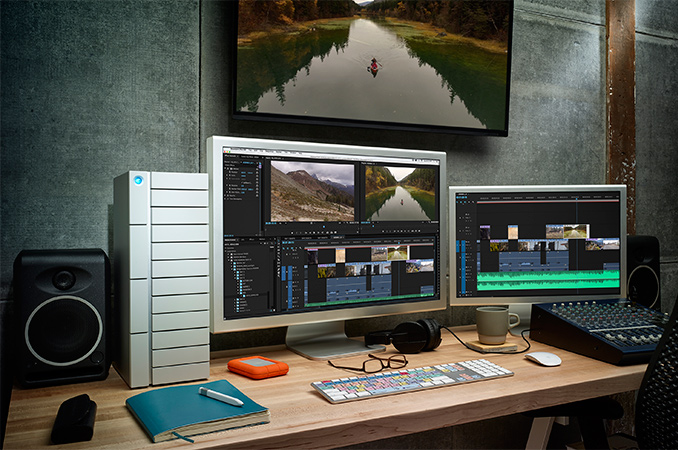
LaCie this week has introduced two new workstation-grade external storage solutions using Thunderbolt 3 with the focus on big on-the-desk data storage. The 6big and 12big devices pack in six or twelve enterprise-grade hard drives respectively and can provide up to 60 TB or up to 120 TB of storage space. The HDDs can be implemented as a JBOD or work in various RAID modes. LaCie’s devices promise to be able to take advantage of Thunderbolt 3’s 40 Gb/s bandwidth by providing up to 1400 MB/s or 2600 MB/s read speeds, which can be important for those who work with UHD video content.
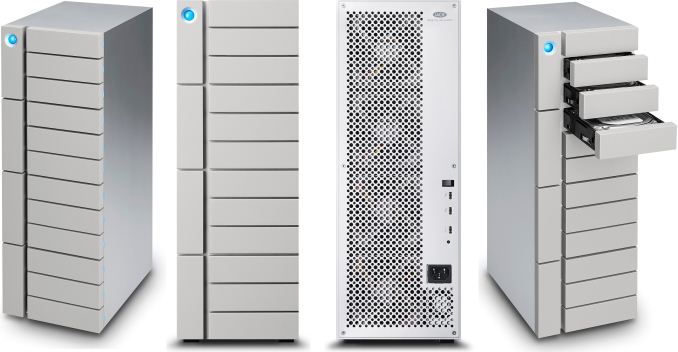
The LaCie 6big and 12big DAS with six and 12 drive bays are made of aluminum and come with integrated PSUs and cooling. The storage devices are based on a proprietary platform from LaCie, which supports hardware RAID 0/1/5/6/10/50 modes. Seagate, the owner of the LaCie brand, does not disclose details about the platform behind the new DAS products, but it naturally has a hardware RAID controller (presumably from Seagate’s LSI division) as well as Intel’s Alpine Ridge controller for Thunderbolt 3.
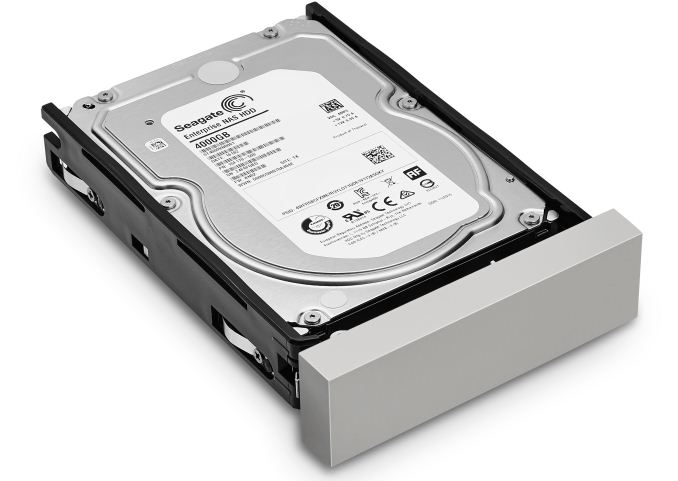
The LaCie 6big and the LaCie 12big external storage devices will be sold in various configurations that use different hard drives, all of which support hot swapping and feature 7200 RPM spindle speed. The top-of-the-range 60 TB and 120 TB models use Seagate’s helium-filled Enterprise Capacity 10 TB HDDs rated for 2 million MTBF and 550 TB/year writes. Meanwhile the lower-capacity DAS devices will use Seagate’s Enterprise NAS HDDs rated for 1.2 million hours MTBF and 300 TB/year writes. The LaCie 6big and 12big will initially be available fully populated, and from a performance point of view maximum read and write speeds will mostly depend on RAID modes.
Both DAS solutions from LaCie feature two Thunderbolt 3 ports, making it possible to daisy-chain a display or another TB3 device to the storage arrays. In addition, the 6big and the 12big are equipped with one USB 3.1 Type-C connector which allows to use them with systems not equipped with TB3, but at considerably lower speeds (i.e., up to 350 – 400 MB/s depending on RAID mode). Like other LaCie’s DAS products with multiple drives, the 6big and the 12big come with the company’s proprietary RAID management software that allows setting them up and then monitoring the condition of the drives. For pricing the LaCie 6big 24 TB starts at $3199 whereas the LaCie 12big 48 TB starts at $6399. | ||||||||||||||||||||||||||||||||||||||||||||||||||||||||||||||||||||
| 10:00a | The Glorious PC Gaming Race GMMK-BRN Modular Mechanical Keyboard Review In today's review we are taking a look at the GMMK-BRN mechanical keyboard from Glorious PC Gaming Race the first such keyboard from the recently founded US-based company. The minimalistic keyboard features a modular switch design, allowing it to work with the majority of plate-mounted keyboard switches available, regardless of their manufacturer. | ||||||||||||||||||||||||||||||||||||||||||||||||||||||||||||||||||||
| 12:01p | Seagate Introduces Game Drive SSD for Xbox (360 and One): 512 GB SSD for $199
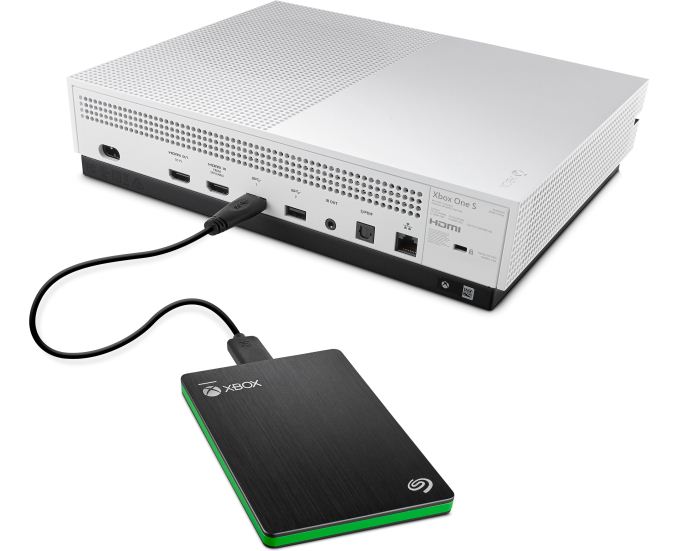
Seagate has announced its new Game Drive for Xbox SSD. While the name suggests it is primarily for the original Xbox, this drive is focused for the Xbox One (regular and S) and Xbox 350, allowing users to store more titles using NAND flash memory. Due to the higher performance of SSDs compared to HDDs used in an Xbox One, the Game Drive for Xbox SSD is being promoted as enabling faster boot and game loading times. The Seagate Game Drive for Xbox SSD has a storage capacity of 512 GB and uses the USB 3.0 interface to connect to the console. According to Seagate, the SSD can store approximately 15 games (assuming that their size is in the range between 35 GB and 50 GB) and various downloadable content. The drive comes in an aluminum enclosure that is durable and somewhat matches the design of the Xbox One (at least, the original black version). Since the SSD connects to the system using a USB 3.0 Gen 1 cable, its read and write speeds are expected to be limited to near ~400 MB/s (due to overhead incurred by 8b/10b encoding) without additional proprietary drivers (like ASUS' Turbo modes). Nonetheless, 400 MB/s is considerably higher than read/write performance provided by 5400-RPM HDDs used inside the Xbox family (typically, such drives feature read speeds of around 150 MB/s with poor random performance). Seagate does not disclose whether the Game Drive for Xbox SSD uses TLC or MLC NAND flash, or which controller is in play so, we cannot make any assumptions regarding endurance of the product. Nonetheless warranty times are listed for America (1-year), Europe (2-years) and Asia-Pacific (3-years).
As for pricing, Seagate intends to charge $199.99 for its Game Drive for Xbox SSD, which is $20 to $30 higher compared to other external SSDs compatible with Microsoft’s latest console. Amazon, GameStop and other consumer electronics retailers plan to start selling the device in November. In addition to the Game Drive for Xbox SSD, Seagate also offers 2 and 4 TB mechanical hard drives for Microsoft’s Xbox One as well as 1 TB SSHD drive for Sony’s PlayStation 4. | ||||||||||||||||||||||||||||||||||||||||||||||||||||||||||||||||||||
| 2:00p | Enermax SteelWing Small Form Factor PC Chassis: Aluminum and Glass, $160
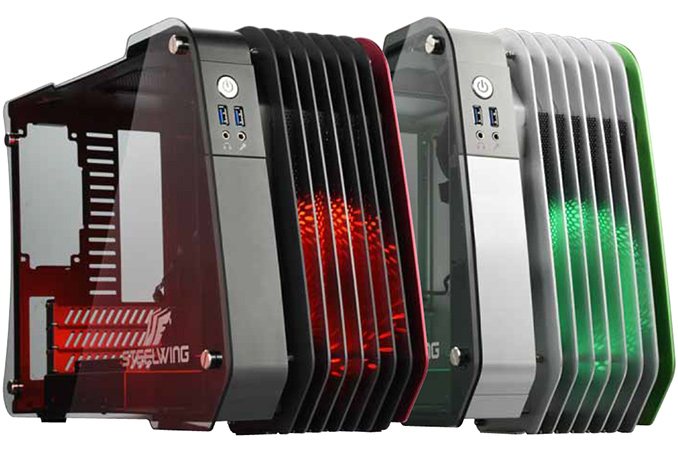
Enermax has started shipments of its new SteelWing chassis this week, designed specifically for small form-factor desktop PCs. The new PC case is made of aluminum and tempered glass, it has an extravagant yet capacious design with advanced ventilation and can fit in a custom liquid cooling system, a high-end graphics card and a powerful processor. The SteelWing is essentially designed to be an aesthetic centerpiece. The Enermax SteelWing (ECB2010) chassis can accommodate an mATX or a Mini-ITX motherboard, a typical full-height high-end graphics card (up to 290 mm in length), one SFX PSU, as well as two or more 2.5"/3.5" storage devices (one 2.5"/3.5" SSD or HDD can be installed next to the case fan, but only if the space is not used by an LCS radiator). The PC case uses a semi-open design featuring seven aluminum plates as well as one 120-mm fan to ensure proper airflow in the constrained space of the SteelWing. For front panel IO, the case also has two USB 3.0 Type-A ports as well as two 3.5 mm audio jacks on the front panel.
Since the PSU is located right next to the CPU, maximum height of the CPU cooler is 80 mm. This limits the choice of the cooling system to either something low-profile (Intel's stock coolers, or something like Noctua’s LH9A), or a sealed liquid-cooling system with a 120-mm radiator (such as the Enermax Liqmax II 120S). Enermax does not impose any limitations for TDP because there is enough space inside the case to house a custom liquid cooling system. As a result, the maximum SFX PSU wattage could be the only limiting factor when it comes to CPU or GPU TDP.
On the aesthetics end, the Enermax SteelWing has either a green or a red aluminum side panel accompanied by a green or a red 120mm fan. Such styling is clearly made to appeal to performance enthusiasts with a color coded GPU arrangement as well.
Enermax says that the SteelWing chassis are set to be available in the U.S. in the coming days for $159.99 (a tip: first at Newegg). | ||||||||||||||||||||||||||||||||||||||||||||||||||||||||||||||||||||
| 3:00p | Microsoft Lifts the Lid on Some Intel Skylake-EP Details via the Open Compute Project
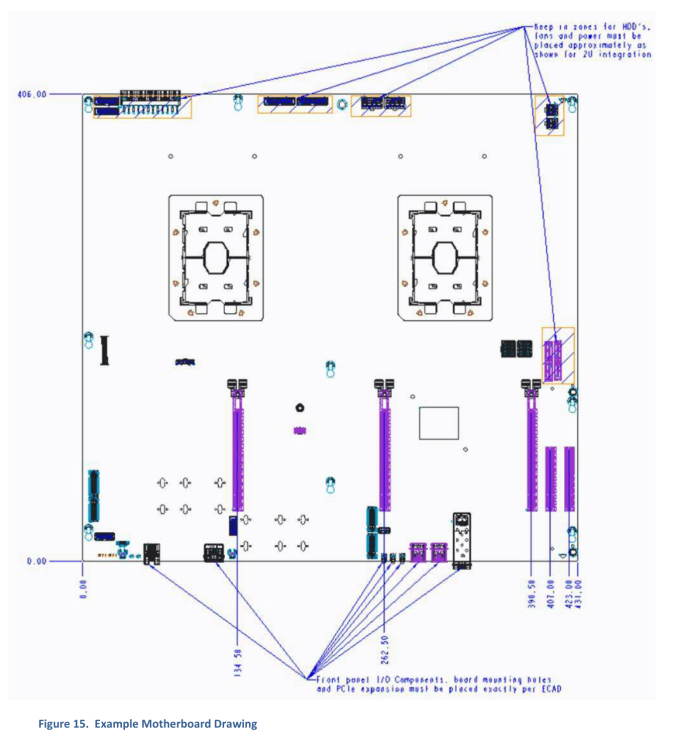
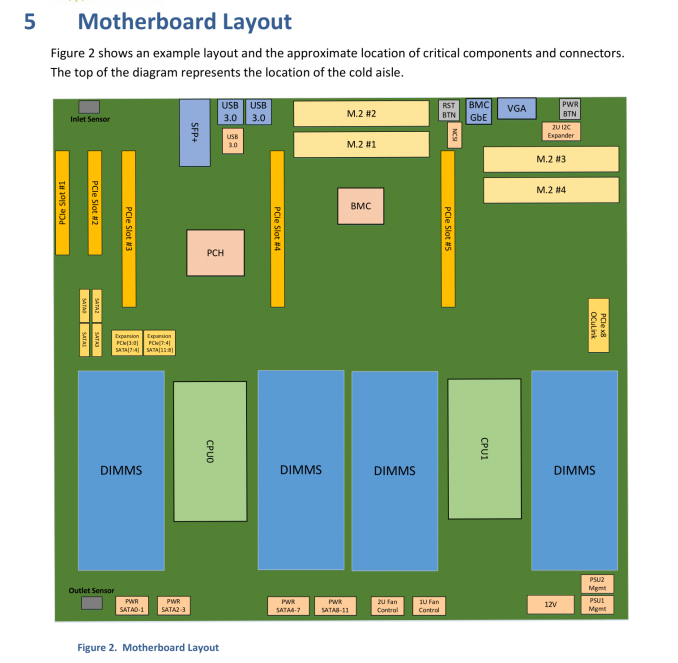
As part of the European Digital Infrastructure Summit in London this week, Microsoft's Azure team will be lifting the lid on Project Olympus, the next generation hyperscale cloud hardware design and model for open source hardware development, in collaboration with the Open Compute Project (OCP). Project Olympus is being described as a way to embrace future platforms in a standardized design, much like other OCP projects, and the open source standards behind the platform are offering insights into Intel’s Skylake-EP Platform, known as Purley. It seems odd for information about Skylake-EP to be sanctioned at this time (technically none of the documents mention Intel, Skylake or Purley, but it can be deciphered as below), especially given the recent release of Broadwell-E/EP and Intel’s previous stance of limited data release prior to launch. It would appear that the information Microsoft are providing at the summit has been sanctioned, however sometimes putting two plus two together requires a little digging. All this information is posted on the Microsoft Azure blog, which links directly to the OCP pages where motherboard specifications and server mechanical specifications are provided in PDF format. It’s a Socket We’ve Seen Before, Which Can Make WavesBeing the motherboard guy at AnandTech, I skipped straight to the motherboard information. Page 31 of the motherboard document gives the following example motherboard drawing:
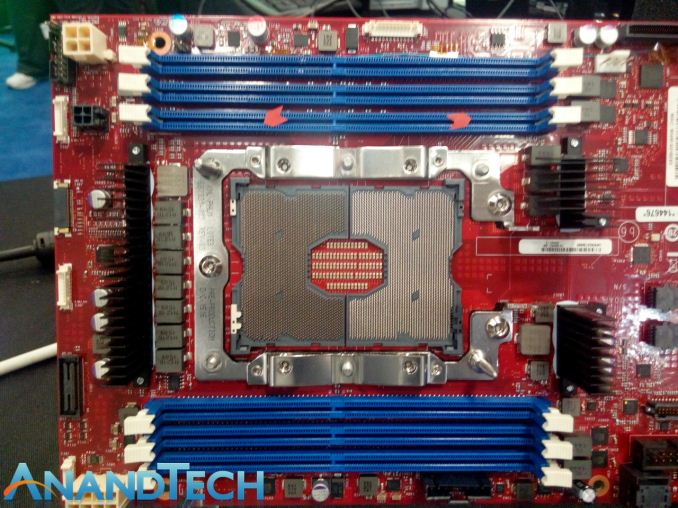
Here is a dual-socket design, with a set of PCIe slots, some power connectors and other I/O components (some fiber Ethernet, for example). But jam packed in the middle are two very large sockets. We’ve seen these before, back at Supercomputing 2015 when Intel announced Knights Landing, which is a Xeon Phi product:
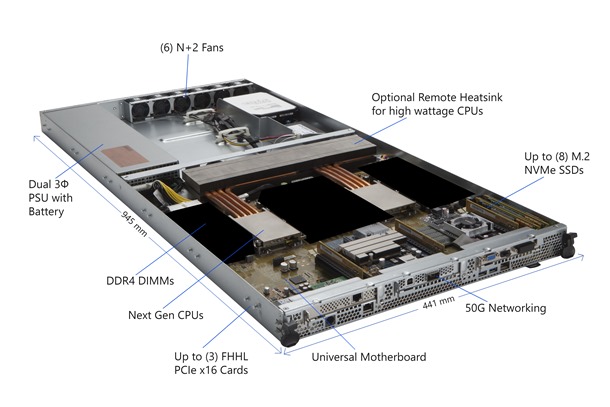
Xeon Phi's Knights Landing design uses an LGA3647 implementation based on its 72 cores, 16GB of MCDRAM, and six memory channels. There are a lot of pins because there’s a lot to power up. In previous generations of EP processors, both EP and E have shared the same socket. If I wanted to use my E5-2699 v4 Broadwell-EP LGA2011-3 processor in an X99 consumer motherboard instead of an i7-6950X, I could. Essentially all the Core and all the Xeon E5 CPUs have shared a common socket, making it easy for 1P/2P/4P processors to share around. If Purley / Skylake-EP uses the LGA3647 socket, this means one of four things. The first is that this might not be Skylake-EP, and something odd like Skylake-EN. The second is that Skylake-E will also share the same socket, and be LGA3647. This sounds somewhat implausible, given that Skylake-EP will have to handle at least the same amount of cores as Broadwell-EP, so there would be a lot of pins on a consumer platform for no reason. The third possibility is that Skylake-E and Skylake-EP are going to be different sockets. This would indicate a split between consumer HEDT and dual-socket workstations and servers. Given previous generational changes, Skylake-E for consumers is expected to follow a similar pattern – around 2000 pins in a single socket design. However if Skylake-EP is making the jump to a significantly larger socket, especially for 2P workstation and server designs, it will produce a spread of difference in potential for pricing structures and implementation. The fourth possibility extends from the third, and that Skylake-EP will have two socket designs depending on the size of the core. For Broadwell-EP, there were three designs for the silicon underneath – a low core count (LCC), a medium core count (MCC) and an extreme core count (XCC). If Intel are splitting up the sockets, it may be the case that only the XCC or MCC+XCC sides of the equation are using LGA3647. LCC designs are typically used for the consumer E series parts anyway, so Intel may decide to make the low core designs of EP on the smaller socket. There’s a wealth of possibility here. I Heard You Like RAM. I Heard You Like Storage.On the main Microsoft Azure page, a handy diagram of an example machine was provided (with some areas blacked out):
Here we see that motherboard from the image above, using two low profile heatsinks with copper piping feeding an optional heatsink inside the chassis. To the sides of each of the sockets are big black squares, indicating where the DDR4 memory should go. Nearer the bottom of the board are networking implementations (50G is labeled), and PCIe slots suitable for three full-height, half-length (FHHL) PCIe cards. Interestingly on the right-hand side, we have labeled ‘up to 8 M.2 NVMe SSDs’. Back to the motherboard specification, we see the list of blacked out areas along with a more comprehensive sequence of potential configurations:
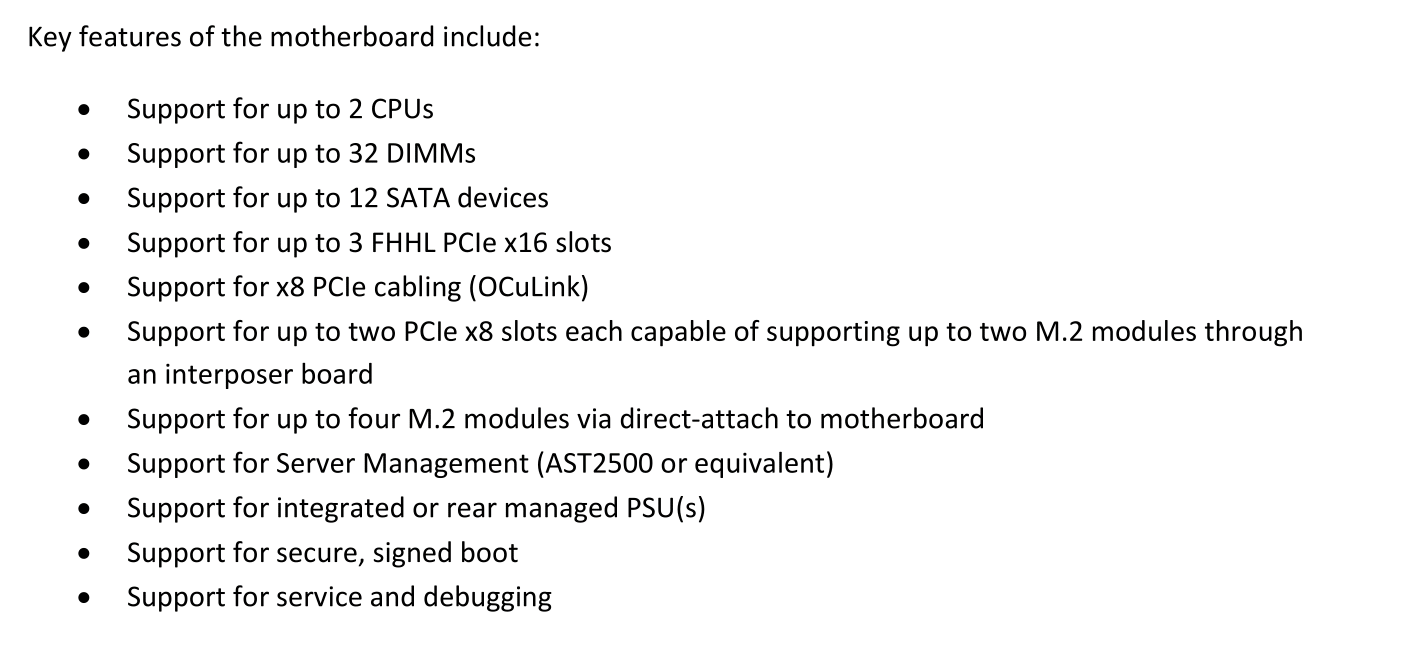
There are spots for up to 32 DIMMs, which makes 16 per socket. Depending on how many memory controllers the CPU has, this could mean 8-channel and 2 DIMMs per channel (DPC), or 4-channel and 4 DPC. Nowhere does it state the maximum DRAM support per CPU, but DDR4 LRDIMMs are currently at 256GB/module, meaning a potential maximum of 4TB per CPU or 8TB per system. We expect Skylake-EP to support 3D XPoint at some stage as well. On that list of support also mentions up to 12 SATA devices, up to 3 FHHL cards, and two PCIe x8 slots capable of supporting two M.2 modules each. So this is where that 8x M.2 comes in – if we get four from two PCIe x8 slots, and combine this with up to four M.2 direct attach modules, that makes eight.
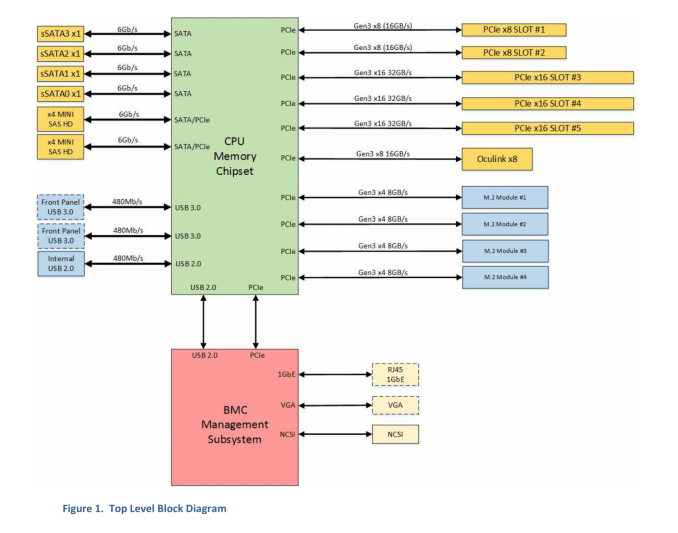
The top-level block diagram is also worth a look. Patrick from STH specifically points out the PCIe 3.0 support for the platform:
On the right-hand side, adding up all the PCIe numbers and it comes to 88 PCIe 3.0 lanes, or 44 per CPU. This would be an upgrade on the 40 lanes per CPU currently on Broadwell-EP. There is also provision for PCIe lanes to be used with the mini-SAS connectors on the left-hand side. Technically the BMC also requires a PCIe link as well. So When?Given the long product cycles of Intel’s EP platforms, and the fact that the Big Seven cloud providers have a lot of clout over sales means they are most likely testing and integrating the next generation hardware. The release to the public, and smaller players in the OCP space, is a long and slow one. We’re not expecting Skylake-E/EP out until well into 2017, if not the year after, so information will certainly be on the slow burn. Supercomputing 2016 is happening in Utah in a couple of weeks, and although we won’t be there due to scheduling, something may pop out of the woodwork. We’ll keep our eyes peeled. Source: Microsoft, ServeTheHome Related ReadingSuperComputing 15: Intel’s Knights Landing / Xeon Phi Silicon on Display
| ||||||||||||||||||||||||||||||||||||||||||||||||||||||||||||||||||||








| << Previous Day |
2016/11/01 [Calendar] |
Next Day >> |