[Most Recent Entries] [Calendar View]
Wednesday, November 2nd, 2016
- HP and MSI Demonstrate Backpack PCs for VR Gaming
- ZOTAC ZBOX MAGNUS EN980 SFF PC Review - An Innovative VR-Ready Gaming Powerhouse
- ZOTAC ZBOX CI523 nano Fanless Skylake-U mini-PC Review
- Enermax SteelWing Small Form Factor PC Chassis: Aluminum and Glass, $160
- Cryorig Unveils Mac Pro-Like PC Case for Gaming PCs, Ultra-Slim Desktop Chassis
- Lian Li Launches the PC-A51 ATX Mid-Tower Reverse Air-Flow Chassis
| Time | Event | |||||||||||||||||||||||||||||||||||||||||||||||||||
| 10:00a | LaCie Announces Bolt3: 2 TB External SSD at 2.8 GBps over Thunderbolt 3
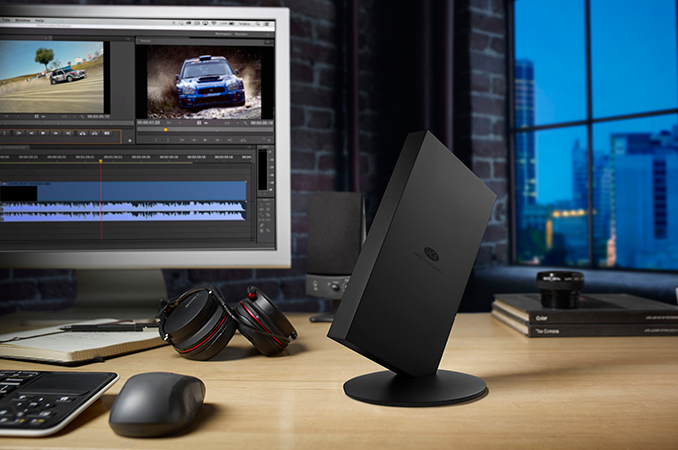
LaCie this week has introduced its first external solid-state storage solution using Thunderbolt. The Bolt3 uses two M.2 SSDs in RAID 0 mode to enable 2 TB of storage as well as up to 2800 MB/s data rate, which is the highest level of performance offered by an available commercial DAS device. The Bolt3 is being advertised for video professionals who edit 4K (and up) video. The LaCie Bolt3 (STFF2000400) packs in two 1 TB SSDs in M.2 form-factor that work in RAID 0 mode to enable up to 2800 MB/s read and up to 2200 MB/s write speeds. Seagate, the owner of the LaCie brand, does not disclose which SSDs and/or RAID controller the device has under the hood, but Seagate states that the Bolt3 was designed with long-term reliability in mind. This might imply that the device uses drives with high endurance (although, we cannot say whether the maker uses datacenter-grade SSDs). The external storage solution can realize its whole potential when connected to a TB3-enabled computer using the active Thunderbolt 3 cable that is bundled with the device. The Bolt3 also has another TB3 receptacle so to daisy chain more Thunderbolt 3 devices (storage or display) or even charge them (the Bolt3 has its own external PSU).
From an aesthetic point of view, the LaCie Bolt3 is designed to be seen on a desk. It is made of black aluminum, it features a blue LED on the backside and the enclosure is tilted by 45° to its stand. The mounting mechanism uses neodymium magnets that firmly attach the Bolt3 to its stand, but allow to quickly detach it and transport anywhere. Users can have the drive flat as well. To ensure long-term reliability of SSDs inside, the Bolt3 also has active cooling. The LaCie Bolt3 belongs to the company’s limited edition series which are designed to promote performance as well as eye-catching design. This means it doesn't come cheap. The LaCie Bolt3 2 TB will be available this quarter for $1999, which is well beyond the price of consumer SSD storage and more than one would have to pay for a DIY 2 TB Thunderbolt 3 external storage solution. As the LaCie Bolt3 is the fastest off-the-shelf external storage solution available today, the manufacturer wants to charge a premium. | |||||||||||||||||||||||||||||||||||||||||||||||||||
| 12:01p | ZOTAC Announces VR GO Backpack PC with GeForce GTX 1070
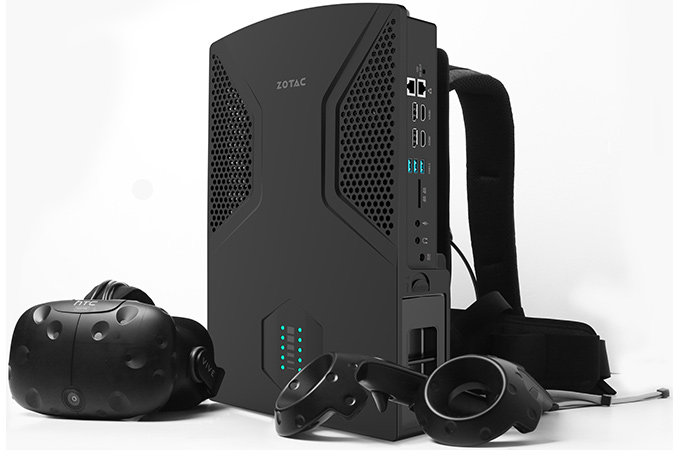
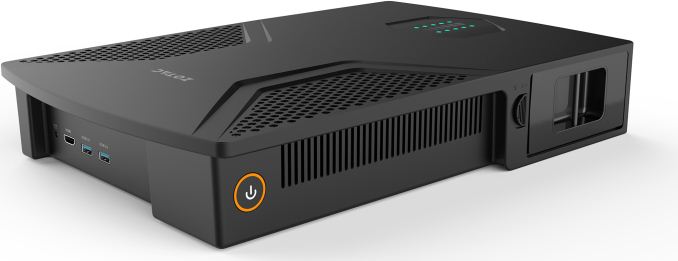
ZOTAC this week has formally introduced its VR GO backpack PC designed for virtual reality enthusiasts. The system is equipped with NVIDIA’s GeForce GTX 1070 graphics, a quad-core CPU from Intel, rich I/O capabilities and a hot-swappable battery. Despite its positioning, the VR GO can be used like a normal desktop computer, which differentiates it from early prototypes of wearable VR PCs from other makers. ZOTAC is mostly known for its graphics cards and high-performance small form-factor PCs, but not wearable systems (which are not that uncommon: industrial- and even space-grade wearable PCs have existed for years). To develop its VR GO computer, the company had to use experience it obtained from building SFF systems for gamers as well as to find ways to minimize weight and to ensure that the design can handle harsh treatment during gaming sessions. Basically, ZOTAC had to fix everything tightly inside the box while ensuring appropriate cooling and proper position of the I/O ports. To make it convenient to connect a VR headset to the VR GO, one side of the device has the appropriate ports. The single side has one HDMI output, two USB 3.0 ports and one power connector on top of it. Such positioning greatly simplifies cable management and makes VR gaming with a PC on your back a little more comfortable. The system also comes with a removable battery pack that enables autonomous operation for (waiting on offical numbers) hours.
While virtual reality is considered as an important milestone for gaming, it hardly makes sense to develop a PC only for VR, which is why ZOTAC’s VR GO is a powerful PC in general and can be used like a desktop computer too. It has three additional USB 3.0/3.1 Type-A connectors, an SD card reader, four additional display outputs (two HDMI, two DP), two GbE ports as well as two 3.5 mm audio jacks. Inside the ZOTAC VR GO there is a custom motherboard in a proprietary form-factor carrying an Intel Core i7 CPU, two DDR4 SO-DIMMs, an M.2 SSD (PCIe 3.0 x4), an 802.11ac Wi-Fi module and NVIDIA’s GeForce GTX 1070 MXM module. To cool down the CPU and the GPU (a total TDP of 150 W), ZOTAC uses a proprietary low-profile air cooling system but has not disclosed details. At this point, we do not know whether the manufacturer reinforced the design of its cooler's backplate somehow, but this is a logical thing to expect. To expand the storage capacity of the system, ZOTAC also added one bay for a SATA-based 2.5" storage device (either HDD, which might be affected by rapid movement, or a high capacity TLC SSD). ZOTAC’s VR GO system is not the first backpack-type PC developed by the company. At Computex 2016 the hardware manufacturer already demonstrated a wearable system, but that was largely a prototype and still in the early design stage. By contrast, the VR GO looks like a commercial product. ZOTAC does not specify exact availability timeframe for its VR GO backpack PC other than Q4 2016 as well as its estimated price. We expect to see it at CES in early January for sure.
Related Reading
| |||||||||||||||||||||||||||||||||||||||||||||||||||
| 2:00p | Lian Li PC-Q37 Announced: Two-Stage Mini-ITX Chassis with Tempered Glass
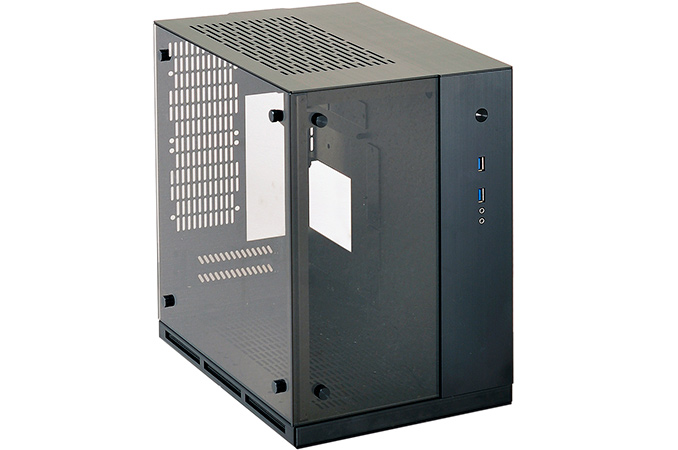
On Tuesday Lian Li introduced its PC-Q37 mini-ITX chassis designed for performance and modding enthusiasts based around small-form factor systems. The miniature PC case can accommodate high-end hardware and has two windows to show off custom liquid cooling and lighting effects. The Lian Li PC-Q37 chassis uses a two-compartment design that allows maximizing cooling and storage capabilities of the system. One of the chambers houses the power supply along with HDDs and/or SSDs, whereas another chamber accommodates the motherboard, graphics card, memory and cooling. In total, the PC-Q37 can fit in three storage devices into a special rack featuring rubber vibration-dampening pads. The case is compatible only with mini-ITX motehrboards but can easily house a high-performance video card that up to 320 mm long (which is slightly longer than contemporary dual-GPU graphics boards) as well as a fairly powerful SFX PSU that is up to 220 mm long and capable of handling high-end hardware.
As for cooling, the Lian Li PC-Q37 supports two 120-mm optional air intake fans on the bottom (or one 140-mm fan), two optional 120-mm exhaust fans on the top as well as two optional 80-mm exhaust fans on the back panel (or you can attach a fourth 2.5” storage device). To protect against dust, the case uses special filters that can be easily removed and cleaned up. The CPU cooler cannot be higher than 130 mm (including fan), but there is plenty of space on top of the chassis to install a radiator of a closed-loop liquid cooling system.
On the I/O front, everything is fairly typical for an SFF PC case: the PC-Q37 has two USB 3.0 Type-A as well as two 3.5 mm audio jacks on the front panel.
The Lian Li PC-Q37 should be available shortly at Newegg.com for $229, the company has announced. The price of the chassis is relatively high, but since this is one of a few SFF PC cases designed for performance and modding enthusiasts, its MSRP is not surprising.
Related Reading
| |||||||||||||||||||||||||||||||||||||||||||||||||||






| << Previous Day |
2016/11/02 [Calendar] |
Next Day >> |