[Most Recent Entries] [Calendar View]
Friday, November 4th, 2016
| Time | Event | ||||||||||||||||||||||||||||||||||||||||||||||||||||||||||||||||||||||||||||||||
| 8:00a | ZOTAC ZBOX MAGNUS ERX480: SFF PC with Intel Core i5, AMD Radeon RX480, USB-C
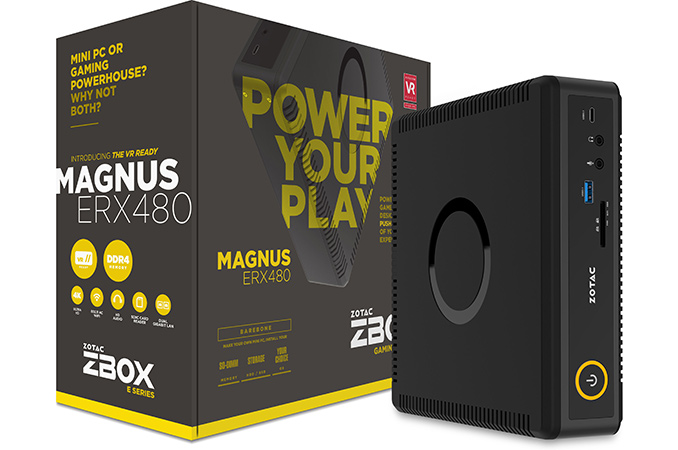
ZOTAC has introduced a new small form-factor system that integrates AMD’s Radeon RX 480 graphics as well as an Intel quad-core Core i5-6400T. The compact PC is designed to drive up to four 4K displays at once and can be used both for gaming as well as for productivity applications that demand multiple monitors. In fact, the manufacturer officially positions the system as an entry-level machine for VR gaming. The ZOTAC ZBOX MAGNUS ERX480 PC is powered by Intel’s Core i5-6400T processor (4C/4T, 2.2 GHz/2.8 GHz, 6 MB LLC cache, 35 W TDP) as well as a custom LGA1151 motherboard with two slots for DDR4-2133 SO-DIMM memory. AMD’s Radeon RX480 MXM module, one M.2-2280 slot for a SATA SSD, a SATA connector, two Gigabit Ethernet controllers, a 802.11ac Wi-Fi/BT 4.2 module and a USB 3.1 controller make up the other key features.
When it comes to connectivity, the ZBOX MAGNUS ERX480 is an example of reasonable set of I/O ports. The system features two HDMI 2.0, two DisplayPort 1.3, two GbE, two 3.5mm audio, two USB 3.0, two USB 2.0, one USB 3.1 Gen 2 Type-A and one USB 3.1 Gen 2 Type-C connectors. In addition, the PC has a 3-in-1 card reader (SD/SDHC/SDXC UHS II). Users with 5.1- or 7.1-channel speaker systems will have to use an external USB audio solution however.
From performance point of view, the ZBOX MAGNUS ERX480 meets the minimum requirements that Oculus VR set for games compatible with the Oculus Rift VR headset back in the first half of 2015: it has a quad-core CPU along with AMD’s Radeon RX 480 GPU, supports up to 32 GB of DDR4 memory and can be equipped with 2 drives (1x M.2 and 1x 2.5"). If game developers follow recommendations of Oculus VR, the MAGNUS ERX480 should run VR titles for Oculus VR with decent framerate.
Speaking of dimensions, it should be noted that like other MAGNUS-series PCs, the ERX480 is not as tiny as Intel’s NUC, but it is not as large as some other models in Zotac's lineup. The relatively small size of the new compact PC from ZOTAC is a result of the company’s decision to use relatively low-power components (the manufacturer claims that the power draw of the ERX480 is 160 W) and air-cooling. We do not know whether the PC gets noisy under high loads, but this is a possibility as the system uses two blowers. ZOTAC traditionally plans to offer three versions of the MAGNUS ERX480: a barebones with just the CPU and GPU installed; a Plus version with a 8 GB DDR4 memory module, a 120 GB SATA M.2 SSD as well as 1 TB HDD; and a Windows edition with DRAM, storage and Windows 10 Home operating system pre-installed. The manufacturer does not disclose its MSRPs at this time, but claims that all the PCs will be available by the end of November. Related Reading: | ||||||||||||||||||||||||||||||||||||||||||||||||||||||||||||||||||||||||||||||||
| 11:45a | ADATA Ultimate SU800 SSDs in M.2 Announced: Entry-Level 3D NAND SSDs for Laptops
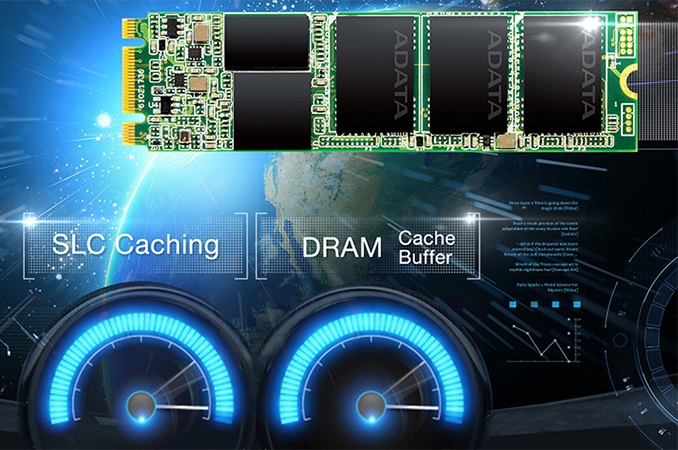
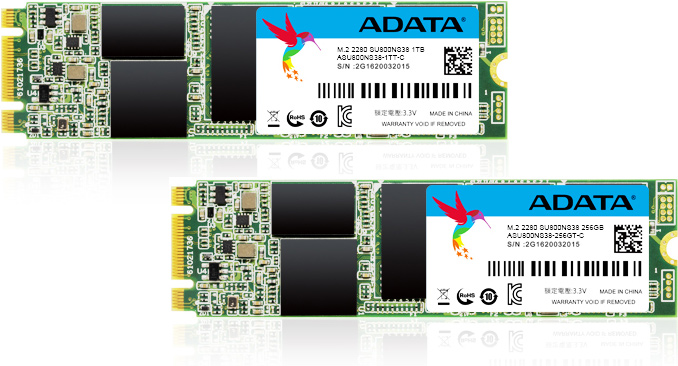
This week ADATA expanded the lineup of its SSDs featuring 3D NAND memory by announcing its Ultimate SU800 drives in an M.2 form-factor. The new SSDs offer similar performance and features as the 2.5” Ultimate SU800 drives introduced earlier this year, hence, the key selling points of the newcomers is their relatively affordable price as well as compatibility with ultra-thin notebooks. The ADATA Ultimate SU800 family of M.2 SSDs include models with 128 GB, 256 GB, 512 GB and 1 TB capacity (the largest one will hit the market a bit later than the others — it is not even listed on the manufacturer's web-site yet). Just like their 2.5-inch brethren, the new drives are based on Silicon Motion’s SM2258 controller (which has four NAND flash channels and LDPC ECC technology) as well as 3D TLC NAND flash memory produced by IMFT. The Ultimate SU800 M.2 SSDs use a SATA 6 Gbps interface and support a DRAM buffer as well as pseudo-SLC caching to maximize the writing speed of the drives.
Speaking of performance, ADATA claims that the higher-capacity Ultimate SU800 SSDs feature up to 560 MB/s read and up to 520 MB/s write speed, whereas the 128 GB model is a bit slower when it comes to writing (up to 300 MB/s). ADATA does not mention random performance of the SSDs as well as their power consumption, but the SM2258 controller in other devices is capable of up to 90,000 read IOPS and up to 80,000 write IOPS, which is good enough for client storage devices.
Since 3D NAND is made using larger process technologies than planar NAND flash memory, it naturally has better endurance and higher performance, which is why ADATA declares 2 million hours MTBF for its Ultimate SU800 M.2 SSDs, which is 0.5 million hours higher compared to 2D NAND-based drives. Nonetheless, the warranty period for the new storage devices is standard - three years. Meanwhile, prices of the Ultimate SU800 M.2 SSDs are $5 to $10 higher compared to the same products in a 2.5-inform-factor. ADATA plans to charge $69.99, $84.99 and $149.99 for 128 GB, 256 GB and 512 GB versions of its Ultimate SU800 SSDs. Since the new drives offer higher endurance and better performance than their predecessors, ADATA positions them above the existing TLC-based M.2 SSDs and reflects this in MSRPs. Eventually, the new drives will inevitably get more affordable, but today the manufacturer charges a small premium for 3D NAND-powered SSDs. Related Reading: | ||||||||||||||||||||||||||||||||||||||||||||||||||||||||||||||||||||||||||||||||
| 2:15p | ADATA SE730, SV620 and SC660 External SSDs Review We have seen rapid developments in flash technology over the last few years. Performance has been going up at one end (with various new options for interfacing with the host), but, the costs have also been driven down at the other end of the spectrum. The appearance of TLC flash has led to lower costs as well as increased densities in flash-based storage devices (both SSDs and USB drives). MLC flash presents the best balance of performance / endurance and cost, while TLC-based drives are intended for the cost-conscious market segment. Back in July, ADATA introduced three external SSDs - the SE730 with a USB 3.1 Gen 2 Type-C interface, and the SV620 / SC660 with a USB 3.0 Micro-B interface. This review takes a look at how the three devices hold up in our rigorous benchmarking suite for direct-attached storage devices. | ||||||||||||||||||||||||||||||||||||||||||||||||||||||||||||||||||||||||||||||||
| 6:00p | Nixeus NX-VUE27P Pro WQHD (2560x1440) Monitor Launched
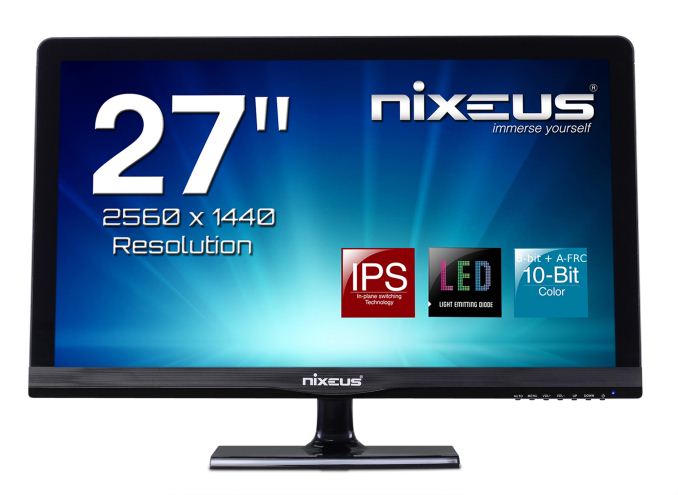
Over the last four years, Nixeus has launched a number of products focused on the gaming market. While the initial focus was on high-resolution monitors, they have now started to include gaming keyboards (mechanical) and mice in their portfolio. In addition, they have also been at the forefront in supporting AMD's FreeSync variable refresh rate technology in their monitors. Last month, they introduced a 'Pro' version of their 27" WQHD (2560x1440) IPS monitor. The new monitor will be sold under the NX-VUE27P model name, with the 'P' indicating that the professional market is being targeted. The 2560x1440 monitor supports 100% sRGB color gamut, while also claiming AdobeRGB support. Except for the latter aspect, the display of the Nixeus PRO Vue 27″ AH-IPS 2560×1440 Mac/PC monitor is identical to the Nixeus VUE27D that we reviewed back in late 2013. Given the review link, I will not go into the details of the brightness, contrast ratio, response time etc of the NX-VUE27P. Unlike many of the vendors that we talk to, Nixeus is quite transparent about the hardware choices they made while designing the product. The panel model and the scaler can be easily found by anyone with access to the hardware, but, Nixeus saved us the trouble and indicated that the NX-VUE27P uses the same panel as that of the NX-VUE27D, the LG LM270WQ1-SDF1. While the NX-VUE27D had only a DisplayPort input (enabled via a MStar scaler), the NX-VUE27P adopts a more recent Novatek scaler that enables additional features - multiple display inputs (DL-DVI-D, DP 1.2, HDMI and VGA), and a mode that can activate the 8-bit + A-FRC feature of the panel ('10-bit' mode). This '10-bit' mode allows Nixeus to add an additional OSD option for AdobeRGB color gamut. Despite this option, the panel capabilities dictate that only around 78% of the AdobeRGB color gamut can be covered by the monitor. The NX-VUE27P also has in-built stereo speakers and a 3.5mm audio jack (for use with VGA and DVI connections). The MSRP is $400, but the current street price seems to be around $390. The monitor carries a 2-year warranty. | ||||||||||||||||||||||||||||||||||||||||||||||||||||||||||||||||||||||||||||||||




| << Previous Day |
2016/11/04 [Calendar] |
Next Day >> |