[Most Recent Entries] [Calendar View]
Monday, November 21st, 2016
| Time | Event | |||||||||||||||||||||||||||||||||||||||||||||||||||||||||||||||||||||||||||||||||
| 9:15a | Best SSDs: Holiday 2016
A lot has changed in the SSD market since last year's Holiday SSD Buyer's Guide. This past summer and fall, Intel and Micron's 3D TLC NAND hit the market and the range of PCIe SSD options expanded greatly. A few market segments are stagnant, but most of our recommendations are relativly new. The most significant shift is that low-end PCIe SSDs have taken the place of high-end SATA SSDs as the middle ground between value SSDs and top of the line PCIe SSDs. The SSD industry is currently suffering through a NAND shortage that has kept prices from dropping much in recent months, and has delayed the availability of Samsung's latest generation of PCIe SSDs. Prices now range from around 23¢/GB for a mainstream SATA drive to 64¢/GB to pre-order Samsung's top of the line 960 Pro M.2 PCIe SSD. As always, the prices shown are merely a snapshot at the time of writing. We make no attempt to predict when or where the best discounts will be. Instead, this guide should be treated as a baseline against which deals can be compared. All of the drives recommended here are models we have tested in at least one capacity or form factor, but in many cases we have not tested every capacity and form factor. For drives not mentioned in this guide, our SSD Bench database can provide performance information and comparisons. Premium SATA drives: Samsung 850 Pro and SanDisk Extreme Pro
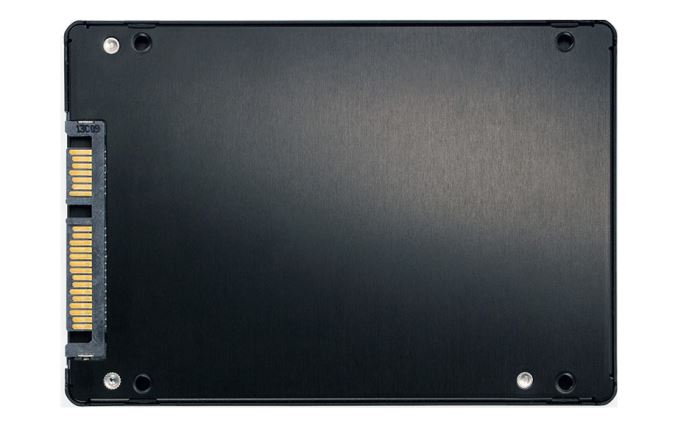
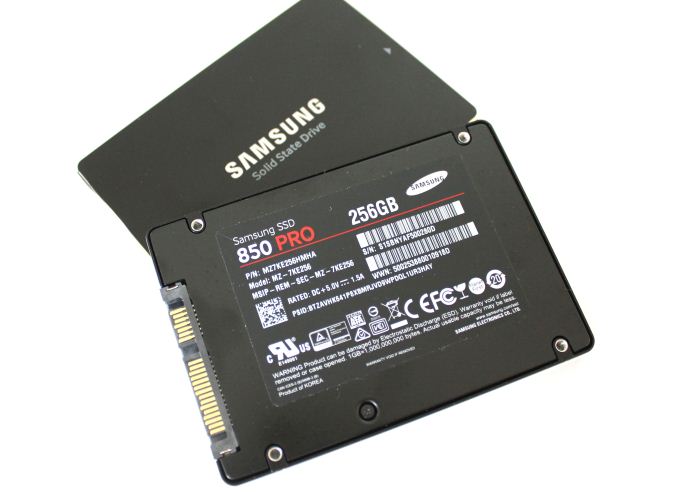
The Samsung 850 Pro is still unchallenged as the top SATA SSD. This isn't much of a claim to fame any more, since there are now cheaper and faster PCIe SSDs. What continues to make the Samsung 850 Pro and SanDisk Extreme Pro stand out are the unmatched ten year warranties in a market where three or five years is standard. However, the write endurance ratings are not unusually high compared to other consumer SSDs. These drives are both premium products for users with demanding workloads. There are much cheaper SATA SSDs that offer peak performance that is close to what these drives deliver, and the growing segment of low-end PCIe SSDs offers far better performance for the money.
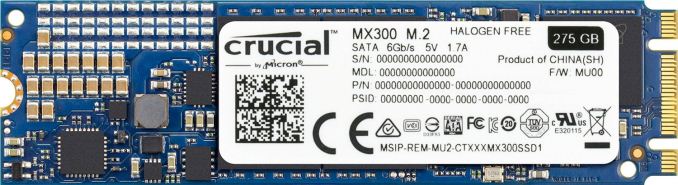
Value & Mainstream SATA: Crucial MX300, Mushkin Reactor 1TB
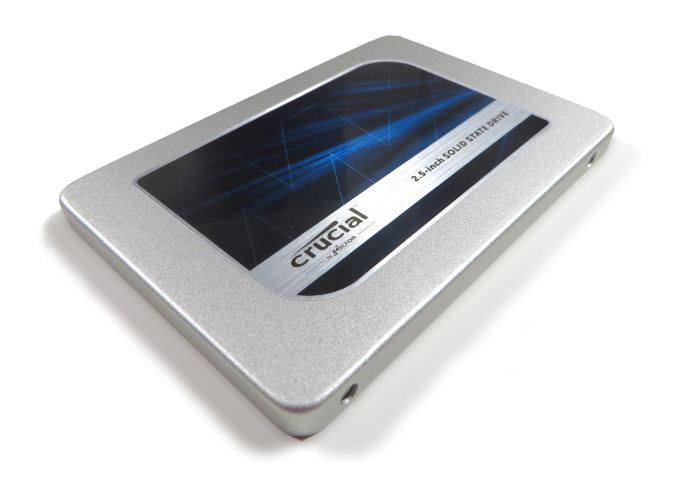
The value segment of the SSD market is where drives trade-off performance and endurance to reach the lowest possible prices. Since SSD prices have tended to drop across the entire market, it is almost always possible to spend just a little more money to get a significant performance boost. The mid-range segment is a battleground between TLC drives with high enough performance, and any MLC drives that can get the price down without sacrificing their inherent performance advantage over TLC. The Crucial MX300 has almost completely taken over this category. It is now one of the cheapest SATA SSDs on the market, and it is faster and far more power efficient than any SSD with planar TLC NAND. MLC SSDs and the Samsung 850 EVO still perform much better under heavy sustained workloads, but the MX300 is good enough for most ordinary use.
PCIe NVMe: Plextor M8Pe and Samsung 960 Pro
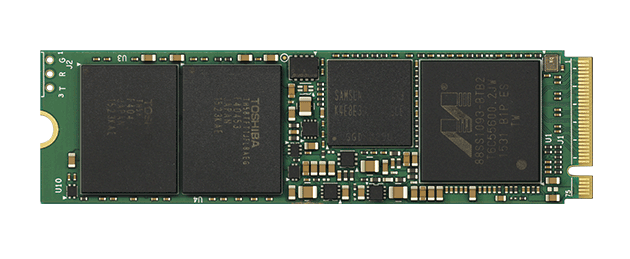
The PCIe SSD market is where most of the action is. The big brands are almost all now shipping a PCIe SSD model and they've been on the market long enough for prices to settle a bit. Samsung's 960 Pro and 960 EVO will help Samsung stay on top, but at the moment Samsung is experiencing supply problems that are likely to continue through the holiday season. Some users may want to wait for the 960 Pro to ship in order to get the absolute fastest consumer SSD or the highest capacity M.2, but the 960 EVO isn't worth waiting for. The Pextor M8Pe is close in performance to the 960 EVO and is faster than the Phison PS5007-E7 based SSDs that several brands are selling. The version of the M8Pe with no heatsink is not only substantially cheaper than the Samsung 960 EVO, it is even a bit cheaper than the Samsung 850 Pro. The one PCIe SSD that doesn't fit in is the Intel 600p. Its price falls in the middle of the SATA SSD market, below the Samsung 850 EVO. On light workloads, it outperforms any SATA SSD, but its sustained performance under a heavy workload is no better than a budget SATA SSD. It is also power hungry even by the standards of PCIe M.2 SSDs, and its efficiency compared to good SATA SSDs is very bad. There are scenarios where the Intel 600p is a great value, but consumers should exercise caution and know their workload before buying the 600p.
M.2 SATA: Samsung 850 EVO and Crucial MX300
M.2 has replaced mSATA as the small form factor of choice, and new product lines are no longer including mSATA variants. Selection of M.2 SATA SSDs is far more limited than 2.5" drives, but there are enouch options to cover a reasonable range of prices and performance levels. The Samsung 850 EVO is the high-performance M.2 SATA drive of choice, and anyone wanting more performance should look to M.2 PCIe SSDs. The Crucial MX300 covers the low end of the market and carries only a slight premium over its 2.5" counterpart.
| |||||||||||||||||||||||||||||||||||||||||||||||||||||||||||||||||||||||||||||||||
| 10:30a | MSI Releases the 'VR One': A Backpack PC For VR From $1999
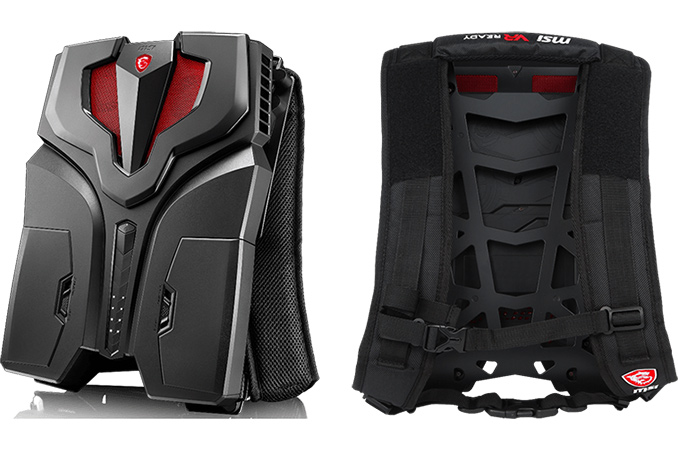
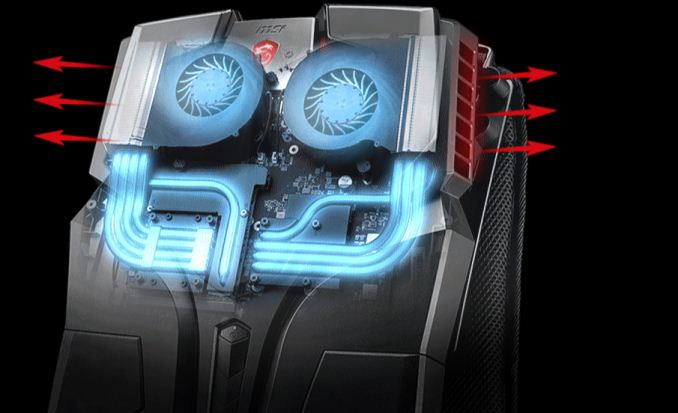
MSI has started to sell its VR One backpack PC designed for virtual reality enthusiasts. The MSI VR One system is now available in the US, and comes equipped with an Intel Core i7 and an NVIDIA GeForce GTX 1060/1070. The backpack promises to pack a lot of performance and can even be overclocked. However, the combination of high FPS and a relative freedom of movement is going to cost: the system starts at $1999. MSI’s VR One backpack PCs rely on the company’s expertise in mobile computing and high-end notebooks. The VR One systems are based on the Intel Core i7-6820HK (4C/8T, 2.7/3.6 GHz, 8 MB LLC, 45 W) processor with an unlocked multiplier as well as NVIDIA’s GeForce GTX 1060 6 GB (VR One 6RD) or GeForce GTX 1070 8 GB (VR One 6RE) GPUs. The key components of the backpack are cooled down using an MSI proprietary cooling system featuring nine heatpipes and two blowers that ensure that the CPU and GPU never overheat even if overclocked (the HM170 chipset supports CPU overclocking). In fact, MSI even supplies its special Shift application that allows the user to boost both the compute and the cooling performance with just a few clicks.
The system comes equipped with a 256 or a 512 GB M.2 PCIe 3.0 x4/NVMe SSD with up to 2.2 GB/s read performance and have another M.2/SATA slot for an additional drive to install more gaming titles. No spinning HDD is equipped by default for obvious reasons.
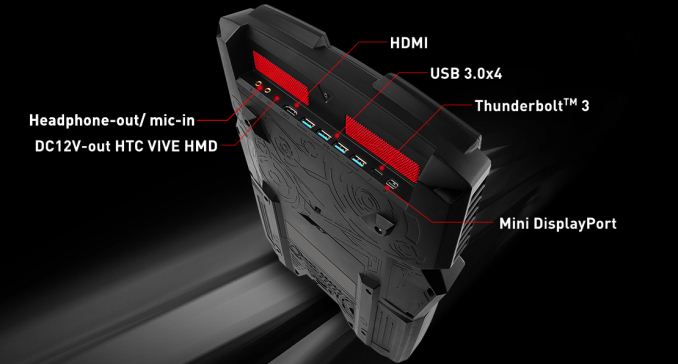
One of the key things about VR gaming backpack PCs is connectivity. The VR One features all the ports needed to connect a VR headset like the HTC Vive with the ports right on top. To simplify connection of the Vive, MSI even supplies a special 3-in-1 cable with HDMI, USB 3.0 and power wires. Moreover, the system packs the Rivet Networks Killer 1535 Wi-Fi 802.11 ac + Bluetooth controller as well as Intel’s Alpine Ridge controller to enable one USB-C/Thunderbolt 3 port.
The whole design of VR One’s motherboard resembles the design of MSI's gaming laptops, which helps to make the PC relatively thin (54 mm) and relatively light (3.6 kilograms). Meanwhile, two hot-swappable batteries enable MSI’s VR One to work completely autonomously for about 1.5 hours each. In fact, the whole outside design of the MSI VR One is optimized primarily for backpack, not desktop operation (unlike ZOTAC’s VR Go). While the VR One can be put on a desk, it will have to lie down, making its ports less accessible. So, the VR One is a system made primarily for virtual reality gaming, not for general-purpose computing. Right now MSI offers the VR One 6RD with the GeForce GTX 1060 and a 256 GB SSD for $1999 in the U.S. The more advanced VR One 6RE with the GeForce GTX 1070 and a 512 GB SSD will be available a little later for $2299. Related Reading: | |||||||||||||||||||||||||||||||||||||||||||||||||||||||||||||||||||||||||||||||||
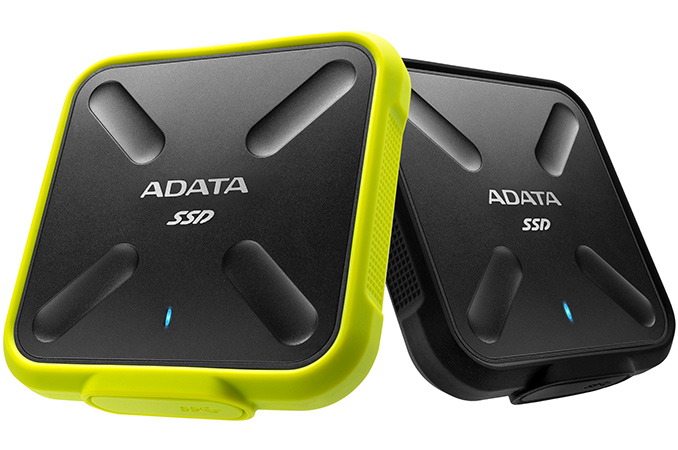
| 2:00p | ADATA Launches the SD700 External SSD: Dust, Water and Shock Resistant (with 3D NAND)
ADATA last week introduced its third SSD featuring 3D NAND memory. The new SD700 is a dust, water and shockproof drive that has up to 1 TB of capacity as well as a weight of only 100 grams. The SSD uses the USB 3.0 interface and is compatible with the majority of modern PCs. The ADATA SD700 comes in a metal enclosure with rubber inlays/pads to ensure hermetic sealing and shock resistance. The company plans to offer three configurations of the drive with 256 GB, 512 GB and 1 TB capacities, all featuring up to 440 MB/s read speed (as conditioned by the maximum real-world transfer rate of USB 3.0 interface due to overhead incurred by 8b/10b encoding). The claimed transfer rates of the SD700 are the same as those of the Samsung Portable SSD T3 (which also used 3D NAND), but the real-world performance of the novelty is yet to be discovered. From a compatibility point of view, the external drives are also similar: they can work with Microsoft Windows, Google Android and Apple macOS. The SD700 from ADATA is based on 384 Gb 3D TLC NAND flash chips made by IMFT and while the SSD maker does not reveal specifics, it is highly likely that the drive uses Silicon Motion’s SM2258 controller (just like other 3D NAND-powered products by ADATA) accompanied by a USB-to-SATA bridge. ADATA designed and tested its SD700 drive to IEC IP68 standard to ensure that it dust-tight and can operate for 60 minutes while submerged in 1.5 meters of water. In addition, the maker also tested its new external SSD to the U.S. Army MIL-STD-810G516.6 shock and drop resistance standard. The SD700 will join ADATA’s family of external SSDs and will be among the first 3D NAND-based external drives that meet the IP68 and the MIL-STD-810G516.6 requirements.
The endurance of 3D NAND, as well as the rugged design, will make the ADATA SD700 a good choice for users that who transfer large amounts of data often and would like to ensure that their information will not be corrupted either as a result of degradation of non-volatile memory or because of a physical damage. For additional piece of mind, ADATA offers a three-year limited warranty with its SD700 drives. The ADATA SD700 external SSDs will be available in all-black as well as black and yellow color schemes shortly at Amazon and Newegg. The 256 GB version will cost $109.99, whereas the 512 GB version will be priced at $189.99. At least from a pricing standpoint, the new SSDs from ADATA look very competitive because they are roughly two times cheaper than LaCie’s Rugged Thunderbolt + USB 3.0 SSDs of the same capacity. Related Reading: | |||||||||||||||||||||||||||||||||||||||||||||||||||||||||||||||||||||||||||||||||
_thumb.png)
_thumb.png)
_thumb.png)
_thumb.png)
_thumb.png)
_thumb.png)


| << Previous Day |
2016/11/21 [Calendar] |
Next Day >> |