[Most Recent Entries] [Calendar View]
Thursday, December 1st, 2016
- Seagate Introduces Game Drive SSD for Xbox (360 and One): 512 GB SSD for $199
- Seagate Introduces Backup Plus Portable 5 TB: The Largest Portable HDD to Date
- Western Digital Expands My Passport External USB 3.0 Drives To 4 TB
| Time | Event | |||||||||||||||||||||||||||||||||||||||||
| 8:00a | Seagate Revives Maxtor Brand for External Storage
UPDATE 12/1 9AM: Seagate confirmed Thursday that it decided to revive the Maxtor brand in a bid to sell value products. In the coming months the company plans to phase-out its inexpensive Samsung-branded products and Maxtor will take their place. Maxtor was a major maker of hard drives that was founded in 1982 and acquired by Seagate in 2006. In the early 2000s, Maxtor was the largest maker of HDDs in the world after its acquisition of HDD division from Quantum, but its advantages somewhat diminished by the middle of the decade due to various reasons, such as the lack of a comprehensive lineup of 2.5” hard drives in the product stack. Maxtor faced severe financial troubles for the most part of its history, and after it was acquired it was also plagued by quality problems as well as controversial management decisions. After Seagate took the company over in 2006, it did ship Maxtor-branded internal and external drives for a couple of years (in fact, external storage was a strong side of Maxtor), but eventually the trademark was dropped.
Earlier this year Seagate decided to start using the Maxtor brand again to sell its M3 and D3 Station external storage products. Both of the DAS devices are also known as the Samsung M3 as well as the Samsung D3 Station which are available worldwide today. In fact, it is surprising to see that Seagate still uses the Samsung brand for hard drive products about five years after the acquisition of Samsung’s HDD business. Under the initial agreement, Seagate had rights to use the Samsung trademark for hard drives for 12 months following the buyout. Apparently, the two companies have amended the initial agreement as Seagate currently offers four Samsung-branded products for consumers. Meanwhile, the revival of the Maxtor brand could indicate that Seagate has begun to phase-out use of the Samsung trademark for its products, which is why it creates alternatives featuring a different brand (some may say that we are dealing with a plain re-badging).
The Maxtor M3 external drive offers 500 GB, 1 TB, 2 TB and 4 TB capacities via a USB 3.0 interface. The top of the range Maxtor M3 model is based on the Spinpoint M10P 2.5”/15 mm HDD with five 800 GB platters featuring shingled magnetic recording technology at 5400 RPM spindle speed as well as 16 MB of cache. In the meantime, models with lower capacities use different hard drives and have smaller dimensions. The DAS comes with AutoBackup and SafetyKey software for automatic backup and protection. The Maxtor D3 Station uses two 2.5” HDDs to offer 2 TB, 3 TB, 4 TB and 5 TB capacities (as opposed to up to 6 TB offered by the Samsung D3 Station version). Just like the M3, the DAS uses a USB 3.0 interface both for data transfer and for power. In addition it also comes with AutoBackup and SafetyKey. Since the D3 Station is designed to serve essential storage needs, it is basically a JBOD device that does not offer any kind of RAID for additional performance or reliability (it also makes for an inconsistent performance profile).
At present, Seagate uses its own brand to sell various external storage devices, the LaCie trademark for premium DAS products and the Samsung brand for select inexpensive external storage solutions. On Thursday the company said that it plans to continue using three brands for its external storage devices going forward with Maxtor taking the the place of Samsung. Seagate intends to add more products into the Maxtor lineup when it makes sense. The statement by Seagate reads as follows. At present, the Maxtor M3 and the Maxtor D3 Station products are available at Amazon and multiple other online and retail stores across the world. Related Reading:
| |||||||||||||||||||||||||||||||||||||||||
| 12:10p | Panasonic Develops IPS Panel with 1,000,000:1 Contrast Ratio, 1000 Nits Brightness
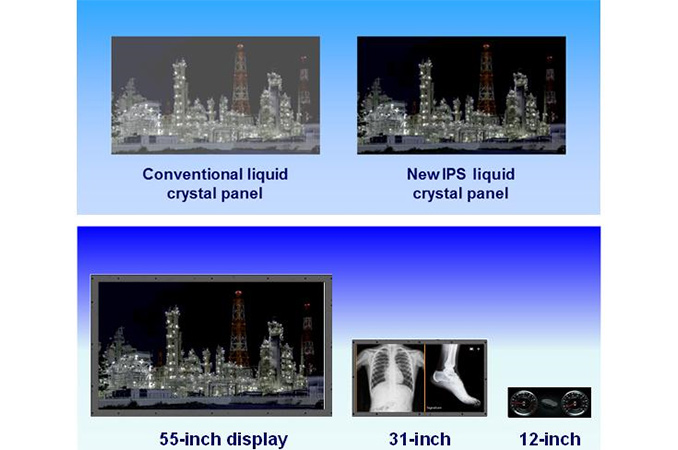
Panasonic has developed a new type of IPS liquid crystal panel that has a 1,000,000:1 contrast ratio, as well as a peak brightness of up to 1000 nits. Many LCD displays often advertise such contrast ratios which are measured against a dynamic backlight and are essentially meaningless, but in this case Panasonic is talking about the static contrast ratio of the display, which only reaches as high as 2000:1 on a typical IPS display. Little information is available about the technology at this point, but Panasonic claims that it is achieved by implementing pixel-by-pixel control of backlight intensity and that panels featuring the tech can be produced using contemporary LCD manufacturing facilities. One of the key advantages that OLED displays have over LCD displays is extremely high contrast ratio that results in superior blacks. The reason why OLEDs can display deeper blacks is simple: such panels do not use backlighting and can completely switch pixels off when they need to display blacks. By contrast, LCDs use backlighting that cannot be turned off on a pixel-by-pixel basis, which is why in many cases blacks look like dark greys. In the most optimal case, an LCD display will use full-array backlighting, where there are several LEDs placed directly behind the liquid crystal layer. This allows for a degree of control by performing local dimming of certain areas, which is how LCD televisions have managed to meet the standards required for HDR certification. However, the precision of the backlight control is not close to that of an OLED display which works at the pixel level. Even more common, especially in monitors and less expensive televisions, is the use of edge lighting where LEDs are placed along the edges of the display and the light is distributed across the panel using a guiding plate, which means you can really only control the overall brightness across the entire display.
As it appears, Panasonic has found a way to substantially increase contrast ratio of IPS LCDs using a high-brightness backlight and a special layer of light-modulating cells that enable pixel-by-pixel control of backlight intensity. These cells are made of light-tolerant liquid crystal material that has different light-transmission properties compared to those used in the display cells. The layer of light-modulating cells is placed between the backlight and the LCD cells and thus can control light leakage. At a high level, one could think of them like gates placed behind each pixel on the display. Panasonic does not reveal many details about its light-modulating cells, but since it uses the term “cells”, it clearly indicates that we are dealing with a relatively thick layer of liquid crystals, not a thin layer of quantum dots (you can see an illustration from Nanosys (a company that produces quantum dot films that are currently used on Samsung TVs and displays) to compare “cells” versus “quantum dots”).
Usage of a high-brightness backlight and a layer of light-modulating cells enable Panasonic to build display panels with up to 1000 nits brightness as well as a static contrast ratio of 1,000,000:1. These figures mean that a black level of 0.001 nits should be possible, which is well beyond what even the best full-array backlit LCD displays can offer today. Panasonic claims that the addition of the layer can be done using the existing equipment for LCD manufacturing, but it's not clear how costly the technology will be to implement or if it requires further components to be added to the LCD stack. The company plans to offer displays featuring the new technology for various professional applications, such as video production, medical, automotive, engineering and so on. Given the positioning, it is obvious that the price of IPS displays with enhanced contrast will be well above that of mainstream monitors. Panasonic intends to start sample shipments of its new monitors in January, 2017, so the commercialization of the technology will not be too far off. Related Reading: | |||||||||||||||||||||||||||||||||||||||||
| 5:10p | MediaTek Adds the Helio X23 and X27 to Its Deca-Core SoC Family
MediaTek added two additional products to its premiere deca-core SoC family today. The Helio X23 and X27 join the previously released Helio X20 and X25, adding additional performance levels for OEMs to choose from. All four SoCs use the same deca-core CPU configuration—two ARM Cortex-A72 cores for heavy workloads that require higher performance and two quad-core Cortex-A53 clusters, using different DVFS curves, for medium to light workloads where lower-power operation is desirable. MediaTek’s custom-developed, power-aware scheduler, CorePilot 3.0, still handles thread distribution. The differentiating factor is clock frequency, with peak frequencies increasing from 2.1GHz / 1.85GHz / 1.4GHz (A72 / A53 / A53) for the X20 to 2.6GHz / 2.0GHz / 1.6GHz for the new X27. The ARM Mali-T880MP4 GPU runs at up to 780MHz in the X20 and X23 and up to 850MHz in the X25. The new X27 bumps the GPU frequency even higher to 875MHz, just shy of the 900MHz peak frequency used by HiSilicon’s Kirin 950/955 that also uses a Mali-T880MP4 GPU.
Both the Helio X23 and X27 are manufactured on the same TSMC 20nm process as the X20 and X25. MediaTek has not made any implementation changes to the layout or cell libraries to push the X27 to higher frequencies, which makes the fact that its A72 cores can hit 2.6GHz on a 20nm planar process even more interesting considering ARM only targets frequencies this high on 14nm/16nm FinFET processes. Other blocks within the X23 and X27, including MediaTek’s Imagiq ISP and integrated Category 6 modem, remain unchanged. The ISP still includes support for dual camera sensors, including color + monochrome configurations that can capture more light than a single color sensor, potentially improving low-light photography. There’s also a 3D depth engine built in to enable depth-of-field post-processing effects. One new feature added to the X23 and X27 is EnergySmart Screen power-saving technology. Part of MediaTek’s MiraVision display suite, it modifies various display parameters in response to changes in ambient lighting and screen content to reduce display power consumption by up to 25%. Products using the new Helio X23 and X27 SoCs have yet to be announced, but MediaTek says smartphones using the new chips will be available soon. | |||||||||||||||||||||||||||||||||||||||||




| << Previous Day |
2016/12/01 [Calendar] |
Next Day >> |