[Most Recent Entries] [Calendar View]
Friday, December 2nd, 2016
- Enermax SteelWing Small Form Factor PC Chassis: Aluminum and Glass, $160
- Lian Li PC-Q37 Announced: Two-Stage Mini-ITX Chassis with Tempered Glass
- The SilverStone SX700-LPT SFX 700W PSU Review
- Thermaltake Releases New SFX PSUs: 450W and 600W, rated at 80 PLUS Gold
- FSP Enters the Market of High-Wattage SFX PSUs with Dagger
- Nokia Is Set to Return to Smartphones and Tablets: What to Expect?
- Microsoft Streamlines Its Smartphone Business Again, Lays Off 1850 People
- HP’s Elite x3 Windows 10 Smartphone to Cost $699, Set to Be Available Worldwide
| Time | Event | |||||||||||||||||||||||||||||||||||||||||||||||||||||||||||||||||
| 10:55a | ASRock Upgrades Beebox-S SFF PCs with Kaby Lake CPUs
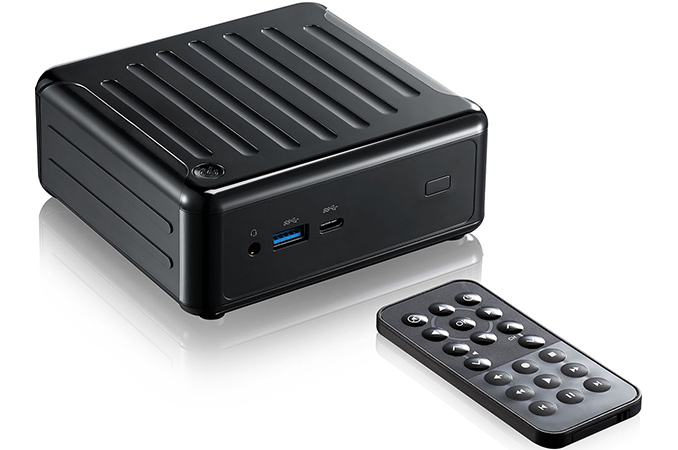
ASRock has introduced updated versions of its Beebox-S small form-factor PCs. The new NUC-like systems are powered by Intel’s Core i5-7100U/i3-7200U CPUs featuring the Kaby Lake microarchitecture, but apart from that the computers are identical to their predecessors running the Skylake chips. ASRock positions its Beebox-S both for general-purpose computing as well as for multimedia playback. Just like their predecessors, the Asrock Beebox-S comes in a small black enclosure (110×118.5×46 mm, 0.6 L) that is akin to other Intel NUC-like systems. Since the PC is based on Intel’s Kaby Lake processor, it has rather advanced video playback capabilities, which make it a good candidate for an HTPC. Moreover, ASRock specifically mentions HDMI 2.0 and support for 4Kp60 with 10-bit HDR output as one of the key features of the new Beebox systems. The manufacturer also installed an IR receiver compatible with a bundled remote controller, further emphasizing a possible positioning of the Beebox-S.
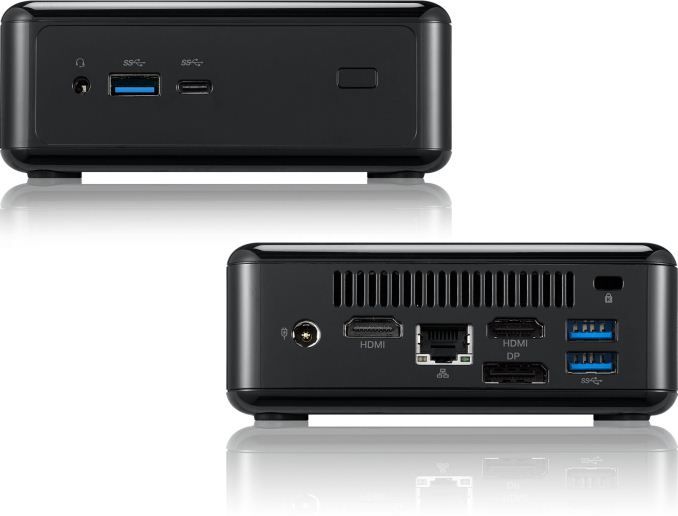
When it comes to connectivity, the SFF PC seems to be good for both office and the living room. The system is equipped with an HDMI 2.0 output (implemented using an LSPCon controller, most likely a MegaChips MCDP2000, and supporting 4096×2160 pixels at 60 Hz as well as HDR10) to connect to modern 4Kp60 UHDTVs (not sure about HDCP 2.2 support, but it should logically be there), an HDMI 1.4 as well as a DisplayPort 1.2. The Beebox-S also has one USB 3.0 Type-A and one USB 3.0 Type-C headers as well as a 3.5 mm TRRS connector for headsets on the front panel. Tthe back panel features two more USB 3.0 ports and one GbE connector. The heart of the ASRock Beebox-S is either Intel’s Core i3-7100U or Core i5-7200U microprocessor in BGA packaging with integrated HD Graphics 620. The system can also be equipped with up to 32 GB of DDR4-2133 memory (two SO-DIMM slots), an M.2-2280 NVMe SSD and a 2.5” SSD/HDD depending on demands of exact customer. Meanwhile, Intel’s 802.11ac Wi-Fi + BT 4.0 wireless module is pre-installed.
This week Newegg started to sell the Beebox-S 7100U and Beebox-S 7200U SFF PCs for $291 and $349, respectively. As it appears that retail pricing of the new Kaby Lake-based ASRock Beebox-S SFF PCs is higher that of the Skylake-powered Beebox-S, which are available for $264 to $320. One more thing to note about the new Beebox-S systems is that they only come in black enclosures, whereas their predecessors feature black, white, silver and golden finishes. We haven't heard of other colors coming, although that may change in the future. Related Reading: | |||||||||||||||||||||||||||||||||||||||||||||||||||||||||||||||||
| 11:00a | The Fnatic Rush G1 Mechanical Keyboard Review In this review we are having a look at the Rush G1, the first keyboard from Fnatic, the professional eSports team who is making an attempt in entrepreneurialism. Their brand name, Fnatic Gear, supplies only apparel and peripherals designed specifically with eSports in mind. | |||||||||||||||||||||||||||||||||||||||||||||||||||||||||||||||||
| 1:00p | Seagate Announces Duet: An Amazon Cloud-Syncing Portable HDD for $99.99
Seagate this week has continued to introduce special-purpose storage devices tailored for select applications: the company is launching its Duet external hard drive that automatically downloads and uploads content from (and to) Amazon Drive to enable instant and offline access to data stored in the cloud. The HDD will be useful for those,who store up to 1 TB of data in the cloud but prefer to have local copies as well. The Seagate Duet is a re-badged Backup Plus Portable Drive with 1 TB capacity and special software that syncs it with the Amazon Drive service. The drive uses a USB 3.0 interface to connect to computers (running Windows or macOS) and has 5400 RPM spindle speed and two platters featuring PMR technology. The HDD needs to be plugged into a PC with internet access in order to connect to the Internet to upload or download data. Users who would like to use the drive like a normal external HDD will have to reformat it (it is doubtful that there will be a lot of such people as the drive costs considerably more than the regular external 1 TB HDDs without cloud-syncing technology). During the initial setup, the Duet drive logins to a customer’s Amazon account and then automatically syncs photos, videos, files, documents, movies and music. After a file is added to the Duet drive, it will be uploaded to the cloud and then available from almost everywhere using any device, including smartphones and tablets that have special apps installed. Alternatively, every file uploaded from a mobile device to Amazon's Drive eventually ends up on the Seagate Duet drive when the device is synchronized.
The Seagate Duet drive will be available exclusively from Amazon in the U.S. for $99.99, which is considerably more expensive than the actual retail price of Seagate’s Backup Plus Portable 1 TB model ($55 - $60). For new U.S. Amazon Drive customers the Duet will come with one free year of Amazon Drive Unlimited Storage (a $59.99 value), which makes the external storage device somewhat more attractive. Meanwhile, existing Amazon Drive customers will essentially pay $40 - $45 for cloud-syncing software. The HDD is covered by a two-year limited warranty from Seagate. Related Reading: | |||||||||||||||||||||||||||||||||||||||||||||||||||||||||||||||||
| 3:00p | Enermax Enters SFX Game with Revolution SFX PSUs
As small form-factor gaming PCs gain traction, more companies enter the scene with small form factor power supplies. Enermax this week introduced its first power supplies in SFX form-factor designed for high-performance systems. The company is now the fifth major supplier of PSUs to offer gaming-grade SFX power supplies, such that enthusiasts now have five brands to choose from, up from two early this year.
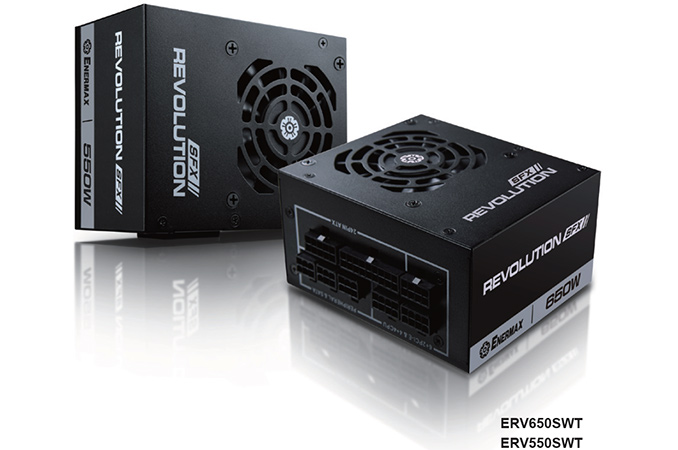
The Enermax Revolution SFX family currently includes two models rated for 550 W (ERV550SWT) and 650 W (ERV650SWT) power output. The new PSUs are compliant with the SFX12V V3.3 and ATX12V V2.4 specifications as well as carry the 80 Plus Gold certification badge. The power supplies come in standard 100-mm depth chassis and feature 80-mm fans that do not operate at loads below 30% as well as a modular design with flexible flat-type cables to ensure easy cable management. Enermax also says that the new PSUs use Japanese electrolytic capacitors rated to handle 105°C temperature and have special protection circuitry to ensure durability and safety.
The Revolution SFX power supplies from Enermax have EPS12V power connectors (one 24-pin and a 4+4-pin connector), two PCIe 8-pin power connectors, six SATA power connectors and four 4P Molex plugs. The presence of two 8-pin (6+2) auxiliary power connectors makes the Revolution SFX compatible with virtually all high-end graphics cards released in the last couple of years, including NVIDIA’s GeForce GTX 1070/1080 that need only one 8-pin plug as well as AMD’s Radeon R9 Fury X that require two 8-pin power connectors. Not all gaming-grade SFX PSUs have two 8-pin power connectors and thus Enermax deserves a credit for this feature.
Both Revolution SFX PSUs come with an SFX to ATX adapter brackets and can be installed into SFX and ATX/Mini-ATX builds. The Revolution SFX 650 W is the most powerful SFX PSU in a 100-mm depth enclosure (SilverStone has 700 W SFX PSUs, but they are 30 mm deeper), hence, it is logical that it can be installed not only into tiny SFX cases, but into general gaming PCs as well. Truthfully, the amount of power connectors supported by both power supplies seems like an overkill for an SFX system, whereas the presence of four 4P Molex plugs indicates that the developers did not forget about those who use either special-purpose hardware. The Enermax Revolution PSUs are expected to hit the market shortly as typically announcements are made about a month ahead of actual availability (though, we do not know whether they are set to become available this year, in time for new PCs ahead of holidays). The 550 W version is set to cost $109.99, whereas the 650 W PSU is to be priced at $124.99. Related Reading: | |||||||||||||||||||||||||||||||||||||||||||||||||||||||||||||||||
| 5:00p | HMD Closes Nokia Brand and Patents Deal with Microsoft, Smartphones Due in 2017
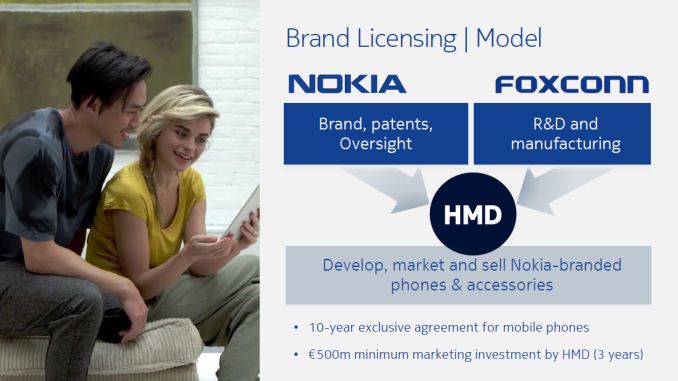
HMD Global and FIH Mobile on Thursday announced that they had completed their buyout of Nokia assets from Microsoft which opens a way for return of Nokia branded smartphones to the market. As expected, HMD and FIH will keep selling Nokia-branded feature phones in developing countries but will add a range of android-based smartphones and tablets to the lineup in 2017. The two companies hope that relationships with operators as well as manufacturing assets (Foxconn) will be instrumental for making their endeavor a success. As reported earlier this year, HMD Global and FIH Mobile, a subsidiary of Hon Hai/Foxconn Technology Group (we will call the company “Foxconn” for simplicity), paid Microsoft approximately $350 million in cash for various Nokia-related assets. Under the terms of the agreement, HMD got exclusive rights to use the Nokia brand on mobile phones and tablets globally (except Japan) for the next 10 years, standard essential cellular patent licenses, software for feature phones and some other intellectual property. Meanwhile, Foxconn got a manufacturing facility in Hanoi, Vietnam, which is used to manufacture Nokia-branded devices along with customer contracts, critical supply agreements, sales and distribution assets (in fact, these will be owned by a subsidiary of FIH called TNS and HMD will have rights to acquire TNS over the next ten years) and so on. HMD and Foxconn will jointly develop, manufacture and sell Nokia-branded devices, whereas Nokia will participate in development and will receive royalties covering both brand and IP rights from HMD for sales of every Nokia-branded product. The three companies are poised to work together because they critically depend on assets owned by each other.
In its announcement on Thursday, HMD reaffirmed plans to introduce a range of Android-based smartphones and tablets in 2017. The company’s announcement was short on details, but it confirmed that the devices will be jointly developed with Foxconn under supervision of Nokia (which intends to control certain aspects of design, performance, and feature-set of the devices), who has know-hows not only in high-volume manufacturing but also in device engineering. Given the short amount of time that HMD, Foxconn and Nokia had to design their new devices, expect the latter to use already known hardware platforms, but add certain elements for differentiation. We do know that Nokia has developed its own UI for Android called Z Launcher, hence it is logical to expect the company to expand the project for Nokia-branded smartphones. Meanwhile, since a lot of important Nokia IP (e.g., PureView imaging, ClearBlack display, etc.) remains at Microsoft, three companies will have to either develop certain technologies from scratch or use off-the-shelf solutions. Such approach has pros and cons: on the one hand, it is hard to create a unique device based on popular platforms; on the other hand, it is possible to build a device in a relatively short amount of time. Hence, expect HMD Foxconn and Nokia to reveal their first smartphone already in the first half of 2017.
Right now, the core business of HMD and Foxconn is Nokia-branded feature phones that are popular primarily in developing countries. On Thursday, HMD also announced the Nokia 216 handset with a 2.4” display running the Nokia 30-series software that will be inexpensive but will still provide basic “smart” functionality like Internet browsing and multimedia playback. Even though sales of such phones are rapidly decreasing, there are still hundreds of millions of such devices sold every year. HMD naturally hopes that it will be able to replace feature phones with inexpensive smartphones and thus will capture a sizeable chunk of the market. As such, expect HMD to focus on not only advanced models for the U.S. and Europe, but also on affordable smartphones for countries like India and Russia, where the brand is particularly strong and where reasonably priced phones are popular. From a market share point of view, inexpensive models are more important than the flagship devices. Nonetheless, Xiaomi and some other makers clearly demonstrated how fine flagship devices affect brand recognition, hence, they are crucial for success. Wrapping things up, the deal between Microsoft, HMD Global and FIH Mobile is now closed and Nokia-branded smartphones (and tablets) are on their way back to the market. It is unlikely that we will hear about them anything at CES, but HMD Global will be present at MWC 2017 and this is where the firm will likely showcase at least some of the upcoming products or at least their key features. Related Reading: Sources: HMD Global, FIH Mobile, Nokia. | |||||||||||||||||||||||||||||||||||||||||||||||||||||||||||||||||

(L2)_thumb.jpg)
(L3)_thumb.jpg)
(L1)_thumb.jpg)





| << Previous Day |
2016/12/02 [Calendar] |
Next Day >> |