[Most Recent Entries] [Calendar View]
Monday, December 5th, 2016
- The State of Wireless Charging Standards in Mobile
- AOC Launches the AG352QCX: 35-Inch 200 Hz 2560×1080 Curved Display with Adaptive-Sync
- EIZO Launches FlexScan EV2780: 27” 2560×1440 Display with USB Type-C Connector
- The GeForce GTX 1060 Founders Edition & ASUS Strix GTX 1060 Review
- ASUS, Inno3D, & Gigabyte Tease Custom GeForce GTX 1060 Cards
- NVIDIA Announces GeForce GTX 1060: Starting at $249, Available July 19th
- NVIDIA Releases GeForce GTX 1060 3GB: GTX 1060, Yet Not
| Time | Event | |||||||||||||||||||||||||||||||||||||||||||||||||||||||||||
| 3:15a | Fold Proteins for Charity & Help AnandTech Beat Tom’s Hardware: Starting December 1st
As we approach the holiday season, the fantastic community team that’s responsible for keeping tabs on our publisher’s technology forums – the AnandTech Forums and the Tom’s Hardware Forums – came to us with a request. They wanted to organize a community activity; something fun, something for charity and, most importantly, something immensely geeky. To that end, I’m happy to announce that we’re going to be holding a Starting December 1st, a contest is going to be held between the AnandTech and Tom’s Hardware forums to determine whose forum and whose community was better. And better still, it will be done for charity. As part of the contest, our publisher, Purch, will be furnishing a $2,500 donation to the Child’s Play charity, which will be made on behalf of the winning team. As for the contest itself, it seemed only appropriate given the two sites’ history that the challenge be computing related, so we decided to compete in the field of distributed computing. What we settled on is to hold a race of sorts using the popular Folding@Home client. In a nutshell, Folding@Home is a long-standing distributed computing project organized by Stanford University that allows individuals to contribute computing time to Stanford’s research. This in turn helps the researchers in combating the illnesses that emerge as a result of proteins not folding correctly, such as Alzheimer's disease and Huntington's disease. Folding@Home has now been going on for over a decade and a half. And along with a long-standing AnandTech folding team, we’ve even used it in GPU benchmarks for a few years now.
Kicking off on December 1st, we will be holding a one-week Folding race to see which team is better. The more computer time donated to Folding@Home – the more protein folding work completed – the more points a team will score, with the highest scoring team being crowned the winner. AnandTech of course is no slouch when it comes to distributed computing. Our team, the aptly named Team AnandTech, has been at it since late 1998, which is almost as long as AnandTech has operated. Among its notable accomplishments is beating the likes of the Macintosh evangelists, Slashdot, Tweakers.net, and more across over a dozen distributed computing projects ranging from computer science to biology to hunting for alien signals. Meanwhile for reasons beyond my understanding, my colleague over at Tom's Hardware, Fritz Nelson, decided to take us on despite the fact that this is practically a home field advantage for Team AnandTech. Suffice it to say, Tom’s Hardware doesn't have team members with the experience or the dedication of Team AnandTech; in other words, they don't stand a chance. And with your help, I want to prove that while adding Tom’s to the list of teams that Team AnandTech has defeated. If nothing else, think of it as doing a favor for Tom's Hardware: after we've burned them in this race, they'll finally be able to put their thermal imaging camera to good use. Ultimately this race is for fun, but it’s also for a good cause. Donating computing time to Folding@Home helps researchers to better understand folding-related diseases, and the $2,500 that our publisher is putting up as part of this contest is going to a wonderful cause that is the appropriately geeky Child’s Play charity. As a result I’d like to encourage everyone to take part in December. The full details on the contest, including how to download the Folding@Home client and join Team AnandTech, our distributed computing team, can be found here. And be sure to drop on by our distributed computing forum and say hello; the team captain is keeping track of how many people sign up, and it's the best place to go to connect with the other team members and to get answers to any questions.
| |||||||||||||||||||||||||||||||||||||||||||||||||||||||||||
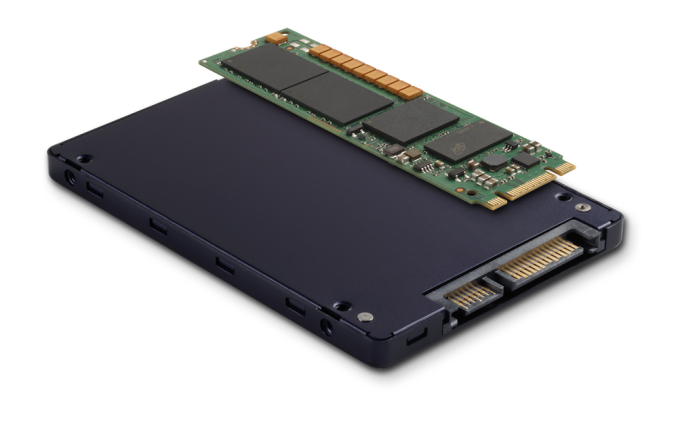
| 8:00a | Micron Announces 5100 Series Enterprise SATA SSDs With 3D TLC NAND
Micron has announced their latest generation of enterprise SATA SSDs, all based on their 3D TLC NAND. The new 5100 series is a full range of enterprise SSDs with capacities ranging from 240GB to 8TB and in three tiers of endurance and performance. Spare area ranges from a minimum of 15% on the density-focused 5100 ECO up to a massive 60% on the performance-focused 5100 MAX. Conversely, write endurance ratings vary from less than one drive write per day (DWPD) on the 5100 ECO up to 5 DWPD on the 5100 MAX. The 5100 ECO and middle-tier 5100 PRO offer M.2 models up to 2TB in addition to their 2.5" form factor models, while the 5100 MAX is only available as a 2.5" drive. Micron's decision to use TLC NAND across the entire range is a notable departure from previous enterprise SSD product lines. The shift was made possible by two major factors: demand for the highest performance and highest write endurance has shifted from SATA to PCIe SSDs, and Micron's 3D TLC with sufficient over-provisioning can hit their endurance targets and the bandwidth limits of SATA more economically than a drive based on 3D MLC would. As enterprise SSDs optimized for consistent sustained performance, the 5100 series does not implement SLC caching and all writes go to TLC NAND. This means that the random and sequential write speeds of the lower-capacity models are significantly impaired, but the larger models in each of the three tiers can saturate a SATA link with sequential writes.
The 5100 series has hardware similarities to the 1100 series client SATA SSDs and the consumer Crucial MX300, all of which use Micron's 3D TLC and Marvell's 88SS1074 "Dean" controller. The 5100 series adds full power loss protection and enterprise-focused firmware. In a feature Micron advertises as Flex Capacity, the divisions between the three product tiers can be blurred with manual over-provisioning. When reducing the accessible capacity of the drive using the device configuration overlay (DCO), steady-state write performance will naturally improve due to the increased spare area. But in addition, past certain thresholds the 5100s will also engage the same changes in flash management strategy that the higher-endurance tiers apply out of the box. Thus, a 5100 ECO can be reconfigured to be a 5100 PRO in all but name. The different capacity and form factor options across the three tiers of the 5100 series adds up to 21 different models, each available with or without TCG Enterprise support and FIPS 140-2 certification. Many of these configurations will not initially be available in retail channels and will instead be sold primarily to high-volume customers. Exact pricing has not been announced, but retail prices are expected to range from 45¢/GB to 75¢/GB depending on capacity and endurance tier, and high-volume direct sales will be cheaper. With the 5100 series replacing the M500DC and M510DC, Micron's business and enterprise SSDs have all transitioned over to their new naming scheme except for the S600DC SAS SSDs. Micron hasn't announced what model number their future SAS SSDs will use, but they currently use 1100 for client SATA SSDs and 7100 and 9100 for PCIe SSDs. They also reserved 2100 for client PCIe SSDs before putting those plans on hold. The 1100 and 5100 Series use Micron's 3D TLC NAND while the rest are still based on planar MLC NAND. Micron expects the 7100 series successor to also switch entirely to TLC when it adopts 3D NAND, so the successor to the 9100 series might be their first use of 3D MLC. | |||||||||||||||||||||||||||||||||||||||||||||||||||||||||||
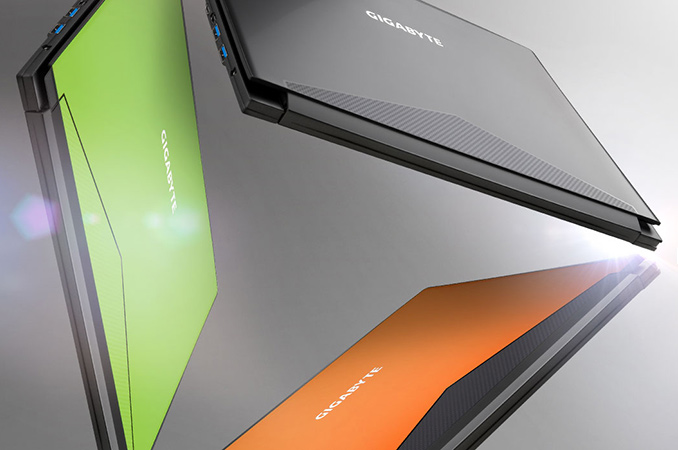
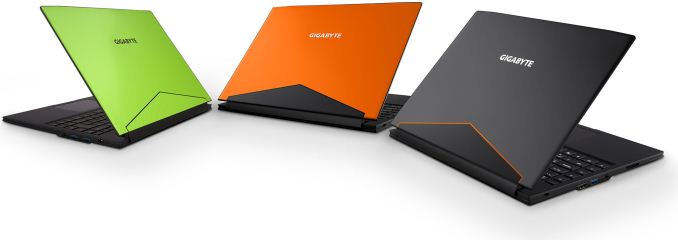
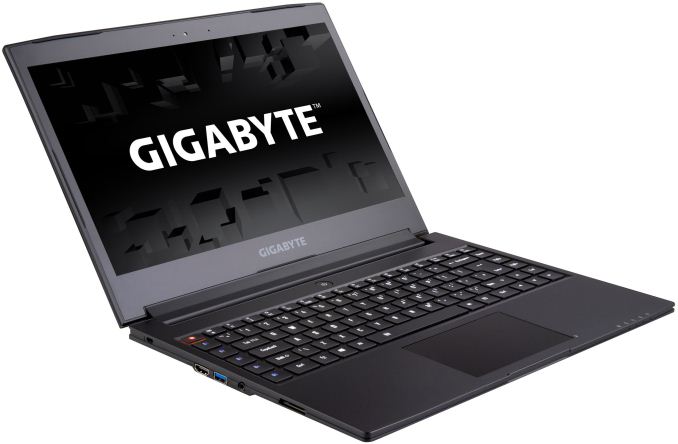
| 8:30a | GIGABYTE Updates The Aero 14 Thin Gaming Laptop: Now with a GeForce GTX 1060 GPU
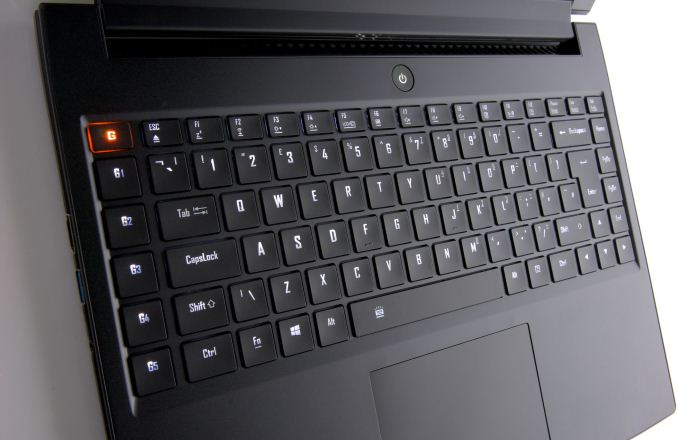
GIGABYTE has introduced an upgraded version of its Aero 14 thin gaming notebook, upgrading to NVIDIA’s GeForce GTX 1060GPU with 6 GB of GDDR5 memory. The system has similar specs and features as the model introduced back in June, but now it offers better performance in games and GPU-accelerated workflows. The GIGABYTE Aero 14 is among the thinnest laptops on the market today. The PC comes in chassis made of aluminum and plastic available with three color options for the display lid: black, green and orange. The Aero 14 is 19.9 mm thick, it weighs around 1.9 kilograms and is equipped with a 94.24 WHr lithium-ion polymer battery that provides a rated 10-hour battery life which is in-line with that of modern business notebooks. Display options for the notebook are limited to an IPS panel with anti-glare coating and 2560×1440 resolution.
The internals of the new GIGABYTE Aero 14 remained generally the same as in the initial model since the manufacturer decided not to wait for Intel’s upcoming Kaby Lake-H CPUs, but has thrown in an NVIDIA GeForce GTX 1060 (1280 stream processors, 80 texture units, 64 raster operations pipelines) to be competitive against direct rivals such as the Razer Blade, which also comes with the GTX 1060 now. Since the new Pascal-based GPU offers considerably higher performance than its predecessors at the same TDP, it will significantly improve user experience during gameplay, especially when it comes to demanding titles, or uses less power for similar performance to the previous generation. Moreover, as NVIDIA is naturally phasing-out its Maxwell offerings, PC makers have to upgrade GPUs in their systems. Just like the initial model, the new GIGABYTE Aero 14 is based on the Intel Core i7-6700HQ processor (four cores with Hyper-Threading technology, 2.6/3.5 GHz 6 MB LLC cache, 45 W TDP, dual-channel memory controller, integrated Intel Gen9 graphics core) as well as the HM170 PCH. The system features 8 or 16 GB of DDR4-2400 memory (up to 32 GB is supported), and a single M.2 slot suitable for up to a 1 TB M.2-2280 SSD (PCIe 3.0 x4 or SATA interface) with up to 2 GB/s read speed.
Meanwhile, I/O capabilities of GIGABYTE’s Aero 14 include a 802.11ac Wi-Fi + BT 4.1 wireless module, one USB 3.1 Type-C header, three USB 3.0 Type-A ports, a TRRS audio connector, an SD card reader, an HD webcam, built-in 1.5 W speakers and a microphone as well as an HDMI 2.0 and an mDP display output. Finally, to make the Aero 14 more appealing to gamers, GIGABYTE included a keyboard featuring five programmable keys to simplify input of complex key combinations.
Pricing of the new GIGABYTE Aero 14 depends on exact configuration and location. For example, Amazon currently offers the Aero 14Wv6-GN4 laptop with the Core i7-6700HQ, GeForce GTX 1060 6 GB, 16 GB of DDR4-2400 memory (one module) and a 512 GB SATA SSD for $1699. Other configurations may be more affordable or expensive. In the meantime, Newegg is still selling the Aero 14 with the GeForce GTX 965M for $1349. *Many thanks to digiguy for corrections. Related Reading: | |||||||||||||||||||||||||||||||||||||||||||||||||||||||||||
| 11:00a | AOC P2779VC: 27” PLS Display with Qi Wireless Charging Base for $199
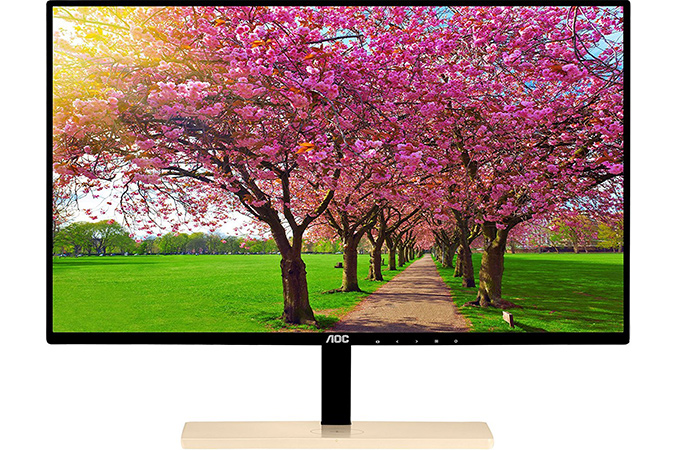
AOC has introduced a new 27” display that features Qi wireless charging for mobile phones in the base. The monitor uses a PLS panel and has standard characteristics for a mainstream device aimed at office environments. Despite this, the P2779VC is one of the first 27” displays with Qi wireless charging and it will make an appealing option for those who need both large screen and Qi, especially given its affordable price. The AOC P2779VC is a 27” IPS monitor with a 1920×1080 resolution, 300 nits brightness, 178°/178° viewing angles, and a 60 Hz refresh rate (static contrast ratio is unknown). The display is listed as reproducing 16.77 million colors, enough for office workloads, and has a response time of 5 ms gray-to-gray, enough for videos and gaming. AOC does not confirm adherence to any particular color space in its spec sheet.
When it comes to connectivity, the AOC P2779VC is a fairly basic monitor with one D-Sub and two HDMI 1.3 inputs. Unlike some other mainstream displays, this one does not have built-in speakers or a USB hub which may be an advantage for tightly-packed corporate offices that have to deal with noise (minus speakers) and mind corporate security (minus USB).
Meanwhile, the key selling feature of the P2779VC is its base that features a Qi wireless charging pad in the base. As far as we could find, commercially, only Samsung has released two SE370 displays that support Qi and feature 23.6” and 27” PLS panels. As a result AOC’s monitor is not going to have too many rivals right now. Keep in mind that at present there are tens of smartphones and tablets with integrated Qi wireless charging technology (including those from ASUS, Samsung, Google, HP, Microsoft and other) and there are accessories that enable the tech on devices without integrated support (e.g., on Apple iPhone 6S). The AOC P2779VC comes with a black or gold base and with the company’s standard three-year warranty. The price of the display is $199.99, which is a bit lower when compared to the price of the Samsung SE370 270 that is available for $213.80. Related Reading: Source of Images: Amazon. | |||||||||||||||||||||||||||||||||||||||||||||||||||||||||||
| 1:30p | NVIDIA’s GeForce GTX 1060 Gets Hybrid Cooling on Inno3D's iChill Black Model
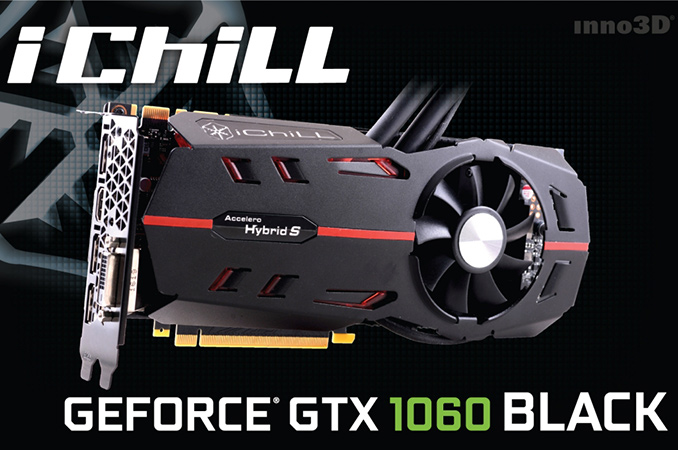
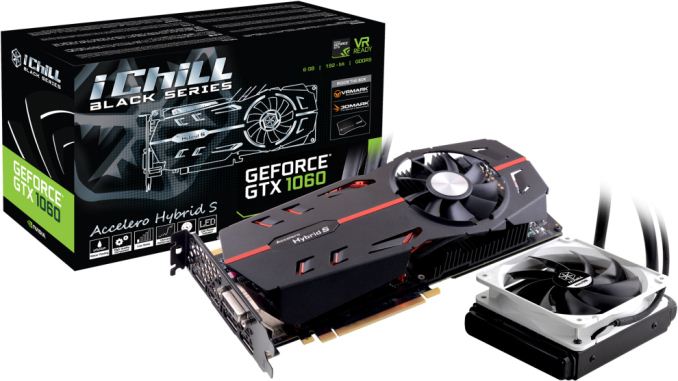
Inno3D has expanded its lineup of video cards based on NVIDIA’s GeForce GTX 1060 graphics processor with an add-in-board featuring a hybrid cooling system using a closed loop liquid cooler. The graphics card comes with a factory-overclocked GPU, whereas the advanced cooler promises some additional overclocking potential for those who plan to squeeze all of the juice out of a GP106. The Inno3D iChill GeForce GTX 1060 Black is built upon a PCB with a proprietary custom design that is longer compared to that of NVIDIA's reference design and comes with a pre-installed Arctic Accelero Hybrid S AIO cooling system, featuring a 120-mm heat exchanger with a fan. The GP106 GPU runs at 1569/1784 MHz (base/boost), which is a bit higher compared to NVIDIA’s reference cards but is in line with Inno3D’s other factory-overclocked boards based on the same processor. The board is equipped with 6 GB of memory running at 8.2 GT/s and has five display outputs (Dual Link DVI-D, HDMI 2.0b, 3x DisplayPort 1.4). As for power, the card requires an 8-pin auxiliary PCIe power connector.
NVIDIA’s GeForce GTX 1060 (GP106) graphics chip is popular both among makers of video cards (AIB partners) as well as end-users, as referenced by recent numbers by Jon Peddie Research. Large suppliers of AIBs usually have four or more graphics solutions/cards based on the GP106 in their lineups. Nonetheless, Inno3D seems to be the first company to offer GeForce GTX 1060 with a hybrid air and liquid cooling system. The GP106 graphics processor is a rather good overclocker: with NVIDIA’s own cooler its frequencies can be increased by 200 MHz, whereas with a more advanced air cooler it can run at over higher clock-rates (check our review for more details).
Theoretically, Inno3D’s hybrid cooling system should provide more overclocking headroom compared to air coolers. In this case, the question is how significant that additional headroom is or if the average chip can support it. That being said a better cooling system also means lower temperatures in general and a potentially longer lifespan. Moreover, the hybrid cooling system may also be a bit quieter than inexpensive air coolers, but it requires more space inside the PC. Inno3D did not reveal recommended price for the iChill GeForce GTX 1060 Black graphics card, but we imagine that it is going to be higher than the MSRP of a typical GeForce GTX 1060 6 GB product, which is $249. Related Reading: Source: Inno3D via TechPowerUp.
| |||||||||||||||||||||||||||||||||||||||||||||||||||||||||||







_thumb.jpg)
_thumb.png)
_thumb.png)
_thumb.png)


| << Previous Day |
2016/12/05 [Calendar] |
Next Day >> |