[Most Recent Entries] [Calendar View]
Wednesday, December 7th, 2016
| Time | Event | |||||||||||||||||||||||||||||||||||||||||||||||||||||||||||||||||||||||||||||||||||||||||||||||||||||||||||||||||||||||
| 8:00a | Extending Home Networks - A Comparison of G.hn, HomePlug AV2 and Wi-Fi Mesh Over the last decade or so, we have seen a rapid increase in the number of devices connecting to the home network. The popularity of IoT has meant that even devices that are not mobile require communication over the Internet, but, their placement might be far away from the primary router in the house. Given this situation, it is essential to find a reliable way to extend the reach of the home network. There have been many attempts to come up with a standardized way to do it, but consumers have been forced to use range extenders, powerline networking kits and the like to increase the reach of their home networks. Given the multitude of available options, what underlying technology should consumers look for? This article provides a comprehensive overview of the available options as well as a quantitative comparison in one particular residential scenario. | |||||||||||||||||||||||||||||||||||||||||||||||||||||||||||||||||||||||||||||||||||||||||||||||||||||||||||||||||||||||
| 12:01p | The Khronos Group Announces New Standards Collaboration for VR Integration
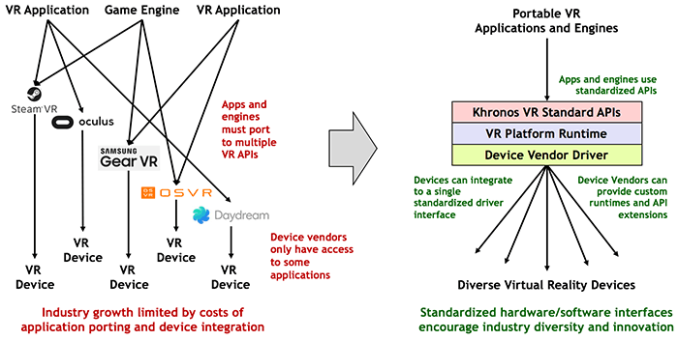
It’s no secret that at this early point in the lifecycle of VR that there are many different platforms, solutions and paths to choose from when it comes to content and standards for motion and control. Due to the range of APIs created for game engines and different VR solutions, such as Steam VR, Oculus, OSVR, Daydream etc., it can be difficult for developers to create one-application-fits-all software. As a result, their software typically ends up specializing for a particular VR solution over others. This can arguably limit industry growth at the expense of differentiation. The goal of the new Khronos VR Standards initiative, announced this week, is to create a set of standard APIs that portable VR applications and engines can use to interface with different hardware and vendor device drivers. Much in the same way that Vulkan is designed to be a low-level graphics standard that can target any capable set of hardware and software, the end goal here is to have a sufficient number of companies and developers on board to create a singular API interface for all future VR development, making a single app compatible with any device and software stack that adheres to the new standard(s).
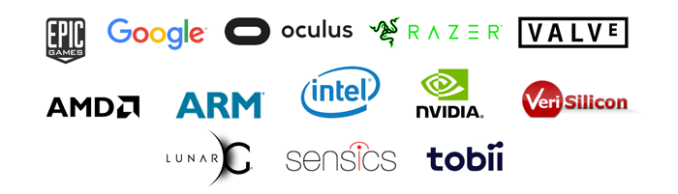
At this time, Khronos is only putting out the announcement that this new VR Standards Initiative is in the early stages and encouraging companies in the VR space to get on board. The usual suspects are publicly participating (Google, Oculus, Valve, Intel, AMD, ARM, NVIDIA, EPIC Games, Razer, Tobii), and we were told that a number of other companies are also involved but not publicly at this time (we questioned Khronos about Microsoft, and Chinese participants as well). Khronos confirmed that this is still early days for the initiative, at the point where the scope of the specification is still being determined. As a result, aside from headset tracking, controllers and other devices in a VR runtime, the scope could go beyond simple VR implementations and move to delocalized streaming and virtualized environments, depending on the participants in the Initiative. We were told that typical Khronos cycles for this sort of thing are 18-24 months before a ratified standard is in place.
From Khronos’ press release: “Khronos has been on the forefront of advanced graphics and system APIs for over 15 years, and in keeping with that tradition and obligation to the industry at large has embarked on a new, vitally needed set of APIs and standards for the emerging VR market. We applaud the industry-leading companies that are coming together as Khronos members for this endeavor, and expect the whole industry will share our sentiment,” said Jon Peddie, President of JPR. Any company interested in participating should get in contact with Khronos. There have been some initial presentations at SIGGRAPH Asia this week. | |||||||||||||||||||||||||||||||||||||||||||||||||||||||||||||||||||||||||||||||||||||||||||||||||||||||||||||||||||||||
| 4:45p | HGST Ultrastar SN200 Accelerator: 7.68 TB Capacity, 6.1 GB/s Read Speed, 1.2M IOPS
Western Digital this week announced two high-end HGST Ultrastar families of SSDs designed for high-frequency workloads in cloud and hyperscale environments that require instant response time. The new drives will act like application accelerators and will thus offer very high sequential and random performance as well as very low latency. The manufacturer does not reveal a lot of information about the HGST Ultrastar SN200 family, but we do know that it is based on a proprietary controller that is compliant with the NVMe 1.2 specification, uses PCIe 3.0 interface and supports “advanced ECC” (which is probably a marketing way of saying LDPC). The HGST Ultrastar SN200 family of solid-state accelerators consists of two lineups: the SN260 and the SN200. The Ultrastar SN260 is designed for maximum performance, which is why it uses PCIe 3.0 x8 interface and is set to be available in half-height/half-length add-in card form-factor. By contrast, the Ultrastar SN200 uses a more traditional 2.5”/15 mm form-factor along with dual-port U.2 connector featuring PCIe 3.0 x4 interface (dual-port is needed for high-availability systems). To appeal to different types of customers and workloads, the SN200 and the SN260 SSDs will come in endurance-optimized and capacity-optimized models with the former offering up to three drive writes per day (DWPD) for five years and the latter offering up to 7.68 TB capacity (see the table for details) as well 1 DWPD for five years. Power consumption and other features of different types of drives are similar: they do not consume more than 25 W under load and they support end-to-end data path protection, secure erase, power-loss protection and so on. When it comes to performance, the HGST Ultrastar SN260 with 800 GB – 7.68 TB capacity is the absolute champion in Western Digital’s product stack and is also among the fastest high-capacity NVMe PCIe SSDs today (it only pales in comparison with Seagate’s Nytro XP7200, which is a PCIe 3.0 x16 SSD with read speeds speced at 10 GB/s). The SN260 is rated at up to 6.4 GB/s for sequential reads and up to 2.2 GB/s for sequential writes (both capacity and endurance models). The new SSDs can perform up to 1.2 million random read IOPS as well as up to 200K/75K random write IOPS (endurance/capacity models). The HGST Ultrastar SN200 is considerably slower than the SN260 (as expected) with sequential and random reads, but write performance of the two drive families is similar. The SN200 SSD supports sequential read speeds of up to 3300 MB/s as well as sequential write speeds of up to 2100 MB/s.
Western Digital is sampling its HGST Ultrastar SN200 NVMe family of SSDs to select customers and plans to start their commercial shipments in the first quarter of 2017. The drives will be covered with a five-year warranty and will come with two million-hour MTBF rating. Related Reading: | |||||||||||||||||||||||||||||||||||||||||||||||||||||||||||||||||||||||||||||||||||||||||||||||||||||||||||||||||||||||
| 5:00p | HGST Ultrastar SS200 SSD: Up to 7.68 TB, 1.8 GB/s, Dual-Port SAS 12 Gbps Western Digital has introduced a new family of Ultrastar SS200 SAS SSDs that wed high-performance with capacities up to 7.68 TB as well as relatively high endurance. The drives are aimed at mixed-use and read-intensive workloads that require not only maximum throughput, but also reliability. To guarantee the latter, the Ultrastar SS200 uses the company's Guardian technology. The HGST Ultrastar SS200-series SSDs are designed for datacenters that rely on SAS backplanes, which are used for modern read-intensive and mixed-use workloads that benefit from performance and reliability (e.g., financial transactions, e-commerce, virtualization, database analytics, etc.). The drives come in 2.5”/15 mm form-factor with two SAS 12 Gbps ports and are based on the Guardian platform originally developed by SanDisk. The Guardian technology handles flash management, signal processing, end-to-end data path protection, power-loss protection and so on. Unlike the previous-gen products featuring the Guardian, the Ultrastar SS200 SSDs are based on a proprietary Western Digital controller and firmware, not a third-party chip with a custom firmware, the company told us. The manufacturer claims that the SS200 drives use “commercial-grade” MLC NAND memory, which probably means 128 Gbit ICs made using 15 nm fabrication process.
Since different workloads mean different demands for capacities and endurance, Western Digital plans to offer capacity-optimized versions of the SS200 that can store 480 GB – 7.68 TB of data and rated for one drive write per day (DWPD) for five years as well as endurance- and performance-optimized models rated at 3 DWPD for five years that can store 400 GB – 3.2 TB of data. Power consumption of the Ultrastar SS200 SSDs is configurable and can be as low as 9 W or as high as 11 W. When it comes to performance, the HGST Ultrastar SS200 supports sequential read speeds of up to 1800 MB/s as well as sequential write speeds of up to 1000 MB/s. Random read performance of the Ultrastar SS200 is up to 250K, whereas random write performance is rated at 86K/36K (performance-/capacity-optimized models). Samples of the HGST Ultrastar SS200 SAS lineup of SSDs are available to select customers now and Western Digital intends to begin their volume shipments in the first quarter of 2017. The drives will be covered with a five-year warranty and will be rated at 2.5 million-hour MTBF. Related Reading: | |||||||||||||||||||||||||||||||||||||||||||||||||||||||||||||||||||||||||||||||||||||||||||||||||||||||||||||||||||||||
| 10:00p | Microsoft and Qualcomm Collaborate to Bring Windows 10 & x86 Emulation to Snapdragon Processors
Today at Microsoft’s WinHEC event in Shenzhen, China, the company announced that it’s working with Qualcomm to bring the full Windows 10 experience to future devices powered by Snapdragon processors. Terry Myerson, executive vice president of the Windows and Devices Group at Microsoft, is “excited to bring Windows 10 to the ARM ecosystem” and looks forward to bringing “Windows 10 to life with a range of thin, light, power-efficient and always-connected devices,” which may include anything from smartphones to tablets to ultraportable laptops to servers. These new Snapdragon-powered devices should support all things Microsoft, including Microsoft Office, Windows Hello, Windows Pen, and the Edge browser, alongside third-party Universal Windows Platform (UWP) apps and, most interestingly, x86 (32-bit) Win32 apps. They should even be able to play Crysis 2. This announcement fits nicely with Microsoft’s “Windows Everywhere” doctrine and should come as no surprise. It’s not even the first time we’ve seen Windows running on ARM processors. Microsoft’s failed Windows RT operating system was a modified version of Windows 8 that targeted the ARMv7-A 32-bit architecture. It grew from Microsoft’s MinWin effort to make Windows more modular by reorganizing the operating system and cleaning up API dependencies. This work first surfaced in Windows Server 2008, which could be installed with a stripped-down, command-line only interface that did not include components such as Internet Explorer that were not necessary for specific server roles. Windows RT also leveraged the newer Windows Runtime (WinRT) API that offered several new features such as digitally signed app packages distributed through the centralized Windows Store and the ability to run apps within a sandbox. It also made it easier for software developers to target multiple CPU architectures. However, Microsoft’s rework of Windows was not yet complete, leaving Windows RT with a bunch of legacy Win32 code that went unused. It also could not run Win32 desktop apps, severely limiting the number of available apps to only those using WinRT and distributed through the Windows Store.
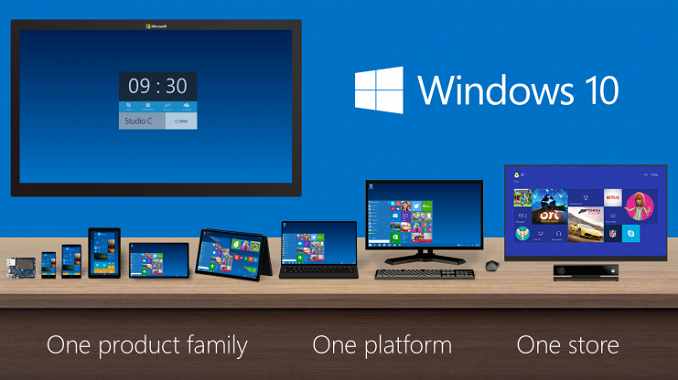
MinWin and its derivatives have continued to evolve over the past few years after getting a major boost in 2013 when Microsoft reorganized its disparate software platforms into the singular Operating Systems Engineering Group. The end result is Windows 10, a modular OS that can run on anything from low-powered IoT devices to high-performing workstations and servers. Its foundation is OneCore, MinWin’s direct descendant, that includes only the operating system kernel and components essential for any hardware platform. OneCore UAP (Universal App Platform) is another major module for Windows 10 whose groundwork was laid during the creation of Windows Phone and Windows RT. It provides support for Universal Windows Apps and Drivers, along with more advanced features such as the Edge browser and DirectX. On top of these modules, Microsoft can add modules that target specific device families (desktop, mobile, Xbox, HoloLens, etc.) that provide specialized features and shells. Also included in OneCore UAP is Universal Windows Platform (UWP). An extension of the WinRT API used in Windows 8, it allows developers to create universal apps that are CPU architecture agnostic and can run on multiple devices, seamlessly adapting their user interface and input methods to the hardware they’re running on. With UWP, the architecutre independence is achieved by having pre-compiled versions for each platform available from the Store, which will then download and install the correct version for the individual device. The major change with today's announcement over Windows RT and UWP is that x86 apps will be able to run on Qualcomm's ARM-based SoCs, along with support for all of the peripherals that are already supported with Windows 10. This alone is a huge change from Windows RT, which would only work with a small subset of peripherals.
Microsoft is also focusing on having these devices always connected through cellular, which is something that is not available for many PCs at the moment. Support will be available for eSIM to avoid having to find room in a cramped design to accomodate a physical SIM, and Microsoft is going so far as to call these "cellular PCs" meaning they are expecting broad support for this class of computer, rather than the handful available now with cellular connectivity. The ability to run x86 Win32 apps on ARM will come through emulation, and to demonstrate the performance Microsoft has released a video of an ARM PC running Photoshop. This of course raises several questions, few-if-any of which Microsoft is willing to answer. Intel has long exerted strong control over the x86 ISA, limiting or outright preventing competitors like NVIDIA from implementing x86 support. So how Microsoft and Qualcomm are able to (for lack of a better way to put it) get away with this is a big question. Certainly there's no indication right now that this has Intel's formal blessing. The key points here are that this is a form of software emulation - Microsoft even calls it as much - and that only 32-bit x86 support is being offered. On the former, this means that there's no hardware execution of x86 instructions taking place - though Microsoft and Qualcomm are certainly lining up instructions as best they can - which avoids many of the obvious patent pitfalls of doing x86 in hardware, and puts it in the same category as other x86 emulation mechanisms like DOSBox and QEMU. Meanwhile only supporting 32-bit x86 code further rolls back the clock, as the most important of those instructions are by now quite old, x86 having made the jump to 64-bit x86-64 back in 2003. So it may very well be that it's easier to avoid any potential legal issues by sticking with 32-bit code, though that's supposition on our part. In any case it will be interesting to see what instructions Microsoft's emulator supports, and whether newer instructions and instruction set extensions (e.g SSE2) are supported in some fashion. Of course, the performance of this solution remains to be seen. x86 is not easy or cheap to emulate, and an "emulator" as opposed to a Denver-like instruction translation makes that all the harder. On the other hand, while maximizing x86 compatibility is great for Microsoft and Qualcomm, what they really need x86 for is legacy applications, which broadly speaking aren't performance-critical. So while x86 on a phone/tablet ARM SoC may not be fast, it need only be "good enough." In any case, Windows 10’s ability to scale and adapt to essentially any hardware platform is a remarkable feat of engineering, and it’s what makes today’s joint announcement with Qualcomm possible. The first devices with Snapdragon SoCs running the full Windows 10 experience should be available in the second half of 2017. It will be interesting to see what shape these devices take and which companies produce them. Some new lower-cost, full-featured Windows 10 tablets would be a welcome addition, and Qualcomm has its eyes on the low-powered server market too with its Centriq product family. A Windows 10 smartphone with a Snapdragon SoC is also likely, but with Windows Phone 8 holding less than 1% global market share, according to Gartner, Microsoft is essentially starting from scratch. Will the benefits of universal apps be enough to lure software developers and users of other Windows products away from Android and iOS? Can Windows 10 reestablish Microsoft as a major player in the smartphone market, or is the hole it has dug over the past decade too deep? | |||||||||||||||||||||||||||||||||||||||||||||||||||||||||||||||||||||||||||||||||||||||||||||||||||||||||||||||||||||||



| << Previous Day |
2016/12/07 [Calendar] |
Next Day >> |