[Most Recent Entries] [Calendar View]
Wednesday, December 21st, 2016
- GIGABYTE Announces GeForce GTX 1070 Mini ITX OC
- Lian Li PC-Q37 Announced: Two-Stage Mini-ITX Chassis with Tempered Glass
- The NZXT Manta mITX Case Review
- The Fractal Design Node 202 Case Review: Mini-ITX Gaming For the Living Room
- Corsair's Bulldog PC Barebone for the Living Room is now Available: $299/$399
- The ASUS Maximus VIII Impact Z170 ROG Mini-ITX Motherboard Review
- GALAX Shows Off Single-Slot GeForce GTX 1070 Graphics Card
- Corsair Releases Force MP500 SSDs: 3 GB/s, Phison PS5007-E7, MLC NAND
- The Plextor M8Pe (512GB) SSD Review
| Time | Event | ||||||||||||||||||||||||||||||||||||||||||||||||
| 9:00a | AMD Releases Radeon Software Crimson ReLive Edition 16.12.2 Update
We are not even two weeks out from the release of AMD's Radeon Software Crimson ReLive Edition and we have been given an update. The 16.12.2 update brings the driver version to 16.50.2001, and there is no game specific support bundled in with this update. Though we do have a hefty list of fixes, most of which apply directly to ReLive features. First up we have a fix in for a specific bug. When using AMD FreeSync technology with a borderless fullscreen application, and playing dynamic content such as a video or another application, performance issues were possible. AMD also notes in the known issues that a small number of apps may still experience this issue. I say it’s at least safe to say they are working on the issue. Most of the remaining fixes fall cleanly under ReLive related issues and problems. Radeon ReLive may have failed to install on some system configurations. Instant Replay may have failed to enable itself after being turned off due to content protection conflicts. There are also some fixed translations errors for both Radeon Settings and Radeon ReLive. Audio recorded by Radeon ReLive may have sometimes played back in slow motion. Radeon ReLive also may have had issues recording or issues toggling the Overlay/Toolbar when Frame Rate Target Control (FRTC) is enabled, if issues remain the workaround noted is to disable FRTC while using Radeon ReLive. Additionally, mouse cursor movement may stutter in recorded video when there is little movement other than the cursor itself. In AMD Multi GPU configurations the second GPU was exiting the low power state while Radeon ReLive was enabled. There were also problems taking screenshots of secondary displays with Radeon ReLive. In an oddly specific outline for a bug, DOTA 2 may have experienced game corruption while task switching while recording with Radeon ReLive in AMD Multi GPU configurations. Slightly less specific to that other MOBA, Radeon ReLive’s Overlay will not launch or record when running League of Legends in administrator mode and borderless fullscreen. Moving back to other issues outside of ReLive, Radeon Settings was not loading upon system boot. There was also flashing and graphics corruption found when running Battlefield 1 with Multi GPU on the RX400 series cards. Chromium may have failed to use hybrid decode for VP9 content, and though I’m not sure how this ties to a GPU drivers there appears to be a fix for long ping times with some Wi-Fi adapters. I also find it interesting that in the release notes under known issues we have ReLive issues separated out into another list. I don’t know whether this is a sign of diligence, showing that they are tracking and staying on top of many issues, or if someone decided that the list of issues was getting too big and needed to be split. Either way, AMD is obviously continuing their trend to update often and provide a decent to sizable number of fixes with every update. Last year felt like a sharp increase in the effort put into these updates and there is still no sign of them slowing down. There are no game specific optimizations in this update. I assume they were all hands on deck, to keep up with all issues uncovered after the big update two weeks ago. As always, those interested in reading more or installing the updated hotfix drivers for AMD’s desktop, mobile, and integrated GPUs can find them either under the driver update section in Radeon Settings or on AMDs Radeon Software Crimson ReLive Edition download page.
| ||||||||||||||||||||||||||||||||||||||||||||||||
| 11:00a | G.Skill Announces Trident Z RGB Illumination to DDR4
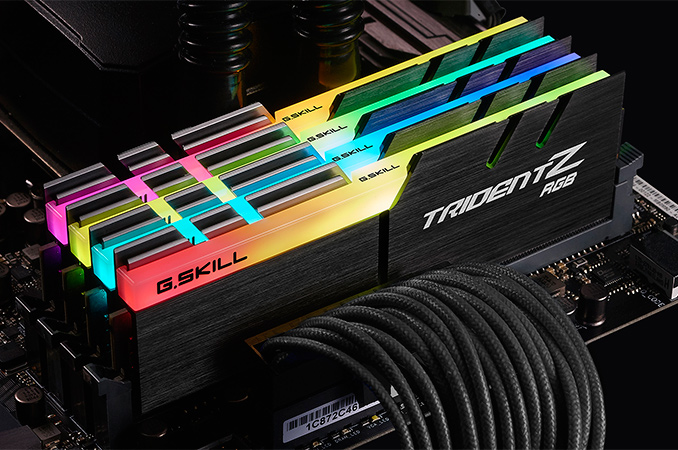
G.Skill this week has announced a new addition to its Trident Z family of high-performance DDR4 memory modules aimed at modders. The new Trident Z RGB will feature software-controllable RGB LEDs on top of the modules. The DIMMs will require no additional connectors and will work in all DDR4-capable computers running Windows. The new G.Skill Trident Z RGB modules will be based on the company’s custom 10-layer PCB, will feature speed bins up to DDR4-4266 and XMP 2.0 SPD profiles to appeal to users seeking for both style and high memory performance. The DIMMs will use Trident Z’s aluminum heat spreaders, however now equipped with RGB light bars on top (as opposed to metallic bars in case of regular DIMMs). Previously the company offered Trident Z modules with different color schemes, and the addition of RGB illumination is G.Skill’s next step.
The manufacturer says that the Trident Z RGB will display a rainbow of colors in a wave-style lighting effect by default, but users will be able to customize lighting and design their own lighting effects using a special program that controls the light bars. G.Skill does not reveal how exactly those LEDs work or controlled, but most probably the company uses one or two of the “spare” RFU (reserved for future use) pins that DDR4 modules/slots have and/or 12 V supply pins not used on consumer DIMMs to control and power the LEDs. G.Skill’s Trident Z RGB will not be the first DDR4 memory modules on the market to feature light bars. For example, Corsair introduced its Vengeance LED DIMMs this summer. However, G.Skill will be the first to offer software-controllable RGB light bars on its memory modules and bring additional levels of freedom of expression to modders. You can watch G.Skill’s Trident Z demo video at the company’s YouTube channel.
G.Skills plans to start selling the new Trident Z memory modules with RGB lighting sometimes in mid-January 2017, so chances are there might be some at CES early next month. The manufacturer does not disclose prices of the upcoming Trident Z RGB DIMMs and it is hard to predict how much will those lighting effects cost to end users. Software to configure the lighting is set to become available from February 2017. Related Reading: | ||||||||||||||||||||||||||||||||||||||||||||||||
| 1:00p | ZOTAC Launches GeForce GTX 1070 Mini for Mini-ITX PCs
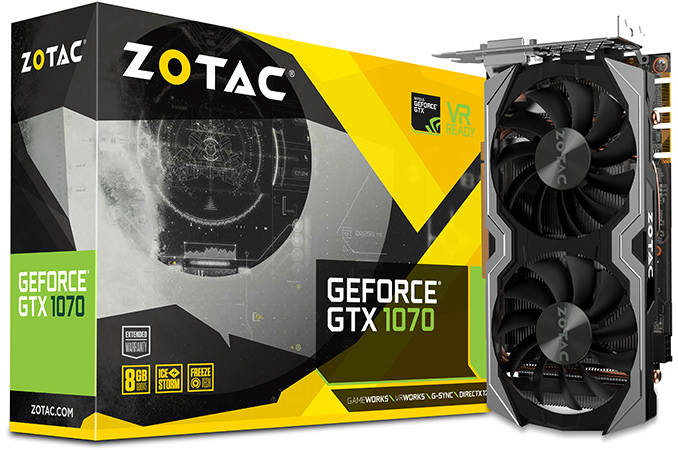
ZOTAC has added a small form-factor video card based on NVIDIA’s GeForce GTX 1070 GPU to its lineup of products. The graphics adapter is designed for Mini-ITX PCs and will be the second product of such kind on the market after GIGABYTE’s GeForce GTX 1070 Mini-ITX released earlier this year. From performance and connectivity point of view, ZOTAC’s GeForce GTX 1070 Mini (ZT-P10700G-10M) card resembles larger designs by other companies: the GP104 GPU (with 1920 stream processors, 120 texture units and 64 raster operations pipes) operates at 1518/1708 MHz (base/boost), 8 GB of GDDR5 memory function at 8 Gbps data rate and deliver 256 GB/s of bandwidth. Meanwhile the card is equipped with three DisplayPort 1.4 connectors, an HDMI 2.0b port as well as one dual-link DVI port, which is exactly what NVIDIA’s reference cards offer.
Despite the small size, the ZOTAC GeForce GTX 1070 Mini is equipped with a rather sophisticated cooling system (not exactly surprising because we are talking about a 150 W TDP here) featuring a copper base, two thick heat pipes, a relatively large aluminum radiator with thin fins as well as two 90-mm fans. The cooling system requires more space than coolers on other Mini-ITX graphics cards, but most of such builds have some extra space inside. The card requires one 8-pin auxiliary PCIe power connector to function, just like all the other GeForce GTX 1070 graphics adapters around.
ZOTAC does not disclose a lot of details regarding its Mini-ITX graphics cards and things like VRM design of the board remain unknown. NVIDIA’s reference GeForce GTX 1070 comes with a 4+1 phase VRM, but GIGABYTE’s GeForce GTX 1070 Mini-ITX actually has a 5+1 phase VRM design (more VRMs has various positive and negative effects and doesn't specify the quality of such components in a number alone).
When it comes to price, the ZOTAC GeForce GTX 1070 Mini costs $395 at Amazon and Newegg, which is a bit more expensive than NVIDIA’s reference GTX 1070 graphics adapters, but is still more affordable than the GTX 1070 Founders Edition. Related Reading: | ||||||||||||||||||||||||||||||||||||||||||||||||
| 3:00p | GALAX Shows Off Phison PS5008-E8 SSD with 3D NAND
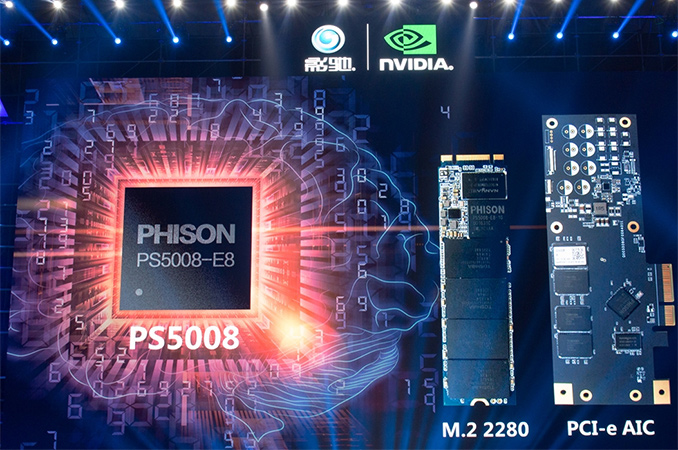
GALAX is a relatively well-known name in the world of video cards because the company offers a lot of non-reference graphics based on NVIDIA GeForce GPUs. In the recent years, Palit Microsystems, the parent company of GALAX and one of the largest makers of graphics cards, decided to expand GALAX’s business with SSDs and memory modules. At an event in China this past week, GALAX demonstrated/announced one of the industry’s first SSDs based on Phison’s PS50008-E8 controller. Just like many other newcomers, GALAX does not develop its SSDs itself, but buys turnkey platforms from other makers, such as Phison, which sells controllers along with memory and firmware. At present, GALAX lists three 120 – 240 GB MLC NAND-based SATA drives on its website: one SSD is powered by the Phison PS3109-S9 controller, another drive featuring the PS3110-S10 as well as the third model that uses a controller by JMicron. The contemporary drives from GALAX target entry-level PCs, but in the coming months, the company plans to expand its SSD lineup with at least two more advanced offerings based on Phison’s PS50008-E8 controller and Toshiba’s 3D NAND memory. GALAX made the announcement at an event in China and did not disclose all the details about the new drives except the fact that they will come in M.2-2280 as well as PCIe AIC form-factors and will use a PCIe 3.0 x2 interface. Phison’s PS5008-E8 controller is compliant with the NVMe 1.2 specification, supports four NAND channels, a DDR3/DDR3L DRAM buffer, AES-256 encryption as well as Phison’s new error correction algorithm called StrongECC, however exact features on the GALAX model will be up to its product team. The controller is compatible with MLC and TLC NAND flash made using 15 nm and 16 nm process technologies as well as 3D NAND memory. Phison started to sample its PS5008-E8 controller with select customers in Q3 2016, so SSDs based on the chip are unlikely to hit the market this quickly (we expect Q2 onward). On the other hand, Toshiba’s 64-layer 3D NAND is not yet available in mass quantities, which is why Phison, GALAX and other suppliers of SSDs have time to polish off their products based on the PS5008-E8. Given the number of NAND flash channels supported by the Phison PS5008-E8 as well as its PCIe 3.0 x2 bus, SSDs using the controller will only target entry and mainstream PCs. On the other hand, GALAX’s partnership with Phison would enable the company to introduce more powerful SSDs based on the PS5007-E7 controller with Toshiba’s MLC NAND and PCIe 3.0 x4 bus aiming at the high end of the market. GALAX did not reveal when it expects to release its new SSDs featuring the PS5008-E8 chip, but given the state of Toshiba’s 3D NAND, it is unlikely that this is set to happen earlier than in mid-2017. Related Reading:
| ||||||||||||||||||||||||||||||||||||||||||||||||






| << Previous Day |
2016/12/21 [Calendar] |
Next Day >> |