[Most Recent Entries] [Calendar View]
Wednesday, December 28th, 2016
| Time | Event |
| 12:01a | Lenovo Updates The ThinkPad Lineup: New Models, Welcome Changes
Today Lenovo is announcing a refresh of most of its ThinkPad lineup, and although the model numbers have only changed a bit, there are some very welcome changes to the lineup as well. Since most of the lineup is just being refreshed, we’ll go over what’s new on a holistic level. Lenovo’s ThinkPad lineup is one of the most well known lineup of laptops around. They’ve been the business focused lineup in Lenovo’s laptop arsenal for some time, and the ThinkPad is a staple in many businesses and enterprises. For 2017, Lenovo has done a gentle retouch of most of the product lineup, brining about some new technology and other changes. The first big announcement is that Lenovo is launching Intel Optane caching drives on select ThinkPad models. We’ve followed the development of this new non-volatile storage solution for some time, and please check out the full write-up on this announcement of shipping 3D XPoint here. Due to the small storage capacity, these initial Optane M.2 drives will be used for HDD caching on several ThinkPad models, including the ThinkPad T470p, L470, L570, T470, and T570. Lenovo is also switching to the Microsoft Precision TouchPad drivers, for a more consistent experience across devices. This is certainly a welcome change, and it’s great to see more companies leverage this. Precision TouchPad is continuously being updated by Microsoft as well. The software side is only half of the story of course, but it’s a big part of the experience. Still on the software side, Lenovo is also switching the entire ThinkPad lineup for 2017 to a Windows 10 Signature Edition image. This is excellent news not only for the home user, who won’t have to deal with gratuitous software which was not always needed or welcome, but for business users this should allow for faster deployment as well, since a custom image may not be required at all. After some of the news stories over the last couple of years, it is excellent to see a company shipping Signature Edition images right out of the box for an entire product lineup, and we can only hope this expands to the rest of Lenovo’s laptops. On the hardware front, other than Optane, Lenovo is making a big push for USB-C and especially Thunderbolt 3. With the addition of this port, Lenovo is able to offer some new accessories to provide an easier docking solution than the traditional docking station. ThinkPads have shipped with fingerprint readers for some time, and Lenovo is also supplementing the T470 and T570 with Windows Hello cameras, for facial recognition. This doesn’t replace the fingerprint, but gives another option for end users. Possibly the most interesting news of all is that Lenovo is going to be offering some ThinkPad models in a new silver color, alongside the traditional matte black. Although this could be blasphemy to some, the new color looks great in the images provided, and hopefully we’ll be able to get some hands-on time with them at CES and see how it looks in person. ThinkPad Yoga 370
As far as new models, Lenovo is launching the ThinkPad Yoga 370, which is a 13.3-inch FHD version of their ThinkPad Yoga lineup, which previously consisted of the 12.5-inch Yoga 260 and 14-inch Yoga 460. The ThinkPad Yoga 370 offers an integrated pen which docks inside the laptop, as well as Thunderbolt 3, and it will be offered in black or silver with availability in March 2017, starting from $1264. ThinkPad T470
The T470 is one of the new models to feature an optional Intel Optane 16 GB cache drive, and it also will have a touch fingerprint reader and Windows Hello camera option. Thunderbolt 3 is also here on the 14-inch laptop, along with a GeForce 940MX GPU and up to 32 GB of DDR4. It continues to feature the split battery, with a 23 Wh in the front and a removable 48 Wh or 73 Wh battery in the rear. It will be available in February starting at $914 ThinkPad T570
The 15.6-inch T series is similar to the T470 in that it will offer Thunderbolt 3, fingerprint, IR camera, and Intel Optane caching, and it also keeps the dGPU with the GeForce 940MX, but the larger model can also be had with a UHD display (3840x2160) in addition to the standard FHD (1920x1080) version. It will be available in March starting at $909. ThinkPad T470s
The ThinkPad T470s continues to get slimmer and lighter. What was once a slightly lighter T series is now a 14-inch notebook that is under three pounds, with the latest version just 2.9 lbs. It can be had with up to 24 GB of memory, with 8 GB soldered on and a single DIMM available for another 16 GB. It still features Ethernet, along with Thunderbolt 3 and up to 1 TB of PCIe SSD. The thinner T series is also available in silver, with availability in February starting at $1099. ThinkPad T470p
The p model is for performance, with 45-Watt CPUs instead of the U series found in the slimmer and lighter notebooks. This is combined with the GeForce 940MX, and up to 32 GB of DDR4. The T470p is also available with the 16 GB Intel Optane caching drive, and split batteries with up to 12 hours of battery life with the larger 72 Wh battery in the rear. The T470p will be available in March starting at $1049. ThinkPad 13
The ThinkPad 13 is Lenovo’s value offering, and it will be available in January for a starting price of $674. For less than $700, it will feature Intel Kaby Lake processors, with up to 32 GB of DDR4 with 2 DIMM slots, and up to 512 GB of PCIe storage. The display is a FHD 1920x1080 touch version, and it features 3 USB 3.0 ports, USB-C which doubles as a charging port, dTPM 2.0, and a SD card reader. It’s 19.1mm thick and weighs 3.17 lbs. It will also be offered in black or silver. ThinkPad L470
The L series is positioned as the mainstream business value lineup, and they slot in for a bit less money than the T series. The L470 is a 14-inch FHD IPS model, and it also features optional Intel Optane caching, and 2 DIMMS for up to 32 GB of RAM. It keeps the split batteries as well, offering up to 95.5 Wh of battery capacity. In addition, it adds a discrete GPU in the Radeon R5 M430. It will be available in March starting from $799. ThinkPad L570
This 15.6-inch laptop is quite a bit different than the similarly named L470, in that it doesn’t have the split battery, or discrete graphics. It has a single 48 Wh battery, along with optional Intel Optane caching or SSD drives. The base model is a 1366x768 TN display, so be careful, although there is a FHD IPS offering as well. It features a dedicated number pad and optical drive, and it can be had with up to 32 GB of DDR4 with the 2 DIMM slots, and will be available in March starting at $809. ThinkPad X270
This 12.5-inch ThinkPad has been around for quite a while now, and the latest version adds USB-C for power, display, and data. RAM options are 4 to 16 GB of DDR4, and storage is up to 2 TB of HDD or 512 GB PCIe SSD. It offers the ThinkPad split battery with 23 Wh in the front and 48 or 72 Wh in the rear. With the largest battery, Lenovo claims up to 21.4 hours of battery life. It comes in at 2.9 lbs, with availability in March from $909 Gallery: ThinkPad Refresh 2017
      |
| 12:01a | Lenovo Launches New ThinkPad Accessories: Docking And Displays
Along with a refresh of the ThinkPad lineup, Lenovo is also offering several new accessories to compliment the new laptops. There are two new docks, and two new displays, each offering at a minimum USB-C connectivity to simplify connections. ThinkPad Thunderbolt 3 Dock
It’s great to see more Thunderbolt 3 docking solutions on the market. Thunderbolt 3 offers up to 40 Gbps full duplex, which gives a lot more options for IO than ever before. It can natively support two DisplayPort 1.2 streams, for up to two UHD displays at 60 Hz each, and because it’s done over USB-C, it can leverage the 100 Watts of power delivery from that port. Since the ThinkPad Thunderbolt 3 dock is meant for business uers, some of the port selections may seem odd, but are still required by many organizations. The Thunderbolt 3 dock offers two DisplayPort ports, HDMI, VGA, five USB 3.0 ports with one of these always powered, Gigabit Ethernet, headset jack, and a Thunderbolt 3 port over USB-C, meaning you won’t lose your USB-C port when docking with this.
The dock ships with a 135-Watt AC Adapter, which provides up to 65W of power to the laptop, and the remainder for powering the accessories. There is also a power button on the dock to control the ThinkPad power state when docked, which is nice since the laptop could easily be closed when docked. As far as display outputs, this dock will drive up to three UHD displays, but in that scenario only one will be at 60 Hz, since both of the DisplayPort outputs are from a single DP 1.2 stream. The third display would be driven off the Thunderbolt 3 output. It can drive two UHD displays at 60 Hz though, which is a much more likely scenario anyway.
The Gigabit Ethernet port also supports PXE boot and Wake-On-LAN for select ThinkPad systems. The ThinkPad Thunderbolt 3 Dock will be available in February for $279.99. ThinkPad USB-C Dock
If your laptop has USB-C Gen 2, but not Thunderbolt 3, then this dock offers a subset of the Thunderbolt 3 versions features, due to the more limited bandwidth of USB 3.1 Gen 2. It still offers two DisplayPort outputs, along with VGA, and 3 USB 3.0 ports, 2 USB 2.0 ports, 1 USB Type-C port, Gigabit Ethernet, and a headset jack. This dock ships with a 90-Watt AC Adapter, offering up to 60W of power to charge the laptop. The display options are much more limited than the Thunderbolt 3 option due to the limited bandwidth. A single UHD display can be driven but only at 30 Hz, or dual 1920x1080 displays at 60 Hz. The Gigabit Ethernet port still offers PXE boot and Wake-On-LAN support for select ThinkPad systems.
The ThinkPad USB-C Dock will be available in January for $199.99. ThinkVision P24h and P27h Displays
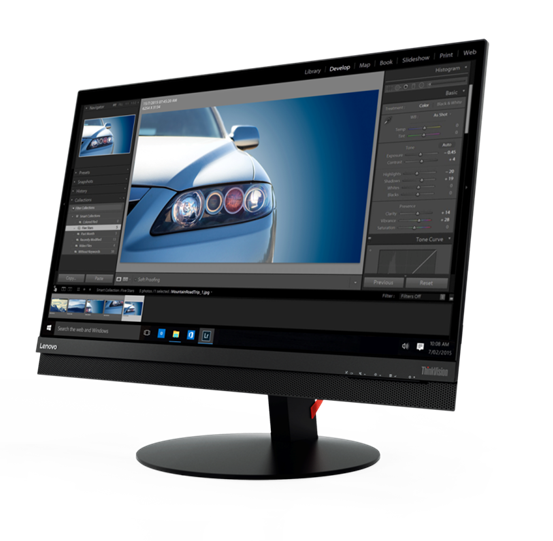
Lenovo is also launching two new ThinkVision displays, which offer the same features in either a 23.8-inch or 27-inch model. These thin bezel IPS displays both offer QHD (2560x1440) resolution and factory-calibrated sRGB color gamut. Whether this means per-panel or per-batch is unknown, but it’s good to see a focus on improved color accuracy rather than just quoting gamut coverage values. Both displays offer two HDMI inputs, DisplayPort input, DisplayPort output for daisychaining, and a USB-C offering for a single cable connection. There are also five USB 3.0 ports, with four down and one up, with the USB now on the edge of the display for easier access. The stand features adjustable height, tilt, swivel, and pivot of plus or minus 90° and there is a ThinkCenter TINY desktop connector as well. With the USB-C option, and four USB 3.0 ports, the display could be easily used as a single cable docking solution, and the display will offer up to 45W of power delivery to charge a laptop.
Both of these displays will be available in March 2017, with the P24h priced at $259 and the P27h priced at $329. Source: Lenovo |
| 12:04a | Kaby Lake Systems With Intel Optane SSDs Coming Soon
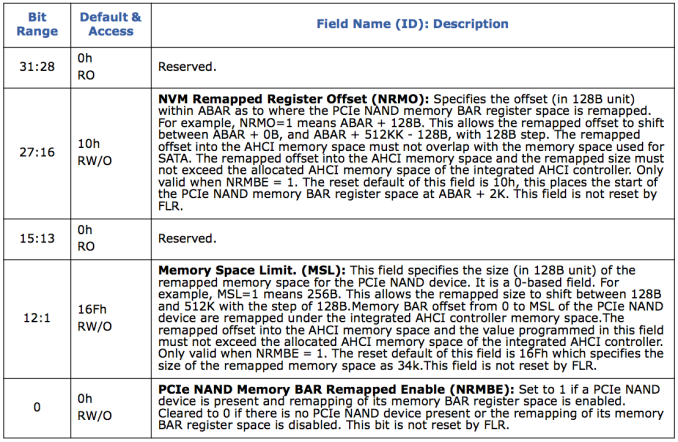
Lenovo's announcement today of a new generation of ThinkPads based on Intel's Kaby Lake platform includes brief but tantalizing mention of Optane, Intel's brand for devices using the 3D XPoint non-volatile memory technology they co-developed with Micron. Lenovo's new ThinkPads and competing high-end Kaby Lake systems will likely be the first appearance of 3D XPoint memory in the consumer PC market. Several of Lenovo's newly announced ThinkPads will offer 16GB Optane SSDs in M.2 2242 form factor paired with hard drives as an alternative to a using a single NVMe SSD with NAND flash memory (usually TLC NAND, with a portion used as SLC cache). The new Intel Optane devices mentioned by Lenovo are most likely the codenamed Stony Beach NVMe PCIe 3 x2 drives that were featured in roadmap leaked back in July. More recent leaks have indicated that these will be branded as the Intel Optane Memory 8000p series, with a 32GB capacity in addition to the 16GB Lenovo will be using. Since Intel's 3D XPoint memory is being manufactured as a two-layer 128Gb (16GB) die, these Optane products will require just one or two dies and will have no trouble fitting on to a short M.2 2242 card alongside a controller chip. The new generation of ThinkPads will be hitting the market in January and February 2017, but Lenovo and Intel haven't indicated when the configurations with Optane will be available. Other sources in the industry are telling us that Optane is still suffering from delays, so while we hope to see a working demo at CES, the Optane-equipped notebooks may not actually launch until much later in the year. We also expect the bulk of the initial supply of 3D XPoint memory to go to the enterprise market, just like virtually all of Intel and Micron's 3D MLC NAND output has been used for enterprise SSDs so far. Support for Intel Optane branded devices based on 3D XPoint memory technology has long been bandied about as a new feature of the Kaby Lake generation of CPUs and chipsets, but Intel has not officially clarified what that means. The plan of record has always been for the first Optane products to be NVMe SSDs, but NVMe is already thoroughly supported by current platforms and software. Because Optane SSDs will have a significantly higher price per GB than NAND flash based SSDs, the natural role for Optane SSDs is to act as a small cache device for larger and slower storage devices. The "Optane support" that Kaby Lake brings is almost certainly just the addition of the ability to use NVMe SSDs (including Optane SSDs) as cache devices. At a high level, using Optane SSDs as a cache for hard drives is no different from the SSD caching Intel first introduced in 2011 with the Z68 chipset for Sandy Bridge processors and the Intel Rapid Storage Technology (RST) driver version 10.5. Branded by Intel as Smart Response Technology (SRT), their SSD caching implementation built on the existing RAID capabilities of RST to use a SSD as a block-level cache of a hard drive, operating as a write-back or write-through cache depending on the user's preference. For SATA devices, no hardware features were required but booting from RST RAID or cache volumes requires support in the motherboard firmware, and Intel's drivers have used RAID and SRT SSD caching to provide product segmentation between different chipsets. With the release of Skylake processors and the 100-series chipsets, Intel brought support for NVMe RAID to RST version 15. This was not as straightforward to implement as RAID and SRT for SATA drives, owing to the fact that the SATA drives in a RST RAID or SRT volume are all conveniently connected through Intel's own SATA controller and managed by the same driver. NVMe SSDs by contrast each connect to the system through general-purpose PCIe lanes and can use either the operating system's NVMe driver or a driver provided by the SSD manufacturer. In order to bring NVMe devices under the purview of Intel's RST driver, 100-series chipsets have an unusual trick: when the SATA controller is put in RAID mode instead of plain AHCI mode, NVMe devices that are connected to the PCH have their PCI registers re-mapped to appear within the AHCI controller's register space and the NVMe devices are no longer detectable as PCIe devices in their own right. This makes the NVMe SSDs inaccessible to any driver other than Intel's RST. Intel has provided very little public documentation of this feature and its operation is usually very poorly described by the UEFI configuration interfaces on supporting machines. This has caused quite a few tech support headaches for machines that enable this feature by default as it is seldom obvious how to put the machine back into a mode where standard NVMe drivers can be used. Worse, some machines such as the Lenovo Yoga 900 and IdeaPad 710 shipped with the chipset locked in RAID mode despite only having a single SSD. After public outcry from would-be Linux users, Lenovo released firmware updates that added the option of using the standard AHCI mode that leaves NVMe devices alone.
(excerpt from Intel 100-series chipset datasheet) In spite of the limitations and rough edges, Intel's solution does ensure reliable operation in RAID mode, free of interference from third-party drivers. It's certainly less work than the alternative of writing a more general-purpose software RAID and caching system for Windows that can handle a variety of underlying drivers. It also lays the groundwork for adding support for NVMe cache devices to Intel's SRT caching system. Intel's SRT already has caching algorithms tuned for 16GB to 64GB caches in front of hard drives, so now that they have a solution for mediating access to NVMe SSDs it is simple to enable using both features simultaneously. The changes do need to be added to both the RST driver and to the motherboard firmware if booting from a cached volume is to be supported. Backporting and deploying the firmware changes to Skylake motherboards should be possible but is unlikely to happen. In the years since Intel introduced SRT caching, another form of tiered storage has taken over: TLC NAND SSDs with SLC caching. NAND flash suffers from write times that are much longer than read times, and storing multiple bits per cell requires multiple passes of writes. To alleviate this, most TLC NAND-based SSDs for client PC usage treat a portion of their flash as SLC, storing just one bit per cell instead of three. This SLC is used as a cache to absorb bursts of writes, which are consolidated into TLC NAND when the drive is idle (or when the SLC cache fills up). Even TLC NAND has reasonably high read performance, so there is little need to use SLC to cache read operations. By contrast, Intel's Smart Response Technology has to cache access to hard drives, where both read and write latencies are painfully high. This means SRT has to balance keeping frequently-read data in the cache against making room for a burst of writes. Having a lot of static data hanging around on the cache device will cause significant write amplification to result from any wear leveling, but SRT already reduces the write load by having sequential writes bypass the cache. Taking into account that 3D XPoint memory can handle millions of write operations per cell, even a small 16GB cache device should have no trouble with endurance. |
| 10:00a | The GIGABYTE Z170X-Ultra Gaming & Z170X-Designare Motherboard Review In this review we are having a look at GIGABYTE's Z170X-Ultra Gaming and Z170X-Designare, motherboards that were designed with a way of bringing U.2 support to the market. The two motherboards share many similarities, yet also several important differences, which we will examine and compare to other products currently available in the market. |
| 6:00p | South Korea Fines Qualcomm $865 Million for Anti-Trust Violations
Word comes out of South Korea today that the country’s antitrust regulatory authority, the Korean Fair Trade Commission (KFTC), has ruled against Qualcomm in an ongoing antitrust investigation and is fining the company $865 million. The product of a 3 year investigation, the KFTC has ruled that Qualcomm abused their market position with respect to how and to whom they licensed out access to various important cellular patents, refusing to license certain patents and unnecessarily bundling others. This latest fine from South Korea comes as Qualcomm has been in the hot-seat with various nations’ regulators over the past couple of years, all of whom has been investigating Qualcomm for similar reasons. This includes China, who fined Qualcomm $975 million and imposed new licensing rules on the company back in February of 2015, and the EU, who still has their own antitrust investigation open. At the core of both cases has been how Qualcomm has handled and licensed its patent portfolio, and at times how this intersected with how the company sold & priced their own chips implementing those patents. South Korea’s ruling marks the second time Qualcomm has been fined by a national regulator for anticompetitive actions in the past couple of years, and is the second time altogether that the country has fined Qualcomm (they were also fined in 2009 in a dispute over CDMA; the appeal is still pending). Similar to last year’s case in China, the crux of the issue in the KFTC’s ruling appears to have been Qualcomm’s bundling of patents for chip customers, which the KTFC has ruled forced customers to license patents they did not need. Meanwhile the KFTC is also taking Qualcomm to task over their unwillingness to license standards-essential cellular technology patents to rivals, which restricted their ability to compete with Qualcomm. As it would not be possible to build standards-compliant modems without infringing on those patents, competing products would be open to lawsuits from Qualcomm. Along with the $865 million fine, the KFTC is also ordering Qualcomm to change their business practices to put an end to their illegal behavior. This includes ending patent bundling and renegotiating patent licensing deals with customers if requested, and to properly negotiate the licensing of patents with rivals on a good faith basis. In a response to the KFTC’s ruling, Qualcomm has released their own statement, stating that they disagree with KFTC’s ruling on the grounds that it violates international trade agreements, that no harm has been done to the market, and that the KFTC did not question Qualcomm’s licensing model in their previous CDMA investigation. Qualcomm has also said that once the formal written order from the KFTC comes out – a process that can take months – they will immediately appeal the order and the fine. Meanwhile it’s worth noting that this is the first such case where Qualcomm is appealing the ruling; in the China ruling, Qualcomm entered into an agreement with Chinese regulators to accept the fine and new patent licensing rules in order to end the investigation.
|








| << Previous Day |
2016/12/28 [Calendar] |
Next Day >> |