[Most Recent Entries] [Calendar View]
Friday, January 6th, 2017
- LG Announces 32UD99: 4K IPS Display with 95% DCI-P3, HDR and USB-C
- BenQ Launches the SW320: a 4K Display with HDR for Professionals
- Panasonic Develops IPS Panel with 1,000,000:1 Contrast Ratio, 1000 Nits Brightness
- EIZO Launches ColorEdge CG2730 and CS2730 2560×1440 Displays for Professionals and Prosumers
- Dell Introduces UltraSharp UP3017 30-Inch Professional Display with 16:10 Aspect Ratio and DCI-P3 Color Space
- Acer Introduces A Pair Of Predator Gaming Displays
- ASUS VA326H and VA326N-W: 31.5-Inch Curved 144 Hz FHD Displays for $399
- Samsung CFG70: Curved 144Hz Displays with Quantum Dot Backlighting and AMD FreeSync
- Dell Unveils UltraSharp U3417W: Makes Its Curved Display More Curved
- LG Announces the 34UC79G: 34-Inch Curved 21:9 Display with 2560 × 1080 Resolution, 144 Hz Refresh Rate for $700
- LG 38UC99 Announced: 37.5-Inch Curved 21:9 Display with 3840×1600 Resolution
| Time | Event | ||||||||||||||||||||||||||||||||||||||||||
| 7:00a | Kopin at CES 2017: 2K120 VR, Whisper Voice Recognition
If you’ve never heard of Kopin before, you’re probably like most people. Going into CES I had no idea what Kopin was, but it turns out that they’re actually a fairly significant company that has been around for decades working on microdisplay technology after spinning off from MIT’s Lincoln Labs. Naturally, as a spin-off of a DoD lab their primary revenue currently comes from the US government/DARPA, which is willing to fund rather expensive projects like microdisplay technology as it has applications in systems like the F-35 JSF, which has a Kopin microdisplay in the helmet along with microdisplays for systems like thermal weapon sights, night vision goggles, laser rangefinder/designators, TOW launcher sights, and advanced rifle sights like the Trijicon CCAS.
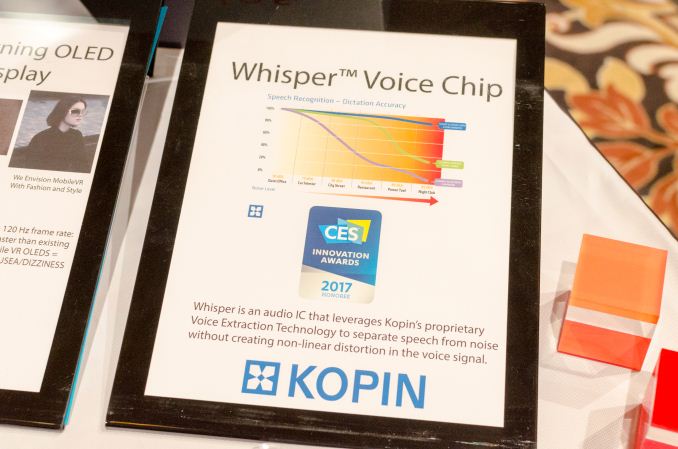
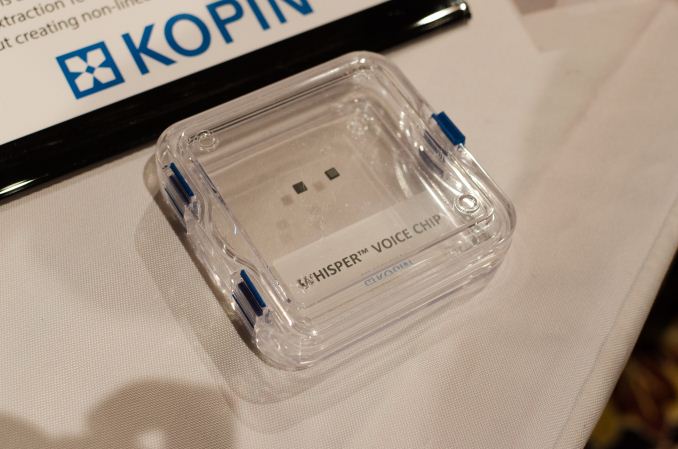
For CES, Kopin had a number of interesting new products to show off, chief among which was the Whisper voice chip. They were relatively cagey about discussing the specifics of implementation here but the essence is that rather than attempting to subtract out noise, Kopin’s approach attempts to extract out the voice signal to improve reliability for voice command applications. They claim this dramatically improves accuracy in high-noise environments relative to existing solutions commonly seen in smartphones, but I wasn’t able to necessarily prove this when playing around with a babble track and the demo equipment which was around 80 dBA. Power is said to be less than 10 mW and output uses the common i2s interface.
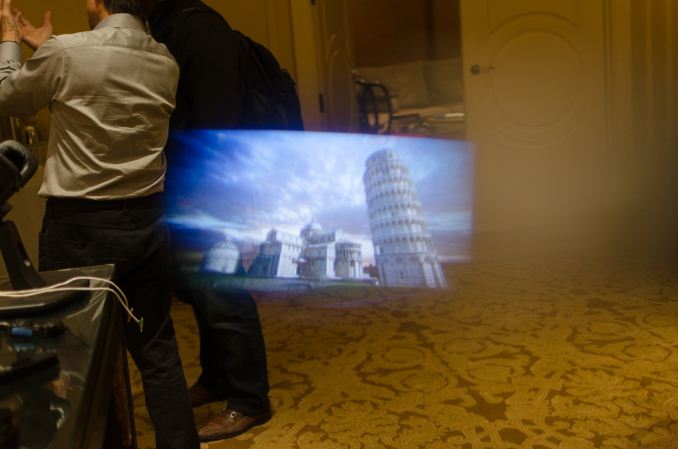
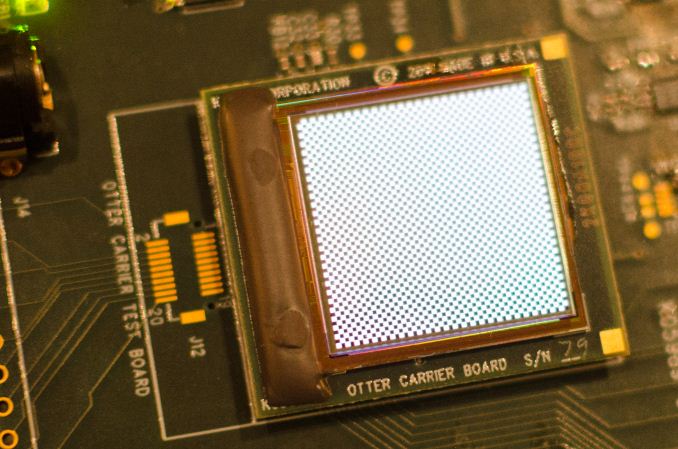
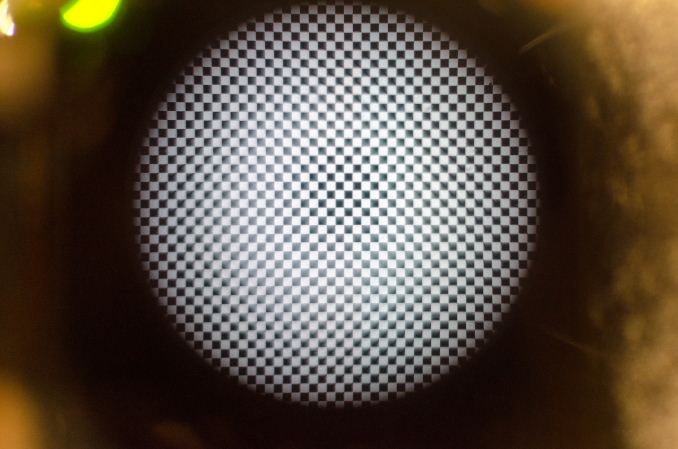
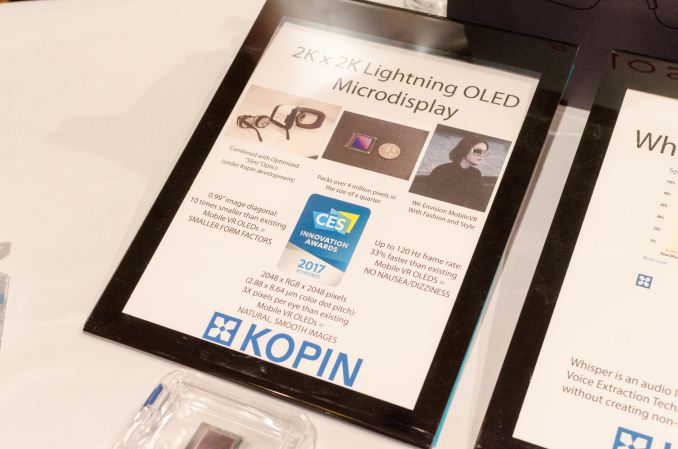
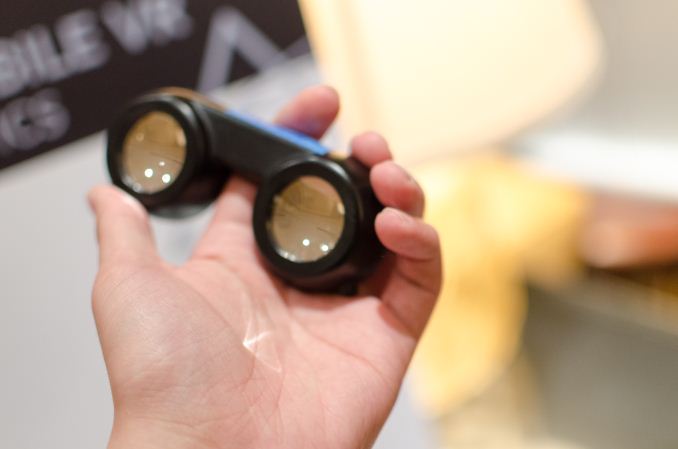
Probably the most interesting product shown was their OLED “Lightning” microdisplay designed for VR. With a 2048x2048 resolution and a 1 inch diagonal size it has 2925 pixels per inch and actually achieves this properly with red, green, and blue subpixels per pixel rather than two subpixel arrangements like PenTile. While they weren’t going to divulge the exact details on how this is achieved, in essence by creating the TFT backplane from a single crystal of silicon and slicing the substrate such that the wafer is only about 100 angstroms thick, the backplane is translucent and can be used to create the active matrix for LCDs and OLED displays.
This method also allows for common circuitry like the display driver to be integrated into the backplane which dramatically reduces bezel requirements. Of course, the cost of such methods is non-trivial so we won’t be seeing such methods in smartphones any time soon, but such displays can work for VR with the right optics. If you study the principles behind the design of semiconductor devices you’ll know that using polysilicon and/or amorphous silicon are going to adversely impact device properties due to defect states that impact things like recombination lifetime and carrier mobility. By using this single crystal silicon method, in addition to a high 2048x2048 resolution, the display refreshes at 120Hz with 10 microsecond latency and has a high fill factor above that commonly seen in smartphone AMOLED displays along with low power consumption.
Seeing is believing here, and I quite literally could not see anything resembling aliasing on the display even with a 10x loupe to try and look more closely at the display. The ultimate test here would be Vernier acuity, but due to the early state of the device it was simply running a demo loop of test patterns rather than any arbitrary displayed image. Using slow motion 240 FPS capture I was unable to see any flickering or similar issues.
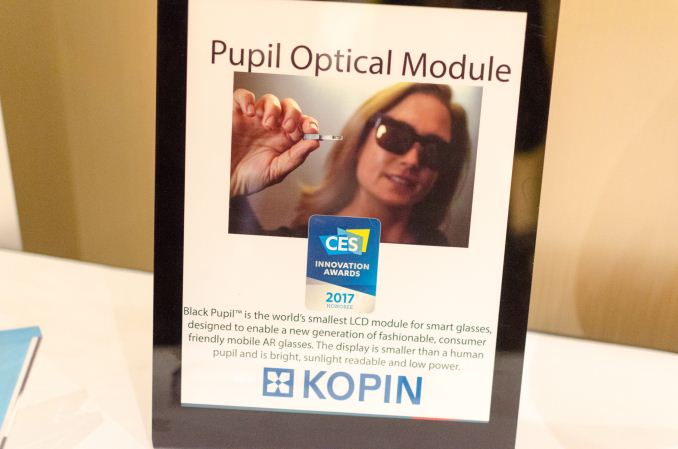
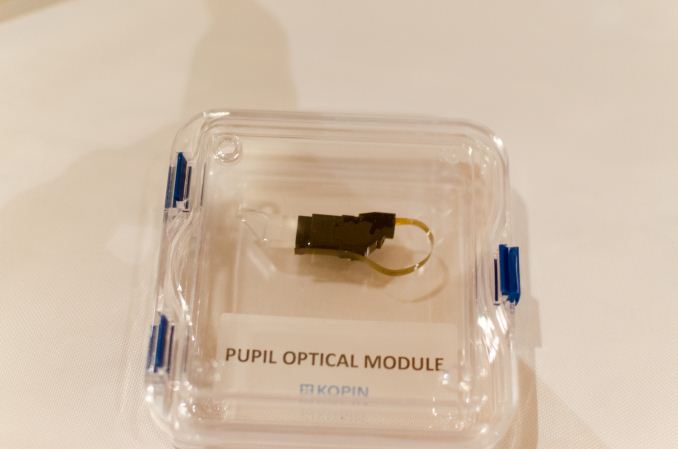
In addition to these announcements, Kopin also launched a new Pupil optical module which is said to be the smallest optical LCD module for smart glasses which seems to work fairly well when I tried it out. Resolution is nHD, or 640x360 but considering the size it’s within expectations. Overall, I try to find something truly interesting and innovative at CES every year and I think Kopin is one of the few companies really doing something that I haven’t seen before. | ||||||||||||||||||||||||||||||||||||||||||
| 8:00a | CES 2017: Ambarella Booth Tour
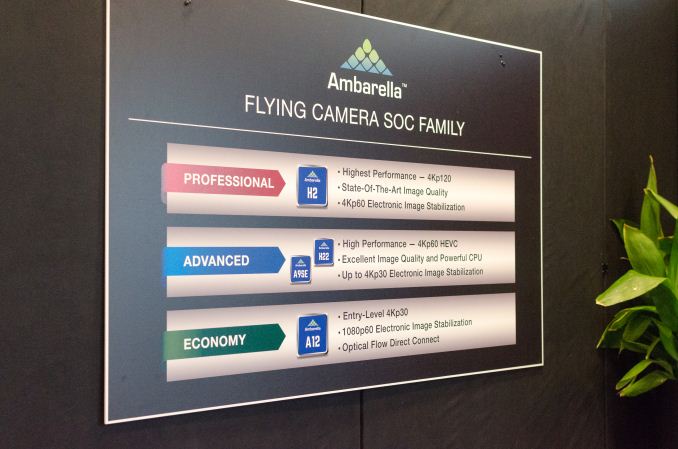
As usual, this year Ambarella had a number of interesting announcements and demos to show off. At a high level, the important announcements for this year are the H3 8K UHD video chip, H22 4K UHD drone/action camera chip, and the A9AQ automotive video chip with B6 serializer/deserializer companion chip that are AEC-Q100 qualified for automotive use. For those that don’t follow Ambarella too closely, the H3 SoC is the successor to the H2 SoC, going from 4K120 capture to 8K30 capture or dual 4K60 capture for things like 360 cameras and includes things like a quad core A53 for computer vision and other compute tasks to avoid a separate chip. EIS is now supported up to 4K60. Like the H2, 10-bit HDR is also available to improve performance.
For drones and similar devices that don’t require as much capability in the ISP department, the H22 SoC enables up to 4K60 in HEVC and EIS for 4K video, likely limited to 4K30. Like the H3, it also has a quad core A53 cluster with NEON for compute and similar tasks. For drone applications, it also supports the ability to provide a low latency 1080p output for things like drone racing applications.
The A9AQ SoC is specifically targeted at automotive applications and allows for three cameras to run off of a single chip which allows for digital rear and side view mirrors in a car and has features like HDR to provide better visibility in low light and high contrast, in addition to LED flicker mitigation to avoid flicker effects from LED streetlights and headlights. This chip also has the ability to stitch together various video feeds to provide a surround view with the cameras. To reduce cost, deserialization has been integrated into the A9AQ and the B6 allows for the parallel output of a camera up to 4K30 to be serialized for simplified implementation. Gentex is said to be using the A9AQ for their automotive rear vision systems so we should be seeing more systems like these in the near future to deal with the horrific rear visibility in modern cars. While not directly related to the A9AQ, it’s also worth noting that Ambarella is being used in OEM dashcam solutions as well which integrate directly into the car and require no setup to begin use unlike third party dashcams.
As usual, Ambarella’s booth had a number of interesting demonstrations to show applications of their various SoCs. It’s been found before but the Snapchat Spectacles use Ambarella’s SoCs to enable video capture and other features, and in addition to traditional markets like security cameras and dashcams, Ambarella’s chips are being used in things like police body cameras. A few of the interesting demos shown for traditional applications were things like object classification and fast camera shutdown for motion detection. In order to enable longer battery life for battery-powered security cameras, Ambarella has updated their software to detect relevant objects like humans and packages when determining whether to continue to record when the motion sensor is activated, which improves idle time as things like swaying trees won’t cause the camera to stay on all the time. This can also be applied to hardwired cameras to do things like intelligent notification for package drop-off and similar applications.
Another interesting demonstration shown for security camera use was dynamic bit rate for HEVC, which helps to reduce storage consumption and Ambarella’s reference design for 360 cameras. These aren’t necessarily the most eye-catching things, but stuff like this helps with getting real products to market that have good user experience.
As for eye-catching demos, it’s fairly interesting to see things like LED flicker mitigation in action, as well as comparisons between things like Qualcomm Snapdragon video encode and EIS quality when compared against even something like the Ambarella A9SE which falls somewhere around the mid-range for their line-up. I’ve mentioned my concerns with the Snapdragon 820 video quality before so this probably isn’t a surprise for those that follow such things but it’s rather shocking when you see the difference side by side.
The final demo of note was the ability for Ambarella SoCs to have a direct low-latency digital feed to an external source, which is quite interesting as it seems that things like Connex and DJI’s Lightbridge are in a similar space but I suspect that given that Ambarella is in the business of selling SoCs rather than an end to end solution that they will be able to help enable more open/standard solutions at lower cost here. Latency is said to be below 10ms which should be getting close enough that it’s quite usable. Overall, it looks like a lot of the demos that we saw from last year have finally reached maturity and can begin the process of being integrated into consumer products which is impressive to see. | ||||||||||||||||||||||||||||||||||||||||||
| 8:30a | ASUS Announces ZenFone AR and ZenFone 3 Zoom
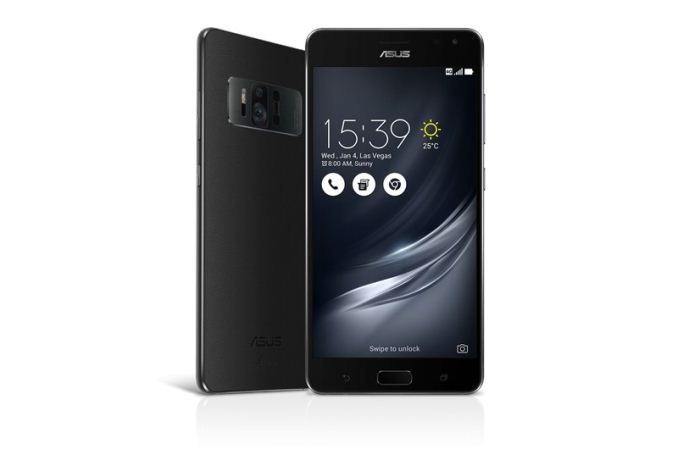
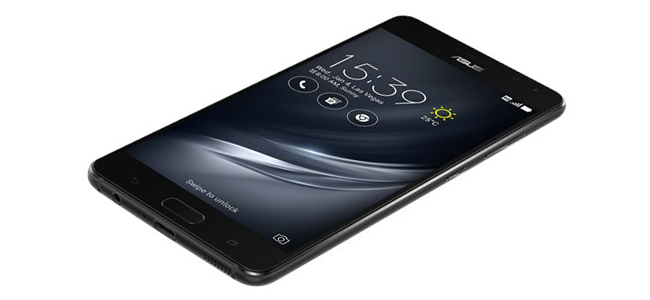
ASUS recently announced two new smartphones: the ZenFone AR and ZenFone 3 Zoom. Each phone has an array of cameras that provide advanced imaging features such as simulated depth of field and augmented reality (AR). The ZenFone AR is the first smartphone that supports both Google’s Tango AR technology and Daydream VR. Tango, which has been in development for some time and recently debuted in Lenovo’s Phab 2 Pro, gives the ZenFone AR motion tracking, depth perception, and environment mapping capabilities, allowing you to do things like measure physical objects, play new interactive games, or view maps and other relevant data overlaid on the environment shown on the phone’s 5.7-inch QHD SAMOLED screen.
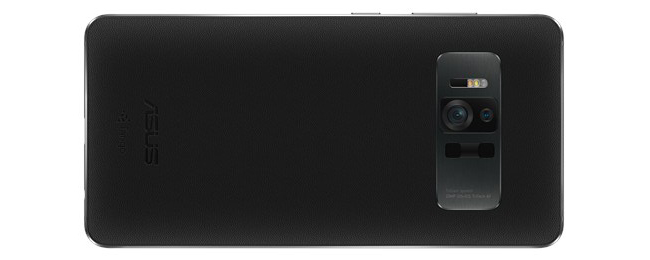
The phone’s AR and imaging experiences are enabled by ASUS’ TriCam system that combines a motion tracking camera, a depth camera that’s paired with an infrared illuminator, and a 23MP Sony IMX318 Exmor RS primary camera paired with an f/2.0 lens. It also has 4-axis OIS to help steady the camera during long exposures, a color spectrum sensor to improve white balance accuracy, and a hybrid autofocus system that combines dual-pixel phase detection (2PDAF), laser, and contrast based AF that should provide good performance in a range of lighting conditions. ASUS claims the camera can focus in as little as 0.03 seconds in ideal conditions. The front camera uses an 8MP sensor and includes its own LED selfie flash.
Inside the ZenFone AR is a Snapdragon 821 SoC that includes two of Qualcomm’s custom Kryo CPU cores running at up to 2.35GHz and another two Kryo cores that can reach 2.19GHz. The Hexagon DSP provides the six degree of freedom position tracking used by Tango. Because of the high demands placed on all the processors inside the SoC (CPU, GPU, DSP, ISP) when running AR and VR applications, the ZenFone AR includes a heat pipe to help keep things cool. It will be interesting to see how this cooling solution works and if it proves sufficient to keep the SoC from throttling during heavy use. The SoC is paired with either 6GB or 8GB of RAM. There’s also several internal storage tiers starting at 32GB and ranging all the way up to 256GB, with the option to expand storage further with a microSD card. It only comes with a 3300mAh battery, however, which seems a bit small for a 5.7-inch phone that’s intended to run power-hungry VR/AR applications.
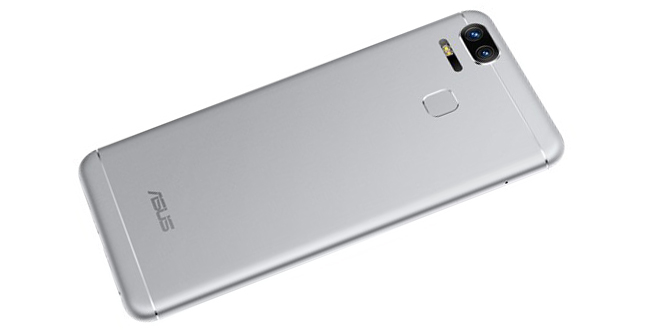
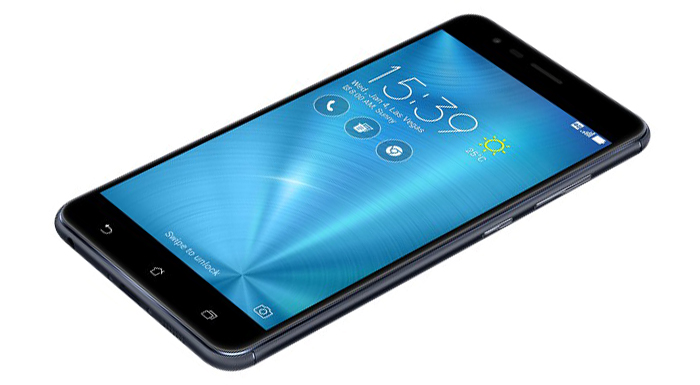
The aluminum frame has chamfered edges around the front and back. A power button and volume rocker are on the right edge, while the USB Type-C port, 3.5mm headphone jack, and single downward-firing speaker are all located on the bottom edge. The back is covered in charcoal-colored leather, with the serious-looking camera module with a stainless steel surround being the dominant feature. The front is covered edge-to-edge with Gorilla Glass 4. The pill-shaped home button doubles as a capacitive fingerprint sensor and is flanked by capacitive back and recent apps buttons. The ZenFone 3 Zoom does not support Tango or Daydream. Instead it focuses exclusively on photography. It uses two rear cameras with different focal lengths to provide what ASUS calls 2.3x optical zoom. This does not work like a true zoom lens, however, which can smoothly adjust focal length between its extreme settings. The ZenFone 3 Zoom simply switches between the two cameras in addition to performing digital zoom.
The wide angle camera has a 25mm equivalent focal length that captures a wider field of view but makes objects appear smaller and farther away than they appear to the naked eye. The zoom camera has a 59mm equivalent focal length that makes objects appear slightly larger and closer relative to what your eye sees but has a more restricted field of view. Having a second camera without a wide angle lens is actually very useful in many situations. This approach is similar to what Apple used for the iPhone 7 Plus’ dual camera system. The wide angle camera uses a 12MP Sony IMX362 Exmor RS sensor with large 1.4µm pixels. It has a six element lens with a large f/1.7 aperture that lets more light reach the sensor, boosting low-light image quality. It also includes OIS and a color spectrum sensor like the ZenFone AR, along with the same hybrid autofocus system that combines dual-pixel phase detection (2PDAF), laser, and contrast based AF. The zoom camera, which has a five element lens array, also uses a 12MP sensor; however, ASUS didn’t provide any further details, so it’s not clear if it also has OIS and the same hybrid AF system. There’s also a 13MP selfie camera that uses the screen for a flash.
The ZenFone 3 Zoom makes due with a Qualcomm Snapdragon 625 SoC that has an octa-core Cortex-A53 CPU running at up to 2.0GHz. It also has half the amount of RAM as the ZenFone AR, with 3GB or 4GB options available. You can also choose between 32GB, 64GB, or 128GB of internal storage that’s expandable via microSD. Besides the dual rear camera, the ZenFone 3 Zoom’s other standout feature is its large 5000mAh battery, which, when combined with the Snapdragon 625 and its A53 CPU cores on the 14nm LPP FinFET node, should deliver excellent battery life.
The aluminum uni-body chassis is available in three different colors: Glacier Silver, Navy Black, and Rose Gold. The sides and corners are nicely rounded, similar to the iPhone 7. There’s a color-matching capacitive fingerprint scanner on the back and capacitive navigation buttons on the front below the screen. Gorilla Glass 5 covers the 5.5-inch 1080p SAMOLED display, which ASUS claims reaches a peak brightness of 500 nits. The ZenFone 3 Zoom will be available in February, while the ZenFone AR will be available in Q2 2017. | ||||||||||||||||||||||||||||||||||||||||||
| 10:45a | ASUS VivoPC X: Core i5, GeForce GTX 1060, 512 GB SSD, 5-Liter Chassis, $799
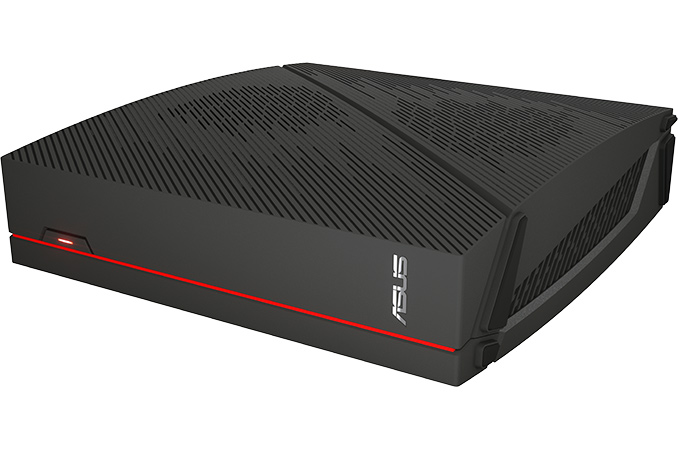
ASUS at CES has introduced its new game console-like PC that weds relatively high performance, compact dimensions and a moderate price tag. The new VivoPC X packs Intel Core i5 CPU and NVIDIA GeForce GTX GPU into a 5-liter chassis. Traditionally, ASUS has positioned its Vivo-series computers as miniature PCs for mainstream tasks, whereas ROG systems were designed for gamers and multimedia enthusiasts. With the release of the VivoPC X, the computer maker changes that positioning and offers an SFF gaming-grade system under the Vivo brand. The reasons for the decision are simple: sales of small form-factor PCs are growing and so are sales of machines for gamers. ASUS wanted to address both markets with computers at more or less mainstream prices and the VivoPC X is a result of this decision. The mini PC is positioned below the ROG GR8 II and its performance is lower, however, ASUS thinks that the combination of price and performance will satisfy many people looking for a console-like gaming PC. The ASUS VivoPC X M80 is based on the Intel Core i5-7300HQ (4C/4T, 2.5 GHz/3.5 GHz, 6 MB cache, HD Graphics 630, 45 W) mobile processor, the Intel HM175 PCH as well as NVIDIA’s GeForce GTX 1060 graphics processor with G-Sync support. Since many gamers demand to have the performance of an SSD and capacity of a hard drive, the system will be equipped with a 512 GB M.2 SATA SSD as well as a 2 TB HDD with 7200 RPM spindle speed. The PC also comes with 8 GB of DDR4-2133 memory. To cool down the system components, ASUS uses a custom cooling system consisting of a blower for the GPU and a large aluminum heatsink for the CPU.
When it comes to connectivity, the ASUS VivoPC X has four USB 3.0 Type-A ports, two USB 2.0 headers, Gigabit Ethernet, an IEEE 802.11ac Wi-Fi with BT 4.1 module, three display outputs (two HDMI and one DisplayPort), 5.1-channel audio with Sonic Suite software enhancements and so on.
The computer uses mobile PC components in a bid to keep its physical size small and power consumption low: its volume is about five liters and its power consumption is less than 230 W (it uses an external power brick to feed itself). Meanwhile, usage of such components also means that its future upgrades will be rather complicated if possible at all (for example, the GPU is soldered to the motherboard and is thus not upgradeable). The ASUS VivoPC X will be available in March, 2017, for $799. Related Reading: | ||||||||||||||||||||||||||||||||||||||||||
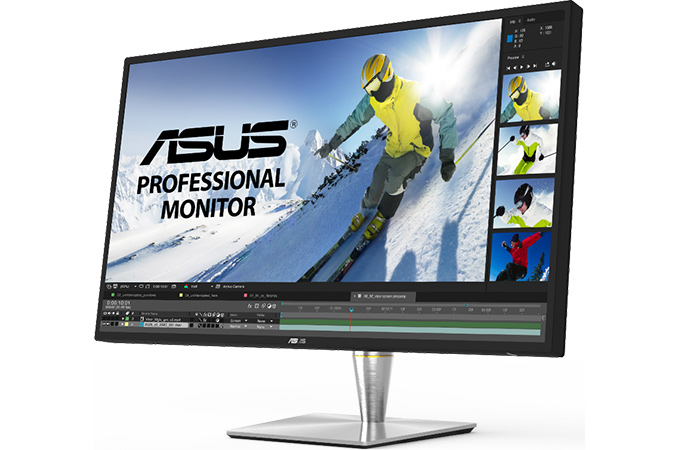
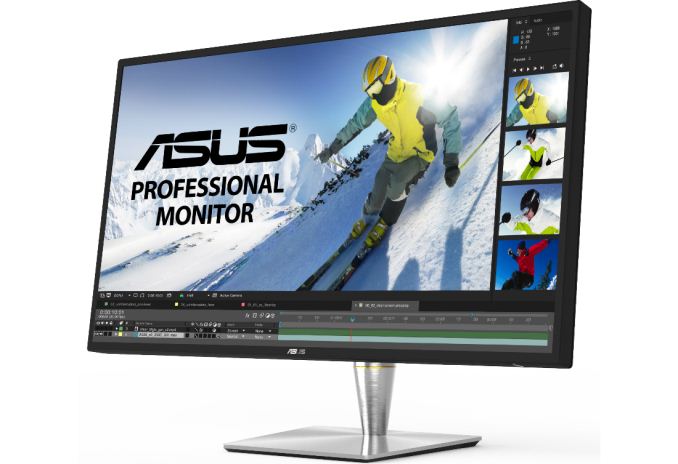
| 11:15a | ASUS ProArt PA32U Display: 4K, 1000 Nits Brightness, 95% DCI-P3, 85% Rec. 2020
ASUS introduced a new professional-grade monitor at CES this week. The unit supports a 4K (UHD) resolution, HDR10, a very high brightness and an astonishing range of color gamuts required by artists, designers, photographers and video professionals today, including the Rec. 2020 (BT.2020) standard. The ProArt PA32U will be available in the second half of this year at a rather hefty price tag, as you can imagine. In addition, ASUS announced its ProArt PA27AQ monitor aimed at the entry level segment of the professional market. The ASUS ProArt PA32U uses a 4K UHD panel with HDR capabilities, a quantum dot film and a special backlight featuring 384 LED zones that enable 1000-nit brightness and support for local dimming. The manufacturer notes that its new panel with quantum dots, backlighting and calibration enable the monitor to cover 99.5% of the Adobe RGB, 85% of the Rec. 2020, 100% of the sRGB and 95% of the DCI-P3 color spaces, which makes the display particularly appealing to artists and photographers (Adobe RGB) as well as to video editors and animation designers who do post-production work for digital cinema or TV (DCI-P3 and BT.2020). The number of features, as well as the use of quantum dot technology, represents an interesting combination for a professional display. Moreover, it looks like the ASUS ProArt PA32U will be one of the first mass-market monitors supporting the Rec. 2020 color gamut at all and covering 85% of it.
The ProArt PA32U monitor will be calibrated at the factory, but people with appropriate equipment will be able to further tune them their particular needs. The ProArt PA32U stores all the color parameters locally (and not on the PC), so users will be able to use it with different devices without the necessity to recalibrate it. This will be particularly valuable for those who works on Apple macOS and Microsoft Windows platforms. To hook up the monitor to either PC, the PA32U is equipped with a Thunderbolt 3 input (which means DP 1.2 over a USB-C cable), but we do not know whether other ports are supported. Since this is a preliminary announcement, ASUS does not disclose whether it uses an IPS or VA panel, or if the TFT is ASi or IGZO (like it used for its previous-generation flagship professional display) for its PA32U as well as details about the LUTs (look-up-tables), refresh rate and so on. We do understand that the panel is an LCD based on usage of quantum dots and high, but not prohibitively high, price. For people who do not need 4K UHD resolution, Rec. 2020 or DCI-P3 color spaces and HDR, ASUS plans to offer its 27” ProArt PA27 AQ monitor with 2560 × 1440 resolution, sRGB color gamut and Thunderbolt 3 input. The monitor will also come pre-calibrated and will support the same ProArt Calibration features as its bigger brother (color-accuracy tuning, uniformity compensation local store of parameters, etc.). The ASUS ProArt PA32U will be available in Q3 2017 for $1799 – $1999. Pricing of the ProArt PA27AQ (as well as its availability timeframe) are unknown.
Related Reading: | ||||||||||||||||||||||||||||||||||||||||||
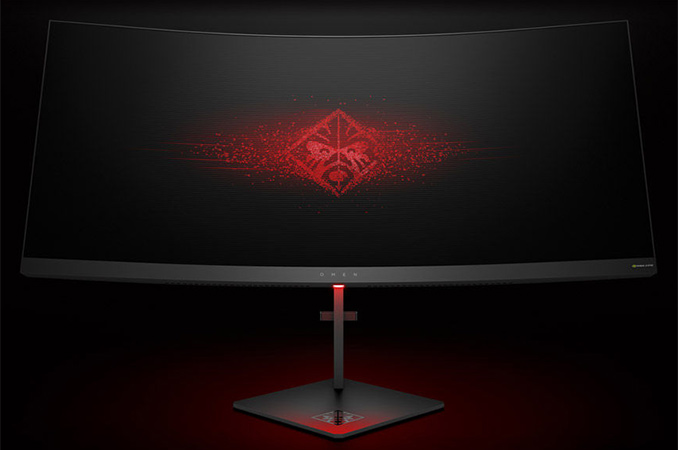
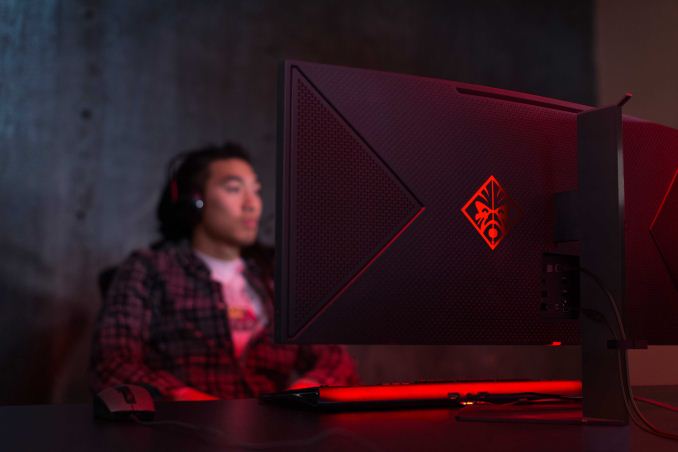
| 11:50a | HP Announces Omen X 35-Inch Curved Display for Gamers
HP at CES introduced its first ultra-wide curved display for gamers that belongs to the company’s Omen X lineup. The unit will be among the largest monitors from HP and also the company’s first one to support NVIDIA’s G-Sync technology. The release of the Omen X 35” screen emphasizes growing importance of gaming hardware for HP. The HP Omen X 35” display is based on an AMVA+ panel with 3440×1440 resolution, 300 nits brightness, 1800R curvature, a 2500:1 contrast ratio, a 100 Hz refresh rate and a 4 ms response time, which makes for an interesting combination of characteristics. To smooth the gaming process, the monitor supports NVIDIA’s G-Sync technology, but the maker does not disclose supported working range of the tech. HP says that the monitor can reproduce 16.77 million colors and supports 100% of sRGB color gamut, which is something logical to expect from a gaming display that will run primarily Microsoft Windows.
For connectivity, the Omen X 35” can use either a DisplayPort 1.2 or an HDMI 1.4 input. In addition, the monitor has a three-port USB 3.0 Type-A hub, an audio input and a headphone jack. Since the HP Omen X 35” is a premium monitor for gamers, it does not have integrated speakers because the majority of gamers use standalone audio systems or headphones.
HP will position its Ultra WQHD Omen X 35” as its top-of-the-range monitor for gamers and will price it accordingly, at $1300 when it becomes available in March. Curvature, 21:9 aspect ratio, thin bezel and NVIDIA’s G-Sync technology will be the main selling points of the monitor. At present, there is only one competing display with 3440×1440 resolution and similar features (the ASUS ROG SWIFT PG348Q), so, HP’s offering will be comparable with its direct rival and ahead of other suppliers. Meanwhile, the display will be covered by HP’s one-year limited warranty, which is considerably shorter than other suppliers of monitors provide.
| ||||||||||||||||||||||||||||||||||||||||||







| << Previous Day |
2017/01/06 [Calendar] |
Next Day >> |