[Most Recent Entries] [Calendar View]
Thursday, January 12th, 2017
- ASUS ProArt PA32U Display: 4K, 1000 Nits Brightness, 95% DCI-P3, 85% Rec. 2020
- ASUS VA326H and VA326N-W: 31.5-Inch Curved 144 Hz FHD Displays for $399
- AOC Launches the AG352QCX: 35-Inch 200 Hz 2560×1080 Curved Display with Adaptive-Sync
- BenQ Announces the ZOWIE XL2540: 24-Inch 240 Hz Full-HD Display 'for e-Sports'
- Samsung CFG70: Curved 144Hz Displays with Quantum Dot Backlighting and AMD FreeSync
| Time | Event | ||||||||||||||||||||||||||||||||||||||||||
| 3:30a | HTC Announces New Phones For U: HTC U Play and HTC U Ultra
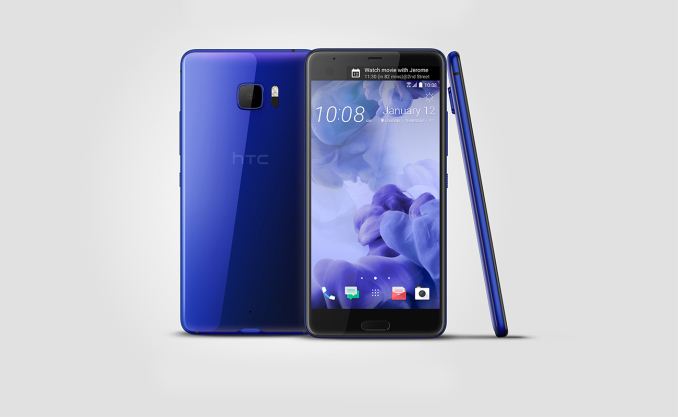
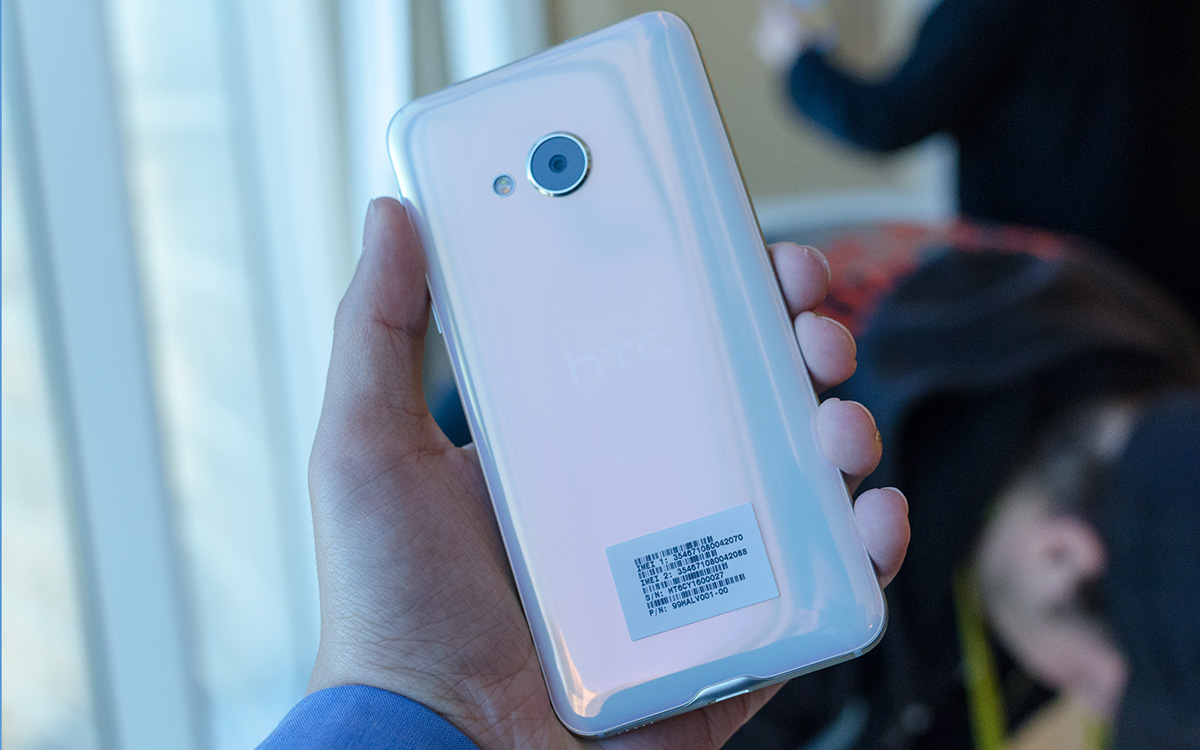
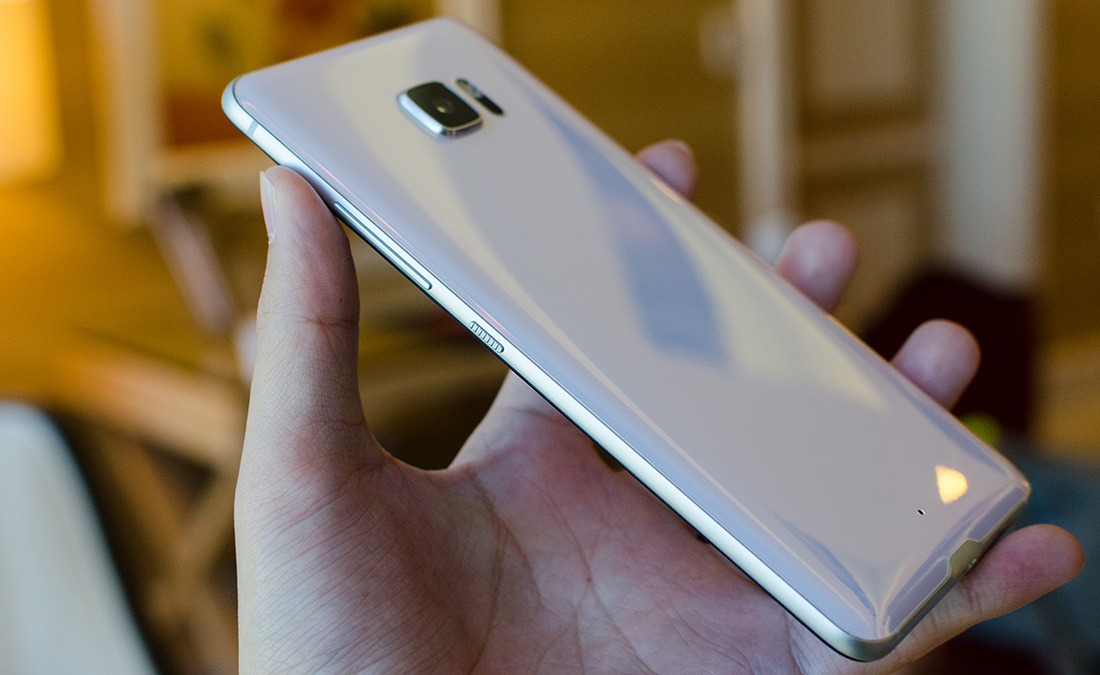
HTC added two new smartphones to its lineup today: the HTC U Play and HTC U Ultra. Both phones use an aluminum frame paired with a curved glass back, an unusual choice of materials for HTC, which has a reputation for creating nice-looking, aluminum unibody phones. Underneath the rear glass are layers of colored minerals that reflect light in interesting ways and add visual depth, creating what HTC calls a “liquid surface” that gives the phones an iridescent sheen. Each phone comes in four different colors: Brilliant Black, Cosmetic Pink, Ice White, and Sapphire Blue. Gallery: HTC U Ultra: Colors
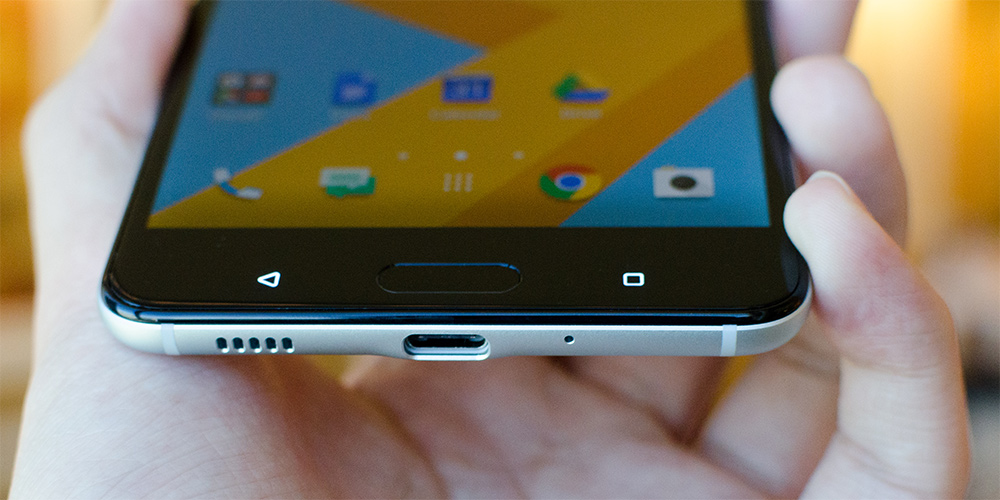
    Both phones have a single-piece volume rocker and highly textured power button on the right edge. There’s also a single downward-firing speaker and a microphone on the bottom edge. Unlike most phones that use a symmetrical pattern of slits to conceal these components, the HTC U phones just use a small circular hole for the microphone. Neither phone includes a 3.5mm headphone jack, instead using the USB Type-C port for audio.
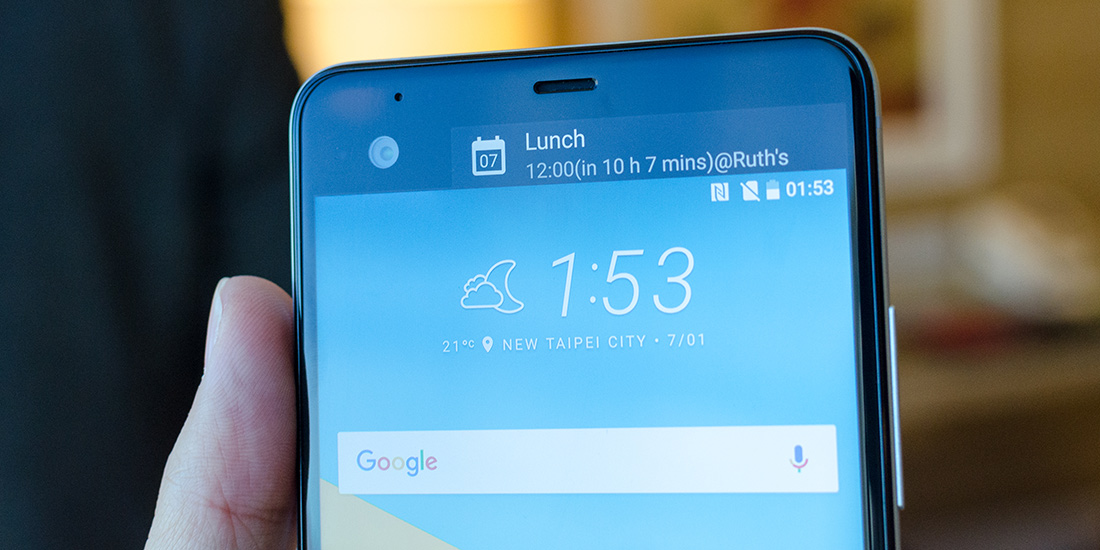
The smaller U Play comes with a 5.2-inch 1080p (423PPI) IPS LCD display that’s covered with Gorilla Glass. The more expensive U Ultra includes HTC’s “Dual Display” that combines a larger 5.7-inch 1440p (515PPI) IPS LCD with a secondary 2.0-inch 160x1040 IPS color LCD in the upper bezel, similar to LG’s V20. This secondary screen displays contextual shortcuts to favorite contacts or apps, reminders, and notifications among other things.
The HTC U Play has a 16MP rear camera with phase detect autofocus (PDAF) and optical image stabilization (OIS) paired with an f/2.0 lens that has a wide-angle 28mm equivalent focal length. The circular camera module sits proud of the rear glass and has a circular dual-tone LED flash offset to one side. Around front is a 16MP selfie camera that uses an UltraPixel branded sensor with larger pixels to boost low-light performance. It also has an f/2.0 lens and a wide-angle 28mm equivalent focal length that’s useful for squeezing more people into a group shot. Both the front and rear cameras have an automatic HDR mode that improves dynamic range for scenes with dark shadows and bright lights without user intervention.
The HTC U Ultra’s front-facing camera is similar to the U Play’s, but the rear camera uses a 12MP sensor with larger 1.55µm pixels. While the specifications are similar to the HTC 10’s rear camera, which generally produces high-quality images and uses the Sony IMX377 Exmor R sensor, the U Ultra is likely using the Sony IMX378 Exmor RS sensor that’s found in Google’s Pixel phones, because it includes an upgraded hybrid autofocus system that combines PDAF with laser AF, which the IMX377 sensor does not support, to improve performance over a broader range of lighting conditions. The U Ultra’s rear camera has OIS to help remove hand shake during long-exposure shots and is paired with a larger aperture f/1.8 lens that should help it capture more light. The U Ultra’s rear camera module is square and sticks out farther than the U Play’s camera, which is likely a consequence of using a lens with a larger aperture.
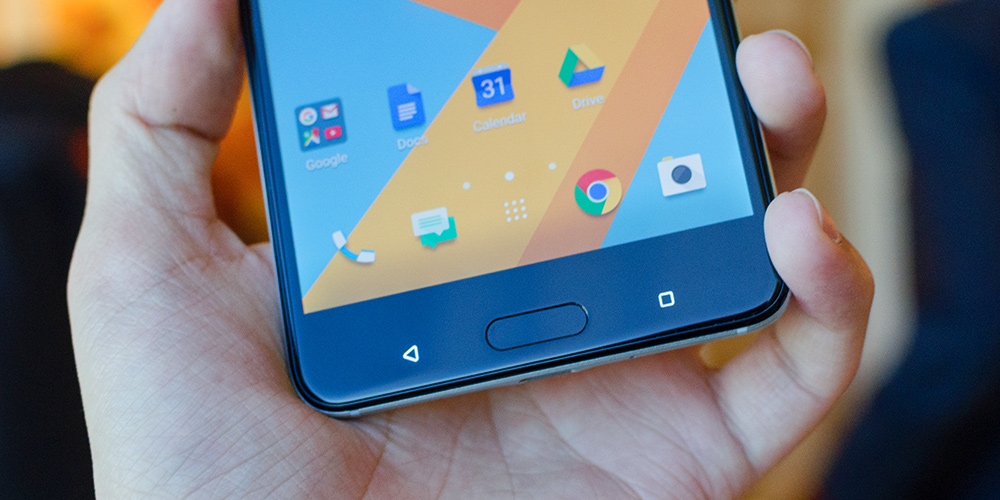
Both phones have a pill-shaped, capacitive-touch fingerprint scanner on the front that doubles as a home button, with capacitive navigation buttons to either side. The fingerprint sensor and buttons are not centered in the lower bezel, however. Instead, they sit very close to the lower edge, making them a little harder to use. While we have not seen inside these phones yet, this design concession is likely to make room for the display/touch controller(s). Other OEMs have found ways to relocate these components to reduce bezel size or make room for navigation buttons, but HTC does not appear to be using those methods here.
The U Play’s MediaTek Helio P10 SoC includes eight Cortex-A53 CPUs and a Mali-T860MP2 GPU for limited gaming. The U Ultra steps up to a Snapdragon 821 SoC; however, like Google’s Pixel phones, it uses the same peak CPU frequencies as the lower-clocked Snapdragon 820. It’s a curious design choice, but it should not have a noticeable impact on everyday performance. I would definitely like to see larger batteries in both phones. Inside the U Play’s 3.50-7.99 mm thick chassis is a 2500 mAh battery. For comparison, the smaller 5.0-inch Google Pixel packs a 2770 mAh battery into a 7.3-8.5 mm thick chassis, and the 5.1-inch Samsung Galaxy S7 packs a 3000 mAh battery in its 7.9 mm thick chassis. It’s a similar story for the U Ultra, whose 3000 mAh battery inside a 3.60-7.99 mm thick chassis looks small compared to the 3450 mAh battery in the 0.5 mm thicker but smaller 5.5-inch Pixel XL, or the 3600 mAh battery in the smaller (5.5-inch) and thinner (7.7 mm) Galaxy S7 edge. The U Ultra does include Qualcomm’s Quick Charge 3.0 for rapid charging, while the U Play supports 5V/2A charging.
The U Ultra has a few other upgrades over the U Play too. While it’s possible to use voice commands on both phones to answer calls, dismiss alarms, and send messages, for example, only the U Ultra can respond if it’s asleep with the screen locked, a feature likely enabled by Snapdragon 821’s low-power DSP. HTC’s BoomSound feature is also exclusive to the U Ultra, which uses the earpiece on the front of the phone as a tweeter and the downward-firing speaker for lower frequencies. The HTC U Play will be available in select markets around the globe in Q1 2017, for an undisclosed price, with options for either 3GB or 4GB of RAM and 32GB or 64GB of internal storage. Meanwhile, the HTC U Ultra, which comes with either 64GB of internal storage and Gorilla Glass 5 covering the front or 128GB of storage and harder sapphire glass, is available for pre-order in the US January 12, exclusively at htc.com, starting at $749. It comes unlocked and is compatible with AT&T and T-Mobile networks. | ||||||||||||||||||||||||||||||||||||||||||
| 9:00a | ASUS Demonstrates ROG Swift PG27UQ: 4K, 144 Hz, HDR, DCI-P3 and G-Sync
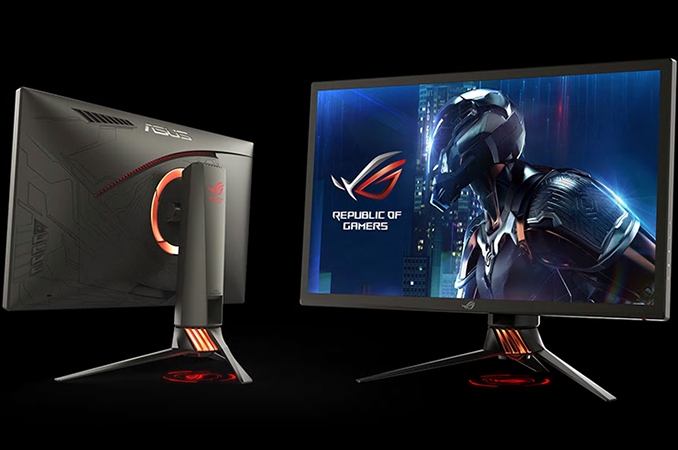
ASUS introduced the industry’s first 4K HDR gaming display with a 144 Hz refresh rate using a quantum dot film at CES. The ROG Swift PG27UQ will be a new dream gaming monitor from the company because it features all the modern display technologies and a very fast refresh rate. Since the product is not set to hit the market immediately, ASUS decided to stay quiet about its price and availability timeframe, though expect it to be around $1500-$2000. The ASUS ROG Swift PG27UQ is based on AU Optronics’ AHVA panel with a 4K (3840×2160) resolution, up to 1000 nits brightness, and a 144 Hz refresh rate with G-Sync. The manufacturer gave the panel a quantum dot treatment via a 3M film in early samples, but as of yet we do not know the exact color gamuts support as these have not been announced yet. ASUS has stated that the panel will offer support for HDR10, which means it might end up offering settings HDR-related color spaces, but at this time it is unconfirmed. Additionally, the monitor is equipped with NVIDIA’s G-Sync HDR variable refresh rate technology for smooth gameplay. Finally, the PG27UQ received a new direct LED backlighting with 384 zones that enables the high brighness and should lend itself to better contrast ratios (this enables localized dimming as a result). In the recent years, monitors tailored for gamers have gotten increasingly popular because they offered key features important for the target audience: a large diagonal, high PPI, a very high refresh rate and a variable refresh rate technology. Meanwhile, to enable all of the aforementioned, manufacturers had to make certain design tradeoffs when it comes to resolution, brightness and at times even viewing angles due to panel selection, which may have compromised other types of experiences. The new ROG Swift PG27UQ packs everything that ASUS had to offer when it comes to gaming and multimedia, enabling users to have premium experience across the board. The novelty is not absolutely tradeoff-free, though: the display is smaller than the ROG Swift PG348Q.
To take advantage of all the features that the ASUS ROG Swift PG27UQ has to offer, owners will have to use an NVIDIA GeForce GTX 10-series graphics card with a DisplayPort 1.4 connector that supports 4K/144 output (albeit, with DSC) and HDR. NVIDIA’s previous-gen GeForce GTX 9-series GPUs have an HDR-supporting HDMI 2.0a display controller, but the HDMI port on this panel is only good up to 60 Hz at 4K. While we do not know when ASUS intends to mass-produce the ROG Swift PG27UQ, it is highly unlikely that this is going to happen shortly for several reasons. Firstly, ASUS and AU Optronics demonstrated the prototype of the panel that powers the display at Computex 2016 and so far, we have not seen any indications that AUO has started mass production of its 4K/144Hz panels. Secondly, contemporary high-end graphics cards barely deliver 60 fps at 4K in games - without sufficient grunt, the monitor will simply not use all of its potential in high-end titles, which could affect demand. On the price side, keep in mind that the Swift PG348Q will remain the flagship ASUS ROG display and therefore the new PG27UQ will unlikely cost more than its bigger curved brother does. We've heard murmurs around the $1500-$2000 price point, but we will see. Given the timescale of a device like this, I suspect we will have more information around Computex time (early June). Related Stories: | ||||||||||||||||||||||||||||||||||||||||||
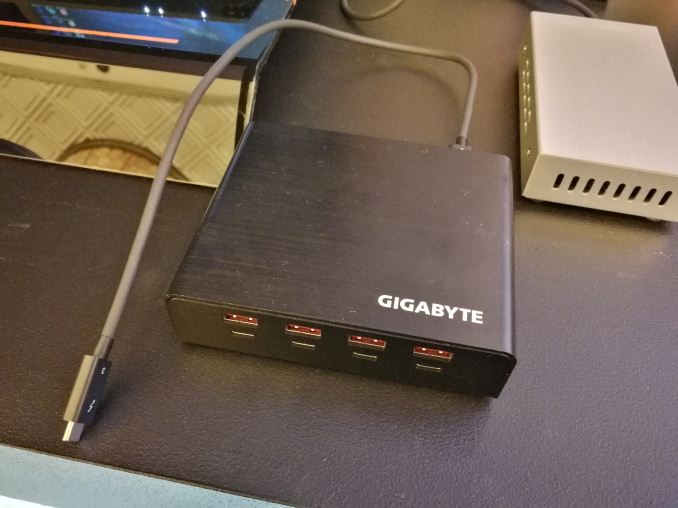
| 11:00a | CES 2017: GIGABYTE’s Thunderbolt 3 to 8x USB 3 Dock
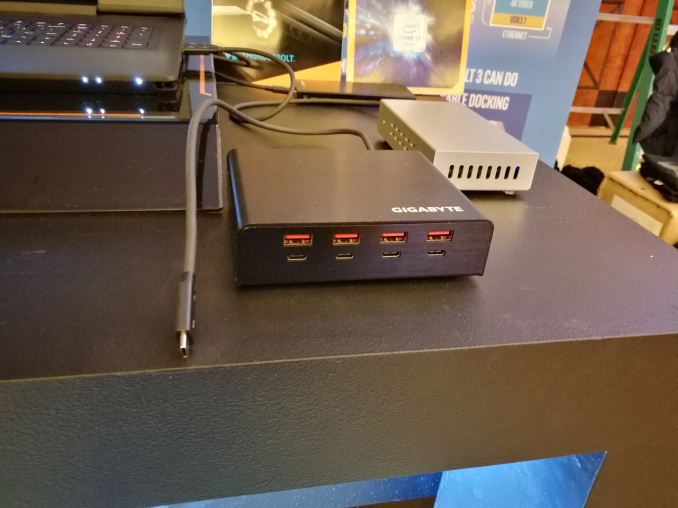
In some ways, Thunderbolt 3 is opening up a new world of connectivity. Having 40 Gbps of bandwidth to play with, along with a number of key mobile devices turning to it as their only source of connectivity, will in some form or another drive the hub and peripheral market beyond what TB1 and TB2 did. That being said, the market is still a bit slow: products are announced, but are region limited or produced in small quantities while the rest of the market develops the functionality to use it. So when we see a good trinket, it can be exciting if it reaches retail. So enter a GIGABYTE dock that takes Thunderbolt 3 and splits the PCIe lanes between eight USB 3 ports, four using Type-A and four using Type-C. I must confess that I didn’t confirm if these were USB 3.0 ports at 5 Gbps or USB 3.1 at 10 Gbps, which if it was using the latter I would suspect employs a PLX switch and a set of ASMedia ASM1142 controllers to provide the functionality, but would also mean that a user could not pummel the maximum data rate of each port when all were in use. If I were to be cynical, this could just be a single controller and a hub, which would make the unit very disappointing.
At present this unit did not support power passthrough or daisy chaining, however we did suggest both to GIGABYTE as a feature, especially the latter with the ability to daisy chain storage devices. Given that this unit doesn’t require external power, it is at least taking the power required from the TB3 connector. Something like this would go a long way to helping users that rely on a single port out of their device at least. Now admittedly there are a variety of TB3 docks coming to the market offering all sorts of port sets, and these docks typically start at around $150 to get anything more than a couple of USB ports, an Ethernet port and a card reader. We’ll wait and see how GIGABYTE decides to play in this space. | ||||||||||||||||||||||||||||||||||||||||||
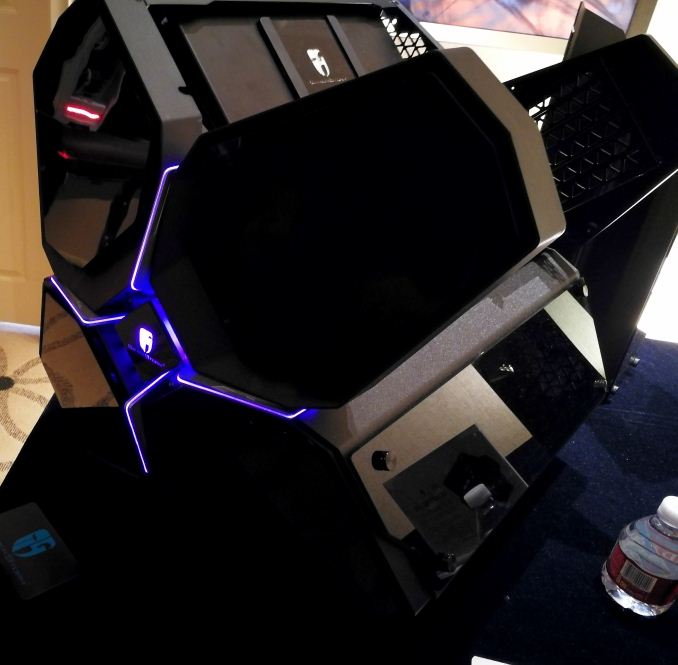
| 1:00p | DEEPCOOL Showcase the GamerStorm Quadstellar: One Big Metal Shuriken Chassis
While we haven’t talked much about Deepcool over the years, every show I always ended up scheduling a meeting with them and they always seem receptive to ideas regarding their new chassis designs. The top end products come through the GamerStorm brand, and currently feature the Genome featuring an integrated helix-based reservoir water cooler attached to the front of the chassis, and the Tristellar – a three-pronged mini-ITX chassis designed to wow anyone that sees it. At CES this year, we were shown the next iteration of the Tristellar. The Quadstellar is the bigger brother, supporting a full-sized extended ATX motherboard along with space for 12 storage drives, pretty much any size power supply you need (280mm), and houses a special segment for three graphics cards connected via PCIe 3.0 cables to the motherboard.
There’s support for five 120mm cooling fans in the design, or up to a 3x120 liquid cooler and a 2x120 liquid cooler as well. The idea here is to support dual GPU systems, such as the ASUS dual LGA2011-3 motherboard, as well as tri-GPU configurations. There’s plenty of room to move for sure, and perhaps the GPU segment is one of the best bits.
I postulated that this would make a good test bed for Ryan, making it easier to switch GPUs in and out of the system. Don’t get me wrong, this chassis is huge – 523 x 485 x 485 mm, and when the system is loaded the front facing fins are going to be designed to open up to allow more airflow.
Currently this is only a prototype – Deepcool told me that the aim is to build a fully aluminium version of the chassis and for it to weigh under 10kg all for around $300. That would be quite impressive, and we discussed the feasibility of adding feet to the bottom of the case in case someone wanted to prop it up vertically.
Despite the perhaps over-the-top look of the chassis, Deepcool is interested in any further suggestions for the design. The goal here is to have something near final at Computex, ready to ship in Q3.
| ||||||||||||||||||||||||||||||||||||||||||
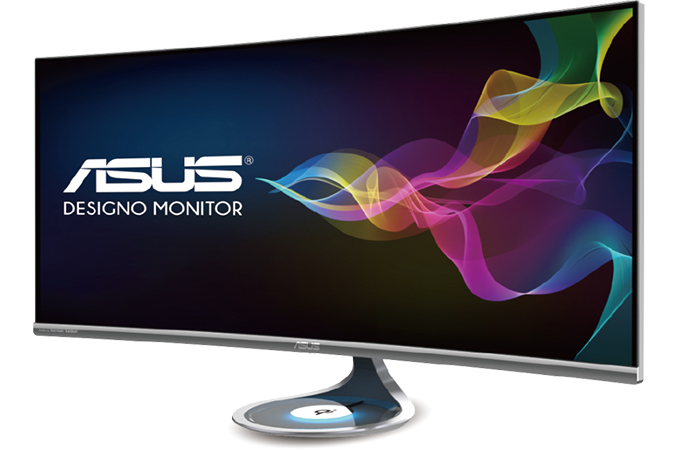
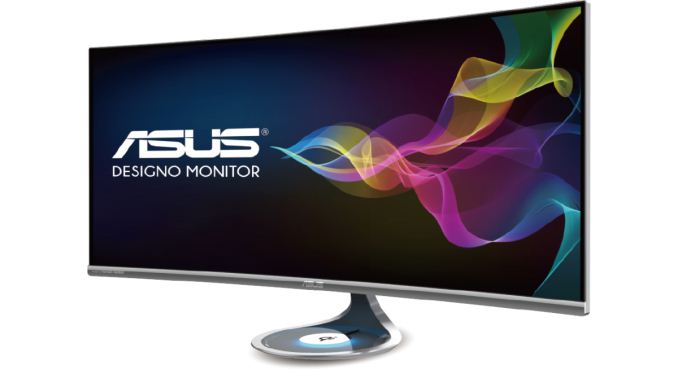
| 3:00p | ASUS Announces Designo Curve MX38VQ: 37.5 Inch Curved Display with Qi Charging
ASUS has introduced its largest Designo Curve display to date that weds style with a sophisticated feature set. The new MX38VQ uses a UWQHD-class (3840x1600) IPS panel and is equipped with a Qi wireless charging pad, as well as a Harman/Kardon-designed audio sub-system. The product will hit the market in the second half of this year and its price will not be very high for its size and features. ASUS introduced its first Designo-series display eight or nine years ago in an attempt to address customers looking for an elegant design as well as premium specifications. Today, the lineup includes ten 23” to 34” monitors with eye-catching aesthetics that use high-resolution IPS panels and built-in audio co-designed with brands like Bang & Olufsen or Harman/Kardon. The Designo Curve is a relatively new addition to the Designo family as the first monitor in the sub-series was announced in mid-2016. At CES, ASUS introduced the second curved Designo display that will also be the largest monitor in the company’s stylish lineup and among the largest ultra-wide displays on the market in general. The ASUS Designo Curve MX38VQ is based on a 37.5” IPS panel with a 3840×1600 resolution, a 24:10 aspect ratio and 2300R curvature. The rather distinctive specs of the panel may point to the fact that it was sourced from LG and we already know what it is capable of. The resolution of the display is well suited for displaying UHD content filmed in an aspect ratio of 2.35:1 or 2.40:1 (a lot of movies are shot in such aspect ratios). Like the smaller curved Designo model, the MX38VQ uses a stereo audio sub-system co-designed with Harman/Kardon that features two 8 W speakers and software enhancements. As for connectivity, the new monitor has DisplayPort and HDMI inputs, just like many contemporary products.
One of the main selling points of the new Designo Curve MX38VQ display is a 5W/1A Qi wireless charging pad in the base. So far, only AOC and Samsung have released monitors with Qi charging commercially (the Designo Curve MX34VQ announced last year is still not available) and there are no large high-end displays with this feature on the market right now. Meanwhile, there are tens of smartphones and tablets with integrated Qi wireless charging (including those from ASUS itself, but also from Samsung, Google, HP, Microsoft and other) and there are accessories that enable the tech on devices without integrated support (e.g., on Apple iPhone 6S). ASUS plans to start selling the Designo Curve MX38VQ in Q3 2017 for $1099, which is considerably lower compared to the current price of the LG38UC99 (~$1600) that allegedly uses the same panel. The monitor is already listed on the company’s global website, which may indicate that the product will be available rather earlier than later.
Related Reading: | ||||||||||||||||||||||||||||||||||||||||||
| 5:00p | Kingston Launches DataTraveler Ultimate GT USB Flash Drive with 2 TB Capacity
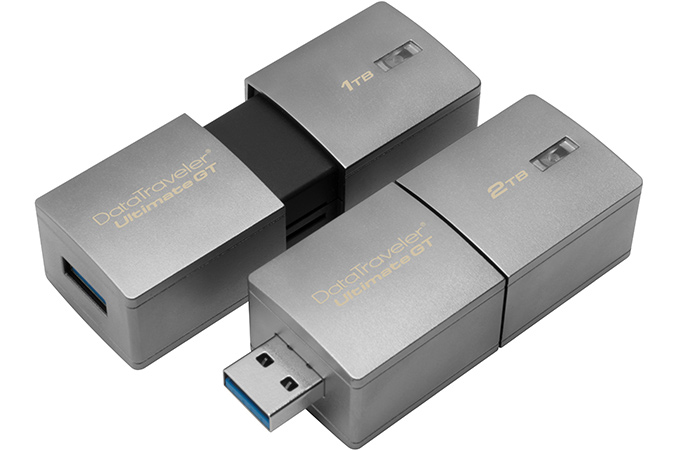
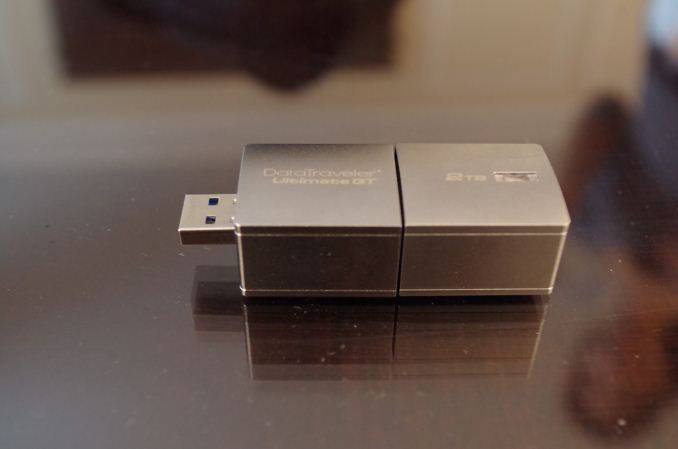
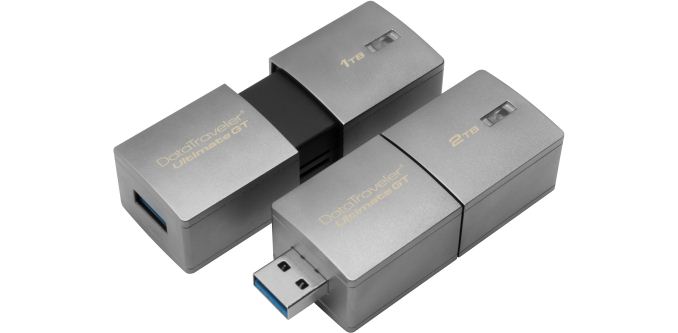
Kingston this week introduced its new DataTraveler Ultimate GT USB flash drive with a re-freshed design and up to 2 TB capacity. The new devices are designed for those who need to store large collections of multimedia files. The new Kingston DataTraveler Ultimate GT family of flash drives consists of 1 TB and 2 TB models with a USB 3.0 Type-A connector. The drives come in zinc-alloy metal enclosures to protect from physical damage and are relatively compact for their capacities (at least, more compact than external HDDs or SSDs). The new storage devices feature exactly two times higher capacity than their predecessors, the Kingston DataTraveler HyperX Predator 3.0 (512 GB and 1 TB) drives, introduced four years ago at CES 2013. What is unclear is whether they beat their ancestors in terms of performance (up to 240 MB/s read and 160 MB/s write), but keep in mind that the real-world transfer rate of the USB 3.0 interface is around 400 MB/s at best.
The DataTraveler Ultimate GT USB flash drives will be primarily useful for people who need to carry large amounts of data, but not necessarily edit it. For example, photographers, construction workers or scientists may offload images/videos/documents from their notebooks to such drives just for backup reasons. In fact, keeping in mind that many of such folks may work in harsh environments, the DataTraveler Ultimate GT drives are rated to support extended storage and operating temperature ranges: they can be stored at -40°C and operate at -25°C (-20°C and 0°C for typical USB drives). Kingston will start to ship the new DataTraveler Ultimate GT USB flash drives in February and the storage devices will be covered with the company’s five-year warranty. The drives will work with any modern Microsoft Windows OS that supports such flash drives (Windows 7 SP1 and later), Apple MacOS (10.9.x and later), Linux (2.6.x and later) as well as Google’s Chrome OS. As for pricing the DataTraveler Ultimate GT USB flash drives are expected to have a price premium given their positioning. For example, the DataTraveler HyperX Predator 1 TB still costs well over $1000 at retailers like Amazon and Newegg.
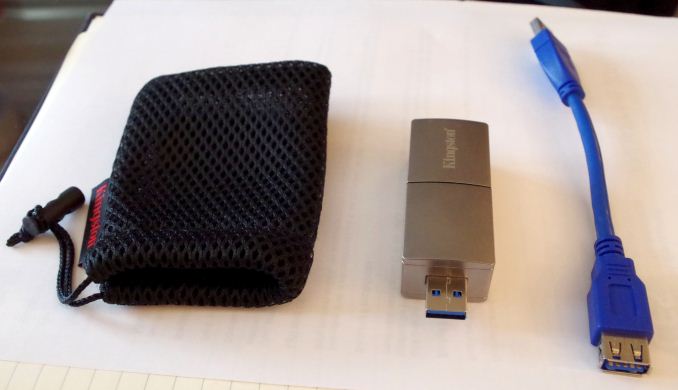
It will also come with a carry pouch and a USB cable to alleviate issues where it interferes with other ports:
| ||||||||||||||||||||||||||||||||||||||||||







| << Previous Day |
2017/01/12 [Calendar] |
Next Day >> |