[Most Recent Entries] [Calendar View]
Wednesday, January 18th, 2017
- Philips Begins to Sell 43” 4K IPS BDM4350UC Display for $799
- ASUS Announces Designo Curve MX38VQ: 37.5 Inch Curved Display with Qi Charging
- HP Announces Omen X 35-Inch Curved Display for Gamers
- AOC Launches the AG352QCX: 35-Inch 200 Hz 2560×1080 Curved Display with Adaptive-Sync
- LG 38UC99 Announced: 37.5-Inch Curved 21:9 Display with 3840×1600 Resolution
- Patriot Introduces LX 256 GB microSDXC Card with Class 10, U3 Certifications
- The SD Card Association to Classify IOPS Performance of Memory Cards via Logo
- Western Digital Rolls Out 256 GB SanDisk microSDXC Memory Cards
- SD Association Announces SD 5.0 Specification: SD Cards For UHD and 360° Video Capture
| Time | Event | |||||||||||||||||||||||||||||||||||||||||||||||||||||||||||||||||||||||||
| 8:00a | 3-Way Low Profile CPU Cooling Shoot-Out: Reeven, Phanteks, & Noctua Today we're taking a look at horizontal CPU coolers from Reeven, Phanteks, and Noctua. Although horizontal CPU coolers are likely to always remain a niche market relative to their tower-style brethren, the continued growth in and shift to smaller form factor PCs has given them a higher profile among system builders as of late. Sometimes you cannot just buy the best cooler for the job for the simple reason that it will not fit into the system. This is particularly true for compact and/or narrow cases, especially those meant for ITX systems and horizontal placement. With the majority of typical CPU coolers being tower-type constructs, it is difficult to find one that fits inside compact case designs. To that end we've grabbed a few horizontal coolers to take a look at this segment: the Reeven Steropes RC-1206b, the Phanteks PH-TC12LS and the Noctua NH-C14S. These three vertical coolers are all meant for desktop/HTPC designs but they also are significantly different in terms of size, giving users a range of options in trading off size with cooling capacity. The smallest of these coolers, the Steropes, starts us off at 60 mm tall, moving up to 74 mm with the PH-TC12LS, and jumping up to 115/142 mm with the NH-C14S. | |||||||||||||||||||||||||||||||||||||||||||||||||||||||||||||||||||||||||
| 8:00a | Philips BDM4037UW Goes on Sale: 40 Inch 4K Curved Display for $800
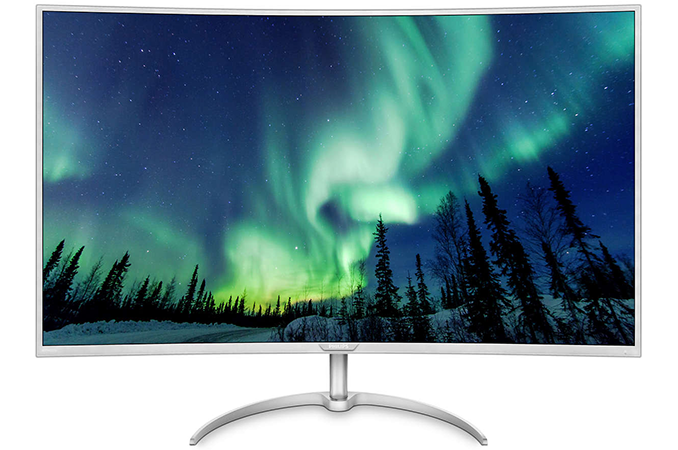
TPV Technology, the company that produces monitors under the Philips brand, this week began to sell one of the world’s first curved displays with a 4K resolution that was formally introduced at IFA last September. The BDM4037UW monitor was designed primarily for consumers seeking for UHD experience on the PC, which is why the screen is not too expensive when its dimensions, curvature and resolution are considered. Nonetheless, PBP and PiP capabilities of the display make it useful for various control room applications as well. Curved and UHD monitors are gaining traction these days because prices of models featuring good panels with decent brightness, contrast ratio and viewing angles have become more palatable in the recent quarters. However, the popularization of curved and UHD displays have been two isolated trends so far. The majority of curved monitors are ultra-wide and feature approximately 21:9 (2.33:1) aspect ratio because manufacturers want users to have a more immersive experience. By contrast, flat 4K UHD displays feature an aspect ratio of 16:9. So far, no company has introduced a curved 4K computer monitor because its curvature would hardly bring a lot of advantages for 27” – 32” panels (typical for computer screens). Meanwhile, Philips decided to offer a curved UHD display that is large enough for curvature to make sense.
The Philips BDM4037UW display is based on a 40” VA panel with a 3840×2160 resolution, 300 nits brightness, 3000R curvature, a 4000:1 contrast ratio, a 60 Hz refresh rate and a 4 ms response time. The manufacturer claims that the monitor can reproduce 1.07 billion colors (listed online as 'dithered 10-bit', but doesn't clarify native support) and is rated to support 85% of the NTSC color gamut. Technically speaking, 85% of the NTSC color space is wider than 100% of the sRGB color space, but what we do not know is whether the latter is officially rated out-of-the-box (and it seems odd not to confirm sRGB coverage).
While the BDM4037UW is primarily aimed at consumers, one of its key selling points (apart from dimensions, resolution, and curvature) is support for Philips’ MultiView PBP (picture-by-picture) technology for up to four devices as well as PiP (picture-in-picture) for up to two devices that will be useful in various control or trade rooms where one of such displays can replace four monitors with a lower resolution. To enable PBP and PiP features, the BDM4037UW is equipped with two DisplayPort 1.2, one HDMI 1.4, one HDMI 2.0 and one D-Sub input. In addition, the monitor has a quad-port USB 3.0 hub with one header supporting fast charging. As for audio, the display is equipped with two 5 W stereo speakers. At present, the Philips BDM4037UW monitor is available in Europe. The display costs £589 in the U.K. and €749 in Eurozone. Meanwhile, it is unknown when TPV plans to start selling the BDM7037UW monitor in the U.S. as well as its pricing. Related Reading: | |||||||||||||||||||||||||||||||||||||||||||||||||||||||||||||||||||||||||
| 11:00a | ASUS ZenBook 3 Deluxe UX490UA: Kaby Lake, 16 GB RAM, 1 TB SSD, TB3, 14" FHD, 2.4 lbs
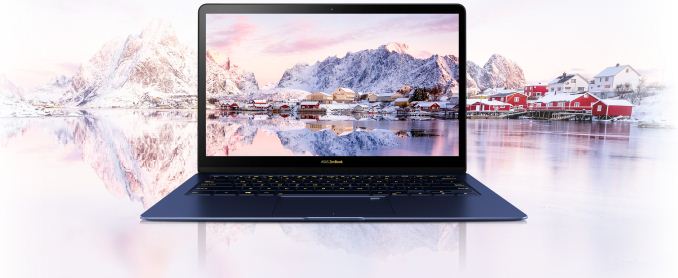
ASUS has now launched the latest addition to its ZenBook family of ultra-thin laptops with 14” displays. The new ZenBook 3 Deluxe UX490UA boasts with Intel’s latest Kaby Lake-U microprocessors, up to 16 GB of memory, up to 1 TB SSD along with an advanced audio sub-system, an updated keyboard and a fingerprint reader in a 12.9 mm-thick design that weighs around 1.1 kilograms (2.4 lbs). ASUS’ ZenBook is among the most popular families of ultra-thin laptops on the market today that competes against the likes of Apple's MacBook, Lenovo's ThinkPad X1 as well as the HP Spectre. The PCs come with fully-fledged Intel Core processors along with a choice of high-capacity SSDs as well as a rather decent spec list in general. As it appears, ASUS decided to improve ZenBook’s design further by adding a larger 14” display, a high-capacity 46 Wh battery, an advanced audio sub-system co-designed with Harman Kardon, a trusted platform module as well as two Thunderbolt 3 ports and a USB 3.1 Type-C port. The Deluxe version of the ZenBook 3 laptop weds business features with multimedia capabilities, style and expandability options: a rather rare combination.
The ASUS ZenBook 3 Deluxe UX490UA is based on the Intel Core i5/i7 processor with integrated HD Graphics 620 and Microsoft’s Windows 10 Pro operating system. Different versions of the ZenBook 3 Deluxe UX490UA will be equipped with 8 or 16 GB of LPDDR3-2133 DRAM as well as up to 1 TB PCIe 3.0 x4 SSD. For connectivity, the laptop uses an 802.11ac Wi-Fi + BT 4.1 wireless module, has one USB 3.1 Type-C header (which is also used for charging) and is equipped with two Thunderbolt 3 ports that can work in DisplayPort 1.2 and USB 3.1 Gen 2 modes. The laptop can be connected to 4K displays, an external GPU and an external storage system, greatly expanding its capabilities. To ensure that the PC does not overheat or throttle, ASUS uses a new 3-mm thick cooling solution that it expects to be efficient enough for the CPU and the SSD.
Like other high-end ZenBook laptops, the UX490UA comes in unibody enclosure made of an aluminum alloy that is said to be stronger compared to a standard aluminum alloy. To protect the display, the ZenBook 3 Deluxe uses Gorilla Glass 5 from Corning. Meanwhile, depending on configuration, the new ZenBook will come in a blue or a gray finish. It is worth noting that unlike some other Zenbook high-end models (such as the Zenbook Infinity), as far as we can tell, this device will not be touch screen enabled.
ASUS did not announce pricing of its ZenBook 3 Deluxe UX490UA machines, but given that the PC will exist in multiple configurations, it will vary quite significantly. For example, ASUS’ ZenBook 3 non-Deluxe laptops are available for $1099 and $1599, depending on specs. Keep in mind that the Deluxe versions of ASUS products are naturally positioned above the rest, so expect the ZenBook 3 Deluxe to come at a premium. Related Reading: | |||||||||||||||||||||||||||||||||||||||||||||||||||||||||||||||||||||||||
| 1:00p | ADATA Demonstrates 256 GB microSDXC Card
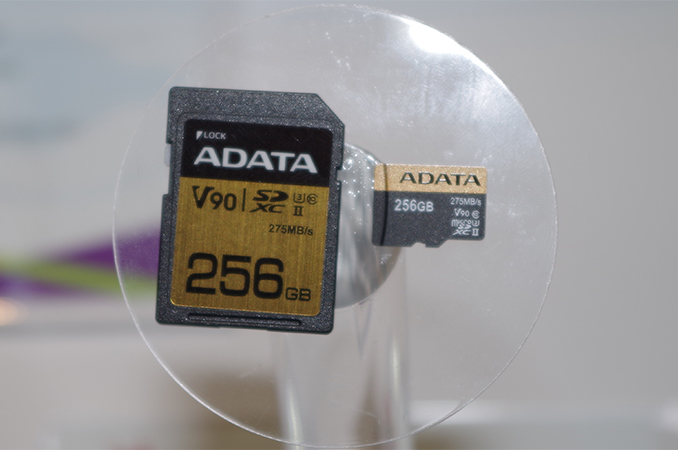
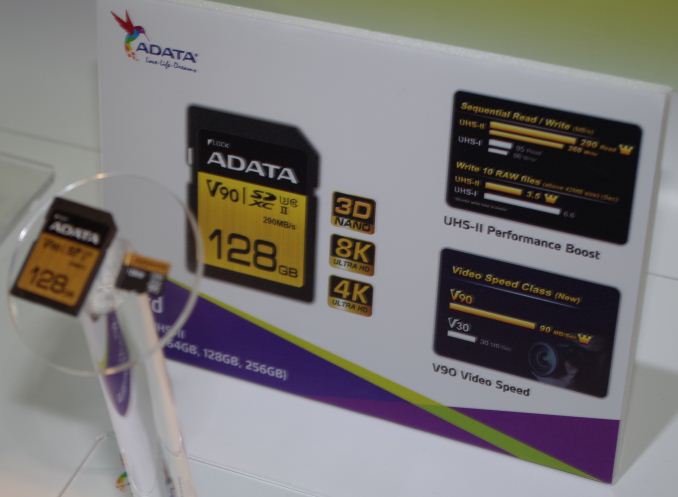
At CES, ADATA showcased its first microSDXC memory card with 256 GB capacity. The card is qualified for up to 275 MB/s transfer speed and can be used to record UHD and 360° videos. The manufacturer did not formally announce the product, but the product on display should indicate that the company plans to release it in the foreseeable future. The ADATA microSDXC 256 GB memory card is based on 3D MLC NAND flash memory from SK Hynix, uses the UHS-II bus as well as is rated for up to 275 MB/s maximum read speed and up to 260 MB/s write speed when installed into an appropriate device. The new card carries Class 10, U3 and V90 labels meaning that its performance does not drop below 90 MB/s and it is suitable for recording 2Kp120, 4Kp120 and 8Kp120 videos. ADATA is the second independent supplier of NAND flash-based devices to introduce a microSDXC card with 256 GB capacity after Patriot. Moreover, ADATA is also among the first to introduce a 3D NAND-based memory card with the UHS-II bus that is designed for the high end of the market.
In fact, use of 3D MLC NAND flash memory for memory cards is important in general because it demonstrates that IC makers are ramping up production of 3D NAND and supply such memory to third parties. One of the advantages that 3D MLC NAND has over TLC NAND made using a thin planar process technology is higher endurance and potentially higher reliability. In addition to the 256 GB microSDXC, ADATA also uses 3D NAND for other SD cards as well as for lower-capacity cards.
ADATA did not announce pricing of its 256 GB microSDXC card, but given performance and positioning, we expect the device to have a professional-grade price tag. Related Reading: | |||||||||||||||||||||||||||||||||||||||||||||||||||||||||||||||||||||||||
| 3:00p | ASRock Shows DeskMini GTX/RX, using Micro-STX Motherboard with MXM Support
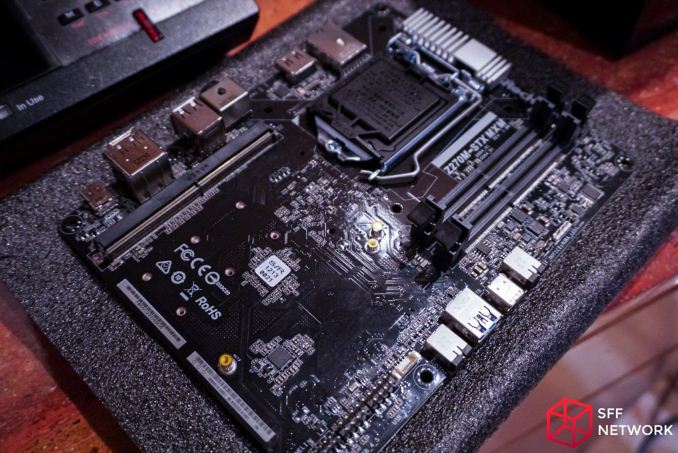
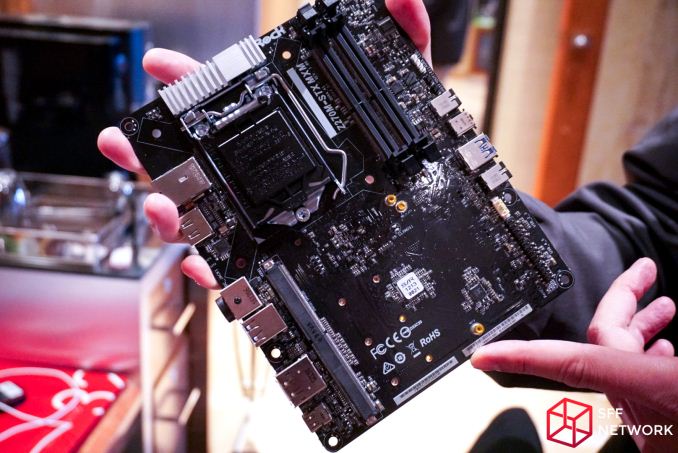
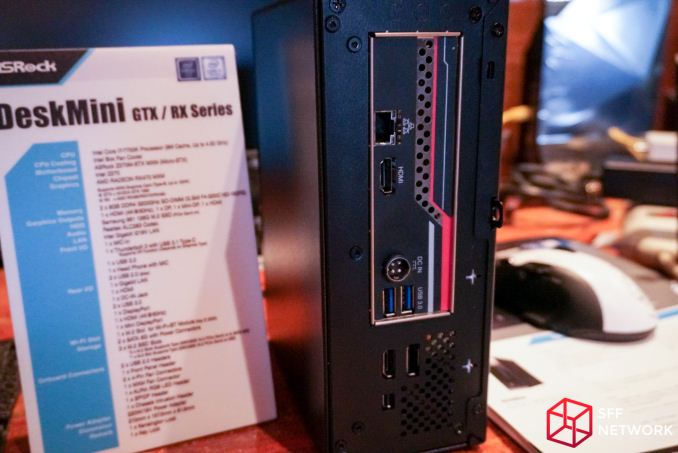
One of the recurring themes in my discussions with motherboard manufacturers over the past several years is one of introducing differentiation to products and through that, new form factors. When mini-STX was shown by Intel last year as a different form factor focusing just on the processor rather than PCIe lanes, we saw the launch of several small-sized PCs, mainly for embedded functions, that could leverage a full desktop-class CPU and socket. As always with CPU-only products, some users request a little more graphics oomph, so insert ASRock’s new ‘micro-STX’ type of motherboard and mini-PC that uses MXM-type graphics.
Unfortunately our trip to ASRock at CES was curtailed due to other meetings overrunning, but it was interesting to note that ASRock was at the show formally with a suite, rather than just casually taking coffee meetings the previous two years that I had been. So all our pictures in this piece are from the Small Form Factor Network, and many thanks to them. The mini-STX form factor is based around a 5-inch by 5-inch motherboard design, which gets you enough space for a socket, some memory and some IO. With this micro-STX motherboard, ASRock is clearly going at length to support more: the MXM module bay takes up the whole second half of the motherboard, and one key thing to note here is the socket area. On the left-hand side, where we would normally expect to see the IO, we have Intel’s recommended socket area marked. Normally this is left near-blank to account for coolers and such, but ASRock as engineered the rear IO right up to the socket itself, and using low profile IO ports to allow a cooler to fit. Because of the way mini-STX platforms work with few power phases, these are solely above the socket as not to interfere with to the left of the socket.
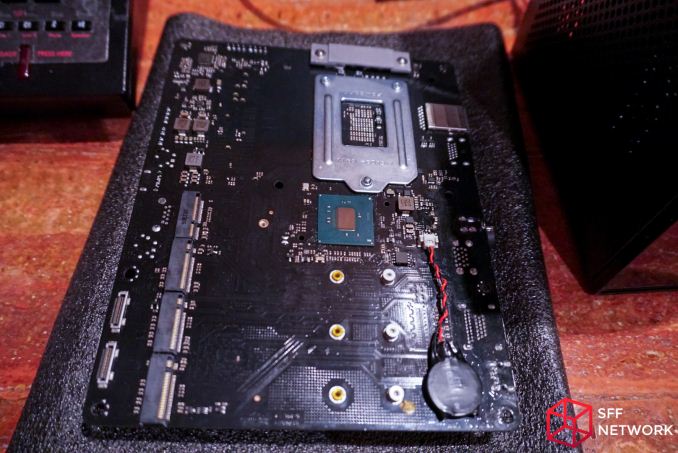
On the front side of the board, the chipset is nowhere to be found. That’s because it is on the back, along with the CR2032 battery and three M.2 ports. Because of the chipset support, all three are PCIe 3.0 x4 capable, with spacing for 2260 and 2280 sized M.2 ports. For good measure, there’s also an M.2 WiFi port.
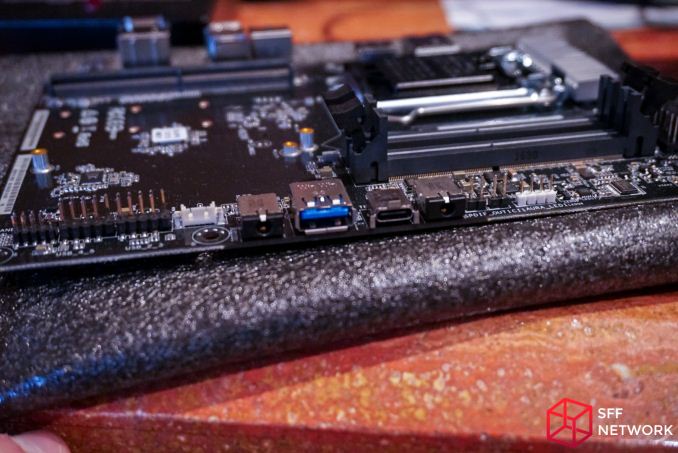
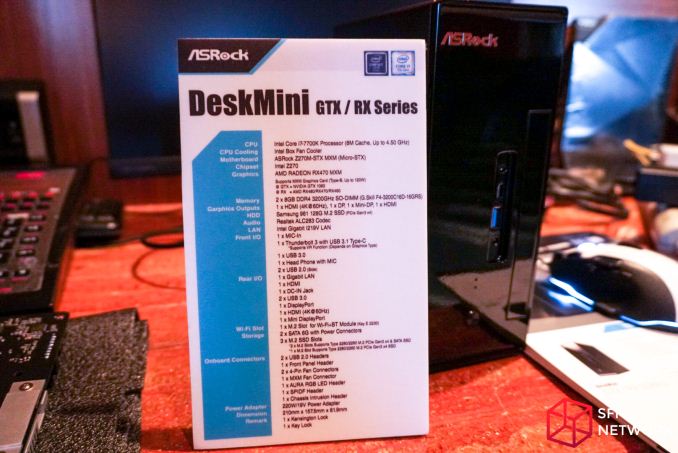
Front functionality comes through a USB 3.0 Type-A, a USB 3.0 Type-C (ASRock in their sign claim this is USB 3.1 and Thunderbolt 3, however I cannot see an ASMedia ASM1142/ASM2142 nor an Alpine Ridge controller for this), and two audio jacks from the Realtek ALC283. The front uses an Intel I219-V gigabit Ethernet controller, two USB 3.0 ports, an HDMI port, HDMI 2.0 port (via MCDP2000), a DisplayPort adaptor, a mini-DP port, and a DC-In jack.
It’s worth noting that the specifications list also has two SATA ports on the description, but like the TB3 controller, I can’t see them on the pictures, front or rear. As a system, the 2.7-liter DeskMini GTX/RX will feature a Core i7-7700K using an Intel stock cooler (so don’t expect much in the way of overclocking), support for up to 16GB of DDR4-3200 SODIMM (not sure why it’s not 32GB, perhaps z-height?), a 128GB Samsung 961 M.2 SSD, and an MXM Type-B graphics card: either a GTX 1060 for the GTX model, or an AMD RX card for the RX version. The PSU is rated at 220W, which can limit options.
Personally, I’d prefer a solid copper cooler on there for a Core i7, but a Core i5/i3 would do OK with the stock cooler. Prices and release date are unknown.
| |||||||||||||||||||||||||||||||||||||||||||||||||||||||||||||||||||||||||









| << Previous Day |
2017/01/18 [Calendar] |
Next Day >> |