[Most Recent Entries] [Calendar View]
Thursday, January 19th, 2017
- Seagate to Shut Down One of Its Largest HDD Assembly Plants
- LaCie Launches 6big and 12big: Up to 60/120 TB External Storage with Thunderbolt 3
- Seagate Introduces New Generation of Enterprise Performance 15K HDDs with NAND Caching
- Seagate BarraCuda Pro 10TB Helium HDD Capsule Review
- Logitech 2014 Switzerland Tech Day: The Hills Are Alive With The Sound Of Romer G
- Logitech Announces The Ambidextrous G900 Chaos Spectrum Gaming Mouse
- Logitech Formally Exits OEM Mouse Market
- The Logitech G910 Orion Spectrum Mechanical Keyboard Review
- Logitech Acquires Saitek Brand and Product Lines, Expands Its Sim Controllers Biz
- Samsung Updates Notebook 9: Kaby Lake, USB-C, Starts at 816 Grams
- ASUS ZenBook 3 Deluxe UX490UA: Kaby Lake, 16 GB RAM, 1 TB SSD, TB3, 14" FHD, 2.4 lbs
- Lenovo Reveals Yoga 910 Convertible: Intel’s Kaby Lake Meets 4K Display and Ultra-Thin Form-Factor
| Time | Event | ||||||||||||||||||||||||||||||||||||||||||||||||||||||||||||
| 9:30a | Seagate Launches 1 TB and 2 TB Enterprise Capacity 3.5-inch HDDs
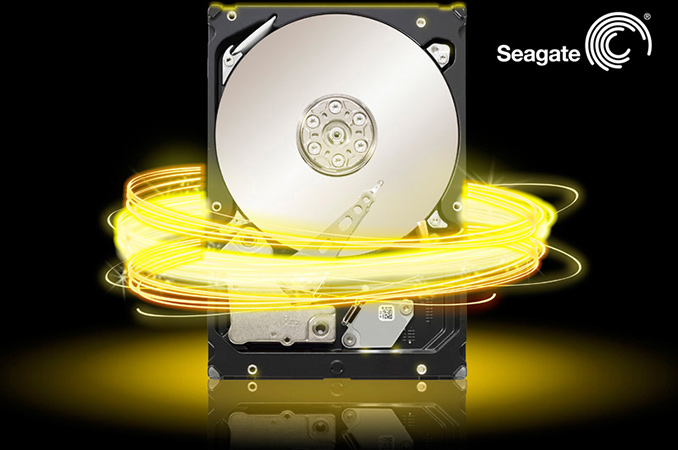
Seagate has quietly added two enterprise-grade HDDs to its Enterprise Capacity lineup of hard drives. While the 'Enterprise' name has recently implied high-density products, the new 3.5” drives only store one or two terabytes of data and are aimed at businesses seeking for high reliability, 512 bytes sector size, but not a lot of storage space. In the recent years, we observed two main trends on the market of HDDs: the number of drives sold has been decreasing because of strong competition from SSDs, but their average capacities have been increasing because of new technologies (e.g., helium, SMR, the evolution of PMR, etc.). Enterprises and operators of cloud data-centers are the primary consumers of high-capacity hard drives because such drives help them to reduce their footprint and optimize power consumption. Since such HDDs are used in multi-drive RAID environments and are subject to heat and vibrations, they are based on special platforms that ensure their long-term reliability (by using a motor attached to both top and bottom covers, dual-plane balance control, improved heads, special firmware and so on). Because such drives offer higher capacity, they are harder to make and test. Also, on top of a longer typically-business style warranty, they naturally cost more than desktop-class HDDs. Meanwhile, due to overall benefits they bring, cloud service providers and enterprises are willing to pay a premium for such HDDs. As it appears, there are also customers who need hard drives with improved reliability and performance, but who are not interested in very high capacities or the latest technologies. The new Seagate Enterprise Capacity 3.5 HDDs with 1 and 2 TB capacities are based on the latest PMR platters and feature a native 512-byte block size, which is a requirement of some legacy applications. The HDDs have a 7200 RPM spindle speed, 128 MB cache and a SATA 6 Gbps interface. When it comes to performance, Seagate declares 194 MB/s max sustainable transfer rate, 4.16 ms average latency and up to 7 W power consumption. The 1 and 2 TB versions of the Enterprise Capacity 3.5 HDDs are rated for 24/7 operation, up to 550 TB/year TBW and offer all the enterprise-grade features that the higher capacity models, including on-the-fly error-correction algorithms, PowerChoice technology (enables data-center managers to lower power consumption of HDDs during idle time), RAID rebuild feature and so on.
Seagate did not announce exact pricing of its Enterprise Capacity 3.5 HDDs with 1 and 2 TB capacities. It is logical to expect such drives to cost less than higher capacity models, but do not expect them to cost like desktop HDDs because we are talking about models with enterprise features, which are physically different to other hard drives. Seagate targets very specific SMB and enterprise customers with its entry-level Enterprise Capacity 3.5, so, pricing per-GB will not be a bargain. Meanwhile, the HDDs are covered with Seagate’s five-year warranty and have MTBF rating of two million hours. Related Reading: Sources: Seagate, The Register. | ||||||||||||||||||||||||||||||||||||||||||||||||||||||||||||
| 11:00a | Logitech Launches G203 Prodigy Gaming Mouse with A New 6000 DPI Sensor
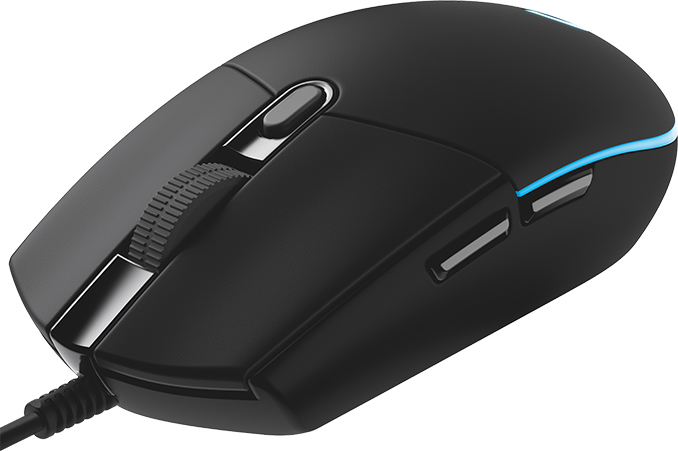
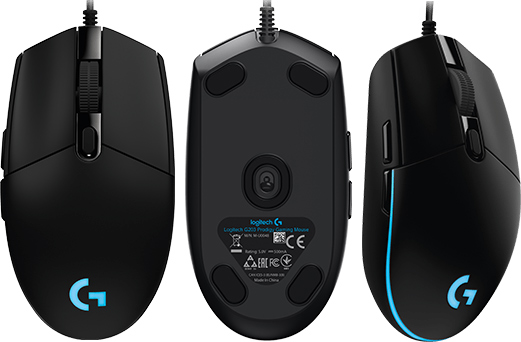
Logitech this month introduced its new G203 Prodigy gaming mouse that combines a classic aesthetic with a high-resolution sensor, programmable buttons and RGB LED lighting. What is important is that the mouse is considerably less expensive than typical gaming mice. Computer mice have greatly evolved in the past decade as manufacturers try to offer better ergonomics for different types of users and applications. Many mice today feature additional buttons and/or a rather fancy shape because their producers try to address hardcore gamers or prosumers looking for maximum comfort during their many-hour game or work sessions, with many users preferring different grips and layouts. The Logitech G203 Prodigy is promoted as a departure from the concept of complex design and we are told it brings ergonomics back to basics - the new mouse is made to resemble a simplistic shape that popular mice are known for, but we are told it can be done without sacrificing usability. The Logitech G203 Prodigy is based on one of the company’s in-house-customized sensors with on-the-fly adjustable resolution (200-6000 DPI) along with an ARM processing core that supports USB report rate of 1000 Hz (appropriate software is required for relevant operating systems). Just as in the case of the higher end devices, the G203 Prodigy can be completely reprogrammed using Logitech’s software and then used on different PCs since button configuration is stored inside the mouse. Finally, developers of the G203 could not ignore the trend and installed a programmable RGB LED into the G logotype on the mouse.
One of the important aspects of the Logitech G203 Prodigy is its price: the company sells it for $39.99 in the U.S. and for €44.99 in the E.U., which is below the price of typical gaming mice that may retail for well over $100. Knowing that Logitech develops various product designs, high-resolution sensors and other components in-house, it is likely that the creation of the G203 Prodigy is a response to the demand of potential customers rather than an attempt to address a lower-end market segment currently controlled by various bulk production companies with a cheap product. The G203 Prodigy is made in Switzerland and thus passes all the rigorous tests that Logitech uses to promote the quality of its products. As pointed out on Twitter by @AfterPad, this is an update to the previous generation Logitech G102. Meanwhile, an interesting thing to consider is that the price of the Logitech G203 Prodigy will be very attractive not only to gamers who do not need fancy design, adjustable weight or plenty of additional buttons, but also makers of higher-end PCs designed for gamers. The G203 Prodigy is the most affordable gaming mouse from the company and thus becomes a good candidate to be supplied with pre-built systems. Related Reading: | ||||||||||||||||||||||||||||||||||||||||||||||||||||||||||||
| 1:00p | Toshiba Is Studying The Possibility of Spinning Off NAND Flash Production
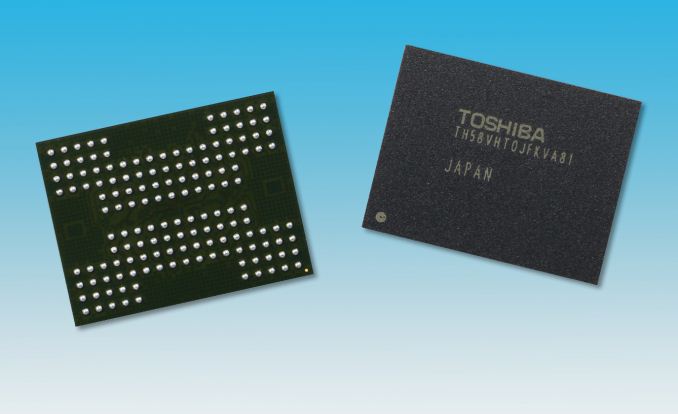
Toshiba on Wednesday confirmed that it is studying the possibility of splitting its NAND flash business into a separate company. While nothing has been decided as this point, the Japanese tech firm needs money and it may sell a stake in its memory business to Western Digital or another investor, based on unofficial reports. In the recent months, Toshiba ran into a new accounting scandal that may require it to write down as much as 4 billion dollars because of cost overruns at its U.S. nuclear power business. The exact number has not been finalized, but the company is already studying various possibilities to offset the massive loss, which would anger its investors after the company already faced an accounting scandal in 2015. Nikkei reports that Toshiba is mulling to spin off its semiconductor business into a separate entity and then sell a 20% in the new company to someone like Western Digital for about $2.7 billion, while retaining 80% stake as well as operational control of the unit. Toshiba confirmed that it is studying the possibility of its memory business spin-off, but noted that no decision has been made and that the in-house NAND production is a focal business.
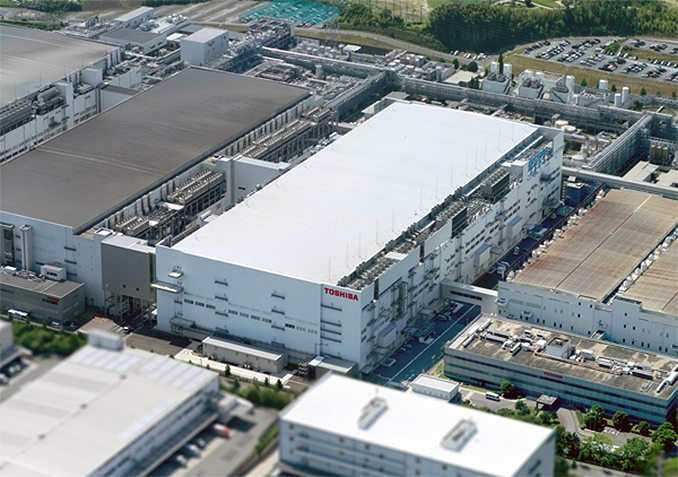
Toshiba and Western Digital already operate the world’s largest NAND flash production complex in Yokkaichi, Mie prefecture, Japan. Formally, the manufacturing facilities belong to joint ventures between the two companies and WD buys wafers from Toshiba. It is not completely clear how the spinoff would work in this case and which parts of Toshiba’s business will be up for sale. For Toshiba, NAND flash production is indeed strategically important because it enables it to produce all types of storage devices in-house. Today, Toshiba makes HDDs, SSDs as well as various types of removable storage at its own fabs using its own components. The only other company that can manufacture all types of storage products using its own media is Western Digital, while companies like Samsung and Seagate lack either HDDs or NAND flash. One of the important things to note is that production joint ventures owned by Toshiba and Western Digital are unlikely to make a lot of money directly because they sell wafers at near-cost to their owners who then earn profits by selling SSDs, memory cards, bulk NAND flash and other devices to their customers. Therefore, if Toshiba is to sell a stake in its semiconductor production business, it needs to sell it to a company that can then use the chips to build products and make some money. Obviously, Western Digital would be a perfect investor because it already has everything needed to produce actual storage devices, but a rumor has it that it is not the only investor considered by Toshiba.
Meanwhile, Toshiba’s plan to spin off its NAND flash business into a separate company may have a significant impact on the market of storage devices in general. Nowadays, Toshiba and Western Digital jointly invest in the development of NAND flash as well as manufacturing process technologies. Changes of the ownership may alter Toshiba’s investments not only in terms of money, but also in terms of R&D spending by the company. In any case, according to reports, no decision has been made. Related Reading: | ||||||||||||||||||||||||||||||||||||||||||||||||||||||||||||
| 3:00p | Fujitsu Announces 13.3" Lifebook U937/P and UH75/B1: 7th Gen Core i5, 8hr Battery, Under 1.77 lbs
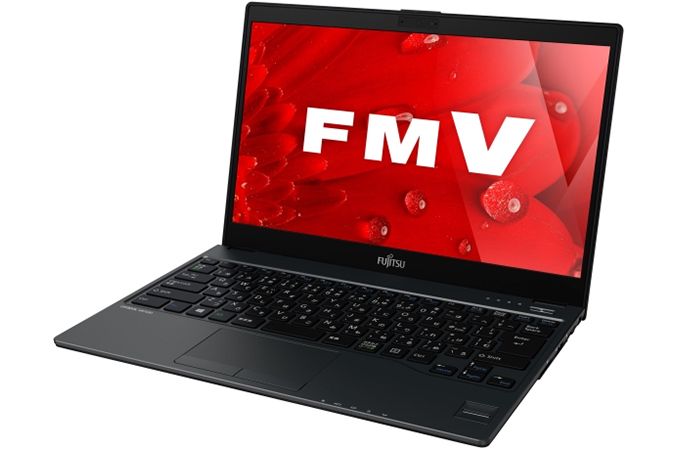
Fujitsu has introduced its new Lifebook U937/P notebook that weighs under 800 grams (1.76 lbs), but offers a fully-fledged Intel Core i5 Kaby Lake-U processor as well as a 13.3” display with FHD resolution. The notebook is designed for business users and thus comes with features like a fingerprint reader. Fujitsu did not announce many details about its Lifebook U937/P, but only said that the laptop is based on the 7th generation Intel Core processor (which, given the timing of the announcement, implies on the Kaby Lake-U), weighs less than 799 grams (1.76 lbs) in its default configuration, is 15.5 mm thick and comes in black or red.
Despite the introduction, no real details other than those above were disclosed. Despite this, a lower weight notebook for the Japan market was also disclosed - the Lifebook UH75/B1. This is a lower-cost laptop, that is also 15.5 mm thick but weighs only 777 grams (1.71 lbs). Specifications of the Fujitsu Lifebook UH75/B1 will hardly exactly match specs of the Lifebook U937/P since the systems are priced differently, but they give an idea what to expect. The UH71/B1 notebook is based on the Intel Core i5-7200U (2C/4T, 2.5 GHz, HD Graphics 620) SoC and is equipped with 4 GB of DDR4-2133 memory (Ian: is that single channel?) as well as a 128 GB SSD. When it comes to input/output capabilities, the Lifebook UH75/B1 offers a 802.11ac Wi-Fi + BT 4.1 wireless module, three USB 3.0 ports (two Type-A, one Type-C), an SD card reader, an HDMI output, a TRRS audio connector, a webcam and a fingerprint reader. As for the battery, the notebook comes with a 25 Wh accumulator that can power it for eight hours.
The Lifebook U937/P and the Lifebook UH75/B1 are among the lightest 13.3” laptops ever produced and will be among the lightest on the market. At the same time, it is noteworthy that the UH75/B1 only has 4 GB of memory and 128 GB of storage space, which is not a lot by today’s standards and may be considered not enough by many users on the go. By contrast, Samsung’s recently updated Notebook 9 weighs 816 grams, but comes with 8-16 GB of DDR4 and a 256 GB SSD. Moreover, Lenovo’s LaVie Z (introduced in 2015) not only had more memory and a larger SSD, but also a higher screen resolution. On the other hand, ultrathin and ultralight laptops are usually full of compromises because various people have different requirements and fulfilling requests of one group means introducing limitations for another. The one common feature through these is that the sub-1.8 lb laptop market is dominated mostly by entrants focusing on the Japanese market.
Fujitsu plans to start selling the Lifebook UH75/B1 in Japan in mid-February for ¥190,000 (~$1660). ETA of the Lifebook U937/P is February, but we do not know whether it is early or late in the month. Meanwhile, the price of the product will be ¥284,900 (~$2486), which is considerably higher than the price of the UH75/B1 and implies on better specifications (e.g., a better SoC, more memory, a higher capacity SSD, etc.). Related Reading:
| ||||||||||||||||||||||||||||||||||||||||||||||||||||||||||||





| << Previous Day |
2017/01/19 [Calendar] |
Next Day >> |