[Most Recent Entries] [Calendar View]
Friday, February 24th, 2017
- ASUS Announces Designo Curve MX38VQ: 37.5 Inch Curved Display with Qi Charging
- Acer Launches Curved XR382CQK Display: 37.5-inch, 3840×1600, FreeSync, & USB-C
- NEC Goes for a Curved Display, Launches 3440×1440 MultiSync EX341R Monitors
- ASUS Demonstrates ROG Swift PG27UQ: 4K, 144 Hz, HDR, DCI-P3 and G-Sync
- Edge Memory Announces Video Speed Class SD Cards
- The SD Card Association to Classify IOPS Performance of Memory Cards via Logo
- SD Association Announces SD 5.0 Specification: SD Cards For UHD and 360° Video Capture
- Western Digital Shows Off Prototype 1TB SDXC Card at Photokina 2016
- Samsung Rolls Out Its First UFS Cards: SSD Performance in Card Form-Factor
| Time | Event | ||||||||||||||||||||||||||||||||||||||
| 10:00a | ASUS Designo Curve MX34VQ Incoming: 34" Ultrawide Curved Display with Qi Charging
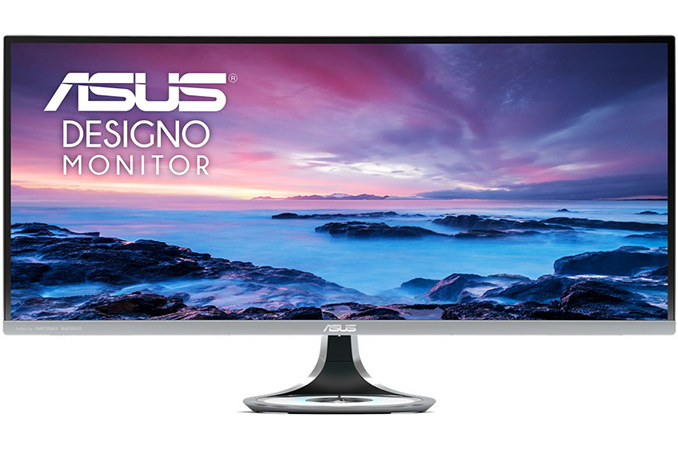
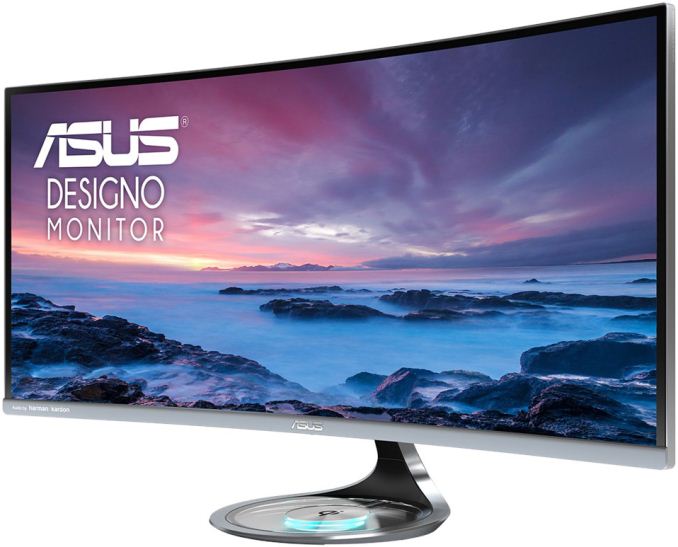
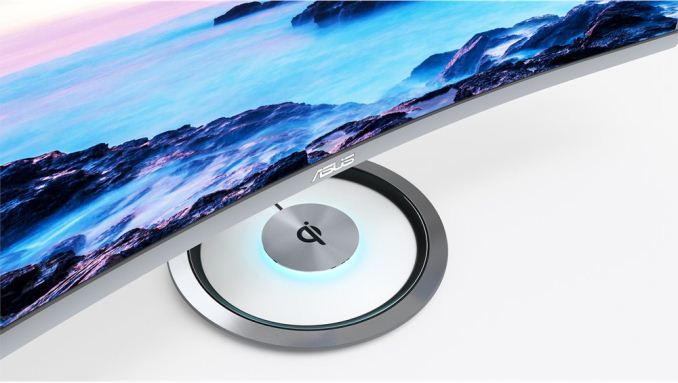
ASUS has started to ship its Designo Curve MX34VQ display that was originally announced in mid-2016. At present, a number of retailers are offering pre-orders on the monitor, starting that it is “coming soon." The monitor is based around a UWQHD-class panel and is equipped with a wireless Qi charging device as well as an audio sub-system co-developed with Harman Kardon. In addition, the display has a 100 Hz refresh rate, a feature that should appeal to gamers. The ASUS Designo Curve MX34VQ has a number of similarities with another ultrawide curved display with a Qi charger, the MX38VQ, which was introduced earlier this year. The two monitors share many design elements, such as ultra-thin bezels, a Harman Kardon-developed audio sub-system consisting of two 8 W speakers, a curved stand made of metal and plastic, and a Qi charger with acrylic elements and blue lighting. Where the two displays differ is in their panels, curvature and other specifications.
The ASUS Designo Curve MX34VQ is based on a 34” VA panel with a 3440×1440 resolution (2.39:1 aspect ratio), offering a maximum brightness of 300 nits, a 3000:1 contrast ratio, a 100 Hz refresh rate, 178°/178° viewing angles, a 4 ms response time, and 1800R curvature. The panel can reproduce 16.7 million colors and appears to be a pretty typical sRGB gamut design. As for connectivity, the Designo Curve MX34VQ monitor has three HDMI 2.0 ports, a DisplayPort 1.2 port (PiP and PBP functions are supported), and a 3.5-mm audio jack.
The ASUS Designo Curve MX34VQ can be pre-ordered from Amazon and B&H for $799, which seems to be its official price. If that does end up being the official price then it'll be a bit lower than I had initially expected, given the stylish design and rather decent specifications. For comparison, similar curved ultrawide monitors without Qi support have tended to retail for $899 and higher. In any case, the exact availability date is unknown, but with pre-orders opening up it's reasonable to assume that the MX34VQ will finally hit the shelves in the coming weeks.
Gallery: ASUS Designo Curve MX34VQ
      Related Reading:
| ||||||||||||||||||||||||||||||||||||||
| 2:00p | Sony Announces SF-G UHS-II SD Cards: Up to Nearly 300 MB/s Read/Write Performance
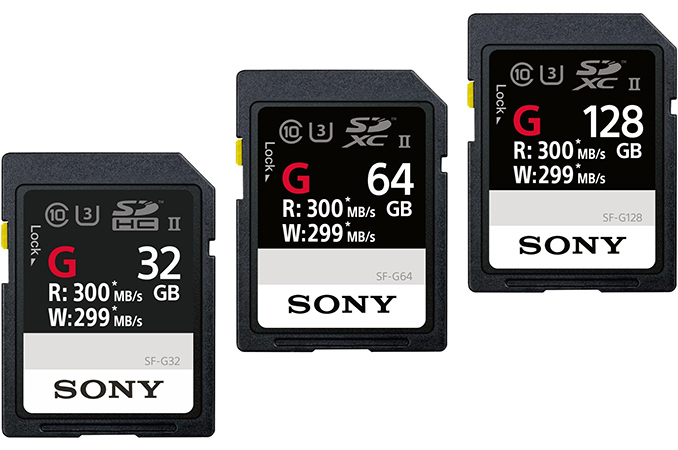
Sony has announced its new lineup of SD cards for advanced 4K/8K, DSLR, and mirrorless cameras. The new SF-G-series memory cards use the UHS-II bus and one of Sony’s proprietary technologies to offer the company's highest read/write performance to date — up to nearly 300 MB/s. The cards will hit the market in the coming months. The Sony SF-G-series memory cards will be available in 32 GB (SDHC), 64 GB (SDXC), and 128 GB (SDXC) configurations. The key selling point of the new Sony SF-G cards is their performance: up to 300 MB/s read speed and up to 299 MB/s write speed, which a quick look finds is around 15% faster compared to competing products (such as the SanDisk Extreme PRO SD UHS-II or the Lexar Professional 2000x UHS-II, both of which offer up to 260 MB/s writes). The new cards from Sony are compatible with various types of SD-supporting devices (cameras, card readers, etc.), but to take full advantage of their speed one needs a device that fully supports the UHS-II bus and has the extra pins the wider bus requires. Sony is not reveaing how they're getting up to 299 MB/s sequential write performance in an SD card, instead only saying that it is enabled by its firmware. One possibility is that the cards use NAND flash memory with very large block sizes (supported by the SD 5.0 standard), which helps to boost write performance. In addition, the NAND controller inside the card may have a special pSLC cache with very fast writes and rather low usable capacities of the devices imply on that, but this could be verified only by testing one of these products.
The new cards from Sony carry the Class 10 and U3 labels to show that their performance does not drop below 10 and 30 MB/s when used with those standards' respective workloads. Being positioned for professional use, the Sony SF-G cards are also waterproof, static-proof, temperature-proof, and shock-proof, which is beneficial for people who travel a lot and/or have to use memory cards in tough conditions. In case the data on cards is lost, Sony supplies its File Rescue tool with them. Sony’s SF-G-series SDXC cards will be available this spring. Pricing is to be determined, but it will vary depending on capacities. In addition to the flash memory cards, Sony will also offer its clients a UHS-II-capable MRW-S1 card reader with USB 3.0 interface, whose price is also unknown. Related Reading: | ||||||||||||||||||||||||||||||||||||||

| << Previous Day |
2017/02/24 [Calendar] |
Next Day >> |