[Most Recent Entries] [Calendar View]
Tuesday, March 21st, 2017
| Time | Event | ||||||||||||||||||||||||||||||||||||||||||||||||||||||||||||||||||||
| 1:00a | ARM Launches DynamIQ: big.Little to Eight Cores Per Cluster
Most users delving into SoCs know about ARM core designs over the years. Initially we had single CPUs, then paired CPUs and then quad-core processors, using early ARM cores to help drive performance. In October 2011, ARM introduced big.Little – the ability to use two different ARM cores in the same design by typically pairing a two or four core high-performance cluster with a two or four core high-efficiency cluster design. From this we have offshoots, like MediaTek’s tri-cluster design, or just wide core mesh designs such as Cavium’s ThunderX. As the tide of progress washes against the shore, ARM is today announcing the next step on the sandy beach with DynamIQ. The underlying theme with DynamIQ is heterogeneous scalability. Those two words hide a lot of ecosystem jargon, but as ARM predicts that another 100 billion ARM chips will be sold in the next five years, they pin key areas such as automotive, artificial intelligence and machine learning at the interesting end of that growth. As a result, performance, efficiency, scalability, and latency are all going to be key metrics moving forward that DynamIQ aims to facilitate.
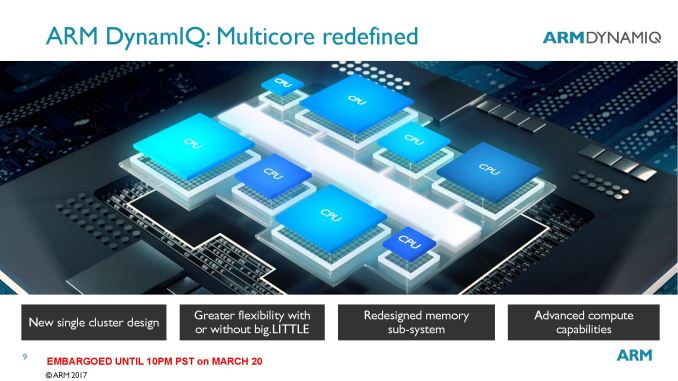
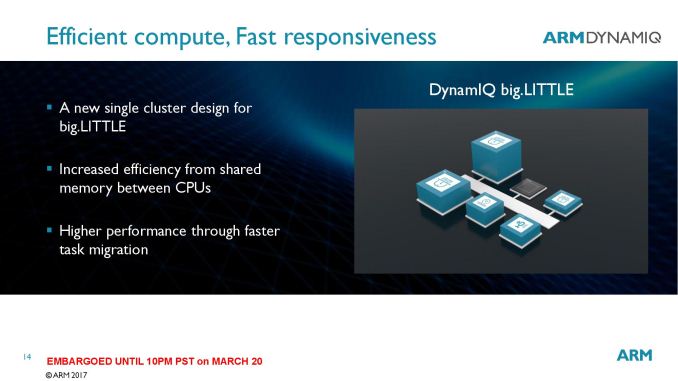
The first stage of DynamIQ is a larger cluster paradigm - which means up to eight cores per cluster. But in a twist, there can be a variable core design within a cluster. Those eight cores could be different cores entirely, from different ARM Cortex-A families in different configurations. Many questions come up here, such as how the cache hierarchy will allow threads to migrate between cores within a cluster (perhaps similar to how threads migrate between clusters on big.Little today), even when cores have different cache arrangements. ARM did not yet go into that level of detail, however we were told that more information will be provided in the coming months.
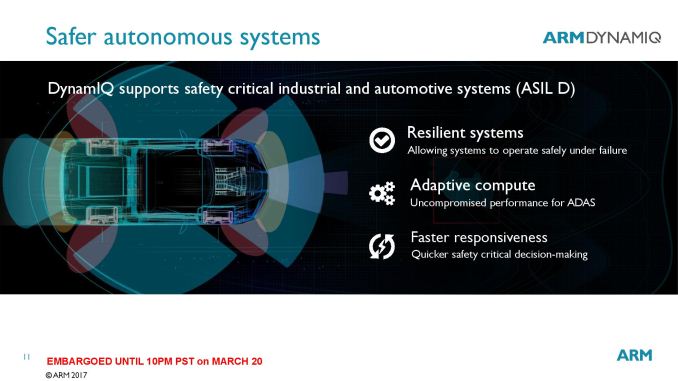
Each variable core-configuration cluster will be a part of a new fabric, with uses additional power saving modes and aims to provide much lower latency. The underlying design also allows each core to be controlled independently for voltage and frequency, as well as sleep states. Based on the slide diagrams, various other IP blocks, such as accelerators, should be able to be plugged into this fabric and benefit from that low latency. ARM quoted elements such as safety critical automotive decisions can benefit from this.
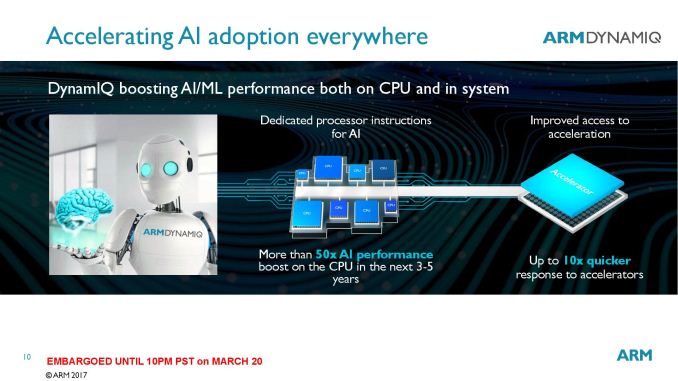
One of the focus areas from ARM’s presentation was one of redundancy. The new fabric will allow a seemingly unlimited number of clusters to be used, such that if one cluster fails the others might take its place (or if an accelerator fails). That being said, the sort of redundancy that some of the customers of ARM chips might require is fail-over in the event of physical damage, such as automotive car control is retained if there are >2 ‘brains’ in the vehicle and there is an impact which disables one. It will be interesting to see if ARM’s vision for DynamIQ extends to that level of redundancy at the SoC level, or if it will be up to ARM’s partners to develop on the top of DynamIQ. Along with the new fabric, ARM stated that a new memory sub-system design is in place to assist with the compute capabilities, however nothing specific was mentioned. Along the lines of additional compute, ARM did state that new dedicated processor instructions (such as limited precision math) for artificial intelligence and machine learning will be integrated into a variant of the ARMv8 architecture. We’re unsure if this is an extension of ARMv8.2-A, which introduced half-precision for data processing, or a new version. ARMv8.2-A also adds in RAS features and memory model enhancements, which coincides with the ‘new memory sub-system design’ mentioned earlier. When asked about which cores can use DynamIQ, ARM stated that new cores would be required. Future cores will be ARMv8.2-A compliant and will be able to be part of DynamIQ.
ARM’s presentation focused mainly on DynamIQ for new and upcoming technologies, such as AI, automotive and mixed reality, although it was clear that DynamIQ can be used with other existing edge-case use models, such as tablets and smartphones. This will depend on how ARM supports current core designs in the market (such as updates to A53, A72 and A73) or whether DynamIQ requires separate ARM licenses. We fully expect any new cores announced from this point on will support the technology, in the same way that current ARM cores support big.Little. So here’s some conjecture. A future tablet SoC uses DynamIQ, which consists of two high-powered cores, four mid-range cores, and two low-power cores, without a dual cluster / big.Little design. Either that or all three types of cores are on different clusters altogether using the new topology. Actually, the latter sounds more feasible from a silicon design standpoint, as well as software management. That being said, the spec sheet of any future design using DynamIQ will now have to list the cores in each cluster. ARM did state that it should be fairly easy to control which cores are processing which instruction streams in order to get either the best power or the best efficiency as needed. ARM states that more information is to come over the next few months. Gallery: ARM DynamIQ Slides
     
| ||||||||||||||||||||||||||||||||||||||||||||||||||||||||||||||||||||
| 7:00a | NVIDIA Releases 378.92 WHQL Driver: Mass Effect and Dolby Vision for Games
This week in a relatively brief driver update, NVIDIA has released their Game Ready driver for the newly released Mass Effect: Andromeda. Following with the 378 branch, 378.92 adds official Game Ready support for the game. This includes the usual driver optimizations as well as an SLI profile for EA's soon-to-be blockbuster game. Alongside Mass Effect, we are also getting game ready support for Rock Band VR, and updated SLI profiles for Dead Rising 4 and Deus Ex: Breach. However buried in this driver release is a second noteworthy and interesting feature addition: NVIDIA is also enabling Dolby Vision support for games. Dolby's competing HDR transport standard is arguably a higher fidelity standard than HDR10 thanks to aspects such as its 12bpc color modes, however its proprietary nature has limited its adoption versus HDR10. And while we're still early in the days of HDR PC monitors – the first HDR10 monitors don't even ship until later this month – Dolby Vision hasn't been on the PC monitor roadmap at all. In any case, the addition of Dolby Vision appears to be aimed at use with TVs, where high-end models do offer Dolby Vision support. So for those users out there who own the necessary TV, an NVIDIA card, and Mass Effect: Andromeda (the sole Dolby Vision-enabled PC game), they should be in for a treat. Anyone interested can download the updated drivers through GeForce Experience or on the NVIDIA driver download page. More information on this update and further issues can be found in the 378.92 release notes.
| ||||||||||||||||||||||||||||||||||||||||||||||||||||||||||||||||||||
| 3:45p | Apple Announces 2017 iPad 9.7-Inch: Entry Level iPad now at $329
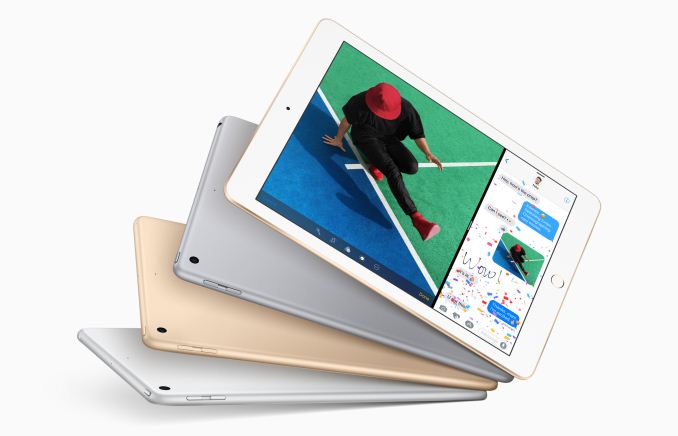
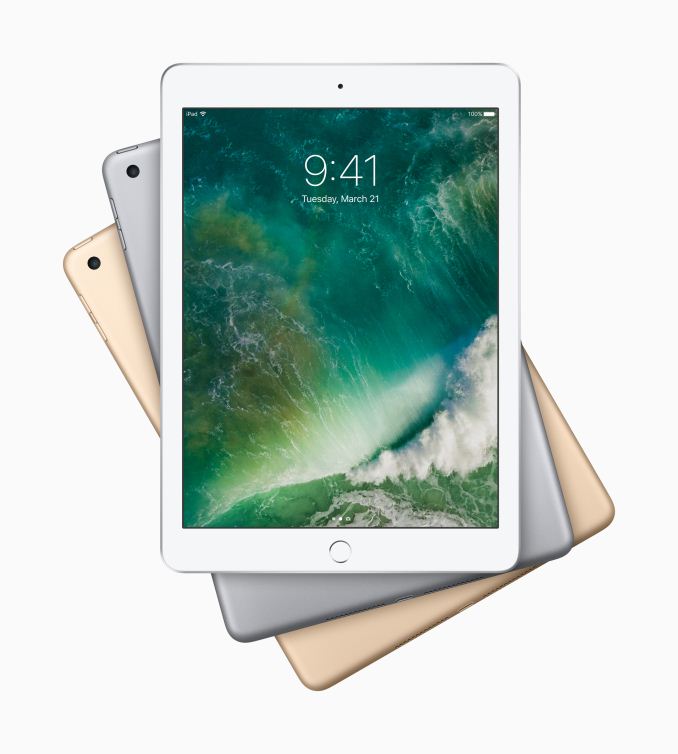
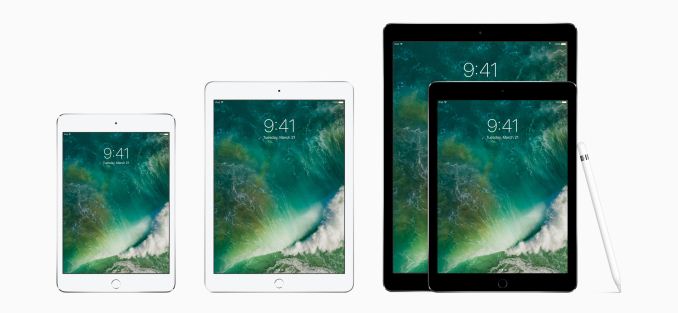
With the spring finally upon us, Apple this morning is going about some spring cleaning of the iPad family. The iPad Air 2 and the iPad Mini 2 have been discontinued, making way for a new entry-level iPad: the simply named iPad 9.7-Inch. This latest iPad is a bit of an unusual twist on the usual Apple fare; it’s not really a successor to the iPad Air 2, and from a features perspective it’s essentially a kitbash of a few different Apple products. None the less, at $329 it’s also the lowest Apple has ever priced a 9.7” iPad, as retailer sales aside, Apple hasn’t offered this size below $399 before. As a result the new 9.7” iPad is likely to make an impact, even in the softening market for tablets.
From a high-level perspective, the iPad 9.7” (2017) is an interesting kitbash between the iPhone 6s, the iPad Air 2, and the iPad Air 1. It’s obvious that Apple was aiming to make a more budget-friendly iPad from the start, so you won’t find any new, cutting edge technology in here. Rather everything is essentially cobbled together from the aforementioned Apple products. This, consequently, is also why the 2017 iPad is not a true successor to the iPad Air 2, as it makes some necessary compromises to hit the $329 price tag. The shell itself is taken from the iPad Air 1, offering the same dimensions and weight as Apple’s 2013 flagship tablet. This means that at 7.5mm, the new iPad is actually thicker than the iPad Air 2 by 1.4mm (~23%), though as we’ll see, Apple appears to be putting some of the additional volume to good use. Apple also seems to have lifted the display assembly from the iPad Air 1; while all of the modern Retina 9.7” iPads have offered a 2048x1536 IPS display, this one in particular lacks the fully laminated display that was introduced in the iPad Air 2 and is part of the reason that the aforementioned tablet was made thinner. Meanwhile inside the tablet itself, Apple has lifted the bulk of the guts from the iPhone 6s. At the heart of the new iPad is an Apple A9 SoC, which incorporates a pair of Apple’s “Cyclone” CPU cores and a 6 cluster PowerVR Series7XT GPU. Based on Apple’s performance estimates, it looks like this is clocked at or very near the 1.85GHz clockspeed of the iPhone 6s, so burst performance should be very close to the iPhone’s. Meanwhile Apple hasn’t confirmed the memory capacity, but since the A9 is a PoP design (and all other 9.7” iPads have 2GB of RAM), 2GB is almost certain for the new iPad as well.
Finally, from the iPad Air 2 comes the tablet’s camera modules. The rear camera is an 8 Megapixel f/2.4 camera that we’ve seen in the iPad Air 2 and a number of other Apple tablets, while the front camera is Apple’s similarly common 1.2MP f/2.2 camera. Apple doesn’t publish the exact sensor configuration, but I would be surprised if this wasn’t lifted wholesale from Apple’s existing camera module stockpile. Getting back to size for a moment, the 2017 iPad 9.7” will also have the highest capacity battery of a 9.7” iPad in the last few years. Along with the iPad Air 1 shell, Apple has also brought back that tablet’s 32.4 Watt-hour battery, giving it a 19% battery capacity boost over the iPad Air 2. Coupled with the use of a smartphone SoC, and I’m very curious to see what real-world battery life is at. While Apple officially advertises the iPad as having the same 10 hour (Wi-Fi) battery life as the other iPads, there’s definitely some room to pick up another hour or two of runtime. Though ultimately it’s going to be the display that’s the deciding factor, as it’s already the biggest power consumer on an iPad. Apple will be offering the 2017 iPad 9.7” in two capacities, 32GB and 128GB, with the latter capacity carrying a $100 premium. Somewhat surprisingly, the company is also offering a version of the tablet with a cellular modem despite the budget-focused nature of the tablet. Unfortunately Apple is still charging a $130 premium for this functionality, which feels especially steep given the tablet’s low base price. Finally, Apple will begin taking pre-orders for the tablet this Friday the 24th. The tablet is set to ship to next week to both pre-order customers and retail stores.
Overall it will be interesting to see how Apple’s new entry-level iPad does in the market. The company’s tablet business continues to chug along, but sales as well off from their heyday as tablet replacement cycles are closer to laptops than phones. At the same time the iPad 2 was one of Apple’s most popular tablets due to its relatively low price for its size, so Apple may be looking to recapture some of that energy. Though it’s interesting to note that in this process, Apple has actually increased the price of an entry-level iPad some; whereas the discontinued iPad Mini 2 was $269, the new iPad bumps that up by $70. Speaking of which, the new iPad does put the remaining iPad Mini 4 configurations in a bit of an odd spot. The tiniest tablet actually did get an update of its own: the $399 32GB model was discontinued, and the sole 128GB model has been dropped to $399 in its place. Despite the price shuffle though, it is an older design and remains the only iPad not using an A9-generation processor. While Apple’s spring cleaning makes it clear which tablet Apple wants to be their entry-level iPad, the Mini remains as the odd man out in this new lineup.
| ||||||||||||||||||||||||||||||||||||||||||||||||||||||||||||||||||||

| << Previous Day |
2017/03/21 [Calendar] |
Next Day >> |