[Most Recent Entries] [Calendar View]
Wednesday, May 3rd, 2017
- Sapphire Nitro+ Radeon RX 580 & a Sapphire Stein
- Sapphire Pulse Radeon RX 580 & a Sapphire Stein
- Set of 3 Sapphire Steins
- Seagate Announces Enterprise Capacity 12 TB HDD: 2nd-Gen Helium-Filled Hard Drives
- Seagate Confirms Plans for 12 TB HDD in Near Future, 16 TB HDD Due in 2018
- Western Digital Expands Purple Lineup with a 10 TB Helium-Filled HDD
- Western Digital Announces Ultrastar He12 12 TB and 14 TB HDDs
- Seagate to Shut Down One of Its Largest HDD Assembly Plants
- Seagate Introduces BarraCuda 2.5” HDDs with Up to 5 TB Capacity
- Thermaltake View 31 Tempered Glass Case
- Thermaltake Smart Pro RGB 850W PSU
| Time | Event | ||||||||||||||||||||||||||||||||||||||||||
| 8:00a | AT20 Giveaway Day 6: Sapphire Sends Radeon RX 580s & Some Steins
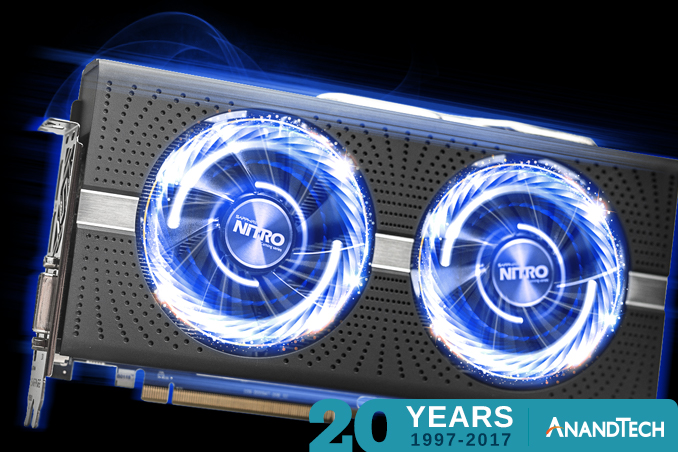
We’ve hit the middle of the week, so that means it’s time for day 6 of our 20 day giveaway celebration of AnandTech’s 20th anniversary. This morning we have some more video cards to give away, courtesy of Sapphire. Perhaps AMD’s closest board partner, the company has sent over one of each of their Nitro+ factory overclocked Radeon RX 580 card, and their slightly lower-key Pulse Radeon RX 580. The company has also sent over a bit of true swag, with a set of their steins. We have one each for the video card winners, and a 3 piece set for our third winner.
The AnandTech 20th Anniversary Celebration – Sapphire Giveaway Sapphire Nitro+ Radeon RX 580 8GB
At the high-end of Sapphire’s Radeon RX 500 series lineup is the Nitro+ series, the company’s gaming-focused, factory overclocked cards. The Nitro+ RX 580 sports a factory overclock of 1411MHz, 71MHz over AMD’s reference clock. Internally, the card is built on a custom Sapphire PCB with significantly beefed up power delivery (and a 235W TDP to match), backed by Sapphire’s Black Diamond chokes. Cooling for the card is provided by one of Sapphire’s dual-fan Dual X coolers, which sports a set of rather sizable 95mm diameter fans. The fans also feature Sapphire’s Quick Connect feature, which allows them to be quickly connected and disconnected if necessary. And for some added flair, the Nitro+ also features full RGB lighting built into the card’s shroud, which Sapphire advertises under the Nitro Glow 2 name. Sapphire Pulse Radeon RX 580 8GB
Meanwhile we also have Sapphire’s Pulse Radeon RX 580 card, the company’s entry-level RX 580 board. Like its bigger sibling, the Pulse is a dual-fan open air cooler type card, sporting a Dual X cooler with a pair of quick connect fans. The factory overclock on this card isn’t as aggressive as with the Nitro+, with Sapphire shipping the card at 1366MHz, 26MHz over the AMD reference. In turn, the card is a bit more compact as well, coming in at just 9.1-inches long. Sapphire Stein
Last, we have Sapphire Steins for each video card winner, and another 3 for the 3rd place winner. Hoist your favorite drink in one while gaming, or use it to host company. Finally, as with our other giveaways, today’s giveaway is only open for 48 hours, so be sure to enter soon. However please note that for legal reasons, we’re only able to open these giveaways to residents of the United States. Good luck to everyone! And be sure to check in this afternoon for our next giveaway. | ||||||||||||||||||||||||||||||||||||||||||
| 11:00a | Seagate Ships 35th Millionth SMR HDD, Confirms HAMR-Based Drives in Late 2018
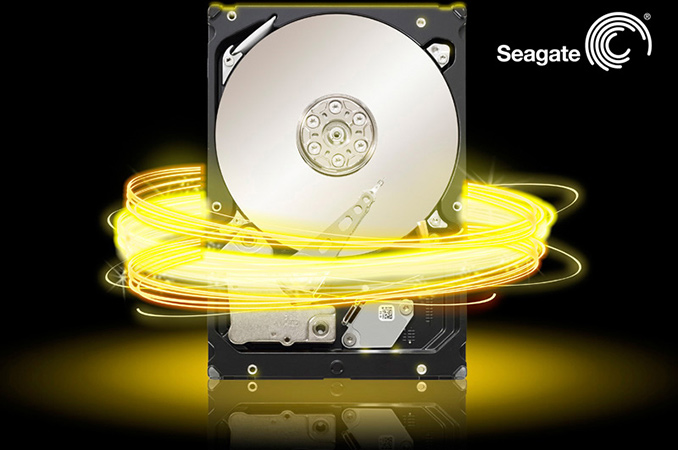
Seagate last week made two rather important announcements regarding its current and upcoming hard drives. First, the company said that it had shipped 35 million HDDs based on shingled magnetic recording (SMR) technology. Second, the manufacturer confirmed plans to launch commercial hard drives based on its heat-assisted magnetic recording (HAMR) technology by the end of 2018, the first time the company set a precise launch timeframe for such HDDs. 35 Million and CountingSeagate launched the Archive 8 TB, its first HDD based on SMR, in 2013. Due to the technology, it targeted archive applications - the majority of the archival workload is sequential writes, and the data is hardly ever updated, concealing peculiarities of shingled magnetic recording. As reported multiple times, to increase areal density, HDDs featuring SMR write new magnetic tracks that overlap part of the previously written tracks. This may slow down the rewriting process since the architecture requires hard drives to rewrite adjacent tracks after any writing action. To mitigate such peculiarities, Seagate incorporated various features into its device-managed SMR-based drives, which were described by Mark Re (CTO of Seagate) in an interview last year. Over the course of the recent years, Seagate has introduced several generations of SMR-based drives for archive, nearline, NAS, surveillance and mobile PC applications. Each generation refined the use of shingled magnetic recording technology in a bid to improve performance (for example, Seagate added SLC NAND-based cache to its 2.5” SMR drives) as well as improving areal density. During a recent call with investors and financial analysts, Stephen Luczo, CEO of Seagate, said that the company had shipped 35 million SMR-based hard drives and was about to launch its fourth generation of SMR-based HDDs. The head of the company did not elaborate on the benefits of the fourth-gen SMR, but Seagate has indicated that its platform is expandable for performance and areal density benefits. In fact, we already know from Western Digital’s announcement of a 14 TB HDD that the upcoming new-gen 3.5” SMR platters have a capacity of 1.75 GB per platter, so we expect Seagate to deal with disks of around the same areal density/capacity.
What is noteworthy is that shipments of SMR-based drives are accelerating as Seagate expands use of the technology. Seagate shipped around four million of SMR HDDs in the first two years (from September 2013 to September 2015) and then shipments of SMR HDDs have comparatively skyrocketed over the past six quarters. The main reason why Seagate has managed to accelerate sales of its SMR drives significantly in a short period of time is because such HDDs are contained and managed in isolation, but also because they are drop-in compatible with existing data center and client infrastructure where these drives make sense the most. That being said, we suspect that certain large customers of Seagate still adjust their software before deploying such drives, eliminating unnecessary writes and thus optimizing performance and power consumption by another step from regular testing. To put Seagate's position into context, SMR-based HDDs from HGST are managed by hosts, which requires tangible investments from their customers. Even though the Ultrastar Ha-series is strictly aimed at clients who primarily appreciate raw capacities and relatively low power consumption (a feature of helium-filled HDDs), the integration issue is not such a big problem for Western Digital as the company still ships many high-margin products. Still, device-managed SMR expertise helps Seagate to address certain market segments with products that have no direct rivals. For example, the Seagate BarraCuda 2 TB HDD and the Seagate FireCuda 2 TB hybrid HDD have no direct competitors in the 2.5”/7mm segment. One of Seagate’s targets going forward is to make products that do not compete against SSDs directly:
HAMR-Based HDDs Due in Late 2018While it is inevitable that client HDDs will continue to compete with client SSDs, high-end special-purpose drives are going to complement what is available with NAND flash. High-capacity HDDs based on HAMR technology are not going to have direct flash-based rivals of the same price and capacity, therefore, it is important for Seagate to launch such drives sooner rather than later. During the conference call, Seagate indicated that HAMR-based HDDs are set to be released commercially in late calendar 2018.
This is not the first time that Seagate has made a HAMR-related announcement, but this is the first time when the company has set a particular launch timeframe for such drives. Previously, Seagate has implied that the first HAMR-based HDDs would feature a capacity of 16 TB, which is a significant increase from 12 TB hard drives due to be released in the coming weeks. Given the fact that data centers cry out for high-capacity drives, it is inevitable that HAMR-based HDDs with increased performance and higher capacities will be in high demand. Keeping in mind that late 2018 (by “late” companies usually mean the fourth quarter) is over a year away, Seagate is not sharing details about experimental deployments of HAMR-based HDDs that may be planned for 2017/early 2018. Related Reading: | ||||||||||||||||||||||||||||||||||||||||||
| 2:00p | AT20 Giveaway Day 6.5: Thermaltake View 31 Case & Smart Pro Power Supply
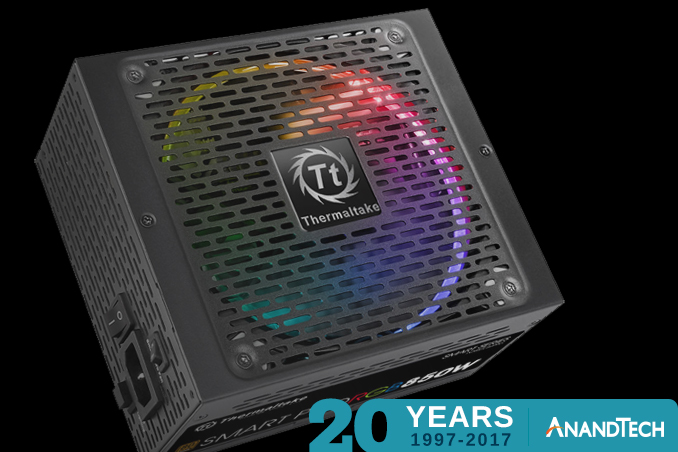
For this afternoon’s giveaway, we have a pair of prizes from the crew over at Thermaltake. The case, cooling, and peripheral manufacturer has sent over both their View 31 Tempered Glass case and their Smart Pro RGB 850W Bronze PSU. Whether you need a case for a new PC build, or a more powerful PSU for a system upgrade, this afternoon’s prizes should have you covered. The AnandTech 20th Anniversary Celebration – Thermaltake Giveaway Thermaltake View 31 Tempered Glass Case
Our literally big prize of the day, Thermaltake’s View 31 case is an interesting deviation from the usual mid-tower case. The marquee feature for the case is its tempered glass windowed side panels, which the company touts for its large size and the improved durability of glass over traditional plastic windows. The case also forgoes any 5.25” bays, making full room for its fully modular internal bays and plenty of cooling options.
The case comes with a pair of 140mm Riing fans with blue LED lighting pre-installed, with one fan for intake and a second fan for exhaust, with plenty of room left over for additional fans and radiators. Meanwhile the extra-wide case also sports an unusual feature: a space for vertically mounting a video card to keep the weight off of the motherboard. Thermaltake Smart Pro RGB 850W PSU
Our second prize of the afternoon is Thermaltake’s 850W Smart Pro RGB PSU. This is a fully modular PSU – ATX cable and all – with up to 4 PCIe 8 pin power connectors. On the power delivery side, the Smart Pro is rated for 80Plus Bronze, while delivering up to 70.5A (846W) on the 12v rail. Living up to its “RGB” name, the PSU’s 140mm fan features 256-color RGB lighting, and as an added kicker can shut off entirely in low load/temperature conditions for silent running. Finally, as with our other giveaways, today’s giveaway is only open for 48 hours, so be sure to enter soon. However please note that for legal reasons, we’re only able to open these giveaways to residents of the United States. Good luck to everyone! And be sure to check in tomorrow for our next giveaway. | ||||||||||||||||||||||||||||||||||||||||||




| << Previous Day |
2017/05/03 [Calendar] |
Next Day >> |