[Most Recent Entries] [Calendar View]
Tuesday, May 9th, 2017
- Huawei Mate 9 Smartphone
- Huawei P10 Smartphone
- Trident Z RGB DDR4-3200 CL14 32GB (4x8GB) Kit
- Trident Z RGB DDR4-3600 CL16 32GB (4x8GB) Kit
- Ripjaws KM780 RGB Keyboard + Ripjaws MX780 Mouse
| Time | Event | ||||||||||||||||||||||||||||||||||||||||||||||||||||||||||||||||||||||||||||||||||||
| 8:00a | Previewing Maxiotek's MK8115 SSD Controller: Can DRAM-less Drives Make The Cut? Maxiotek, the fabless SSD controller design group formerly part of JMicron, has released their first new controller since being spun off. The MK8115 is a DRAM-less SATA SSD controller intended for low-cost SSDs using 3D NAND. We tested 512GB engineering samples using both Micron's 3D MLC and 3D TLC. | ||||||||||||||||||||||||||||||||||||||||||||||||||||||||||||||||||||||||||||||||||||
| 9:15a | AT20 Giveaway Day 10: Huawei Calls for Mate 9 and P10 Smartphones
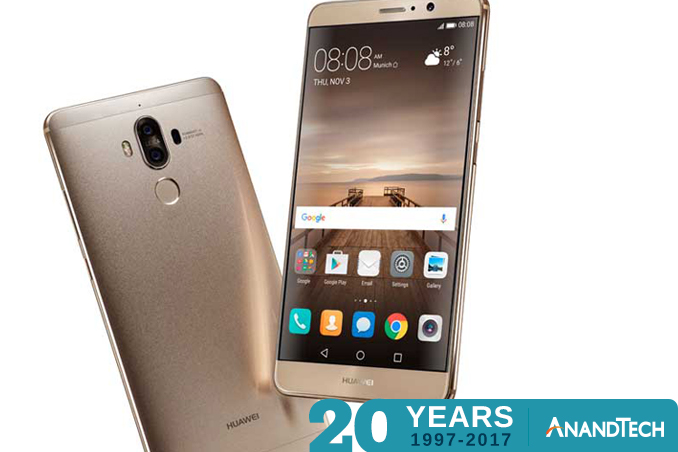
Hey everyone, we’re back again for day 10 of our 20 day giveaway celebration of AnandTech’s 20th anniversary. Starting us off this morning is Huawei. We haven’t had a phone giveaway in a couple of days now, so the rising Chinese smartphone manufacturer is supplying us with a set of their latest phones. Need something big? Then for that we have the Mate 9. Or something a bit more one-hand friendly? Then for that we have the recently launched P10. The AnandTech 20th Anniversary Celebration – Huawei Giveaway Huawei Mate 9
Launched at the tail-end of last year, the Mate 9 is Huawei’s flagship phablet. With a 5.9 inch 1080p LCD display, the Mate 9 is a big deal. But not just for the screen: it’s also one of the first Huawei phones to feature subsidiary HiSilicon’s Kirin 960 SoC, a current-generation 16nm FinFET-built SoC that incorporates ARM’s latest Mali-G71 GPU and Cortex-A73 CPU. As a result the Mate 9 ends up being a very fast phone.
Rounding out the package is a 64GB of NAND and 4GB of RAM, along with a 12MP rear camera based on Sony’s IMX286 sensor and incorporating OIS and laser auto-focus. Meanwhile the phone’s modem is based on Huawei/HiSilicon’s own LTE modem design, which supports up to LTE Cat12. The phone itself is built around an aluminum unibody, which as Matt Humrick noted in our review of the phone, “gives it a stiff, solid feel that’s atypical for such a large phone.” And Huawei puts that volume to good use as well, filling the phone with a 4000 mAh (15.28 Wh) battery, giving the powerful phone some extra battery capacity to offset its capabilities. Huawei P10
The smaller counterpart to the Mate 9, the Huawei P10 incorporates much of the same hardware in a smaller body. We’re still looking at the Cortex-A73 equipped Kirin 960 SoC, only this time it’s now paired with a 5.1 inch 1080p LCD. The rest of the internal hardware includes 64GB of NAND and 4GB of RAM, and the SoC’s integrated LTE Cat12 modem.
The rear (color) camera is a 12MP f/2.2 design, based on Sony’s IMX286 sensor. Meanwhile the IPS LCD display is capable of covering almost the entire DCI-P3 gamut, which will be particularly useful once Android color management catches up. Powering the phone is a 3200 mAh battery. Finally, as with our other giveaways, today’s giveaway is only open for 48 hours, so be sure to enter soon. However please note that for legal reasons, we’re only able to open these giveaways to residents of the United States. Good luck everyone! And be sure to check in tomorrow for our next giveaway. | ||||||||||||||||||||||||||||||||||||||||||||||||||||||||||||||||||||||||||||||||||||
| 2:00p | AT20 Giveaway Day 10.5: G.Skill Trident Z RGB Memory & 780-Series Peripherals
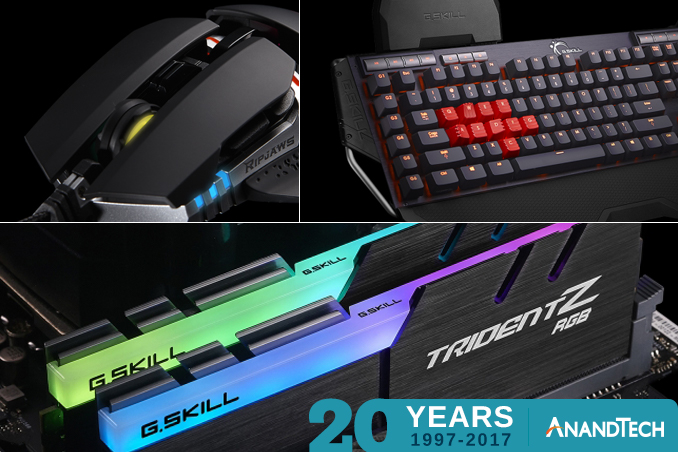
Closing out our giveaways for this Tuesday is G.Skill. The long-lived memory, storage, and peripheral manufacturer has sent over a trio of prizes from across their product lineup. The company’s core specialty is of course RAM, so we have two of their Trident Z RGB DDR4 kits: a 32GB (4x8GB) DDR4-3200 kit, and the even faster 32GB (4x8GB) DDR4-3600 kit. Meanwhile from their peripherals business, we have a complete 780-series mouse and keyboard set, containing a KM780 RGB keyboard and MX780 mouse. The AnandTech 20th Anniversary Celebration – G.Skill Giveaway G.Skill Trident Z RGB DDR4 RAM
Starting things off, we have a duo of G.Skill’s flagship Trident Z RGB memory kits, the DDR4-3200 and the DDR4-3600. The DDR4-3200 kit runs at 14-14-14 timings, meanwhile the DDR4-3600 kit trades a bit of frequency for timings, bumping the latter up to 16-16-16. Both kits offer frequencies well over the DDR4 official spec, so unsurprisingly both require a little more voltage – 1.35v to be precise – to get there, with an XMP 2.0 profile to help motherboards dial in the right settings. Meanwhile both kits are clad in G.Skill’s Trident Z RGB heatspreader. This black metal headspreader includes an exposed lightbar at the top of the memory, which in turn contains a full RGB color lighting solution, allowing the DIMMs to add some more color to a build. G.Skill Ripjaws KM780 RGB Keyboard + Ripjaws MX780 Mouse
Our third G.Skill prize for the day is a mouse and keyboard combo pack containing the company’s Ripjaws KM780 RGB keyboard and Ripjaws MX780 mouse. The KM780 RGB keyboard is a fully mechanical keyboard using Cherry’s MX switches. Besides basic keyboard functionality, the board also includes several extra function keys (including a dedicated timer key!) and a USB 2.0 port for daisy-chaining a mouse. And as is common for high-end keyboards, G.Skill offers a macro command system. Finally, the keyboard offers extensive RGB lighting, with fully programmable per-key RGB backlighting.
Meanwhile the MX780 mouse is the natural counterpart to the KM780 keyboard. The aluminum-framed ambidextrous mouse is based around an Avago ADNS 9800 laser sensor, one of the higher-end sensors on the market today. The body of the mouse itself includes swappable side grips, 8 programmable buttons, and height + weight adjustment. Oh, and of course, RGB lighting courtesy of a 4 zone lighting system. Finally, as with our other giveaways, today’s giveaway is only open for 48 hours, so be sure to enter soon. However please note that for legal reasons, we’re only able to open these giveaways to residents of the United States. Good luck to everyone! And be sure to check in tomorrow for our next giveaway. | ||||||||||||||||||||||||||||||||||||||||||||||||||||||||||||||||||||||||||||||||||||
| 10:00p | NVIDIA Announces Earnings for Q1 FY 2018
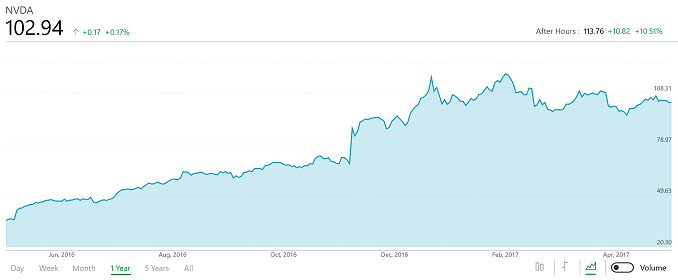
This afternoon, NVIDIA announced their earnings for the first quarter of their 2018 fiscal year. NVIDIA has been having a lot of success moving their core GPU business away from just PC gaming, and into far more categories, and the earnings today suggest that they’ve made some excellent strategic moves, coupled with solid product launches. Revenue for the quarter came in at $1.94 billion, which is an increase of 48% from Q1 2017. Gross margin was up 1.9% from a year ago, with 59.4% for the quarter. Operating income was up a staggering 126% to $554 million, and net income was up 144% to $507 million. This resulted in earnings per share of $0.79, up 126% from a year ago when they were $0.35. Last year, NVIDIA had record revenues, and this fiscal year they are off to an even better start.
Despite NVIDIA diversifying, and creating new markets for their GPUs, gaming is still the core of the company. They have come a long way in some of their segments, but gaming still accounts for 53% of their revenue, meaning it is larger than every other segment combined. Interestingly, despite the high gains in practically all other segments, the growth in gaming was higher. Last year at the end of Q1 2017, gaming accounted for only 52.6% of their revenue. For this quarter, revenue from gaming was $1.027 billion, compared to $687 million a year ago. A strong year of Pascal under their belt, and the launch of the GeForce GTX 1080 Ti, shows that there’s still room for growth in the PC market. Professional Visualization, which is the segment for Quadro, had much lower growth than GeForce, but still increased revenues from $189 million a year ago, to $205 million today. That’s reasonable growth of 8.4%, but compared to pretty much every other NVIDIA segment, it seems like it’s not growing at all. Datacenter is where NVIDIA has really found a great home for their GPU business, especially with the growth in machine learning and AI. NVIDIA’s Tesla business was once an afterthought for the company (well, maybe not the company, but outsiders looking in), but with the launch of the Tesla P100 and smaller variants, and DGX-1, NVIDIA has found some big customers for their datacenter compute products, including Microsoft, Google, and several other cloud vendors. Datacenter revenue was up 186% to $409 million. To put that in perspective, NVIDIA didn’t even discuss datacenter revenues even two years ago, and it’s now their second largest business. Not only that, it’s very likely one of their highest margin businesses as well. Automotive, which came out of the failed Tegra smartphone and tablet business, is still showing strong growth as well. There’s a great saying about making lemonade, and NVIDIA has certainly done that. Revenue for this segment was up almost 24% to $140 million for the quarter. Finally, OEM and IP is the only segment to have a falling quarter, with revenues down about 10% to $156 million.
NVIDIA has followed up strong product launches with solid diversification of their core business, and the results speak for themselves. The last couple of years have been very strong, and it appears that growth is going to continue for at least the near term. NVIDIA is expecting revenues for next quarter to be $1.95 billion, plus or minus 2%, with a gross margin of 58.4% plus or minus 0.5%. Source: NVIDIA Investor Relations | ||||||||||||||||||||||||||||||||||||||||||||||||||||||||||||||||||||||||||||||||||||




| << Previous Day |
2017/05/09 [Calendar] |
Next Day >> |