[Most Recent Entries] [Calendar View]
Monday, May 29th, 2017
- IoT connectivity feature suite - A 802.15.4 (ZigBee) radio, as well as Bluetooth (with the CSRmesh functionality), has been added to enable the new systems to interact directly with smart home devices (without the need for an IP bridge in the middle). Since ZigBee and Bluetooth also operate in the 2.4 GHz band, Qualcomm has added interference mitigation to the board design so that the ZigBee and Bluetooth connectivity don't impact the performance of the Wi-Fi sub-system.
- Voice assistant capabilities - The popularity of voice assistants such as Amazon Alexa, Google Home, etc. has resulted in multiple Wi-Fi devices in the home whose sole functionality is to listen and respond to voice commands. These devices end up impacting the overall Wi-Fi performance in the home for very limited functionality. This use-case is perfect for integration into the units of a mesh Wi-Fi system. Qualcomm is integrating support for APIs to various popular cloud-based assistant applications into their reference design.
- Carrier-grade features - New firmware features enable easy cloud-based management capabilities. In addition, Qualcomm is also exposing certain APIs to customers that will enable porting of SON features into routers / extenders based on silicon from other vendors.
- Additional backhaul capabilities - Current generation mesh networking kits include a wide variety of backhaul options including Wi-Fi, wired Ethernet, and PLC (powerline communication). Qualcomm is also advertising 802.11ad, as well as 802.11ax support for backhaul purposes.
- The Western Digital Black PCIe SSD (512GB) Review
- Western Digital Ships Client SSDs Based on 512 Gb 3D TLC NAND Chips
- ADATA Launches the SU700 SSD Range: Maxiotek MK8115, 3D TLC, Up to 960 GB
- Previewing Maxiotek's MK8115 SSD Controller: Can DRAM-less Drives Make The Cut?
- Mushkin Launches Reactor Armor 3D and Triactor 3D 2TB SATA SSDs: 3D NAND, SM2258
| Time | Event | ||||||||||||||||||||||||||||||||||||||||||||||||||||||||||||||||||||||||||||||||||||||||||||||||||||||||||||||||||||||
| 12:00a | Exploring DynamIQ and ARM’s New CPUs: Cortex-A75, Cortex-A55 Another year, another TechDay, and another ARM facility (this time in Cambridge, UK)—can only mean new ARM IP. Over the span of several days, we got an in-depth look at its latest technologies, including DynamIQ, the Mali-G72 GPU, the Cortex-A75, and (yes, finally) the successor to the A53: Cortex-A55. | ||||||||||||||||||||||||||||||||||||||||||||||||||||||||||||||||||||||||||||||||||||||||||||||||||||||||||||||||||||||
| 1:30a | ASUS Computex 2017 Press Conference Live Blog We are live from ASUS' press conference at Computex 2017. As usual, the company will announce a number of new products that it will start to sell in the coming months and quarters. Products announced by ASUS usually represent the industry's trends, so if you want to take a glimpse at the near future of personal computing, join in. | ||||||||||||||||||||||||||||||||||||||||||||||||||||||||||||||||||||||||||||||||||||||||||||||||||||||||||||||||||||||
| 9:00a | ARM Announces Mali-G72: Bifrost Refined for the High-End SoC
While the bulk of the focus in today’s ARM announcements is on major launch of the first CPU cores to support ARM’s DynamIQ topology – the Cortex-A55 and Cortex-A75 – ARM’s GPU division isn’t sitting by idly. Rather, today the company is giving their GPU IP a timely refresh for the year with the announcement of the Mali-G72. ARM’s new high-end, high-performance GPU design, the Mali-G72 supplants the Mali-G71, undergoing a design revision and optimization against Mali-G71 to further improve performance and power efficiency for high-performance SoCs. Coming off of last year’s launch of the Mali-G71 and its underlying Bifrost GPU architecture, ARM isn’t doing anything quite as wild this year. The company is now invested into Bifrost for the long haul, so like the Midgard architecture before it, the company will be continuing to optimize, tweak, revise, and otherwise refresh the architecture to meet the needs of their customers a year or two down the line. Mali-G72 in turn is the first such revision of the architecture, taking advantage of what ARM learned when designing the G71 in order to improve on their high-performance GPU design.
At the architectural level then, Mali-G72 doesn’t make any radical alterations to the Bifrost architecture. The SIMT quad based execution model stands firm, and the ratios of the various functional blocks have not changed. So clock-for-clock, Mali-G72’s fundamental, throughput on-paper is unchanged from Mali-G71.
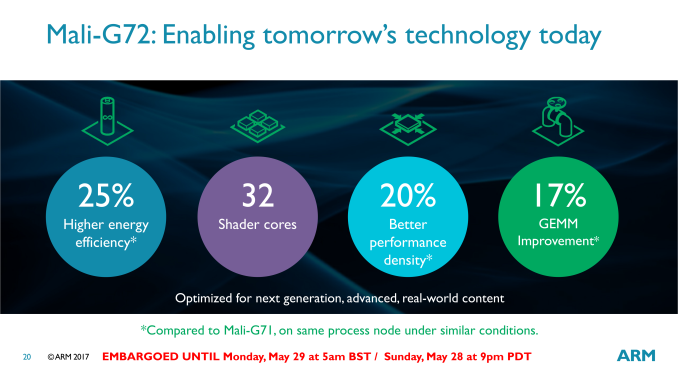
That said, the devil is in the details. And the details on Mali-G72 are all about optimizing. While ARM hasn’t made any high-level changes, the company has made a number of smaller, low-level changes that add up to a more significant impact for elevating Mali-G72 over Mali-G72. As a result the company is promoting the newer GPU design as offering 25% greater energy efficiency and 20% better performance density than Mali-G71, leading to a 40% performance improvement. Area and power efficiency are of course the lifeblood for mobile GPUs, and while the high-performance designs like the Mali-G71/G72 aren’t designed to push the envelope on area efficiency quite as much – favoring high performance instead – SoC vendors are all for trimming precious mm to reduce costs.
ARM isn’t offering a great deal of information on where all of these optimizations come from – it’s very much the sum of a large number of small changes – but at have provided us some key pieces of information. In particular, ARM has actually removed some complex instructions from their architecture, instead executing them over multiple clocks as other, simpler instructions. Excising instructions one big way to save on die space, allowing ARM to throw out the transistors that would be needed to execute those instructions. Obviously this is a double-edged sword – the emulated instructions are slower – but instructions that aren’t used very often likely aren’t worth the silicon. In this case I suspect we’d be looking at some especially esoteric things, such as atomic floating points. ARM has also been doing some tinkering under the hood to improve the throughput of other desirable complex operations. This includes things such as the reciprocal square root and other reciprocal functions, which can now complete faster, but only for graphics (an interesting distinction, since the IEEE 754-compliant operation for compute remains unchanged). This goes hand-in-hand with a more broad set of tweaks to the internal datapaths for the ALUs, though besides further optimizing how data moves between the FMA and ADD/SF units, ARM hasn’t said much more. However when it comes to overall performance efficiency, the big changes on Mali-G72 aren’t at the instruction level, but rather the cache level. All-told, ARM has tweaked buffers and caches at pretty much every step of the way. This includes making the L1 cache, the writeback cache, and the tiler buffer all larger. Meanwhile the instruction cache is unchanged in size, but ARM has tweaked the logic of it (presumably the algorithm used) to improve utilization by reducing misses. All of this cache-related tweaks are geared towards the common goal of reducing memory bandwidth usage. Not only is this important for scaling performance with larger GPUs – GPUs get more powerful faster than memory bandwidth increases – but it improves power efficiency as well, as memory operations are relatively expensive. The overall performance improvement from the larger caches reducing misses certainly doesn’t hurt, either.
ARM in turn is particularly pitching the benefits of the cache changes for both graphics and machine learning tasks. In the case of graphics, their case study of choice found a 42% reduction in how much off-chip memory bandwidth was used in G-buffer writes, primarily due to the larger write buffer. Bear in mind this is likely a case of cherry-picking, but ARM isn’t off-base in that more complex scenes push the limits of smaller buffers (finally justifying the area cost of larger buffers). Meanwhile on the machine learning front, ARM is reporting a 13% improvement in SGEMM benchmark energy efficiency (and 17% for HGEMM thanks to the combination of cache changes and the earlier mentioned instruction changes. One of ARM’s big pushes for their entire lineup of SoC IP is for inference at the edge, so even small improvements help their standings overall.
Wrapping things up, we should see ARM’s new Mali-G72 design show up in devices in another year or so. While ARM isn’t responsible for the actual silicon their IP goes into – and as such, this is ultimately in the hands of SoC vendors – the Mali-G71 did show up on the HiSilicon Kirin 960 only about 8 months after its launch. So if a partner wants to push it, they could do Mali-G72 in a similar amount of time. Though something closer to Samsung’s roughly 1 year cadence is likely to be more par for the course. Gallery: Mali-G72 Press Deck
      | ||||||||||||||||||||||||||||||||||||||||||||||||||||||||||||||||||||||||||||||||||||||||||||||||||||||||||||||||||||||
| 11:00a | Asus Announces VivoBook Pro 15 N580: Intel Kaby Lake CPU, up to 4K Display & GeForce GTX 1050
With Computex now in full swing, earlier today Asus took the wraps off of their latest VivoBook laptop, the VivoBook Pro 15 N580. Starting at $799, the 15-inch brushed aluminum laptop comes with an Intel quad-core processor, and NVIDIA GTX 1050 graphics, with an optional 4K display. Of the information Asus has released so far, the company has released the base price, but not the prices of the higher-end configurations. At the $799 base model will include an Intel Core-i5 7300HQ CPU, 500 GB HDD, and a 1080p display. Meanwhile the high-end model will have a Core-i7 7700HQ, 4K full sRGB screen, NVIDIA GTX 1050 graphics, 16GB of RAM, and both a 512GB PCIe SSD and a 2TB hard drive. Asus will also be including Intel’s Optane Memory for faster storage performance (though it’s not clear if this is just for HDD models or all models).
Considering its plethora of high-end components, the VivoBook Pro's 4.85-pound weight and 0.75-inch thickness are quite reasonable. The VivoBook Pro uses a dual-fan system to keep its powerful components from getting too hot. During a brief hands-on, the laptop felt solid and sturdy in my hands and its metal deck was pleasantly cool to the touch. The VivoBook's backlight keyboard felt sturdy snappy under my fingers and didn't even have a hint of flex. Its buttonless touchpad had just the right amount of friction and resistance for each click. Asus claims that the optional 4K screen on the VivoBook covers an impressive 100 percent of the sRGB color gamut. In my brief time with the laptop, it was difficult to tell how vibrant the colors were as the background and icons the company displayed were rather bland.
The VivoBook Pro doesn't skimp on ports. Its left side contains an Ethernet port, a USB 3.0 connector, HDMI out and a USB Type-C port. The right side houses two more USB 3.0 ports, an SD card reader and a 3.5mm audio jack. It's a shame that Asus didn't put a Thunderbolt 3 port on this laptop, but that would have likely added to the cost. Asus hasn't announced a release date for the VivoBook Pro. However, depending on just what the base configuration is like and how much the higher-end models cost, this laptop could be a great buy for design students or anyone that needs to do creative work, without breaking the bank. Avram Piltch Contributed to this Report | ||||||||||||||||||||||||||||||||||||||||||||||||||||||||||||||||||||||||||||||||||||||||||||||||||||||||||||||||||||||
| 6:45p | Asus Unveils Zen AiO ZN242: Quad Kaby Lake, GeForce GTX 1050, 1080p Display
Asus unveiled the Zen AiO ZN242 at Computex in Taipei this week. This is essentially a refresh of current 24-inch designs, with the addition of an Intel Core i7-7700HQ quad-core CPU, 32GB of RAM, and NVIDIA’s GeForce GTX 1050 GPU, making this all-in-one a candidate for some decent mainstream gaming at 1080p. Indeed, the 23.8-inch IPS panel is FHD (1920x1080). It also features what Asus calls NanoEdge, which means it sports a 2mm bezel that gives the display a 90% screen-to-body ratio, according to Asus. The ZN242 includes a re-worked stand that boasts a much different design than previous versions and a pop-up infrared camera that, in conjunction with Windows Hello, provides facial recognition from up to 4m away.
Under the hood, the system comes with either a 512GB PCIe SSD or an HDD coupled with Intel Optane memory. (We’re probably going to be seeing lots of new systems with those kinds of options this week.). Unfortunately Asus hasn't detailed anything besides the maximum configuration, so it's not clear what the other options are with regards to CPUs and GPUs.
Meanwhile we’re always curious about ventilation, especially when you’re talking about this kind of processing power and discrete graphics. Although we didn’t get a look inside, there are vents in the underside of the chassis, along with a vented Asus logo on the back — a clever touch that would be more effective if the company had a much longer name. An Asus representative said that the Zen AiO ZN242 will be available in September, but the company has not announced pricing. Other details, such as color gamut support, were also not being discussed. Fritz Nelson Contributed to this Report | ||||||||||||||||||||||||||||||||||||||||||||||||||||||||||||||||||||||||||||||||||||||||||||||||||||||||||||||||||||||
| 10:00p | Qualcomm Announces Mesh Networking Wi-Fi Router Reference Design with IoT Functionality
The last couple of years has seen rapid proliferation of mesh networking kits / whole-home Wi-Fi systems in the market. Recent market research suggests that the mesh network segment is almost up to a quarter of the whole Wi-Fi router market. Almost all of the Wi-Fi system kits currently in the market (such as the Netgear Orbi, TP-Link Deco, D-Link Covr, Luma, eero etc.) are based on Qualcomm silicon. Notable exceptions are the Securifi Almond 3, Amped Wireless Ally, and the Ubiquiti Networks AmplifiHD. As part of the 2017 Computex announcements, Qualcomm is taking the lead in formalizing the roadmap for mesh routers. Most of the mesh networking features are based on Qualcomm's Wi-Fi SON (self-organizing networks) set of firmware features. Qualcomm is terming the current set of features as 'Mesh Networking 1.0'. Today's announcement is a reference design (the Qualcomm Mesh Networking Platform) which includes / improves these existing features, and also adds some IoT functionality. The reference design is based on the IPQ40x8/9 platform with Wi-Fi SON functionality integrated. The IPQ40x8/9 is Qualcomm's dual-radio networking SoC, which has the option to add a third radio via its PCIe lanes. As part of a reference design for the next-generation mesh networking systems, the following features are added as part of the firmware and accompanying hardware to the SoC: Qualcomm expects the market for mesh networking systems / whole-home Wi-Fi systems to expand significantly in the future. Machine learning (in terms of better smart home functionality) with a judicious mix of edge and cloud-based intelligence is expected to be a major component when the third-generation mesh platform rolls out. A major chunk of the new functionality (IoT functionality and voice assistant capabilities) already exist today in the Securifi Almond 3. Securifi is one of the pioneers in integrating smart home / IoT functionality into a Wi-Fi router. The Almond 3 is based on a Mediatek platform, and the company has put in extended effort to ensure that the IoT functionality is integrated well with the router functionality from the user-experience perspective. Qualcomm's integration of these features into a reference design will enable more vendors to bring such systems into the market without expending a lot of effort. | ||||||||||||||||||||||||||||||||||||||||||||||||||||||||||||||||||||||||||||||||||||||||||||||||||||||||||||||||||||||
| 10:44p | NVIDIA Computex 2017 Press Conference Live Blog We are live from NVIDIA's Computex 2017 press conference. This year the event is called "From Artificial Worlds to Artificial Intelligence," which probably simbalizes the growing focus of AI for NVIDIA. Given the fact that the market of discrete GPUs is fairly limited, companies like NVIDIA are considering AI as their way to expand revenue. | ||||||||||||||||||||||||||||||||||||||||||||||||||||||||||||||||||||||||||||||||||||||||||||||||||||||||||||||||||||||
| 11:30p | WD Blue 3D NAND SATA & SanDisk Ultra 3D SSDs Launched: 3D TLC NAND, SATA, Marvell
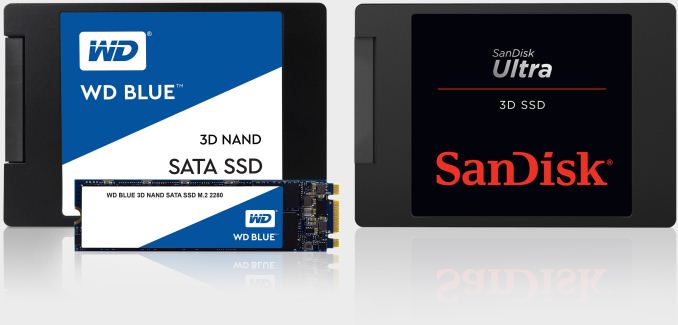
Western Digital on Monday officially launched its first consumer SSDs based on its 64-layer 3D NAND memory. The new drives will be available under the WD Blue 3D NAND SATA SSD and SanDisk Ultra 3D SSD brands and will feature the same controllers, the same capacity points and the same level of performance that one might expect from SATA drives. Western Digital cites reliability and endurance as important selling points of the new SSDs. After Western Digital acquired SanDisk, it not only got its own NAND flash manufacturing capacities and became one the most diverse suppliers of storage devices, but also obtained multiple product lineups as well as renowned brands. This is where Western Digital ran into its first dilemma. On the one hand, Western Digital needs to promote its own trademark, after all, it is one of two vertically integrated companies in the world that can produce both HDD and SSD products. On the other hand, SanDisk is one of the very well-known suppliers of NAND flash-based devices (including removable storage and SSDs) and many customers trust this brand. Therefore, Western Digital just cannot cease using the trademark and write down millions in goodwill. Meanwhile, to keep SanDisk products competitive, it has to constantly release new devices under the name and this is where Western Digital ran into its second dilemma. On the one hand, it can keep developing different product lines for both brands, which would mean additional R&D and manufacturing costs, as well as internal competition, but which would further diversify its product lineup. On the other hand, it can unify development of certain product families and then just sell the same products under different brands. Only time will tell what Western Digital will do with its higher-end and enterprise SanDisk product families, but when it comes to entry-level consumer SSDs, Western Digital decided to go with releasing similar/identical products under the two brands. Such approach makes a lot of sense from the costs standpoint: there is a cut-throat competition on the market of inexpensive SSDs because it is gradually expanding and there are way too many contenders (at least so far) that compete by offering attractive prices of their products, so such strategy makes sense there. Given the approach just mentioned, the new WD Blue 3D NAND SATA and the SanDisk Ultra 3D drives share not only 64-layer 3D TLC NAND memory chips, but also a Marvell controller (presumably, the 88S1074 or the 88NV1120) with some additional engineering and in-house developed firmware. Both aforementioned ICs support Marvell's third-gen LDPC-based ECC technology, but the 88NV1120 does not require any DRAM cache to work, lowering BOM of the drives. Western Digital has not confirmed the exact controller it uses, but all modern Marvell SSD ICs support LDPC. The new products will be available in 250 GB, 500 GB, 1 TB and 2 TB configurations, but in different form-factors: 2.5"/7mm and M.2-2280 for the WD Blue 3D NAND SATA SSDs as well as 2.5"/7mm for the SanDisk Ultra 3D SSDs. As for performance, we are talking about up to 560 MB/s sequential read speed and up to 532 MB/s sequential write speed, which is in line with what other consumer-class SATA drives offer nowadays. Since we are dealing with 3D TLC memory here, the firmware uses pseudo-SLC cache to boost write speed, so, write speeds are bursty, depending on how full the cache is. As for random reads and writes, we are looking at 95K IOPS and 84K IOPS, respectively, which is comparable to other mainstream SSDs with the same interface.
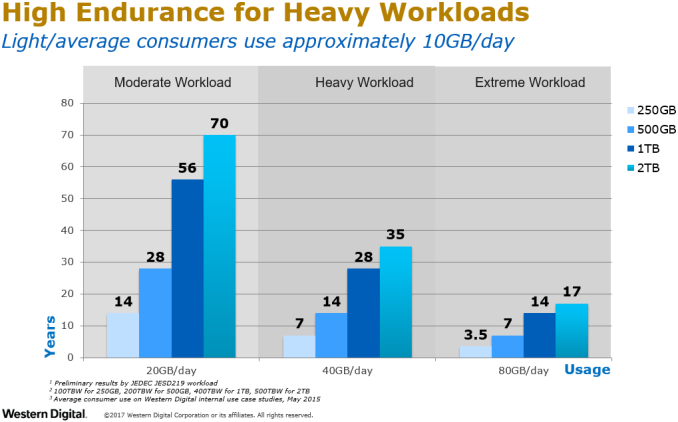
Western Digital rates its 3D TLC NAND-based drives for 1.75 million hours MTBF, which is higher than their drives featuring planar TLC memory, but a bit lower than the MTBF number offered by some competing devices. When it comes to total write ratings, Western Digital also seems to be conservative with its 100 TBW for the 250 GB model, 200 TBW for the 500 GB configuration and so on, even in comparison with ADATA’s SU700. Since the new WD Blue 3D NAND SATA and SanDisk Ultra 3D are Western Digital's first mass market client drives featuring 64-layer 3D TLC NAND chips, it is not surprising that the company decided to go with SATA and moderate reliability/endurance ratings. The firm needs to understand what to expect from mass-production 64-layer 3D TLC NAND on the SSD side of things, which is why it does not want to make big promises. Meanwhile, Western Digital claims in its materials for press that average consumers write about 10 GB of data per day and therefore asserts that its WD Blue 3D NAND SATA and SanDisk Ultra 3D drives will last for years even under heavy workloads.
Western Digital is not very specific about pricing of the drives. 250 GB versions of the WD Blue 3D NAND SATA and SanDisk Ultra 3D SSDs will cost $99.99 (all form-factors) when they are available in Q3 2017, but the manufacturer does not say a word about MSRPs for other configurations.
Related Reading: | ||||||||||||||||||||||||||||||||||||||||||||||||||||||||||||||||||||||||||||||||||||||||||||||||||||||||||||||||||||||






| << Previous Day |
2017/05/29 [Calendar] |
Next Day >> |