[Most Recent Entries] [Calendar View]
Wednesday, May 31st, 2017
- ASUS Unveils Seven X299 Motherboards: Prime, TUF and ROG
- GIGABYTE Launches Aorus X299 Motherboards: X299-Gaming 3, Gaming 7 and Gaming 9
- Intel Announces Skylake-X: Bringing 18-Core HCC Silicon to Consumers for $1999
- Intel Announces Kaby Lake-X Processors: High-End Desktop Getting the Latest Microarchitecture
| Time | Event | ||||||||||||||||||||||||||||||||||||||||||
| 3:30a | Qualcomm Announces First OEMs for Windows 10 on Snapdragon 835
Today, as part of Computex 2017, Qualcomm and Microsoft are joint announcing the next steps for their Windows on Snapdragon strategy. As previously reported, Qualcomm and Microsoft have collaborated to emulate x86 on the Snapdragon 835 SoCs such that 10/ARM can now run x86 Windows applications, and this emulation has reached a point where it's ready for devices to come to market. ASUS, HP and Lenovo will be the first OEMs to adopt the platform, which means we will see devices (laptops, clamshells, 2-in-1s) with the desktop version of Windows 10 but running on ARM. Qualcomm notes that the ubiquitous connectivity akin to smartphones is becoming an important aspect to how users use their computers as well as consume content – introducing the Snapdragon 835 on a productivity platform combined with the integrated Gigabit LTE baseband (Qualcomm’s X16) is a step in that direction along with mobile SoC levels of power draw.
When we first heard about Windows on Snapdragon, we instantly thought that Qualcomm and Microsoft would be going after the Chromebook market, but the announcement today is clear that both companies are going for something a bit more substantial along with all-day battery life. The official press release states that ‘Sleek, thin and fanless PCs running a Windows 10 experience’, with the 10nm SoC, sounds something more than a basic Chromebook. One might suggest that the Snapdragon 835 is a premium SoC, and Qualcomm certainly wants to promote their hardware in high-end premium devices. With Snapdragon 835 in high-end smartphones, one of the elements Qualcomm is promoting is the fact that their SoC solution has a smaller PCB footprint: OEMs can use the extra space and weight for extra battery. This is part of the story which Qualcomm states allowing a ‘truly always on’ device such that updates can run in the background when the system is in sleep modes.
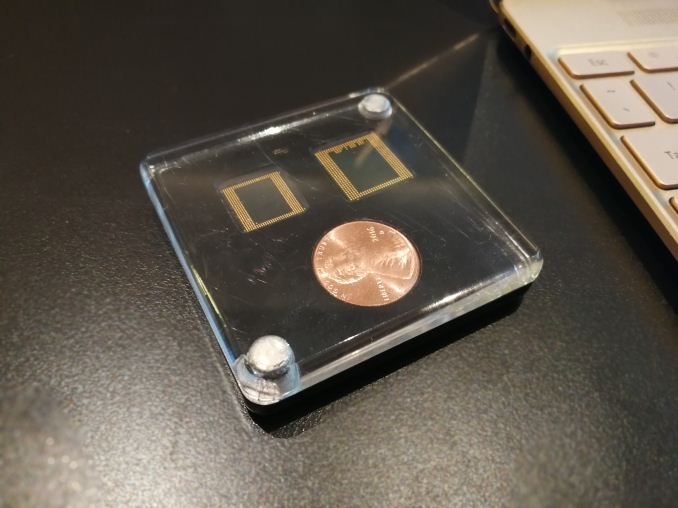
Part of the demonstrations at the Computex show floor, Qualcomm was showing Windows 10 being used with UWP applications but also some non-UWP apps being used, such as 7-zip. The OS element is something we’re likely to hear during Microsoft’s announcements during the week, which I feel might be a tipping point for these sorts of platforms. I’ve been using the MateBook X this week during Computex, and the battery life is actually fairly decent for an 1800 Euro ultraportable with a 15W CPU: but there’s still a small amount of battery anxiety for sure, especially during network use. Qualcomm’s value-add is their baseband experience, which they say is a big plus on this new platform. Having a proper productivity device is a plus, but big questions still surround performance, especially when emulating x86. It’s a problem that has been tackled and failed several times before. The Qualcomm issue here is somewhat smaller than previous attempts, because as far as we understand it only has to target Windows 10, and they’ve worked directly with Microsoft in order to support it. Qualcomm and Microsoft say that this combination is now a solved problem with minimal overhead. The carousel image at the top shows the S835 compared to a 14nm equivalent, showing the 'board space' savings of up to 30%. Qualcomm is keen to point out that a competitor's platform will need things like M.2 in order to add storage, which they say also take up board space compared to a Qualcomm solution. FootprintsAs part of our briefing, Qualcomm showed off an example reference PCB design that might go into the devices that they are targeting.
On the left is an Intel solution, with on the right being from Qualcomm: 96.1cm2 compared to 50.4cm2 respectively. Here's a closer image of the Qualcomm solution (click through for high resolution):
The SoC is on the top right, with storage and memory to the left. It's worth noting on the far right is a USB Type-C connection, which would be the power input as well as how to connect other devices. There is no SIM card, as Qualcomm is integrated a multi-region eSIM which is activated at the time of purchase. | ||||||||||||||||||||||||||||||||||||||||||
| 7:00a | NVIDIA Announces Rocket League Bundle for GeForce GTX 1060 & 1050 Cards
The Rocket League World Championship is just around the corner, running from June 2nd through June 4th in Los Angeles. In celebration NVIDIA has partnered with Psyonix for a new GeForce game bundle: the GeForce GTX Rocket League bundle. This latest bundle covers any GeForce GTX 1060, GTX 1050Ti or GTX 1050 card or OEM desktop PC, as well as notebooks sold with these parts. For those living under an inflated ball, Rocket League is soccer with rocket powered cars. As shown by the upcoming world championship Rocket League has become a popular eSports title with a strong and passionate fanbase. I haven’t run Rocket League on the specific cards in this bundle, but the performance numbers quoted by NVIDIA do not surprise. In fact, this game runs so well on any moderately capable card that we turned it down while choosing games for GPU Bench 2016 last year, as even at 4K it didn't bottleneck high-end video cards.
With that context, I can see the GTX 1060 being a good match for this card at 4K and the GTX 1050 and 1050Ti making good work of 1080p. Though, users running a GTX 1060 may not stretch for a 4K monitor and 4K gamers could make good use of more competent cards on games that are significantly more taxing. Otherwise, if someone’s library is largely eSports titles, then these cards will serve well. The Rocket League Bundle will run from May 30, 2017 through July 31, 2017 and codes must be redeemed through GeForce Experience. It is worth remembering to verify the participation of any vendors purchased from as NVIDIA likely will not give codes for purchases made from sellers that are not participating. | ||||||||||||||||||||||||||||||||||||||||||
| 8:00a | GIGABYTE Launches Aorus X299 Motherboards: X299-Gaming 3, Gaming 7 and Gaming 9
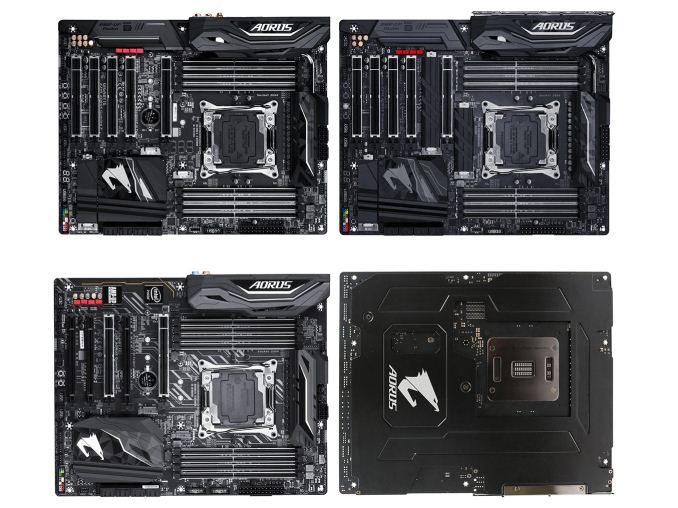
In the wake of Intel's announcement of their upcoming Skylake-X and Kaby Lake-X processors, GIGABYTE has unveiled their lineup of X299 LGA2066 motherboards. Given the fact that this is a high-end platform, GIGABYTE has opted to use their premium AORUS brand for all three initial models, which are the X299 AORUS Gaming 9, X299 AORUS Gaming 7, and X299 AORUS Gaming 3. Starting off with the flagship X299 AORUS Gaming 9, we get to see GIGABYTE's unconstrained vision for this new HEDT platform.
The X299 AORUS Gaming 9 has what appears to be a 12-phase CPU power design, and features Nippon Chemi-Con 10K Durable Black solid capacitors everywhere but in the audio subsystem. There are two 8-pin CPU/EPS power connectors, which should come in handy if a high TDP 18-core Skylake-X processor is installed or just when doing some extreme overclocking. Making full use of this platform numerous PCIe lanes, there are five mechanical PCIe x16 slots, all of which have been mechanically reinforced with steel and additional anchor points for improved retention and shearing resistance. Two of the slots run at x16, one of the slots runs at x8, and the other two are limited to x4, which means that this motherboard will 'only' be able to handle up to three-way graphics card configurations. Storage connectivity appears to be excellent with eight SATA 6Gb/s ports and three M.2 slots that support SATA, PCI-E, NVMe M.2 solid state drives and Intel's new Optane Memory technology. All three slots feature a Thermal Guard cover to help protect and cool the M.2 drives. For those who need a fourth M.2 slot, GIGABYTE have also included an M.2 add-in card in the accessories bundle. If the lack of an U.2 port is a concern, worry not since there is also a M.2 to U.2 adapter included. This motherboard also supports four USB 2.0 ports (two headers), eight USB 3.0 ports (four rear, two headers), and seven USB 3.1 Gen2 ports (five rear, one header). Focusing on the full-speed USB 3.1 Gen2 ports, there are an impressive four Type-A ports and one Type-C port on the rear I/O panel, and a USB 3.1 Gen2 front-panel internal header next to the memory slots. At least some of this USB 3.1 Gen2 connectivity is courtesy of the brand new ASMedia 3142 controller.
When it comes to networking, there are two gigabit LAN ports, one powered by an Intel controller and one by a Rivet Networks Killer E2500 chip. The onboard dual-band 802.11ac Wi-Fi is courtesy of a Killer Wireless-AC 1535 module that supports transfer rates of up to 867Mbps. The wired and wireless Killer interfaces can be used together via the Killer DoubleShot Pro feature to direct high priority traffic to the fastest interface or they can be combined to create one very high throughput interface. While the name might be familiar - Amp-Up Audio - this motherboard features a brand new high-end onboard audio design. It is based on the familiar Realtek ALC1220 codec, but it has been bolstered by some pretty serious components, like a ESS SABRE 9018K2M DAC, Texas Instruments LME 49720 and OPA1622 OP-AMPs, and WIMA audio capacitors. They have also included Creative's Sound BlasterX 720° audio engine software. As should be pretty clear from the above picture, the X299 AORUS Gaming 9 has been outfitted with a ton of RGB LED lighting zones. There are LEDs between the individual memory slots, on both sides of each of the the PCIe slots, built into the chipset cooler, and there's even LED strips integrated into the I/O and audio section covers. Even the rear I/O shield glows! If that's not enough, there are also three headers on which you can plug LED light strips. Speaking of headers, there are seven fan headers, including three water pump headers, one of which is a high current 3 amp version. Apparently some of these Hybrid Fan headers that can provide up-to-the-second information on flow-rate and water temperature and can be monitored in the Smart Fan 5 software suite. The two onboard temperature sensor headers should also be able to feed data into the utility. The bottom edge of the motherboards features an interesting assortment of power and reset buttons, clear CMOS button, ECO button, OC button, and a Debug LED. Last, but not least, the back of the motherboard is covered by a metal armor plate, which will add structural rigidity and protect the various components, solder points, and traces.
The X299 AORUS Gaming 7 is far more similar to the Gaming 9 than it is different. When it comes to expansion slots and storage connectivity everything is exactly the same. The only differences are that two of the three M.2 Thermal Guards are missing, and the M.2 to U.2 adapter is not included in the accessories bundle. The onboard audio features the greatest change, with a swap from the ESS Sabre ES9018K2M to the ES9018Q2Ca and the removal of one of the two op-amps. The X299 AORUS Gaming 7 is also missing the fancy glowing I/O shield, though the other RGB FUSION lighting features all remain identical.
Since there is no Gaming 5 model yet, the step down from the X299 AORUS Gaming 7 to the X299 AORUS Gaming 3 is a little more severe than between the two previous models. Most notably, the Gaming 3 only has one 8-pin CPU/EPS power connector and only two of its PCIe x16 slots are steel-reinforced. The other clear difference is that there is only two M.2 slots - down one from the higher-end models - and there are no M.2 Thermal Guards at all. The USB 3.1 Gen2 front-panel connector has been replaced with a USB 3.0 version, and three of the USB 3.1 Gen2 ports on the rear I/O panel have been replaced by USB 3.0 ports. So in total, this model has four USB 2.0 ports (two headers), ten USB 3.0 ports (six rear, two headers), and two USB 3.1 Gen2 ports (two rear). Speaking of rear I/O, there is only one gigabit LAN port and no Wi-Fi on the X299 AUROS Gaming 3. The onboard audio has also been demoted, with no DAC or op-amps, and no plastic shroud covering that area either. The RGB FUSION lighting feature has also been cut-down a bit, with no LEDs in between the memory slots and only the two primary PCIe x16 slots being lit instead of all five. While we don't yet have any pricing information for any of the models, the GIGABYTE X299 AORUS Gaming series will be available for purchase sometime in June 2017. Gallery: X299 AORUS Gaming 9       Gallery: X299 AORUS Gaming 7      Gallery: X299 AORUS Gaming 3
      | ||||||||||||||||||||||||||||||||||||||||||
| 9:00a | Mighty Mini-ITX: ASRock X299E-ITX/ac with 4 Channel DDR4 and 3xM.2 Support
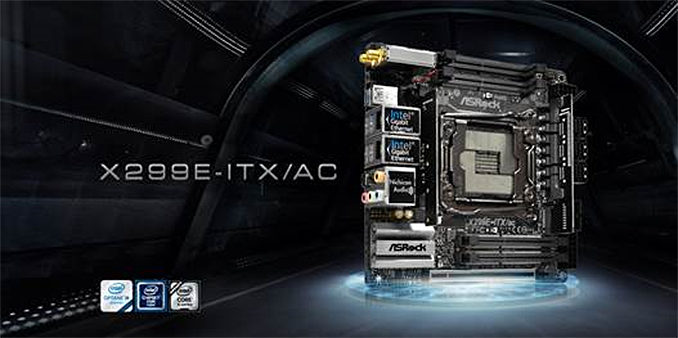
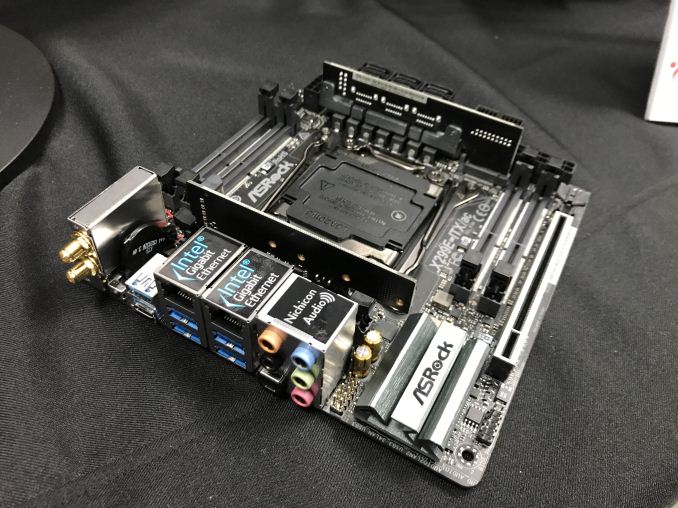
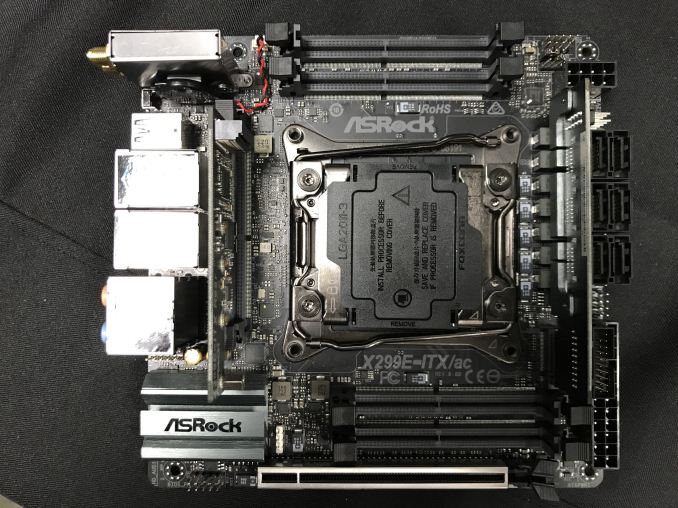
ASRock has announced one of the industry’s first Mini-ITX motherboards for Intel’s latest Core X processors in the LGA2066 packaging. The new X299E-ITX/ac is small, but it takes full advantage of Intel’s new X299 platform, offering support for all CPUs with up to 18 cores, quad-channel DDR4 memory on the higher-end CPUs, three PCIe 3.0 x4 M.2 slots as well as everything that one might expect from a Mini-ITX board, including Wi-Fi.
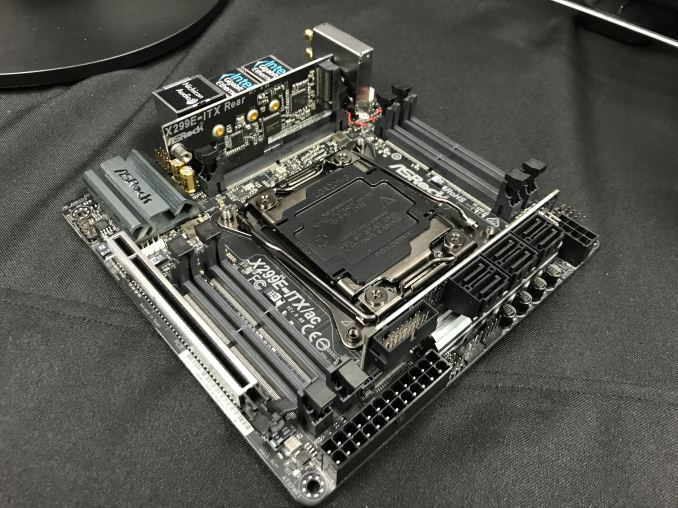
Besides being a miniature motherboard for Intel's HEDT processors, the most important aspect of the ASRock X299E-ITX/ac is support for quad-channel memory in this form-factor. The company’s previous-gen Intel X99-based Mini-ITX mainboard was feature-packed, but one of the things it missed was the quad-channel memory sub-system, which had an expected negative effect on performance in applications that required high memory bandwidth. By contrast, the new unit has four SO-DIMM DDR4 memory slots and even supports DDR4 overclocking (assuming that there are SO-DIMMs that can be significantly overclocked). In fact, putting four memory slots onto a small motherboard while also fitting the LGA 2066 socket and required high-capactiy VRMs is a rather remarkable engineering achievement. The flip side however is that the very tightly packed design of the X299E-ITX/ac may impose certain limitations on compatibility with large cooling systems.
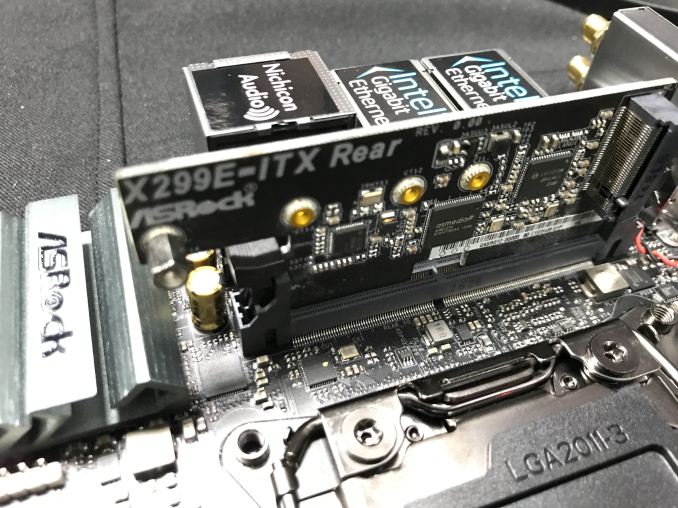
Just like every other Mini-ITX motherboard around, the ASRock X299E-ITX/ac has only one PCIe 3.0 x16 slot for graphics cards. In the meantime, the X299E-ITX/ac is the first miniature mainboard to feature three M.2 slots (PCIe 3.0 x4 or SATA) for SSDs. In addition, the board carries six SATA 6 Gbps headers for builds that require multiple storage devices in drive form-factor. It is noteworthy that in order to fit everything it wanted onto a Mini-ITX PCB, ASRock had to place the USB 3.1 controller, SATA ports and one M.2 slot on custom DIMM-like modules - essentially going vertical when they ran out of horizontal space. Such modules add certain dimension-related limitations to the size of CPU radiators (plus, it remains to be seen how higher-end M.2 SSDs perform when located near a CPU cooler), but this is a tradeoff that the manufacturer had to take.
As for connectivity, the X299E-ITX/ac comes with a 2x2 802.11ac Wi-Fi + Bluetooth 4.2 module (based on an Intel controller), two GbE ports (Intel controllers too), two USB 3.1 headers (Type-A and Type-C), six USB 3.0 connectors, 7.1-channel audio sub-system (enabled by the Realtek ALC1220 controller) and so on.
The ASRock X299E-ITC/ac will be available in the coming months for about $280 - $300, depending on the region and other factors. Such a price point is considerably higher than MSRPs of most Mini-ITX motherboards, but given the fact that this is a very high-end platform (with equally high component requirements) aimed at enthusiasts, it is not unusual. In fact, from many standpoint it may be considered as an entry-level X299 board simply because it does not provide opulence of its bigger brethren.
Related Reading: | ||||||||||||||||||||||||||||||||||||||||||
| 10:00a | ASRock Announces X299 Professional Gaming i9 with 3-Way Multi-GPU, 10Gb Ethernet, & Wi-Fi
ASRock has introduced its flagship motherboard for Intel’s upcoming Core X series HEDT processors. The Fatal1ty X299 Professional Gaming i9 packs about everything that that is possible, including advanced VRMs, multiple PCIe slots, a Wi-Fi module, as well as a 10 GbE port. Despite being extremely feature-rich, the new product is not going to be too expensive. Since Intel’s new X299 platform supports a very diverse range of processors that cost from sub-$300 all the way to $1999, makers of motherboards are trying to address different setups with their products accordingly. Some X299 platforms can be considered as “entry-level” (of the ultra high-end) based on their moderate feature set, others may be considered as mid-range and the most advanced models fit into the “extreme” or “workstation-grade” category for prosumers who need every bit of performance they may get. The ASRock Fatal1ty X299 Professional Gaming i9 belongs to the latter category and is thus aimed at systems without compromises that run processors with 10 or more cores, feature multiple graphics cards, up to a dozen of storage devices, and so on.
One of the important features of the ASRock Fatal1ty X299 Professional Gaming i9 is its 13-phase digital VRM that uses high endurance coils as well as solid-state capacitors and designed to ensure high overclocking potential. ASRock claims that this PWM can handle 720 A and deliver up to 1300 W of power, which is well above any CPU can consume (or survive).
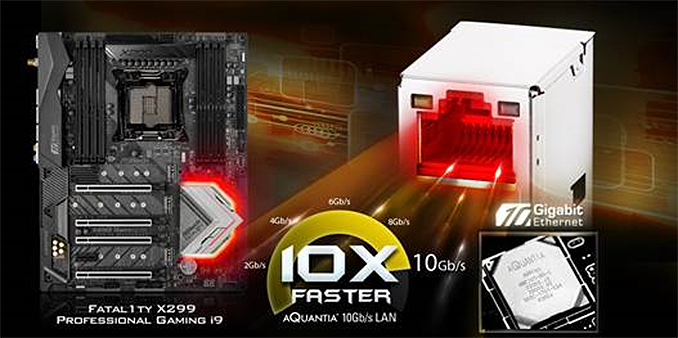
The motherboard carries eight DDR4 DIMM slots and the manufacturer supports memory overclocking up to DDR-4400 and beyond. Previous-gen Intel Core Extreme (Broadwell-E) processors could not run DDR4 at extreme data transfer rates in quad-channel mode and it isn't clear whether the new multi-core Skylake-X will handle DDR4 at 4000+ GT/s in quad-channel mode. However since the X299 platform also supports quad-core Kaby Lake-X CPUs with a dual-channel memory controller that can handle high memory frequencies, support for high DDR4 frequencies may prove especially important for Kaby Lake-X. Another key selling point of the ASRock Fatal1ty X299 Professional Gaming i9 is the the Aquantia AQtion 10 Gb/s Ethernet controller (presumably the AQN-107) that also supports 2.5G and 5G operation. Installing this specific controller on a motherboard that is priced significantly below $500 makes a great deal of sense, as 10 GbE infrastructure (routers, switches) is still very expensive for most users (even those who buy Intel Core X-series CPUs), whereas 2.5G and 5G equipment promises to be a lot cheaper. Whether or not the owner of the X299 Professional Gaming i9 plans to invest in 10 GbE hardware, they will be ready for everything faster than GbE, and that adds value to the motherboard. In addition to the 10 GbE port, the mainboard also has two GbE headers enabled by controllers from Intel. For scenarios when wired connections are unavailable, the motherboard has a 2×2 802.11ac Wi-Fi + Bluetooth 4.2 module (based on an Intel controller). Next up is expandability. The Fatal1ty X299 Professional Gaming i9 has four PCIe 3.0 x16 slots (2 × x16, 2 × x8): three can be used for graphics cards running in AMD CrossFireX or NVIDIA SLI multi-GPU mode, the fourth can be used for an SSD or any other device. Besides, the board has 10 SATA 6 Gbps connectors for systems that need a huge number of SATA storage devices.
When it comes to connectivity, the Fatal1ty X299 Professional Gaming i9 has something to brag about even beyond its vast networking capabilities. The motherboard uses ASMedia’s latest ASM3142 controller that is backed by a PCIe 3.0 x2 connect (instead of x1 in case of the ASM1142) and thus offers higher bandwidth than its predecessor. In total, the board supports eight USB 3.0 Type-A ports, six USB 2.0 connectors, two USB 3.1 (Gen 2) receptacles (Type-A, Type-C) as well as one USB 3.1 (Gen 2) header for a USB-C port on the front of the PC that can deliver 36 W of power. Finally, the platform has a 7.1-channel audio sub-system (enabled by the Realtek ALC1220 controller) with the Sound Blaster Cinema 3 software enhancements by Creative.
The ASRock Fatal1ty X299 Professional Gaming i9 will be available in the coming months for about $350. For those, who don’t need a 10G Ethernet port, 36 W power delivery on the front USB-C port and some other minor things, ASRock will offer the X299 Taichi motherboard that uses the same PCB, but without the aforementioned features, at around $300.
Related reading: | ||||||||||||||||||||||||||||||||||||||||||
| 11:00a | EVGA Unveils its GeForce GTX 1080 Ti K|NGP|N Edition
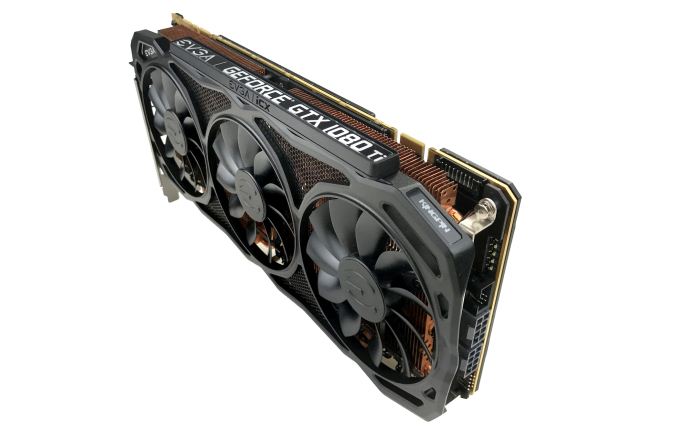
EVGA has once again collaborated with extreme overclocker Vince "K|NGP|N" Lucido to develop the new EVGA GeForce GTX 1080 Ti K|NGP|N Edition. As EVGA’s ultra-high-end overclocking card, EVGA is guaranteeing each card can be to be overclocked to at least 2025MHz, which means we’re looking at a binned card with a whole heap of modifications and tweaks to allow for squeezing the last few MHz out of the card.
EVGA uses a fully custom PCB designed to withstand the rigors of overclocking. The card features a 15 phase digital VRM system with dual 8-pin power connectors on the right edge for better cable management. You will also find the EVGA Evbot connector next to the power connectors on the rear of the card, an interesting situation as this is a feature that doesn’t show up on too many EVGA products these days. The PCB features nine temperature sensors: three for memory, five for PWM, and one for the GPU. When it comes to display connectivity, there are three Mini DisplayPort 1.4 connectors, one DVI, and a single HDMI 2.0 port all in a row, making it possible to create a single-slot graphics card when used with a water block.
The heatsink shroud has a very similar look to EVGA's FTW3 edition video card. Integrated into the black plastic shroud you’ll find three large dual-ball bearing fans pushing air through interlaced copper-plated fins bonded to six copper heatpipes (three 6mm and three 8mm) that are attached to the copper-plated baseplate. A large metal backplate spans the entire length of the graphics card, adding rigidity and structural strength to prevent it from bending under the weight of the heatsink. The card also has accommodations for LN2 overclocking. EVGA's Jacob Freeman tweeted a picture from Computex showing the GTX 1080 Ti K|NGP|N Edition running cool as a cucumber at 2404MHz. The company said the card will be available in July. No price has been announced yet. Steven Lynch Contributed to this Report | ||||||||||||||||||||||||||||||||||||||||||
| 1:00p | ASRock Gives AMD Ryzen Mini-ITX Treatment, Launches X370 Gaming ITX/ac
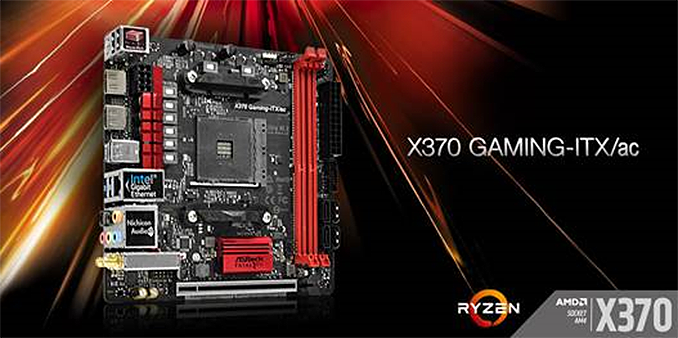
ASRock has introduced a miniature motherboard for AMD Ryzen microprocessors, one of a few such motherboards in the industry. Despite being very small, the X370 Gaming ITX/ac offers everything that a fairly powerful gaming system might require and its price is not too high. The ASRock X370 Gaming ITX/ac is based on the AMD X370 chipset and supports all currently available processors in the AM4 form-factor, including A-series APUs as well as all Ryzen CPUs. The motherboard has a digital eight-phase VRM for the CPU designed to guarantee clean power supply (stability, overclocking potential, etc.). According to ASRock, the mainboard can handle DDR4-3200+ memory (assuming that particular modules work well with AMD Ryzen processors). The new platform has two DIMM slots in total.
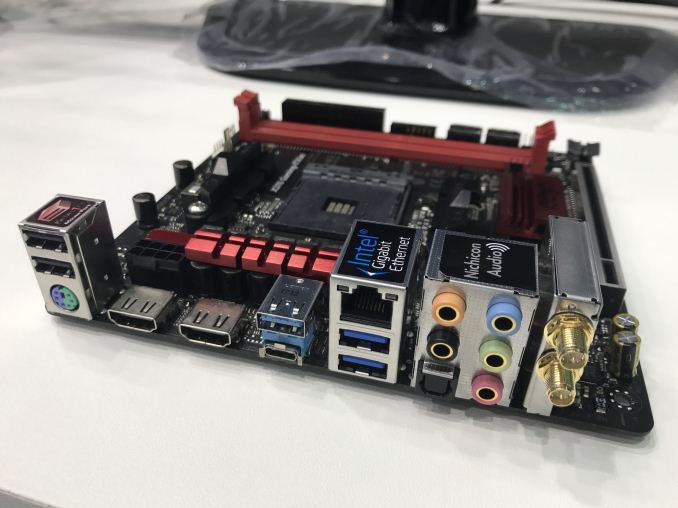
Like many other motherboards in the Mini-ITX form-factor, the X370 Gaming ITX/ac has one PCIe 3.0 x16 slot, one M.2 slot for PCIe 3.0 x4 or SATA SSDs, as well as four SATA ports. Meanwhile in a light bit of irony, the mainboard uses GbE and 802.11ac Wi-Fi controllers from Intel. As for other I/O, everything seems to be pretty standard here: the motherboard has two HDMI outputs, five USB 2.0 ports, six USB 3.0 headers (including one Type-C) as well as a 7.1-channel audio powered by Realtek ALC1220 codec with Creative’s Sound Blaster Cinema 3 enhancing software.
At present, the ASRock X370 Gaming ITX/ac has only one direct rival, the Biostar Racing X370GTN introduced earlier this year. The Racing X370GTN does not have Wi-Fi support, but it has two USB 3.1 Gen 2 (10 Gbps) headers, including one Type-C. Meanwhile, the X370 Gaming ITX/ac seems to have a more advanced VRM for those looking forward overclocking capabilities.
The ASRock X370 Gaming ITX/ac will be available in the coming weeks for $150 – $160, according to the manufacturer. Keep in mind that since there are only two AMD X370-based Mini-ITX motherboards announced so far and small form-factor systems are gaining traction, demand for the X370 Gaming ITX/ac will be very high. That said, don't be surprised if there's some overpricing from select retailers.
Related Reading: | ||||||||||||||||||||||||||||||||||||||||||











| << Previous Day |
2017/05/31 [Calendar] |
Next Day >> |