[Most Recent Entries] [Calendar View]
Friday, June 2nd, 2017
- FSP Dagger 500W and 600W SFX PSUs Come To Market: From $99 with 80Plus Gold
- FSP Announces Twins: 500W and 700W ATX PSU with Redundancy Capability
- The FSP Hydro G 750W Power Supply Review
- FSP Announces Twins: 500W and 700W ATX PSU with Redundancy Capability
- Thermaltake Adds RGB Lighting to Toughpower Grand Gold PSUs
| Time | Event | |||||||||||||||||||||||||||||||||||||||||||||||||||||||
| 8:00a | The Fractal Design Celsius S24 & S36 AIO Coolers Review In this review we are having a look at the newly released Celsius S24 and S36 AIO liquid cooling kits from Fractal Design, the Swedish manufacturer of PC components. Rather than following the industry trend of LED lighting and fancy designs, the new kits seek to combine competitive all-round performance with an elegant, understated design. | |||||||||||||||||||||||||||||||||||||||||||||||||||||||
| 9:00a | FSP Demonstrates Hydro PTM+ 1200 W: a Liquid-Cooled PSU with RGB LEDs
FSP has demonstrated an ATX power supply unit with liquid cooling at Computex. The manufacturer claims that liquid cooling ensures that the PSU stays quiet even under high loads, while its customizable RGB lighting adds style to PCs. Although PSUs with liquid cooling have been demonstrated at various industry trade shows in the past as prototypes, they have never made it to the mass market. By contrast, FSP’s unit is farther along and looks likely to make it to retail. The FSP Hydro PTM+ PSU is rated for a 100 A maximum load and 1200 W power, in line with many air-cooled PSUs. The power supply comes in the ATX form-factor (since it looks like a commercial product and even carries the 80 Plus Platinum badge, it is also likely compliant with the ATX12V v2.31 as well as EPS12V standards) and is 220 mm long. The power supply has a modular design as well as a 140 mm fan, but unlike in the case of regular PSUs, this fan will not speed up under high loads because key components of the power supply are cooled using a waterblock plugged to a loop that also cools CPU or GPU. FSP tell us that due to liquid cooling, its PSU should remain quiet even under high loads.
The Hydro PTM+ PSU is compatible with various custom-built liquid cooling systems. In its booth at Computex the manufacturer demonstrated an open liquid-cooled PC running its PSU, but it says that the unit can be integrated into any computer with a custom LCS, except, perhaps, machines that have a cage for storage devices near the PSU. Based on the demo system created by a famous modder, as well as the PSU's customizable RGB lighting, FSP plans to offer the Hydro PTM+ primarily to the modding community looking for ultimate style.
Liquid cooling is usually used to remove heat from overclocked CPUs and GPUs without excessive noise. Meanwhile, overheating PSU components may generally signal of low efficiency of the power supply itself (tougher components designed for higher loads wouldn’t overheat). Nonetheless, the 80 Plus Platinum badge is supposed to tell us that efficiency of the FSP Hydro PTM+ product is rather high (albeit, at unknown temperatures). It is noteworthy that along the highlights of its product FSP also mentions something called “power overclocking technology”. Based on what the company told us, once LCS is applied, it “enables” the PSU to “handle a 1400 W output".
Technically, any PSU has a peak power output that is higher than the rated maximum output, but they can only work at peak for a short period of time. Apparently, FSP allows its PTM+ to run at 1400W for longer periods, which basically means that this is a 1400 W PSU rated for 1200 W that got its 80 Plus Platinum badge at 1200 W. How high its efficiency is at 1400 W is unknown.
FSP is still finalizing design of the Hydro PTM+ 1200 W and consequently has not announced when it might be available. The company is looking at $700 as a possible price point for the PSU, but depending how the company positions the unit, that number may go up or down. Given how special the product is, FSP may try to sell it to enthusiasts who want maximum performance and minimal noise and on that market high price tags are common. Alternatively, FSP may try to address the ultra-high end segment of the mass market PSUs and in this case it will have to slash the price and explain the end user why a liquid-cooled power supply is considerably better than a regular one.
Related Reading: | |||||||||||||||||||||||||||||||||||||||||||||||||||||||
| 10:00a | Plextor Announces M9Pe SSD: 3.1 GB/s, Marvell Controller, 64-Layer 3D TLC, RGB LEDs
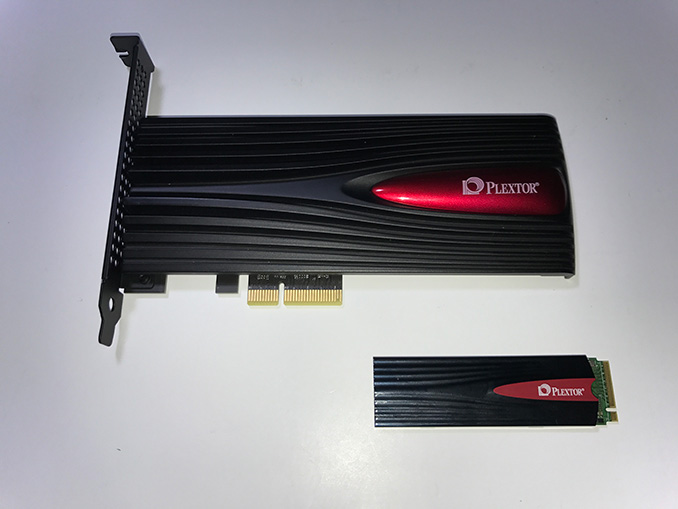
Plextor has announced its next-generation high-end SSD, the M9Pe. The new drive will use Toshiba’s 64-layer 3D TLC NAND memory and a Marvell controller, and will be available in configurations of up to 1 TB. Plextor says that it is planning to bring the drive to market by the end of this year. When it comes to high-end SSDs Plextor has returned to its yearly update cycle, and at this Computex the company announced the successor of the M8Pe drive it launched 12 months ago: the M9Pe. Lite-On, the company behind Plextor SSDs, continued to work with Marvell and Toshiba, who supplied controllers and NAND for the previous-generation drives. For Plextor it is logical to keep the old relationship, especially given the shortage of flash memory on the market. For the Plextor M9Pe, the manufacturer has chosen the Marvell 88SS1093 BTB2 controller as well as Toshiba’s 512 Gb BiCS 3D TLC NAND memory. The 88SS1093 BTB2 controller is equipped with three cores and features 8 NAND channels with 4 CE per channel (32 targets in total). The IC supports a Marvell’s third-generation ECC technology based on the LDPC algorithm and uses PCIe 3.0 x4 interface. Essentially the chip is an updated version of the 88SS1093 with higher frequencies and performance, which makes a lot of sense for higher-end SSDs. It is still an NVMe 1.1 IC, so do not expect any features of the latest NVMe 1.3 spec. Meanwhile, Plextor promises stable performance in sustained use cases, and this is what matters most.
Plextor will offer its M9Pe drives in 256 GB, 512 GB and 1 TB configurations. As for performance, we are looking at up to 3100 MB/s sequential read speed and around 2300 MB/s sequential write speed for the higher-end models, but as the numbers are preliminary; commercial devices might perform differently than the engineering samples the company is testing now. As for form-factors, Plextor plans to offer both an M.2 form-factor card with a radiator, as well as add-in-cards with a larger cooling system featuring RGB LEDs. Plextor intends to bring its M9Pe drives to market by the end of the year. Pricing is something that is hard to tell today because it will depend on multiple factors, including competitive environment, and of course, where NAND prices are later this year.
| |||||||||||||||||||||||||||||||||||||||||||||||||||||||
| 12:00p | Zotac Showcases Mini GeForce GTX 1080 Ti Video Cards
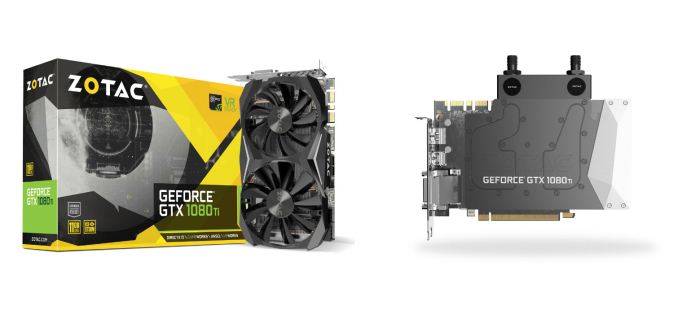
Zotac, well known for its small form factor PCs, motherboards, and graphics cards, is showcasing a pair GeForce GTX 1080 Ti graphics cards at Computex. What's so special about a couple of GTX 1080 Ti GPUs? The company claimed that, at just 8.3 inches (4.5 inches shorter than the company's GTX 1080 Ti AMP Extreme), these are the world's smallest GTX 1080 Ti graphics cards. Not only is the GTX 1080 Ti ArcticStorm one of the world's smallest, but it’s also one of the lightest water-cooled video cards as well. Zotac did not offer information pertaining to clock speeds, however it's interesting to note that both cards feature dual 8-pin power connectors, which is more than a reference-clocked 250W card would need. So it's not outside the ream of possibility that Zotac ships these cards with a factory overclock of some kind, despite their small stature.
In terms of design the GTX 1080 Ti Mini is outfitted with a custom dual fan cooler with aluminum fins and copper heatpipes for increased cooling capacity. The GTX 1080 Ti ArcticStorm Mini features a full cover water block that is compatible with an open-loop water cooling system that uses standard G1/4 type fittings. Both cards include a solid metal backplate that adds structural strength to prevent the card from bending and twisting. Finally, pricing and availability have not yet been announced. Steven Lynch contributed to this report | |||||||||||||||||||||||||||||||||||||||||||||||||||||||
| 1:00p | Raijintek Announces Four New PSU Lines
Among many new products, including cases and cooling solutions, Raijintek revealed several PSU lines at Computex 2017. Raijintek’s top PSU line is called Apella and consists of three members with 550W, 650W, and 750W capacities, featuring 80 PLUS Gold efficiency. The interesting part with those fully modular units is that they will be sold with no modular cables; only the AC power cord will be provided. Users will be able though to choose among a variety of cable kits, which seem to be of high quality, that will only cost 30 euros (around $30 for the US market) while similar cable kits for other PSUs are typically way more expensive. This means you won’t have to pay for the standard cables, which might not be to your taste. We wonder, though, if there will be a standard and even more affordable cable kit for those users who don’t need fancy modular cables, but just want to go with the most affordable option. The 550W, 650W, and 750W Apella units will cost $90, $100, and $113, respectively, and you will have to invest another $30 for a modular cable kit. There is also an SFX-L unit with 500W capacity, which most likely uses a High Power platform. Since there is no official name yet for this unit, its temporary model number is LSFX. The MSRP for this model will be set at $130, which sounds normal for this category. An ATX adapter bracket will also be included.
Dion CP is an affordable PSU line with 80 PLUS efficiency, covering the 550W to 650W capacity range through two models. There is also a slightly more expensive Dino EVO line which, besides higher efficiency (Bronze), also features an RGB fan. According to our sources, the MSRPs of the Dino EVO units will range from $70 to $87. There will also be an SFX line called Helots, and will come in two flavors:300W and 400W max power, with both models having 80 PLUS Bronze efficiency. Just for reference, Helots were the lowest class people in ancient Laconia (Sparta) who were actually owned by the state and used to carry out manual labour tasks, something that allowed Spartans to practice their main hobby, which was training and preparation for war. Both members of this line will feature an ATX adapter bracket, which will render them compatible with normal ATX chassis. Aris Mpitziopoulos contributed to this report | |||||||||||||||||||||||||||||||||||||||||||||||||||||||
| 2:00p | Samsung Announces Notebook 9 Pro 2-in-1, Includes S Pen Stylus
One of Samsung’s unique selling points in the Android phablet market has been the company’s S Pen. The multi-feature stylus comes with Samsung’s popular Galaxy Note line of phones, as well as the company’s tablets. Now, the pen is finally making the jump from Android devices to Windows laptops. It will be bundled with the new Samsung Notebook 9 Pro, a laptop line the company announced this week at Computex. The 2-in-1 comes in 13.3-inch and 15-inch screen sizes and is powered by an Intel Core i7-7500U CPU. The S Pen can sense 4,000 levels of pressure and has tilt sensitivity for drawing in any position. Furthermore, as this is a passive stylus, it doesn’t require charging. Importantly however, the S Pen won’t be limited to just Samsung software, as it is compatible with Windows Ink Workspace.
The 13-inch Notebook 9 Pro comes with 8GB of RAM and the 15-inch laptop uses 16GB. Both have 256GB of SSD storage, while the 15-inch model also comes with a discrete AMD Radeon RX 540 video card. Both screens are full HD, and Samsung claims they provide viewing angles of up to 178 degrees. In addition, both Notebook 9 Pros can charge via USB Type-C, and other ports include 2 USB 3.0 ports, HDMI and a microSD card slot. The laptops also support Windows Hello for facial recognition login. Unfortunately Samsung hasn’t revealed pricing information at this time, but it sounds like these laptops should be ready for the market sooner than later. Andrew Freedman contributed to this report | |||||||||||||||||||||||||||||||||||||||||||||||||||||||







| << Previous Day |
2017/06/02 [Calendar] |
Next Day >> |