[Most Recent Entries] [Calendar View]
Saturday, June 3rd, 2017
| Time | Event | ||||||||||||||||||||||||||||||||||||||||||||||||||||||||||||||||
| 10:00a | Antec Reveals Two New PSU Lines: HCG Pro Gold & HGC Pro Bronze
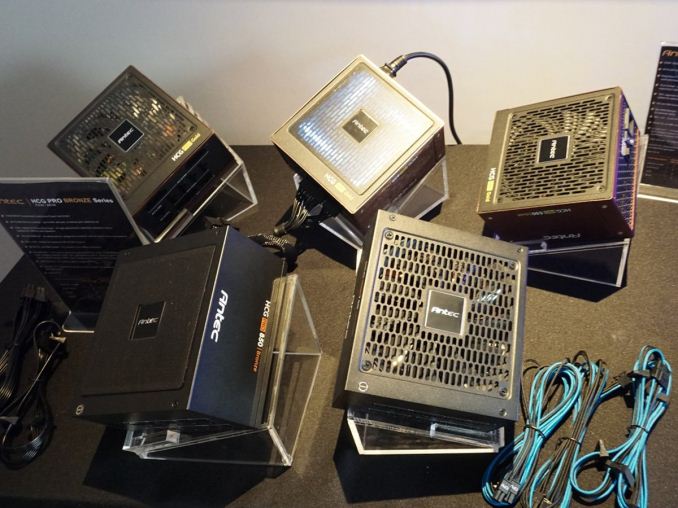
After quite a long time, Antec is ready to release two new PSU lines, the HCG Pro Gold and the HCG Pro Bronze. The HCG Pro Gold line consists of five members with capacities ranging from 550W to 1kW. Besides 80 PLUS Gold efficiency and a fully modular cable design, these units also feature a full-bridge topology on the primary side along with an LLC resonant converter for increased efficiency. On the secondary side a synchronous design is utilized along with a couple of DC-DC converters for the generation of the minor rails. We also noticed that the new Antec PSUs use magnetic fan filters, which can be easily removed for cleaning. This is a good idea, and we first noticed it in some SilverStone units. Finally, Antec will offer individually sleeved cable kits for those PSUs in several colors. The cooling fan in the HCG Pro Gold units uses a fluid dynamic bearing, which is preferred over double ball-bearings because it’s quieter yet still offers the same (and in some cases even higher) lifetime. The only problem with FDB fans is that they aren’t so suitable for semi-passive PSUs, which frequently change from passive to active operation and vice-versa, because during the fan’s start-up phase the friction to the shaft is increased until the oil gets pumped up to the top of the bearing.
The HCG Pro Bronze line consists of only two members, with 750W and 850W max power. As the naming scheme implies, both units have 80 PLUS Bronze efficiency and at their internals only Japanese caps are used, while the cooling fan has double ball-bearings, which are highly preferred over sleeve bearings. All protection features are provided, and both PSUs have four PCIe and two EPS connectors. It is very good to see affordable, mid-capacity PSUs with a couple of EPS connectors. So far we don’t have information on the OEM, availability, warranty, or estimated release date of the new Antec PSUs. Aris Mpitziopoulos contributed to this report | ||||||||||||||||||||||||||||||||||||||||||||||||||||||||||||||||
| 12:00p | Zotac Unveils 2017 ZBox Magnus SFF Gaming PCs: Powered By Intel Core & AMD Ryzen
Besides of course their video cards, Zotac’s other claim to fame is their variety of mini-PCs. For this year’s Computex trade show, the company did not disappoint, with the announcement of a new generation of Magnus gaming mini-PCs. The big change for the upcoming family of Magnus boxes is that they have been revamped to make room for some of Zotac’s mini-branded video cards, including the GTX 1060 and GTX 1070. Previously, the ZBox Magnus family utilized the mobile versions of NVIDIA’s 10-series GPUs. The new ZBox Magnus lineup consists of four different models, with two sporting Intel CPUs and two featuring AMD Ryzen processors. The company wasn’t clear on which specific AMD Ryzen chips would be utilized, but it did disclose that they would sport a 65W TDP.
Each of the two Intel ZBox Magnus offerings sport different CPUs and GPUs, with the Magnus EK51060 featuring an Intel Core i5-7300HQ and a Zotac GeForce GTX 1060 Mini. The Magnus EK71070 sports an Intel Core i7-7700HQ. Both offer support for Intel Optane memory with an M.2 2242/2260/2280 slot. Over on the AMD side of the ZBox spectrum, the new Magnus ER51060 features an undisclosed AMD Ryzen CPU and a GTX 1060; the new ER51070 sports a Zotac GTX 1070 Mini. If the naming convention of each model is any indication of the hardware inside (see the Intel models), the CPUs will likely be Ryzen 5 chips. All of the new ZBox Magnus PCs feature an M.2 slot for PCIe or SATA SSDs, a 2.5” drive bay, and support for up to 32GB (2x16GB) of DDR4-2400 SODIMM memory. There’s also four USB 3.0 ports, two USB 3.1 ports (one Type-A, one Type-C), and a 3-in-1 card reader. Network connectivity is provided by two gigabit Ethernet ports and 802.11ac WiFi. For display output, the new ZBox Magnus PCs sport the same outputs as the GPUs; three DisplayPort 1.4 interfaces, an HDMI 2.0 port, and a DVI-D connector. Pricing and availability for the new ZBox Magnus mini PCs is still undetermined. Derek Forrest contributed to this report | ||||||||||||||||||||||||||||||||||||||||||||||||||||||||||||||||
| 2:00p | MSI Demos Prototype Hybrid Storage Card: M.2 & 2.5” SATA on a PCIe Card
Going a bit off the beaten path for this year’s Computex, MSI surprised us at the show with the prototype of a new hybrid storage array. The MSI Gaming Storage Card is all-in-one PCIe storage card that holds two M.2 NVMe SSDs and a 2.5" HDD. Like existing motherboard drive caching implementations, the idea here is to offer a SSD-cache in front of a HDD, allowing for SSD-like performance of critical data without manually allocating files/programs between the SSDs and the HDD. Except now the entire storage array is on a stand-alone PCIe x8 card. MSI tells us to expect up to 7,200 MBps from the dual NVMe SSD array, which runs in RAID 0. Using large capacity NVMe SSDs will cache a lot of data, so only very cold data will come to the host system directly from the HDD. To ensure data protection, the card features an array of super capacitors that preserve data in flight in the event of a host power fail condition. Meanwhile the NVMe SSDs should benefit from increased airflow from the custom blower style fan used to tame thermal throttling. MSI tells us the card will ship in MSI branded desktop systems. The company doesn't have plans to release the card as a standalone product, though it sounds like with enough consumer interest, that policy may not be set in stone. That said, we were told not to expect this anytime soon, as the card on display is only a prototype. The lead time could be as long as one year away, according to the product manager with whom we spoke.
Chris Ramseyer contributed to this report | ||||||||||||||||||||||||||||||||||||||||||||||||||||||||||||||||


| << Previous Day |
2017/06/03 [Calendar] |
Next Day >> |