[Most Recent Entries] [Calendar View]
Monday, June 5th, 2017
| Time | Event | ||||||||||||||||||||||||||||||||||||||||||||||||||||||||||||||||||||||||||||||||||||||||||||||||||||||||||||||||||||||||||||||||||||||||||||||||||||||||||
| 6:00a | Test Driving Futuremark's PCMark 10 Benchmark Futuremark is a well-respected provider of computer benchmark applications. Their PCMark and 3DMark benchmarks have been around for almost 20 years, and provide a good indication of the system performance for various workloads. Today, Futuremark is launching PCMark 10, their seventh major update to the PCMark series of benchmarks first launched in 2002. PCMark 10 builds upon the PCMark 8 platform, adds a few workloads and streamlines the rest in order to present a vendor-neutral, complete, and easy-to-use benchmark for home and office environments. Futuremark provided us with a preview copy of the benchmark, and we took it for a test drive. This piece presents some of our impressions with the benchmark, and points out areas where it excels, and where it could do with some improvement. | ||||||||||||||||||||||||||||||||||||||||||||||||||||||||||||||||||||||||||||||||||||||||||||||||||||||||||||||||||||||||||||||||||||||||||||||||||||||||||
| 8:01a | Intel Announces SSD DC P4501 Low-Power NVMe SSD With 3D NAND
A month ago, Intel unveiled a new generation of enterprise SSDs based on their 3D TLC NAND and powered by a new generation of Intel NVMe SSD controllers. Intel's first NVMe controller—introduced with the SSD DC P3700—had a great run, but it's been showing its age for a while now. The new controller used on the P4500 and P4600 enables higher performance despite the new drives using 3D TLC NAND compared to the P3700's 20nm planar MLC, and despite the newer controller having only 12 flash channels instead of 18. More significantly, Intel's second-generation NVMe controller is much smaller and more power-efficient, allowing it to be used in product segments that Intel's first generation controller literally couldn't fit in. Intel's new SSD DC P4501 is a lower-power take on their new generation of NVMe technology, putting Intel controllers into M.2 and 2.5" 7mm U.2 SSDs for the first time. With capacities from 500GB to 4TB, the P4501 delivers somewhat lower performance than the P4500 and P4600, but with reduced power consumption and substantially higher density. Intel has previously shipped the SSD DC P3100 M.2 SSD, but despite using the same 3D TLC, it was not at all in the same league as the P4501. The P3100 is based on the same platform as the consumer Intel SSD 600p, with a Silicon Motion controller, poor sustained write speeds and no power loss protection. The P3100 was pitched as a boot drive for servers, but the P4501 can be a serious workhorse. The P4501 supports the same advanced feature set of its bigger siblings, including full power loss protection, NVMe Management Interface, and support for up to 128 queues for optimal performance even in systems with the highest CPU core counts. The P4501 even comes with a slightly higher endurance rating than the P4500.
The M.2 version of the P4501 will provide capacities up to 2TB on a 110mm long card, larger than normal for consumer M.2 SSDs but typical for enterprise SSDs that include power loss protection capacitors. The 2.5" U.2 version uses the same 7mm thickness as consumer SSDs and many of the more value-oriented enterprise SSDs, compared to the 15mm thick form factor that Intel's previous enterprise SSDs have used for thermal dissipation reasons even when the extra volume was not necessary for higher storage capacity. The U.2 version of the P4501 will provide capacities up to 4TB. The P4501 will support tunable power limits: the U.2 version can be capped at 8W, 10W or 12.5W while the M.2 version will support limits of 6W or 8.25W. Idle power is not a priority for datacenter SSDs, but the U.2 version is specified for less than 5W at idle and the M.2 version is specified for less than 3W.
Intel's first-generation NVMe controller came to the consumer market in the SSD 750, the first consumer NVMe SSD. It raised the bar for consumer SSD performance, but as soon as truly client-oriented solutions like the Samsung 950 Pro hit the market, the SSD 750's inconveniently large form factors, high power consumption and lower peak performance started to erode its cachet. The new Intel SSD DC P4501 shows that Intel is in a position to offer a new generation of high-end client NVMe SSDs that will be much better fit for today's market. With new firmware optimized for client workloads and possibly with cost savings from dropping the power loss protection or using Intel's upcoming 64-layer 3D TLC NAND, Intel could have a serious contender for the consumer market in the near future. | ||||||||||||||||||||||||||||||||||||||||||||||||||||||||||||||||||||||||||||||||||||||||||||||||||||||||||||||||||||||||||||||||||||||||||||||||||||||||||
| 12:30p | The Apple WWDC 2017 Live Blog We're here in sunny San Jose, California for Apple's annual World Wide Developers Conference. A show of both hardware and software, it's Apple's keynote event of the year. | ||||||||||||||||||||||||||||||||||||||||||||||||||||||||||||||||||||||||||||||||||||||||||||||||||||||||||||||||||||||||||||||||||||||||||||||||||||||||||
| 1:00p | Lower Cost 10GBase-T Switches Coming: 4, 5 and 8-port Aquantia Solutions at ~$30/Port
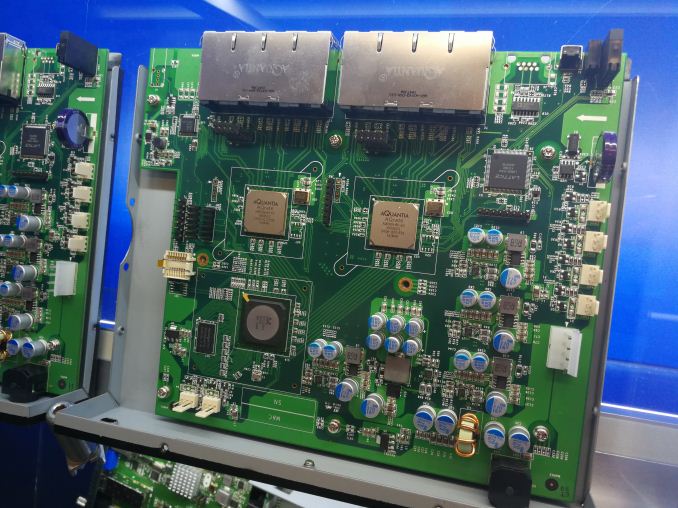
For users that have been following our recent coverage of Aquantia’s new multi-gigabit Ethernet solutions for consumers, the AQtion AQC107 and AQC108 controllers (along with their corresponding PCIe cards), the running theme through all of the >1 Gb Ethernet standards on RJ-45 has been the availability of switches. There are plenty of enthusiasts that would happily upgrade their home network infrastructure to something bigger than gigabit ethernet if there was a realistic price alternative. Current 10GBase-T solutions, for example, can cost >$150 per port for the systems and >$100 per port for the switch, whereas gigabit ethernet is ~$2-5 per port. Aquantia is hoping to break that mould, and showed some of the systems that related partners are moving towards working. I should state at this point that what was on display was early prototypes – Aquantia is working with ODMs and OEMs on getting the fundamentals of such switches right first, before those partners actually coming to market. Aside from the slew of typical enterprise players showing enterprise switches, Aquantia wasn’t prepared to state on record who they are partnering with in the consumer space for switches, although we were told so suspect the usual suspects. Any information we got from the meeting today we were told was expected to be preliminary and non-final, with potentially large differences between now and final products. All that being said, we were told that Aquantia is working on three main solutions for ODMs to look into: a 4-port solution, an 5-port solution, and an 8-port solution. The heart of these platforms is Aquantia silicon supporting four ports, with the 5-port switch version using a 4-port plus 1-port silicon design. The models on display, and used as the top image in this news piece, were done in collaboration with Cameo, who will be one of the first vendors (if not the first) to come to market with a product.
Aquantia demonstrated basic iPerf performance over the network using the switch in 10G mode with two Aquantia AQC107 add-in cards between two systems, showing 9.5G bandwidth in a basic test. The demo switch that was being used was not a final version by any means, in terms of looks and noise levels (it was overengineered for the demo), but this is something Aquantia expects OEMs to address rapidly. Naturally, we asked about pricing of the switches and availability. With the aforementioned caveats, we were told that the switch vendors themselves will be the ones dictating pricing. That being said, after suggesting that pricing in the region of $250-$300 for an 8-port switch that supports Aquantia 10G solutions (so likely 5GBase-T and 2.5GBase-T as well) would be great, we were told that this was likely a good estimate. Previously in this price range, options were limited to a sole provider: ASUS’ XG-U1008, a switch with two 10GBase-T ports and six one-gigabit Ethernet ports for $200. Above that, some Netgear solutions were running almost $800 for an 8-port managed solution. So moving to eight full 10G ports in this price bracket would be amazing, and I told Aquantia to tell OEMs that at that price ($~30 per port), those switches will fly off the shelves with enthusiasts who want to upgrade. Given the early nature of the designs on show, discussions on availability are expected to happen later this year, although Aquantia is likely to let partners announce their own products and time scales for the roll-outs. Related Reading | ||||||||||||||||||||||||||||||||||||||||||||||||||||||||||||||||||||||||||||||||||||||||||||||||||||||||||||||||||||||||||||||||||||||||||||||||||||||||||
| 10:20p | Apple Refreshes Mac Laptops: Pro, Vanilla, & Air All Get New CPUs
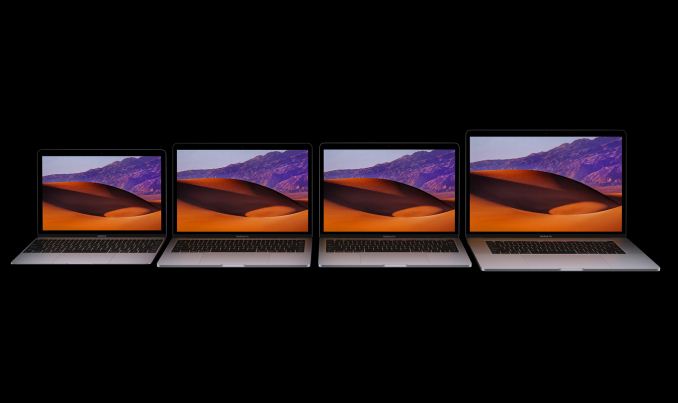
Today at their annual Worldwide Developer Conference, the company announced a slew of hardware updates for their entire range of laptops. Every last laptop, from the mighty MacBook Pro to the humble MacBook Air is getting some sort of CPU or platform update. As a result, Apple has a full family of refreshed laptops for the summer, all of which improve on their predecessor in one or more ways. We’ll start with the MacBook Pro and MacBook, Apple’s two modern laptop families. Both of these laptops have received their long-awaited update to Intel’s 7th generation Kaby Lake platform. Kaby Lake, for a quick refresher, uses the same Skylake CPU core as Intel’s 6th gen Skylake platform, but enjoys a modest frequency boost due to Intel's 14nm+ manufacturing process. Meanwhile on the graphics side of matters, all of these CPUs come with a newer media block that offers full hardware encode and decode of 10-bit HEVC. This is an important distinction since Apple will be supporting HEVC on macOS 10.13 High Sierra. There are no other major changes to the underlying Kaby Lake platform, so other than the clockspeed boost and improved media decoder, Kaby Lake is a conceptually simple update from Skylake.
Accordingly, Apple has only made minimal other internal changes to these laptops. The MacBook does get a newer SSD – presumably the latest Apple design to replace its existing Apple SSD – which Apple states is up to 50% faster than the previous SSD. Surprisingly, the company is now also offering a 16GB memory option on the laptop, an interesting development since they were already using a full suite of chips to get to 8GB; so a teardown will be necessary to see how they’re getting to 16GB.
Meanwhile the 15” MacBook Pro is receiving a dGPU update. Apple has replaced the AMD Radeon Pro 400 series options with the Radeon Pro 500 series, which is comprised of the Radeon Pro 555 and Radeon Pro 560, Like the previous 400 series, both 500 series parts are based on AMD’s Polaris 11 GPU.
Otherwise, Apple hasn’t made any internal or external changes to these laptops. They all have the same screens, same ports, same finishes, etc, as the 2016. And the Touch Bar is still present on all of the 15” SKUs and the higher-end 13” SKUs. So if you want a Touch Bar, you need to buy a more expensive SKU (or alternatively, a lower-end 13” if you don’t want the Touch Bar). Finally, Apple has added a second low-end MBP 13” SKU with a smaller 128GB SSD, which has pushed the price of the cheapest model down from $1499 to $1299 as of the refreshed laptops. All of these updated laptops should be available from Apple on June 7th. MacBook AirMeanwhile in a surprising turn of events, Apple has given the 13” MacBook Air a minor speed boost. The laptop has languished without a real update for a couple of years now, still using Intel’s 5th generation Broadwell CPUs and a now dated low-DPI TN screen. Nonetheless, it’s still one of Apple’s more popular laptops due to its sub-$1000 starting price, which seems to be disrupting any plans to actually discontinue the laptop. As a result, Apple has given it a minor, late-lifetime speed boost.
The updated laptop retains the use of Intel’s Broadwell processor, but the base configurations now uses a faster chip, Intel’s Core i5-5350U, instead of the slower i5-5250U. As hinted at by the minor model number change, this is not a massive difference – both the base and the boost clock are 200MHz faster, for 1.8GHz base and 2.9GHz boost – but it is none the less a tangible performance improvement for Apple’s entry-level laptop.
Otherwise, Apple has not made any other changes. It’s still the same size with the same panel and the same I/O, including the now dated Thunderbolt 2 port. Still, it buys the laptop a bit more time, at least until Apple can figure out what the future of their entry-level laptop model should be. | ||||||||||||||||||||||||||||||||||||||||||||||||||||||||||||||||||||||||||||||||||||||||||||||||||||||||||||||||||||||||||||||||||||||||||||||||||||||||||




| << Previous Day |
2017/06/05 [Calendar] |
Next Day >> |