[Most Recent Entries] [Calendar View]
Monday, June 12th, 2017
- Samsung Investing in 3840x1080 and 3840x1200 Curved Displays at 144 Hz
- Samsung CFG70: Curved 144Hz Displays with Quantum Dot Backlighting and AMD FreeSync
- Acer Announces Predator X27 Monitor: 4K@144 Hz with DCI-P3, HDR10, & G-Sync
- ASUS Demonstrates ROG Swift PG27UQ: 4K, 144 Hz, HDR, DCI-P3 and G-Sync
- ASUS Announces Designo Curve MX38VQ: 37.5 Inch Curved Display with Qi Charging
- LG 38UC99 Announced: 37.5-Inch Curved 21:9 Display with 3840×1600 Resolution
| Time | Event | ||||||||||||||||||||||||||||||||||||||||||||||||||||||||||||||||||||||||||||||||
| 8:01a | Mushkin Announces Availability Of SATA SSDs With 3D NAND
As previewed early this year at CES, Mushkin is now launching their first SSDs using 3D NAND flash. The new Reactor ARMOR3D is the replacement for the successful Mushkin Reactor, which held on to its position as one of the most aggressively priced MLC SATA SSDs as the mainstream segment of the market migrated almost entirely to using TLC NAND flash. The value-oriented Mushkin Triactor hasn't been around for quite as long as the Reactor but it too is being upgraded, to use 3D TLC NAND. The new Mushkin drives continue the pattern of using Silicon Motion SSD controllers, with both new models incorporating the current SM2258 controller. The 3D MLC and 3D TLC NAND comes from Micron, the first flash manufacturer to provide 3D NAND in volume for independent drive manufacturers (Samsung has largely been keeping their 3D NAND for their own SSDs, and the rest are still ramping up production capacity). Both models use the first-generation 32-layer 3D floating gate NAND flash, not the upcoming 64-layer 3D NAND. The major hardware components of the new Mushkin SSDs make them broadly similar to the ADATA SU800, SU900 and XPG SX950 SATA SSDs, all based on the SM2258 controller and Micron 3D NAND. There may be minor firmware differences between ADATA and Mushkin's offerings and they don't exactly match on overprovisioning ratios and usable capacity, but performance should be broadly similar between drives using the same NAND and similar capacity. Mushkin has not announced MSRPs, but the usual online retailers should have these drives in stock soon with competitive pricing.
Mushkin is initially offering a narrower range of capacities than ADATA, with 240–960GB for the Reactor ARMOR3D, and 512GB and 1TB for the Triactor 3D. Larger capacities are likely to be introduced when NAND prices get back down to reasonable levels, but that may not happen until it's time to move to 64-layer 3D NAND. Mushkin is offering three-year warranties on both new models. ADATA's 3D MLC SATA SSDs come with five and six year warranties, so Mushkin will have to beat them on price. Mushkin also has their first NVMe SSD in the pipeline. The upcoming Mushkin Helix will pair the Silicon Motion SM2260 controller with Micron 3D MLC NAND, and like these new SATA drives its closest competition will be another ADATA drive, the ADATA SX8000. | ||||||||||||||||||||||||||||||||||||||||||||||||||||||||||||||||||||||||||||||||
| 10:00a | Samsung Announces First Freesync 2 Monitors: CHG70 & CHG90 - Quantum Dots, Up to 49”, 144 Hz, DCI-P3
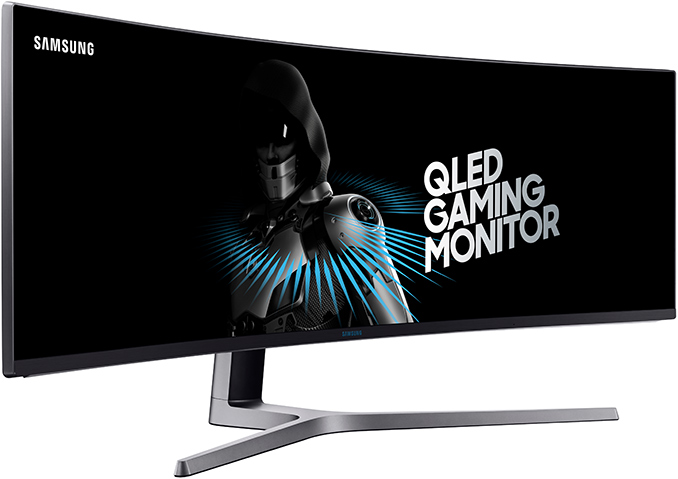
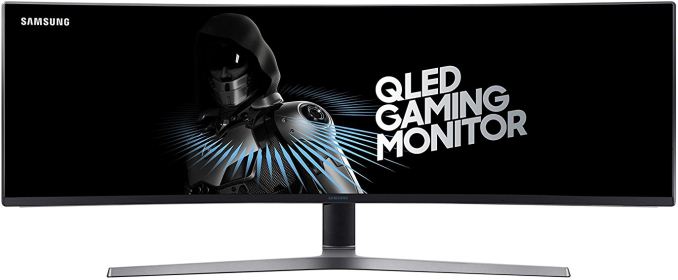
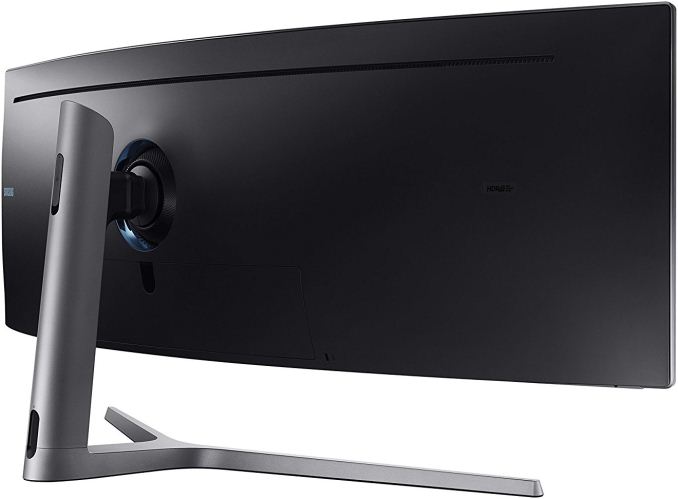
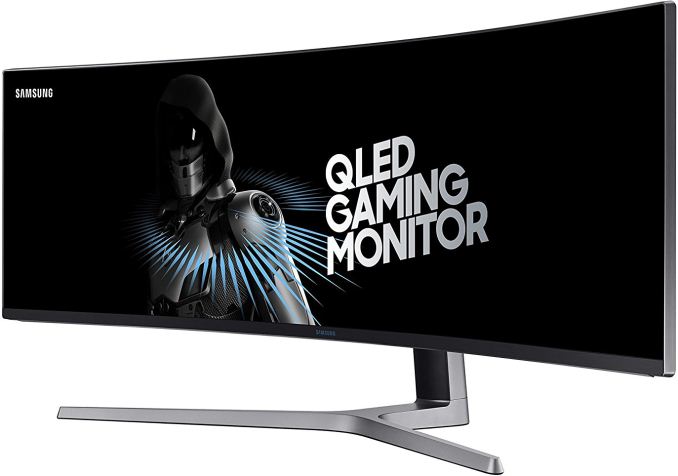
Samsung on Friday announced the C49HG90 monitor, their new flagship gaming monitor that includes virtually all of the major gaming-oriented display technologies available today. The new 49” screen has a an ultra-wide 32:9 aspect ratio, a 144 Hz refresh rate, and uses quantum dot nanocrystals to enable support for DCI-P3 color gamut, and, perhaps most importantly, it supports AMD’s forthcoming FreeSync 2 technology. In addition, Samsung introduced its CHG70-series displays that will support the same technologies, but will be smaller and more affordable. The Samsung C49HG90 is the company’s first ultra-wide display with the 32:9 aspect ratio and the so-called double full HD (DFHD) resolution (3840×1080). The monitor is based on a VA panel with up to 600 nits brightness, 1 ms moving picture response time (MPRT) as well as a 144 Hz refresh rate, two features important for fast-moving games. The panel has 1800R curvature along with 178° viewing angles to make gaming experience more immersive. The smaller C32HG70 and C27HG70 monitors use 32” and 27” curved VA panels (respectively) with a 2560×1440 resolution as well as the same refresh rate and MPRT as on the flagship model. Large dimensions, curvature and a high refresh rate are not the only distinctive features of Samsung’s new breed of gaming displays. The C49HG90 features LED backlighting enhanced with quantum dots that enable support for the DCI-P3 color space (as well as larger-than-sRGB gamut) and the HDR-focused AMD’s FreeSync 2. Samsung claims that the QLED backlighting of the display is similar to that used in its high-end UHDTVs with HDR, but does not say anything about features like local dimming or formal support for the HDR10 spec. Keeping in mind that Samsung’s announcement is focused around games and FreeSync 2 (and the latter uses its own HDR transport) the status of the HDR10 support isn't known at this time.
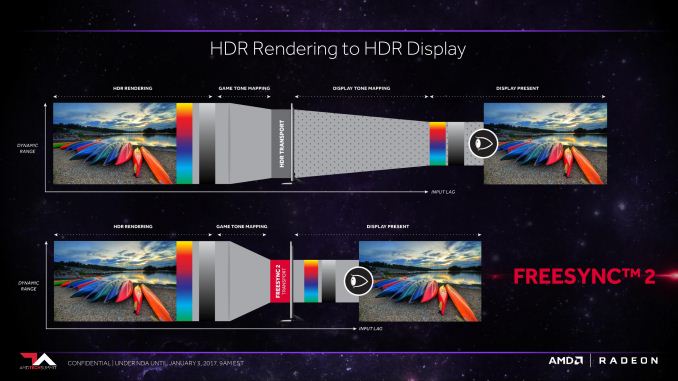
Meanwhile, Samsung’s HDR implementation makes the CHG70- and the CHG90-series displays the first to support AMD’s FreeSync 2, which is something bigger than just a new dynamic refresh rate technology (as discussed in the appropriate article). The FreeSync 2 mandates support for Low Framerate Compensation – an optional feature for FreeSync 1 monitors – but the biggest shift from a feature perspective is how HDR works. Rather than double-tone mapping the dynamic range – tone mapping a game once from its rendering space to HDR10's space, and then again in the monitor from HDR10 to the monitor's native space – FreeSync 2 skips the middle-man by having games tone map directly to a monitor's native dynamic range. This saves potentially precious milliseconds both by removing a step, and by putting the extremely fast GPU in charge of the process instead of the historically inconsistent display processors inside monitors.
As this is the first FreeSync 2-related news to hit the scene in nearly 5 months, there are some remaining questions that at least as of Samsung's announcement have not yet been answered. Chiefly, when AMD will enable FreeSync 2 support on their end, as all of the heavy lifting is being done by AMD's drivers. Coupled with that is a need for FreeSync 2-enabled software – since devs need to code for it – so that there's something to use with the display. Samsung says that it had collaborated with DICE and Ghost Games to enable HDR in the upcoming Star Wars Battlefront II and Need for Speed Payback games, which may indicate that these two titles will be among the first to support AMD’s FreeSync 2.
Samsung plans to demonstrate its CHG70- and the CHG90-series monitors in action at the Ubisoft booth at the E3 convention this week, just a couple of weeks before the devices will hit the market. This in turn implies that this Ubisoft is also set to support AMD’s FreeSync 2 (good news for the GPU developer) in at least some of its titles, but this is a speculation for now.
While the C27HG70 and C32HG70 look like rather regular gaming displays with a high refresh rate and FreeSync 2, HDR and DCI-P3 support as important bonuses, the C49HG90 seems like an experimental model that will compete against multi-monitor setups. Consumer displays with the 21:9 aspect ratio have been available for several years now and are gaining traction, but so far, no monitor manufacturer has attempted to offer a very large monitor with the 32:9 aspect ratio and a relatively low DPI. People buying the C49HG90 will not be able to watch 4K content on them in native resolution and that may stop some gamers from adopting it. On the other hand, those who use multi-display setups for ultra-wide screen gaming today do not necessarily enjoy 4K video anyway. The Samsung C49HG90 will be available in late June at a price of $1499. The monitor is now available for pre-order at Amazon and Micro Center in the U.S. The 32” C32HG70 will cost $699 and is available for pre-order at Newegg, whereas the 27” C27HG70 will be priced at $599 and can be pre-ordered from Samsung now.
Gallery: The Samsung C49HG90 Display
      Related Reading: | ||||||||||||||||||||||||||||||||||||||||||||||||||||||||||||||||||||||||||||||||

| << Previous Day |
2017/06/12 [Calendar] |
Next Day >> |