[Most Recent Entries] [Calendar View]
Tuesday, June 27th, 2017
| Time | Event | |||||||||||||||||||||||||||||||||||||||||||||||||||||||||||||||||||||||||||||||||||||||||||||||||
| 6:00a | The Intel SSD 545s (512GB) Review: 64-Layer 3D TLC NAND Hits Retail 64-layer 3D NAND has arrived with Intel as the first to market. The new Intel SSD 545s is a mainstream consumer SATA SSD that greatly improves on last year's disappointing Intel SSD 540s. Intel hasn't quite beaten Samsung's entrenched 850 EVO, but the SSD market is definitely getting more competitive with this new generation of 3D NAND flash memory. | |||||||||||||||||||||||||||||||||||||||||||||||||||||||||||||||||||||||||||||||||||||||||||||||||
| 8:00a | Google Fined €2.42B by European Commission for Antitrust Violations
This morning Google has become a new record holder in the European Union; unfortunately however it’s not a good record to hold. Capping off a multi-year investigation, the European Commission – the EU’s executive body – has ruled that Google has violated the EU’s antitrust laws with the company’s shopping service and how it is promoted. As a consequence of this ruling, the EU is levying a €2,424,495,000 (~$2.73B) fine against Google, along with requiring the company to cease anti-competitive activities in the next 90 days under threat of further fines. This fine is, in turn, now the largest antitrust fine ever levied by the EU, easily surpassing Intel’s €1.06bil fine in 2009. The EU has been investigating Google for several years now – and indeed hasn’t been the only body to do so over the years – and based on how the investigation was proceeding, it has been expected for some time now that the European Commission would rule against Google. Overall, the Commission bases the size of the fine on the revenue of the offending business – in this case Google’s shopping comparison service – where it can levy a fine at up to 30% of revenue over the offending period of time. So while Google’s fine is quite large, it also represents an equally significant amount of time – over 9 years in the case of Germany and the UK. From an antitrust standpoint, the crux of the Commission’s argument has been that Google has leveraged their dominance of the search market to unfairly prop up and benefit their search comparison service. Specifically, that in their search results Google listed their own shopping service and its results ahead of competing services, severely harming competitors, who saw traffic drops of up to 92% depending on the specific country in question.
For the time being, Google has 90 days to fix the issue. The Commission isn’t recommending a specific remedy, but they expect Google to pick a reasonable remedy and to explain it to the Commission. Ultimately what regulations are looking for is that Google give competitors “equal treatment” – that is, that competing shopping comparison services receive equal footing in Google’s search results, following the same methods and processes that Google uses to place their own service. Should Google not comply, then the Commission has the option of levying a further fine of 5% of all of Alphabet’s global daily turnover. Meanwhile Google has the option of appealing the ruling to the courts, and while they’ve yet to make a decision, they’ve already published their own rebuttal to the Commission’s ruling, indicating that an appeal is likely. In their rebuttal, Google has stated that “While some comparison shopping sites naturally want Google to show them more prominently, our data show that people usually prefer links that take them directly to the products they want, not to websites where they have to repeat their searches.” The company has also noted that they do have competition, particularly from companies like eBay and Amazon. Finally, along with today’s ruling, the European Commission has also noted that they still have other, ongoing cases against Google that they are continuing to investigate. These include issues over the Android operating system – where the Commission is concerned that “Google has stifled choice and innovation in a range of mobile apps and services by pursuing an overall strategy on mobile devices to protect and expand its dominant position in general internet search” – and Google’s AdSense unit, where there are concerns over Google’s policies have reduced choice in the ad market. As a result, even if Google doesn’t appeal today’s fine, their legal wrangling with the EU is not yet over. | |||||||||||||||||||||||||||||||||||||||||||||||||||||||||||||||||||||||||||||||||||||||||||||||||
| 8:30a | ASUS & Sapphire Release Pascal & Polaris-based Cryptocurrency Mining Cards
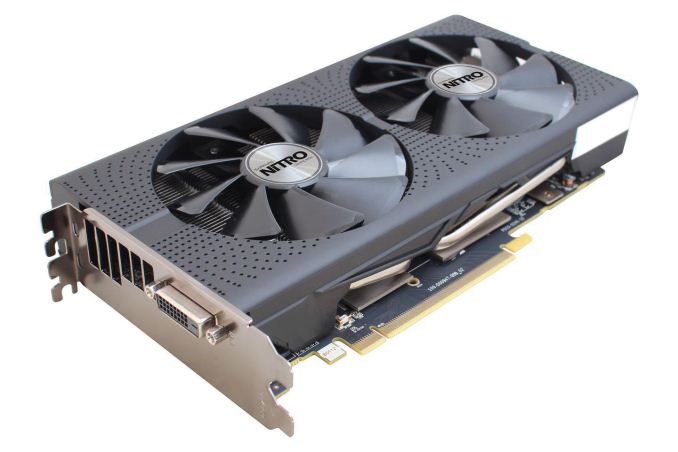
Even during the most bullish Bitcoin days, video card partners had shied away from creating specific SKUs for the purpose of cryptocurrency mining, and that has remained the case since – until now. With the Ethereum mining mania hitting new heights (ed: and arguably new lows), add-in board vendors ASUS and Sapphire have released mining-specific video cards, with variants based off of NVIDIA's GP106 GPU, and AMD's RX 470 & RX 560 video cards. Being built for high hash-rates rather than visual graphics horsepower, these cards are distinctively sparse in their display output offerings. ASUS has outright labelled their cards as part of their new “MINING Series,” with product pages for MINING-P106-6G and MINING-RX470-4G advertising hash-rate production and cost efficiency features. Something to note is that ASUS has chosen to use the GPU codename of GP106, rather than the NVIDIA GTX 1060 branding. The GP106-based card has no display outputs, while the RX 470 card supports only a single DVI-D output despite humorously having HDMI and DisplayPort cut-outs on the PCIe bracket. Both cards are specified at reference clocks.
Meanwhile, Overclockers UK are listing 5 Sapphire MINING Edition SKUs, with 4 RX 470 variants differentiated by memory manufacturer and VRAM size: RX 470s with 4GB of non-Samsung (11256-35-10G) or Samsung memory (11256-36-10G), RX 470s with 8GB of non-Samsung (11256-37-10G) or Samsung memory (11256-38-10G), as well as an RX 560 Pulse MINING Edition card (11267-11-10G). None of the RX 470 variants offer any display outputs, while the RX 560 has a single DVI-D.
In the Overclockers UK product descriptions, cards with Samsung memory are specified for an additional 1 MH/s (mega-hashes per second) over the non-Samsung counterparts, highlighting the importance of memory bandwidth and quality in current Ethereum mining. In addition, the descriptions state a short 1 year warranty and, interestingly, CrossFire support for up to 2 GPUs. It remains to be seen whether these cards can be paired with standard video cards for the purpose of increased graphical performance. Other SKU listings have surfaced in the wild: Sapphire RX 470 4GB with non-Samsung (11256-21-21G) and Samsung memory (11256-31-21G) on Newegg, and MSI P106-100 MINER 6G on NCIX. The Newegg Sapphire RX 470s, unlike the ones listed on Overclockers UK, both have single DVI outputs and 180 day limited warranties. However, the MSI mining card is completely bare of any details. Looking back, Bitcoin, Litecoin, and Dogecoin – as well as many others – have all waxed and waned. Yet video card manufacturers remained the last holdouts in the PC component market in offering cryptocurrency-specific SKUs; since then, there have been tailored chassis’, PSUs, and motherboards both new and old. In the past, surging cryptomining demand has resulted in periodic supply issues, with consequences like $900 R9 290X’s. Now, ASUS and Sapphire seem intent on tackling the current Polaris and Pascal shortages from the most direct angle possible: cryptomining cards. While drastic on some level, it’s representative of the difficult problem faced by both the GPU manufacturers (AMD and NVIDIA) and their video card partners. Mining-inflated demand restricts supply to such an extent that scarcity and artificially high prices infuriate standard consumers looking to purchase video cards. However, overproduction could easily lead into an intractably congested channel after the cryptomining craze has ceased, not to mention potential RMA/warranty headaches or unintentional flooding of the secondary market with used mining cards of variable health. By offering cryptomining cards with limited warranties, restricted display outputs, and presumably lower manufacturing costs, vendors are hoping to capitalize on mining demand while satisfying standard consumers and avoiding undue damage to their brand or revenue. Given these aggressive and forthright efforts by ASUS and Sapphire, it would not be surprising if other add-in board vendors followed suit with a few mining-specific products of their own. | |||||||||||||||||||||||||||||||||||||||||||||||||||||||||||||||||||||||||||||||||||||||||||||||||
| 10:40a | Honor 9 Makes Its Way West: Launching Today in Europe for £380/€450
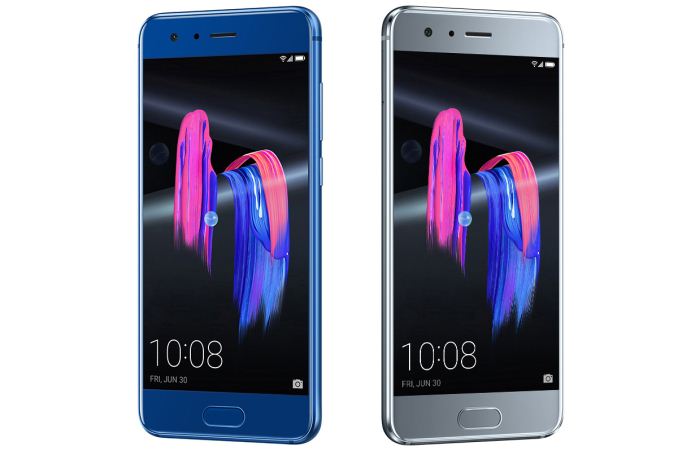
A couple of weeks back at an event in China, Huawei’s Honor sub-brand announced their flagship smartphone for 2017: the Honor 9. Following in the footsteps of the Honor 8 before it, the Honor 9 continues in Honor’s tradition of offering flagship-level smartphones with high-end components at a more mainstream price. At the time of the reveal, the Honor 9 was only being released in China. But now a short few weeks later, Honor is announcing that it is making its way west for its European launch, which kicks off today. Honor’s latest flagship is a 5.15-inch phone that, at first glance, looks a lot like parent company Huawei’s recently-launched P10 smartphone. The Honor phone gets the same latest-generation Kirin 960 SoC from Huawei’s HiSilicon division, and the 5.15-inch 1080p display is only a hair larger than the P10’s 5.1-inch display. This is similar to what we have seen in past generations, with the Honor flagship serving as a more value-priced alternative for consumers who are after the latest Huawei tech.
Rounding out the specifications, depending on the configuration the phone is paired with either 4GB or 6GB of RAM. All (listed) SKUs come with 64GB of NAND for storage, along with a microSD card for additional storage. For wired connectivity, Honor offers a USB 2.0 port as well as a 3.5mm audio jack. Powering the phone is a 3200mAh battery, which works out to being a bit bigger than the battery on last year’s Honor phone. Finally, Honor has thankfully moved the fingerprint sensor for this year’s phone; rather than being on the rear of the phone it’s now on the front of the phone, where it’s easier to access. Meanwhile like the Honor 8 before it, the Honor 9 gets a dual camera implementation. This time however instead of matching color and monochrome cameras, the monochrome camera gets a resolution boost, resulting in a 12MP color (RGB) camera paired with a 20MP monochrome camera. As you’d expect with the significant resolution increase for one of the cameras, along with the more powerful Kirin 960 SoC, the camera is the second major focal point for Honor’s promotion of the phone. Specifically, the company is promising improved low-light photography thanks to the improved monochrome camera.
As for the build of the phone, Honor has once again gone with glass for the front and back of the phone. In fact the overall design of the phone and its construction appears to be very similar to the Honor 8 in this respect; the edge-to-edge glass is comprised of 15 layers, with a 2.5D curve at the edges. New to this year’s model is what Honor is calling “Glacier Grey”, which joins their other color options. As for the launch of the phone, the Honor 9 is available today in much of Europe, including Germany, Belgium, Italy, Russia, and the UK. Interestingly, different countries are getting slightly different phone configurations: the UK gets a 4GB RAM / 64GB NAND configuration for £379.99, meanwhile the rest of Europe is reportedly getting a 6GB RAM / 64GB NAND configuration for €449.99. As for a US release, Honor isn’t announcing anything at this time. However given Honor’s recent struggles, at this point a US release should not be considered a given. Gallery: Honor 9 (Blue)
      | |||||||||||||||||||||||||||||||||||||||||||||||||||||||||||||||||||||||||||||||||||||||||||||||||
| 11:50a | AMD’s Radeon Vega Frontier Edition Formally Launches: Air Cooled For $999, Liquid Cooled for $1499
After what appears to be a very unusual false start, AMD has now formally launched their new Radeon Vega Frontier Edition card. First announced back in mid-May, the unusual card, which AMD is all but going out of their way to dissuade their usual consumer base from buying, will be available today for $999. Meanwhile its liquid cooled counterpart, which was also announced at the time, will be available later on in Q3 for $1499. Interestingly, both of these official prices are some $200-$300 below the prices first listed by SabrePC two weeks ago in the false start. To date AMD hasn’t commented on what happened there, however it’s worth noting that SabrePC is as of press time still listing the cards for their previous prices, with both cards reporting as being in-stock.
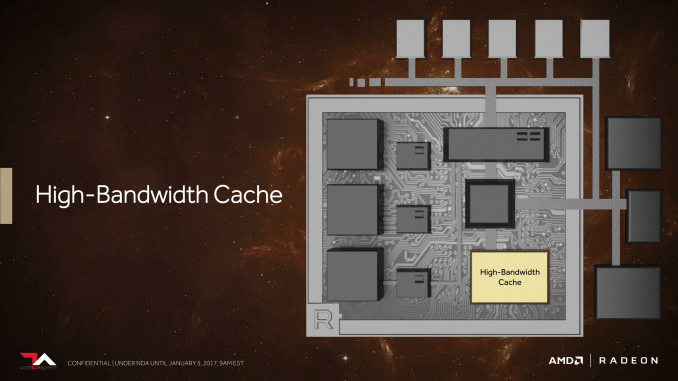
Meanwhile AMD has also posted the final specifications for the card, confirming the 1600MHz peak clock. Sustained performance is a bit lower, with AMD publishing a “Typical clock” of 1382MHz. It’s worth noting that this is the first time AMD has used this term – they’ve previously used the term “base clock”, which is generally treated as the minimum clockspeed a card under a full gaming workload should run at. AMD is typically very careful in their word choice (as any good Legal department would require), so I’m curious as to whether there’s any significance to this distinction. At first glance, “typical clock” sounds a lot like NVIDIA’s “boost clock”, which is to say that it will be interesting to see how often Vega FE can actually hit & hold its boost clock, and whether it falls below its typical clock at all. Feeding the GPU is AMD’s previously announced dual stack HBM2 configuration, which is now confirmed to be a pair of 8 layer, 8GB “8-Hi” stacks. AMD has the Vega FE’s memory clocked at just under 1.9Gbps, which gives the card a total memory bandwidth of 483GB/sec. And for anyone paying close attention to AMD’s naming scheme here, they are officially calling this “HBC” memory – a callback to Vega’s High Bandwidth Cache design.
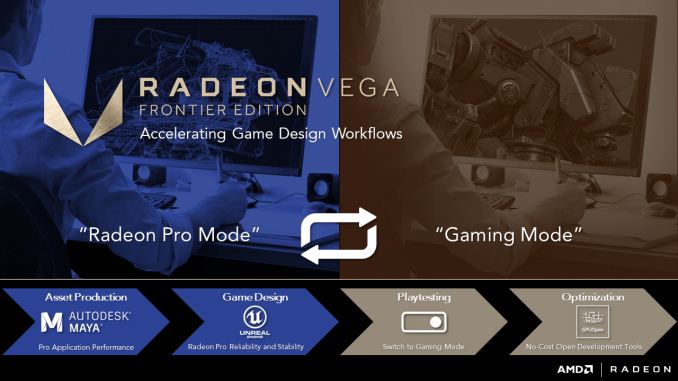
As for power consumption, AMD lists the card’s typical board power as “< 300W”. This is consistent with the earlier figures posted by retailers, and perhaps most importantly, this is AMD’s official typical board power, not the maximum board power. So we are looking at a fairly high TDP card, and given that AMD has had a great deal of time to sit and work on their reference blower designs over the last few years, I’m anxious to see what that means for this initial air-cooled card. For display outputs, the Vega FE devotes its entire second slot to airflow, so all of the display connectors are found on the first slot. Typical for AMD cards of the past couple of years, we’re looking at 3x DP 1.4 ports along with 1x HDMI port. AMD is also throwing in a passive DP to SL-DVI adapter in the box. Moving on, let’s talk about the software setup for the Vega FE. As this is a card meant for (in part) game developers, AMD has opted to give the card access to both their pro and gaming drivers. Taking things one step further however, rather than making them separate downloads and installations, AMD has merged both drivers into a single install. Users can now download a single driver package and simply switch between driver modes in AMD’s control panel, allowing quick access to both driver types.
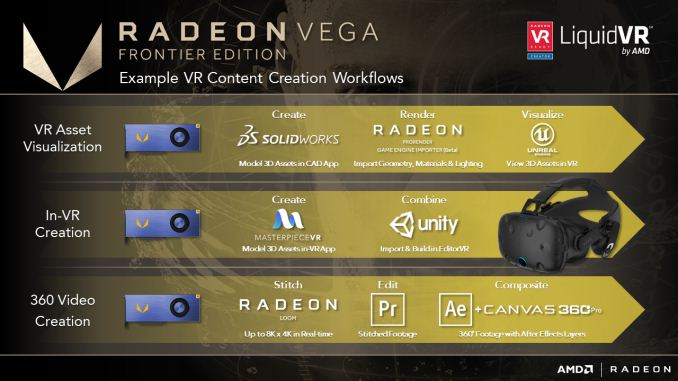
Unfortunately AMD hasn’t released much more in the way of detailed information on how driver switching works. In particular, it’s not clear whether switching requires a reboot or not; I would assume not, but it remains to be seen. Ultimately the primary purpose of this switch is for allowing game developers to switch modes for testing, going from pro driver mode for development to gaming mode for testing. The difference, I suspect, is less about driver code, and more about what driver optimizations are enabled. Games can get away with numerous hacks and optimizations in the name of performance, whereas professional applications need deterministic accuracy. Otherwise, the driver situation touches on probably what remains one of the least-clear points of this product launch: who is the Radeon Vega Frontier Edition for? AMD is doing everything they can to encourage their typical Radeon consumer base to wait for the forthcoming Radeon Vega RX cards. In the meantime the company is stating that the card is “For Data Scientists, Immersion Engineers, and Product Designers” and certainly the pricing is closer to a professional card than a consumer card. Complicating matters is that AMD has been posting performance figures for SPECviewperf, Creo, other distinctly professional workloads, the kinds that typically go hand-in-hand with certified drivers. And at least for the moment, it doesn’t appear that AMD’s drivers have been certified (not that we’d expect them to be for a new architecture).
At a high level the Vega FE seems to compete with NVIDIA’s Titan Xp – and certainly that’s how AMD is choosing to pitch it – though this isn’t helped by the fact that NVIDIA isn’t doing a great job of establishing a clear market segmentation either, particularly since the launch of the GeForce GTX 1080 Ti. The Titan Xp is most certainly a partial gaming card (albeit a very expensive one), whereas AMD is focused more on professional visualization use cases that NVIDIA is not. Though where both overlap is on the compute front, where both the Vega FE and Titan Xp are essentially “entry-level” cards for production compute work. Otherwise, it may be better to treat the Vega FE as a beta testing card, especially given the “frontier” branding and the fact that AMD is clearly attempting to build out a more complete ecosystem for the future Vega RX and Instinct cards. As for compute users in particular, AMD will be releasing the ROCm driver a bit later this week, on the 29th. Vega FE has a lot of potential for a compute card, thanks to its high number of SPs combined with equally high clocks. However serious compute users will need to code for its capabilities and idiosyncrasies to get the best possible performance on the card, which is all the more reason for AMD to get cards out now so that developers can get started. Compute will be the long-tail of the architecture: AMD can tweak the graphics performance of the card via drivers, but it's up to developers to unlock the full compute capabilities of the Vega architecture. Wrapping things up, for anyone interested in picking up the Vega FE, AMD is currently only linking to Newegg’s storefront, where both the air cooled and water cooled cards are listed as “coming soon”. Otherwise SabrePC lists the cards in stock, albeit at prices over AMD’s MSRP. Gallery: AMD Radeon Vega Frontier Edition
      | |||||||||||||||||||||||||||||||||||||||||||||||||||||||||||||||||||||||||||||||||||||||||||||||||






| << Previous Day |
2017/06/27 [Calendar] |
Next Day >> |