[Most Recent Entries] [Calendar View]
Thursday, June 29th, 2017
- DRAM and Motherboard Makers Demonstrate Quad-Channel DDR4-4000+ Operation
- G.Skill Announces 16 GB DDR4-4333 Memory Kit for Intel Kaby Lake CPUs
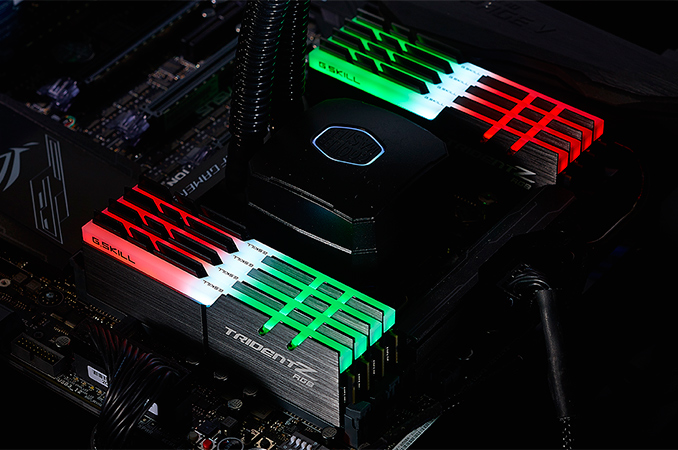
- G.Skill Announces Trident Z RGB DDR4 Kits with 16 GB Modules, Up to 128 GB
- AMD Announces Ryzen AGESA 1.0.0.6 Update: Enables Memory Clocks Up To DDR4-4000
- Corsair Vengeance RGB DDR4 Memory Modules with LEDs Now on Sale
| Time | Event | ||||||||||||||||||||||||||||||||||||||||||||||||||||||||||||||||||||||||||||||||||||||||||||||||||
| 7:00a | Joint Venture Dispute Between Toshiba and Western Digital Escalates, Toshiba Still Unable to Sell NAND Business
Due to serious financial difficulties, Toshiba is trying to sell off their stake of their very successful flash memory business to keep the rest of the company afloat. Western Digital, as a result of their acquisition of SanDisk last year, owns half of the joint venture that Toshiba is selling their stake in. Western Digital would prefer to buy out Toshiba's share to strengthen their own position in the market, but they have struggled to keep up with the bidding as offers climb past ¥2T ($17.8B). The leading bidder has been a consortium with backing from the Japanese government and many major Japanese corporations through the Innovation Network Corporation of Japan and the Development Bank of Japan, as well as investments from Bain Capital Private Equity and rival memory manufacturer SK Hynix. Western Digital has asserted that the terms of their joint ventures with Toshiba require SanDisk's approval before Toshiba can sell their stake, and Western Digital has not given their consent to any sale. This has not stopped Toshiba from continuing to negotiate a sale, so Western Digital has predictably taken legal action. In May Western Digital began arbitration proceedings through the ICC International Court of Arbitration. Toshiba made a partial concession by rolling back the spin-off of some of the memory business assets they were preparing to sell, but their overall plan did not change and Western Digital was not placated. Earlier this month, Western Digital filed for an injunction preventing Toshiba's sale until the arbitration was resolved. Western Digital's action was filed in the Superior Court of California for the County of San Francisco. As the dispute developed, Western Digital and Toshiba continued normal day to day operations of their business, including announcements around Computex about their upcoming SSDs using their 64-layer BiCS3 3D NAND, and the announcement earlier this week of their development of 96-layer BiCS4 3D NAND. Toshiba was hoping to complete a deal with the winning bidder at a shareholder meeting yesterday. In the weeks leading up to that meeting, Toshiba had to issue several reminders of how desperate their financial state is: disclosing new legal actions against them by investors seeking damages pertaining to Toshiba's accounting scandals, announcing that the Tokyo and Nagoya stock exchanges are moving toward delisting Toshiba, and revising their outlook for fiscal year 2016 to reflect a negative shareholder equity of (¥581.6B). Meanwhile, Western Digital reiterated their objection to Toshiba selling the memory business to a third party and warned several third parties that they would view participation in the sale as tortious interference. Most recently, Western Digital also reportedly resubmitted its bid for Toshiba's memory business with an offer around ¥2 trillion, close to the amount offered by the consortium Toshiba had previously selected as the preferred bidder. Toshiba for their part has made no mention of Western Digital's offer. In the aftermath of yesterday's shareholder meeting, Toshiba made several announcements. As expected, Toshiba was not able to finalize a sale of the Toshiba Memory Corporation subsidiary they have consolidated the memory-related assets under, but they are continuing to negotiate with the consortium. Toshiba announced plans for further investment in the joint venture's Fab 6 in Yokkaichi, Japan, and questioned whether SanDisk would jointly invest in the 3D NAND fab. Toshiba also announced that it has filed a lawsuit in the Tokyo District Court against Western Digital alleging unfair competition and seeking an injunction and damages. Toshiba claims that Western Digital is exaggerating their consent rights and also alleges that Western Digital has improperly obtained Toshiba trade secrets by transferring some employees from SanDisk to Western Digital whom have access to Toshiba confidential information through the joint ventures. Western Digital has responded by denying Toshiba's allegations of improper handling of trade secrets, and claims that Toshiba has taken retaliatory action by cutting off some of Western Digital's employees' access to shared databases and facilities. Western Digital reaffirmed their intent to continue fully participating and investing in the joint ventures, and claimed to have not yet received the legal filings pertaining to Toshiba's lawsuit in Tokyo. Western Digital again claimed that the terms of their joint ventures requires that disputes be resolved through the arbitration process, making it clear they consider Toshiba's lawsuit improper. The SanDisk request for an injunction in the California court is scheduled for a hearing on July 14. It appears that there will not be any quick resolution to this dispute unless Toshiba's money troubles force them to accept Western Digital's bid. The consortium that Toshiba is trying to sell to has not made any collective public statements, but we expect continued leaks about the state of their offer. | ||||||||||||||||||||||||||||||||||||||||||||||||||||||||||||||||||||||||||||||||||||||||||||||||||
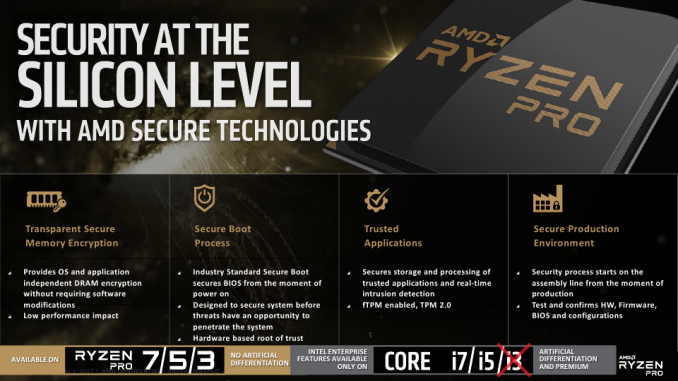
| 9:00a | AMD Launches Ryzen PRO CPUs: Enhanced Security, Longer Warranty, Better Quality This morning AMD is introducing their Ryzen PRO processors for business and commercial desktop PCs. The new lineup of CPUs includes the Ryzen 3 PRO, Ryzen 5 PRO and Ryzen 7 PRO families with four, six, or eight cores running at various frequencies. A superset to the standard Ryzen chips, the PRO chips have the same feature set as other Ryzen devices, but also offer enhanced security, 24 months availability, a longer warranty and promise to feature better chip quality. AMD Ryzen Pro: The Family PortraitThe AMD Ryzen PRO lineup of processors consists of six SKUs that belong to the Ryzen 7, Ryzen 5 and Ryzen 3 families targeting different market segments and offering different levels of performance. As one would expect, the Ryzen 7 PRO models are aimed at workstation applications and thus have all eight cores with simultaneous multithreading enabled, the Ryzen 5 PROmodels are designed for advanced mainstream desktops and therefore have four or six cores with SMT, whereas the Ryzen 3 PRO models are aimed at office workloads that work well on quad-core CPUs without SMT. The specifications of the Ryzen 7 PRO and the Ryzen 5 PRO resemble those of regular Ryzen processors. Meanwhile, the Ryzen 3 PRO are the first chips from the Ryzen 3 lineup and thus give us a general idea what to expect from such products: four cores without SMT operating at 3.1 – 3.5 GHz base frequency along with 2+8 MB of cache.
Just like other Ryzen CPUs, all the Ryzen PRO chips fully support ECC technology, but with certain limitations when it comes to data transfer rates and memory modules — these are peculiarities of the controller and the PRO moniker cannot change them. One of the things to note is that AMD used only DDR4-2400 memory for their internal testing of the Ryzen PRO CPUs, thus, expect PC makers to use the same speed DRAM for their desktops as well. In fact, when it comes to their general feature set, all of the AMD Ryzen PRO CPUs support the same capabilities as their non-PRO brethren do, including AMD’s SenseMi, Precision Boost, Extended Frequency Range, Neural Net Prediction and so on. There is even the AMD Ryzen 7 PRO 1700X CPU in the lineup, completely with its extended performance and 95 W TDP (the first for any AMD PRO platform). Meanwhile, there are four things that the Ryzen PRO bring to the table that give it its PRO designation: enhanced security features, enterprise-class manageability, processor and platform longevity, and enhanced quality (which we are going to touch upon later). With the launch of the Ryzen PRO, AMD is offering pure CPUs for business desktops for the first time ever. Previously the company only offered its A PRO-series of APUs with integrated graphics and TDPs ranging from 35 to 65 W. By contrast, the new CPUs are offered with 65 – 95 thermal envelops, which means that we are not going to see ultra-small form-factor workstations running AMD Ryzen PRO, but may finally see full-sized desktops. It makes sense to note that all Ryzen PRO CPUs, including the highest performing and the most affordable SKUs, will support all of the advertised enterprise/business-grade capabilities. AMD is especially proud about that because their rival Intel does not support enterprise features (such as vPro) on lower-end Core i3 models. At this point AMD is not disclosing the prices of its Ryzen PRO CPUs, and the only metrics that AMD uses in comparing the PRO chips against competing SKUs is performance, not MSRPs or TDPs.
Such comparison shows that AMD’s Ryzen PRO lineup for desktops can cover a wider range of performance requirements than Intel’s mainstream vPro offerings do. For example, the AMD Ryzen PRO 1700X does not have a direct competitor from Intel – at least, not by AMD's accounting. In addition, AMD’s Ryzen 3 PRO 1200 also does not have a corresponding rival from the Core i3 lineup from performance point of view, based on AMD’s comparison. However, since Intel also offers Core i7 and Core i5 CPUs with TDP reduced to 35 W (for which AMD does not have announced competitors in the Ryzen PRO range), such performance-focused comparison does not draw a complete picture. New AMD Security TechnologiesNow let;'s dive into the security features of the AMD Ryzen PRO platform. For years AMD’s processors for business PCs supported additional security technologies (collectively known as AMD Secure Processor and Platform Security Processor before that) enabled by the ARM TrustZone platform with the ARM Cortex-A5 core. AMD’s previous-gen PRO-series APUs included Secure Boot, Content Protection, per-Application security, fTPM 2.0, and support for Microsoft Device Guard, Windows Hello, fingerprint security, data protection and so on. The Ryzen PRO brings all of these features forward, and also adds Transparent Secure Memory Encryption (TSME) on top of them.
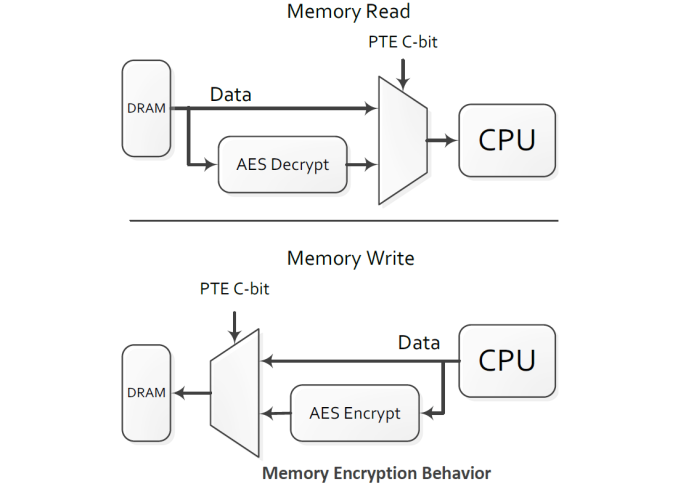
To explain what TSME is, it makes sense to refer to AMD’s Zen memory encryption technologies in general. The Zen microarchitecture features two important technologies: Secure Memory Encryption (SME) and Secure Encrypted Virtualization (SEV) that protect data in DRAM using a dedicated AES-128 engine.
When data is stored on storage devices, it is usually encrypted, but when it is being processed on a CPU or temporarily stored in RAM, it is almost never is, leaving open the possibility of snooping these unprotected areas. As the name suggests, Secure Memory Encryption encrypts content of DRAM in a bid to eliminate data snooping by unauthorized programs or administrators (this is more likely to happen in a server/datacenter environment, but still). This feature will be particularly important for NVDIMMs going forward as they store data even after unplugged from their hosts.
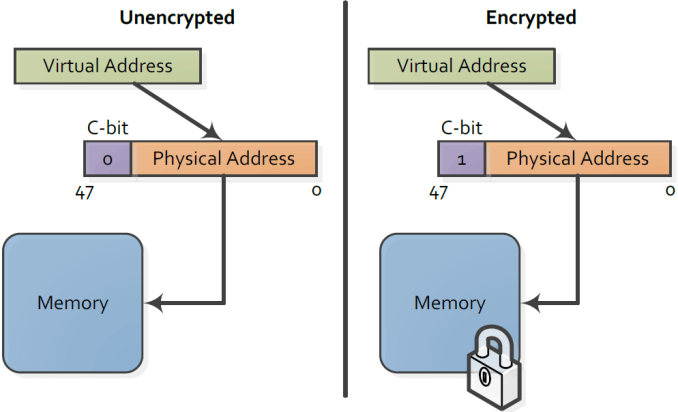
The SME encrypts data when it is written to DRAM and decrypts it when it is read. The AES-128 key is generated by a NIST SP 800-90-compliant hardware RNG and then managed by the AMD-SP hardware (thus, in a secure environment only). Although a dedicated engine performs the encryption/decryption, the process still takes time and thus adds latency to memory accesses. AMD claims that the actual performance impact is not significant, but we will have to test it ourselves before making any conclusions of our own. AMD’s Zen microarchitecture supports full and partial memory encryption for cases when performance is a concern. The one downside to this is that both partial and full encryption modes will require OSes and software to be modified in order to work properly. More practical for daily workstation use is AMD’s Transparent SME mode. As the name impies, Transparent mode is transpartent to OSes and programs, and thus be used with legacy software. Transparent SME mode stil encrypts DRAM completely, and this mode can be enabled from BIOS. At this point Transparent SME is the only type of SME supported by the Ryzen Pro, but AMD’s EPYC processors support all of them.
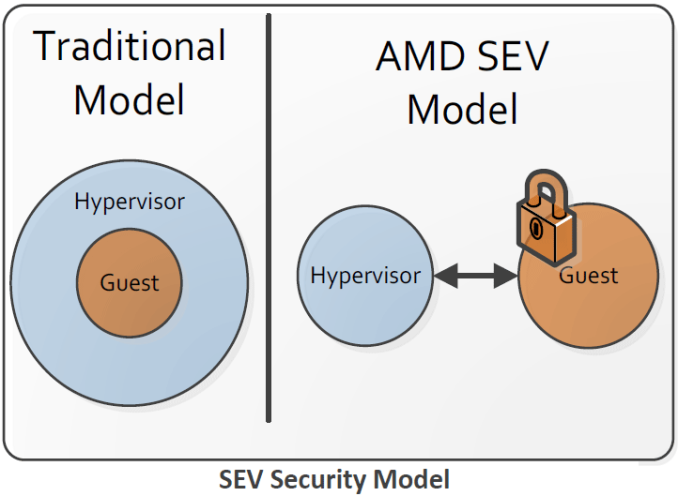
Moving on, AMD's other big security feature for the PRO lineup is Secure Virtualized Encyrption (SEV). SEV in many ways resembles the SME, but in this case, it enables owners to encrypt virtual machines, isolating them from each other, hypervisors, and hosting software. The SEV is an extension to AMD’s virtualization architecture that uses the same hardware as the SME to protect/sandbox selected VMs using different AES-128 keys and eliminating some of the security risks involved in using VMs, particularly in datacenter environments. As the SEV uses different keys for different VMs, it does not work with TSME. By contrast, SEV is fully enabled on AMD’s EPYC processors (it will be interesting to see whether Threadripper chips support the feature as well). One thing that should be noted is that both SME and SEV require support not only at processors themselves, but also at the platform and software levels. Consequently, with the exception of TSME mode (which will still require BIOS/chipset support), it will take some time before actual systems can take advantage of the new technologies supported by AMD’s Zen microarchitecture. A good thing is that owners of the Ryzen PRO will be able to use TSME already this year, and this is where AMD’s new business platform excels Intel’s Core-series offerings. Enterprise Manageability and ReliabilityIn addition to security capabilities, business PCs require some other hardware features as well.
First off, the Ryzen PRO platforms support DASH management protocol and therefore PCs featuring the chips can be remotely managed using tools based on this industry standard developed by vendors of appropriate computers. AMD Pro-series processors have supported DASH for years, no changes here. Secondly, AMD’s Ryzen PRO platforms support 18-month platform stability and 24-month processor availability. AMD guarantees that the Ryzen PRO chips it launches this year will be available for two more years without changes to software, enabling business customers to buy and deploy new systems running the CPUs without modifying the software they use. Finally, all AMD Ryzen PRO CPUs are covered with a 36-month limited warranty, up from 12-month warranty for consumer processors. The reason why AMD offers extended warranty for its business CPUs (apart from the fact that its customers demand this) is because it uses wafers with highest yields/least amount of defective parts to build the Ryzen Pro. AMD believes that wafers with the lowest manufacturing variability provide chips that are “set to meet long term reliability”.
Available This FallAMD promises to share more information about its Ryzen PRO CPUs and supporting platforms on August 29, 2017. The company does not say that actual systems will be available on this date, but since the chip designer already disclosed plans to ship Ryzen PRO in the second half of this year, it is safe to say that at least some Ryzen Pro-based desktops will ship this fall.
As for vendors, expect the usual workstation/commercial PC makers like Dell, HP, Lenovo and other to offer desktops powered by AMD’s Ryzen Pro. Gallery: AMD Ryzen PRO Presentation       | ||||||||||||||||||||||||||||||||||||||||||||||||||||||||||||||||||||||||||||||||||||||||||||||||||
| 9:10a | AMD Inadvertently Reveals Ryzen 3 1300 & 1200 Details
If you were paying close attention to this morning’s announcement of AMD’s new Ryzen Pro SKUs, then you likely noticed something interesting: the non-X PRO chips all have the same performance specifications as their standard consumer counterparts. Specifically, both of the non-X PRO SKUs with existing Ryzen 5 & 7 counterparts have the same core counts, clockspeeds, and TDPs. And for the final 2 Ryzen PRO 3 SKUS? Well, AMD has inadvertently shown their hand here when it comes to forthcoming Ryzen 3.
With the release of the Ryzen PRO 3 specifications, AMD has now confirmed what we’ve been suspecting for the Ryzen 3 specifications for a while now. Ryzen 3 is a quad-core CPU without SMT, so we’re looking at just 4 threads instead of 8, albeit 4 threads without any of the resource contention SMT can sometimes cause. On which matter, it’s worth pointing out that AMD has already previously commented that Ryzen 3 will use the same die as Ryzen 5 and Ryzen 7, so we’re looking at 4 cores distributed over 2 CCXs, like the Ryzen 5 1400 & 1500X.
Similarly, AMD’s reveal indicates that Ryzen 3 will have the same cache structure as the lowest-end Ryzen 5, the 1400. That means just half of the chip’s total 16MB of L3 cache is enabled. However each core still retains its full 512KB of L2 cache. Finally, this inadvertent reveal also confirms that TDPs for the lowest-end members of the Ryzen family will stick with the same 65W TDP as all but the highest-performance Ryzen chips. Of course, it should be noted here that AMD’s accidental reveal doesn’t mean that the 1300 & 1200 will be the only Ryzen 3 chips we’ll see. Just like the Ryzen 5 and 7 only had a couple of PRO counterparts, it’s likely that the story will be the same for the Ryzen 3 series. In particular, Ian suspects a Ryzen 3 1300X will show up, but we shall see in due time… | ||||||||||||||||||||||||||||||||||||||||||||||||||||||||||||||||||||||||||||||||||||||||||||||||||
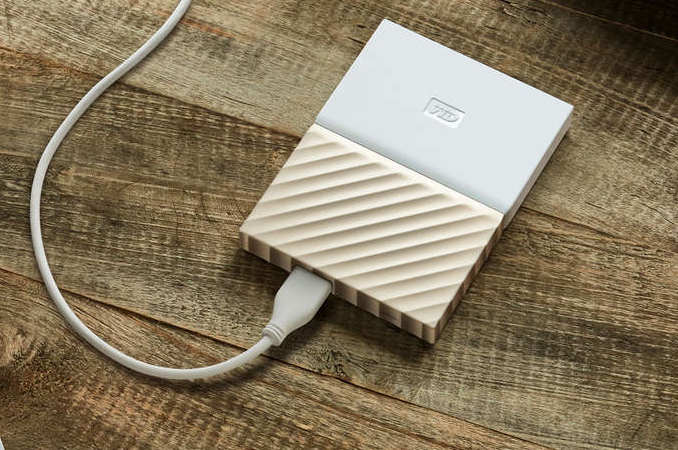
| 11:00a | Western Digital Launches New My Passport Ultra HDDs: New Enclosure, Up to 4 TB
Western Digital this week refreshed its My Passport Ultra lineup of small form-factor external HDDs. The new hard drives use a new enclosure and come with software that backs up data not only from local PCs, but also from social networks and cloud services. As for capacity and interfaces, the new HDDs continue to offer up to 4 TB of storage space and utilize a USB 3.0 interface. The new WD My Passport Ultra external HDDs come in a new metallic enclosure with metallic and matte black gray or white gold finishes that mimics design of other external storage devices by the company. The 1 TB drive uses a thinner enclosure that measures 13.5 mm (0.53”), whereas the models with 2 TB, 3 TB and 4 TB capacities are 21.5 mm (0.85”) thick.
Apart from the new enclosure, the new HDDs feature automatic WD Backup software for local data and content, as well as the company’s new WD Discovery software that backs up users’ data from Facebook, Instagram, Dropbox and Google Drive. By using both software suites, users can consolidate their data from different sources on a single device. Meanwhile, to protect the data, Western Digital offers its WD Backup software that relies on AES-256 hardware encryption. Western Digital is not disclosing whether they're using PMR or SMR technology on the hard drives contained within. Nor are we able to accurately guess the number of platters in the drives, as the thickness of the external enclosures means it's impossible to determine whether the company is using 2.5”/12.5 mm or 2.5”/15 mm HDDs.
Just like their predecessors, the new Western Digital My Passport Ultra drives are covered by a three-year limited warranty. The new drives are available from wd.com as well as from select retailers around the world. The most affordable 1 TB version costs $79.99, whereas the highest-capacity SKU is available for $139.99, which is $20 lower than the My Passport Ultra HDD 4 TB released a year ago.
Related Reading: | ||||||||||||||||||||||||||||||||||||||||||||||||||||||||||||||||||||||||||||||||||||||||||||||||||
| 2:00p | G.Skill Announces Quad-Channel DDR4-4200 Kit for Intel Skylake-X CPUs
G.Skill this past week has formally announced its quad-channel memory kits designed for the latest Intel Core i7 (Skylake-X) CPUs and the Intel X299 platform. The flagship 64 GB Trident Z kit boasts a 4200 MT/s data transfer rate, a rather notable step up from the company's "entry-level" 3600 MT/s kit. In addition, G.Skill is also introducing its new Trident Z Black series dual-channel DDR4-4400 kit for Intel’s Kaby Lake-X processors. G.Skill’s lineup of memory kits for the Intel X299 platform consists of 8 GB and 16 GB Trident and Trident Z RGB DIMMs based on Samsung’s popular 20nm-fabbed 8 Gb DDR4 DRAM modules. The various kits are available at 3600 MT/s, 3733 MT/s, 3800 MT/s, 4000 MT/s, and 4200 MT/s data transfer rates, while their voltages run from 1.35 to 1.4 V. As you'd expect, the higher clocked kits also come with higher latency, with latencies starting at CL16 and reaching CL19 by DDR4-4200 speeds. Which goes to show that even though Intel's Skylake-X and Kaby Lake-X CPUs can handle very high DRAM frequencies, the tradeoff between clocks and timings has not gone anywhere.
Meanwhile it's interesting to note that despite G.Skill's recent obsession with RGB lighting – resulting in the company offering RGB-equipped DIMMs for most of the Trident Z range – the fastest DDR4-4200 and DDR4-4400 kits are not available with RGB lighting. Keeping in mind that this kind of extreme DDR4 overclocking requires increased voltage and very “clean” power, it may not be easy to apply RGB to such DIMMs without affecting their stability. Still, keeping in mind that G.Skill itself demonstrated DDR4-4200 Trident Z RGB DIMMs in quad-channel mode at Computex, it is a matter of time before appropriate modules will hit the market.
G.Skill traditionally announces its new memory modules a little bit ahead of their retail launch and does not set MSRPs ahead of actual availability, so pricing has not yet been disclosed on the company's newest kits. Related Reading: | ||||||||||||||||||||||||||||||||||||||||||||||||||||||||||||||||||||||||||||||||||||||||||||||||||
| 9:15p | NVIDIA Releases 384.76 WHQL Game Ready Driver
A few weeks have passed since driver version 382.53, and it’s time again for another driver update from NVIDIA. Now onto release 384 with driver version 384.76, NVIDIA brings us a good number of bug fixes, along with a Game Ready and Game Ready VR title. Starting things off, the new Release 384 driver branch doesn't bring anything new to the table as far as major features go – at least, nothing that NVIDIA has documented. Instead their efforts have been focused almost entirely on bug fixes and performance improvements. To that end, NVIDIA has addressed issues where Firefall would not run at all. GeForce GTX 1080/1070/1060 stuttering during gameplay in Prey 2 was also addressed, as was texture corruption in No Man’s Sky when SLI was enabled. GTX 970 SLI can now be enabled while Norton 360 is running, as opposed to just when Norton 360 is disabled or in Safe mode. Glitches in Doom (2016) under the Vulkan API were also fixed. NVIDIA also resolved CPU bottlenecks that occur when 3DVision is enabled, as well as issues with DirectX 12 titles failing to capture via GameStream. Issues with choppy video playback on the Windows Store video app while V-Sync was off were fixed. Last and probably least, a typo was corrected in NVIDIA Control Panel for the Command & Conquer Tiberium Alliances name on the Stereoscopic 3D Compatibility page.
The Game Ready headliner for this edition is the LawBreakers “Rise Up” Open Beta while Spider-Man: Homecoming VR Experience is the token Game Ready VR title. Slated to launch on August 8th, LawBreakers is developed by Cliff Bleszinski, whose pedigree includes games from the Unreal and Gears of War series, and is a class/character-based sci-fi ‘hero shooter,’ similar to games like Overwatch and Team Fortress 2. NVIDIA has polished their drivers in preparation for the “Rise Up” Open Beta, which goes from June 30th to July 3rd. As for the Spider-Man, Spider-Man: Homecoming VR Experience is a free tie-in to the upcoming Spider-Man: Homecoming film, and will be available for download on June 30th. While Homecoming VR is not exactly a full game, and described in the title itself as a “VR experience,” NVIDIA has prepped their drivers in advance regardless. Wrapping things up, NVIDIA has added an SLI profile for FIFA 17, as well as adding a “debug” option in the NVIDIA Control Panel Help menu, which removes all overclocking performance and power settings. The updated drivers are available through the GeForce Experience Drivers tab or online at the NVIDIA driver download page. More information on this update and further issues can be found in the 384.76 release notes. | ||||||||||||||||||||||||||||||||||||||||||||||||||||||||||||||||||||||||||||||||||||||||||||||||||
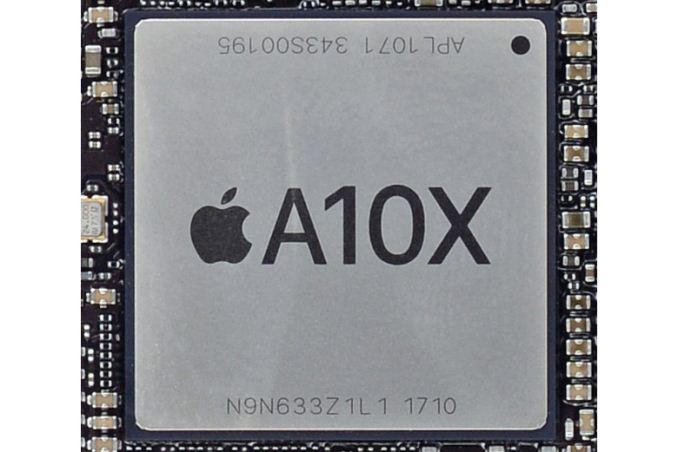
| 11:30p | TechInsights Confirms Apple’s A10X SoC Is TSMC 10nm FF; 96.4mm2 Die Size
One of the more intriguing mysteries in the Apple ecosystem has been the question over what process the company would use for the A10X SoC, which is being used in the newly launched 2017 iPad Pro family. Whereas the A10 used in the iPhone was much too early to use anything but 16nm/14nm, the iPad Pro and A10X is coming in the middle of the transition point for high-end SoCs. 16nm is still a high performance process, but if a company pushes the envelope, 10nm is available. So what would Apple do? The answer, as it turns out, is that they’ve opted to push the envelope. The intrepid crew over at TechInsights has finally dissected an A10X and posted their findings, giving us our first in-depth look at the SoC. Most importantly then, TechInsights is confirming that the chip has been fabbed on TSMC’s new 10nm FinFET process. In fact, the A10X is the first TSMC 10nm chip to show up in a consumer device, a very interesting turn of events since that wasn’t what various production roadmaps called for (that honor would have gone to MediaTek’s Helio X30)
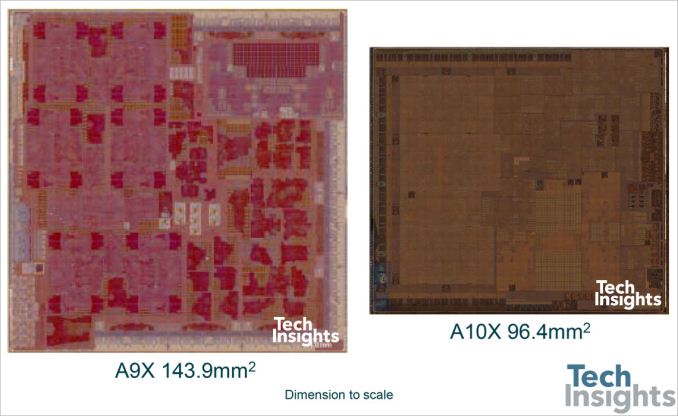
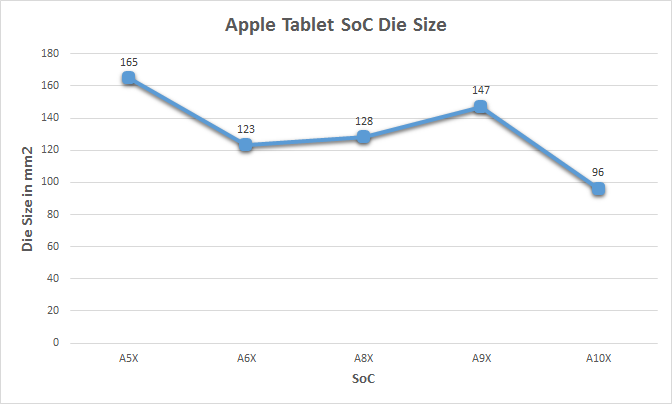
Apple is of course known for pushing the envelope on chip design and fabrication; they have the resources to take risks, and the profit margins to cover them should they not pan out. Still, that the A10X is the first 10nm SoC is an especially interesting development because it’s such a high-end part. Traditionally, smaller and cheaper parts are the first out the door as these are less impacted by the inevitable yield and capacity challenges of an early manufacturing node. Instead, Apple seems to have gone relatively big with what amounts to their 10nm pipecleaner part. I say “relatively big” here because while the A10X is a powerful part, and big for a 10nm SoC, in terms of absolute die size it’s not all that big of a chip. In fact by Apple X-series SoC standards, it’s downright small: just 96.4mm2. This is 24% smaller than the 16nm A10 SoC (125mm2), and in fact is even 9% smaller than the A9 SoC (104.5mm2). So not only is it smaller than any of Apple’s 16nm SoCs, but it’s also about 20% smaller than the next-smaller X-series SoC, the A6X. Or, if you want to compare it to the previous A9X, Apple’s achieved a 34% reduction in die size. In other words, Apple has never made an iPad SoC this small before.
One key difference here however is that the X-series SoCs have never before been the leading part for a new process node. It has always been iPhone SoCs that have lead the charge – A9 at 16nm, A8 at 20nm, A7 at 28nm, etc. This does mean that as a pipecleaner part, Apple does need to be especially mindful of the risks. If an X-series SoC is to lead the charge for the 10nm generation, then it can’t be allowed to be too big. Not that this has stopped Apple from packing in three CPU cores and a 12-cluster GPU design. Speaking of size, TechInsights’ estimates for area scaling are quite interesting. Based on their accounting, they believe that Apple has achieved a 45% reduction in feature size versus 16nm, which is consistent with a full node’s improvement. This is consistent with TSMC’s earlier statements, but given the challenges involved in bringing newer processes to market, it’s none the less exciting to actually see it happening. For chip vendors designing products against 10nm and its 7nm sibling, this is good news, as small die sizes are the rule for pretty much everyone besides Apple. A10X Architecture: A10 EnlargedDiving a bit deeper, perhaps the biggest reason that A10X is as small as it is, is that Apple seems to have opted to be conservative with its design. Which again, for a pipecleaner part, is what you’d want to do.
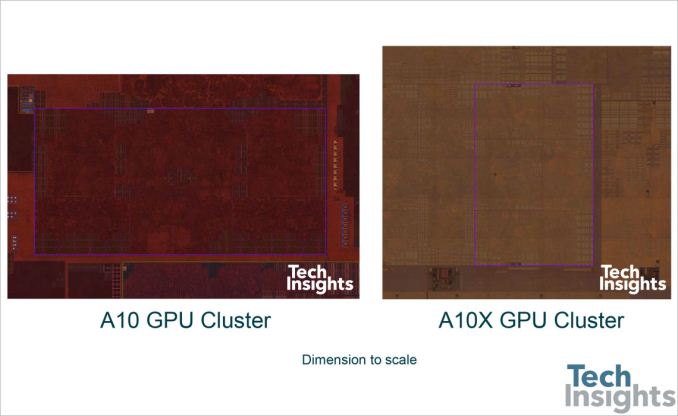
We know from Apple’s official specifications that the A10X has 3 Fusion CPU core pairs, up from 2 pairs on A10, and 2 Twister CPU cores on A9X, all with 8MB of L2 cache tied to the CPU. Meanwhile the GPU in A10X is relatively unchanged; A9X shipped with a 12 cluster GPU design, and so does A10X. This means that Apple hasn’t invested their die space gains from 10nm in much of the way of additional hardware. To be sure, it’s not just a smaller A9X, but it’s also not the same kind of generational leap that we saw from A8X to A9X or similar iterations. Unfortunately TechInsights’ public die shot release isn’t quite big enough or clean enough to draw a detailed floorplan from, but at a very high level we can make out the 12 GPU clusters on the left, along with the CPU cores to the right. Significantly, there aren’t any real surprises here. TechInsights heavily compares it to the A9X and there’s good reason to do so. IP blocks have been updated, but the only major change is the CPU cores, and those don’t take up a lot of die space relative to the GPU cores. This is what allows A10X to be more powerful than A9X while enjoying such a significant die size decrease. As for the GPU in particular, Apple these days is no longer officially specifying whether they’re using Imagination’s PowerVR architecture in their chips. Furthermore we know that Apple is developing their own GPU, independent from Imagination’s designs, and that it will be rolled out sooner than later. With that said, even prior to today’s die shot release it’s been rather clear that A10X is not that GPU, and the die shot further proves that. Apple’s developer documentation has lumped in the A10X’s GPU with the rest of the iOS GPU Family 3, which comprises all of the A9 and A10 family SoCs. So from a feature-set perspective, A10X’s GPU isn’t bringing anything new to the table. As for the die shot, as TechInsights correctly notes, the GPU clusters in the A10X look almost exactly like the A9X’s clusters (and the A10’s, for that matter), further indicating it’s the same base design.
Ultimately what this means is that in terms of design and features, A10X is relatively straightforward. It’s a proper pipecleaner product for a new process, and one that is geared to take full advantage of the die space savings as opposed to spending those savings on new features/transistors. Otherwise I am very curious as to just what this means for power consumption – is Apple gaining much there, or is it all area gains? A10X's CPU clockspeed is only marginally higher than A9X's, and pretty much identical to A10, so we can see that Apple hasn't gained much in the way of clockspeeds. So does that mean that Apple instead invested any process-related gains in reducing power consumption, or, as some theories go, has 10nm not significantly improved on power consumption versus 16nm? But the answer to that will have to wait for another day. | ||||||||||||||||||||||||||||||||||||||||||||||||||||||||||||||||||||||||||||||||||||||||||||||||||








| << Previous Day |
2017/06/29 [Calendar] |
Next Day >> |