[Most Recent Entries] [Calendar View]
Monday, July 3rd, 2017
- LG Announces the 34UC79G: 34-Inch Curved 21:9 Display with 2560 × 1080 Resolution, 144 Hz Refresh Rate for $700
- AOC Launches the AG352QCX: 35-Inch 200 Hz 2560×1080 Curved Display with Adaptive-Sync
- Acer Predator X35 & ASUS ROG Swift PG35VQ Unveiled: 35-inch G-SYNC HDR Monitors - UltraWide, Curved, 200Hz
- Acer Predator Z35P Available for Order: Curved 35" with 3440×1440@120 Hz and G-Sync
- AOC Expands AGON Family with Curved AG322QCX and AG272FCX 144 Hz Displays
- AOC Announces the AGON AG352UCG 21:9 Curved Display: 35", 3440×1440, 100Hz with G-Sync
- HP Announces Omen X 35-Inch Curved Display for Gamers
- ASUS XG-U2008 10GBase-T Network Switch Released: 2x10G + 8x1G for $249
- Lower Cost 10GBase-T Switches Coming: 4, 5 and 8-port Aquantia Solutions at ~$30/Port
- Aquantia Launches New 2.5G/5G Multi-Gigabit Network Controllers for PCs
- Aquantia Launch AQtion 5G/2.5G/1G Multi-Gigabit Ethernet Cards (NICs) for PCIe
- GIGABYTE Exhibits an Aquantia AQC107 based 10G Ethernet PCIe Card
- AKiTiO Displays Thunderbolt 3 to 10GBase-T Adapter
- Nokia 6 Announced: Qualcomm Snapdragon 430, 5.5-Inch Display, Android 7
- HMD Closes Nokia Brand and Patents Deal with Microsoft, Smartphones Due in 2017
- Nokia Is Set to Return to Smartphones and Tablets: What to Expect?
- Microsoft Streamlines Its Smartphone Business Again, Lays Off 1850 People
- HP’s Elite x3 Windows 10 Smartphone to Cost $699, Set to Be Available Worldwide
- Western Digital Announce BiCS4 3D NAND: 96 Layers, TLC & QLC, Up to 1 Tb per Chip
- Toshiba Selects Japan-U.S. Consortium As Preferred Buyer For Memory Business
- Toshiba Introduces XG5 Client NVMe SSD
- Western Digital Ships Client SSDs Based on 512 Gb 3D TLC NAND Chips
- Toshiba Samples 64-Layer 512 Gb BiCS 3D NAND, Announces 1 TB BGA SSD
- Toshiba Finalizes Plans for New 3D NAND Fab: Coming Online in 2019
| Time | Event | ||||||||||||||||||||||||||||||||||||||||||||||||||||||||||||||||||||||||||
| 8:30a | LG’s 34UC89G 21:9 Curved Display with G-Sync, 144 to 166 Hz, Available for $999
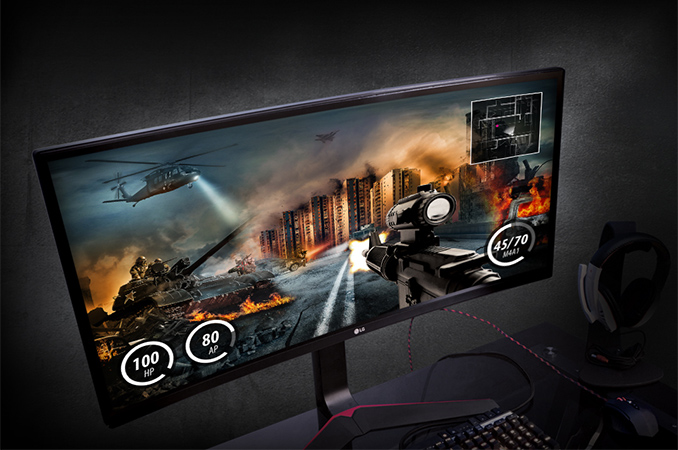
LG has begun to sell its new ultra-wide curved display that appears to be its first monitor to support NVIDIA’s G-Sync technology. The LG 34UC89G resembles the 34UC79G display launched almost a year ago — it has a 21:9 aspect ratio, a 2560×1080 resolution and a native maximum refresh rate of 144 Hz. However, the new unit has a number of important differentiators when compared to the 34UC79G: its panel is listed as brighter, it can be overclocked, and it features G-SYNC. It also costs $300 more. LG was an early adopter of AMD’s FreeSync back in early 2015 and since then it has launched numerous gaming displays featuring this technology. By contrast, the company has never released a monitor with NVIDIA’s G-Sync for an unknown reason. This summer LG finally decided to produce a G-Sync display and started with a model that has moderate characteristics by today’s standards. The LG UltraWide 34UC89G is outfitted with an IPS panel with a resolution of 2560×1080, a peak brightness of 300 nits, a contrast ratio of 1000:1, a 5ms GtG response time and 178° viewing angles. The panel has a native refresh rate of 144 Hz that can potentially be overclocked to 166 Hz, but that is not guaranteed. The new monitor looks like a re-engineered version of the 34UC79G, but given the fact that it has a different scaler (to enable G-Sync) and a panel that is 50 nits brighter and 166 Hz-capable, it seems to be a new display that shares chassis with one of its predecessors.
When it comes to connectivity, the LG UltraWide 34UC89G has a DisplayPort 1.2 and an HDMI 1.4 input, a dual-port USB 3.0 hub as well as a 3.5-mm audio jack. In some regions, the monitor may be equipped with two 7 W speakers (like the 34UC79G in Germany), but LG’s U.S. website does not mention them.
When LG released its 34UC79G last September, the combination of its features (IPS, curvature, a 144 Hz refresh rate and an ultra-wide aspect ratio) looked very compelling at a $699 price point. The situation is a bit different with the 34UC89G. The new monitor has the same 2560×1080 resolution and it costs $999.99 (likely due to G-Sync plus other factors). In the meantime, there is the Acer Predator Z35P 35” curved VA display offering a 3440×1440 resolution, a maximum refresh rate of 120 Hz (albeit via overclocking) and G-Sync available for $1099.99. The 34UC89G still has advantages - an IPS panel and a higher refresh rate.
The LG UltraWide 34UC89G is now available from various retailers worldwide, including Amazon and Newegg in the U.S. Gallery: LG UltraWide 34UC89G
      Related Reading: | ||||||||||||||||||||||||||||||||||||||||||||||||||||||||||||||||||||||||||
| 10:00a | ASUS Launches XG-C100C 10 GBase-T Adapter: Aquantia AQC107, $99
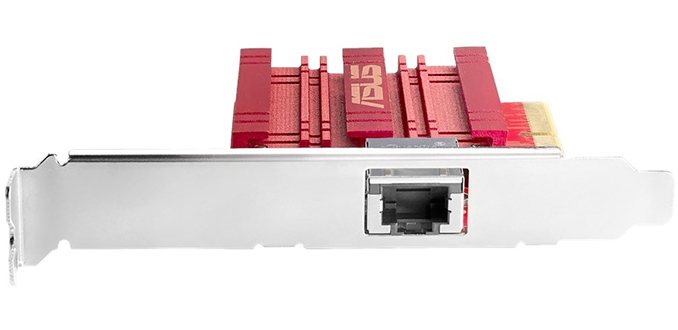
ASUS this week released the first inexpensive vendor-based consumer-grade 10 GbE / 10GBase-T card powered by an Aquantia silicon. The card can be installed in any modern PC with a PCIe 3.0 x4 slot free (either CPU or chipset), and supports 10 Gbps, 5 Gbps, 2.5 Gbps, 1 Gbps and 100 Mbps networking standards over RJ45 connectors using Cat5e/Cat6 cabling. What is important is that the board costs less than $100, at a lower price than Aquantia quoted in the initial announcement ($127). The ASUS XG-C100C is a single port card based on the Aquantia AQtion AQC107 controller that supports five networking standards (100M, 1G, 2.5G, 5G and 10G) and uses a PCIe 3.0 x4 interface. The card is equipped with LEDs that track network activity and connection speed to make it easier for consumers to set up their networks. As for compatibility, the board is compatible with any modern PC running Microsoft Windows 7 and higher, as well as various Linux operating systems.
The XG-C100C board uses a small red PCB as well as a red aluminum cooler to emphasize that it is aimed at higher-end gaming desktops rather than at workstations or servers. It is noteworthy earlier this year ASUS launched its ROG Areion 10G card that is based on the same AQtion AQC107 chip for around $200. That card uses a black PCB with a larger cooling system. Apparently, the design is the only differences between the XG-C100C and the ROG Areion 10G, and the new pricing might indicate the ROG card coming down in price.
The ASUS XG-C100C is available now from various retailers in North America and carries a $99 price tag. It is interesting to note that Aquantia itself sells its AQC107-based cards for about $130. For some reason, ASUS decided to drop the price to a sub-$100 level, possibly, to boost demand. Considering the fact that the Intel X540 and Intel X550-powered cards are sold for $250 to $380, the $99 price point seems very aggressive (albeit still quite high for a network card). As reported previously, the cost of switches and access points is a major concern surrounding the transition to 2.5G/5G/10G for home and SMB. Even though Aquantia is working with its customers to bring lower-cost switches to the market, they are still not available. In the meantime, both Amazon and Newegg are offering the ASUS XG-U2008 10GBase-T network switch for $229 after rebate. Related Reading: | ||||||||||||||||||||||||||||||||||||||||||||||||||||||||||||||||||||||||||
| 11:30a | GIGABYTE Joins AM4 Mini-ITX Club with GA-AB350N-Gaming Wi-Fi Motherboard
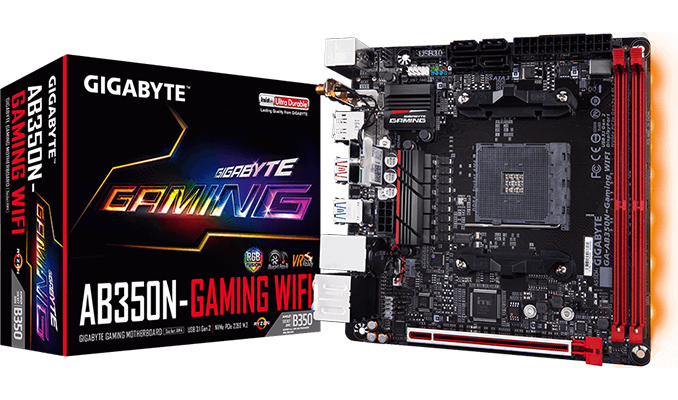
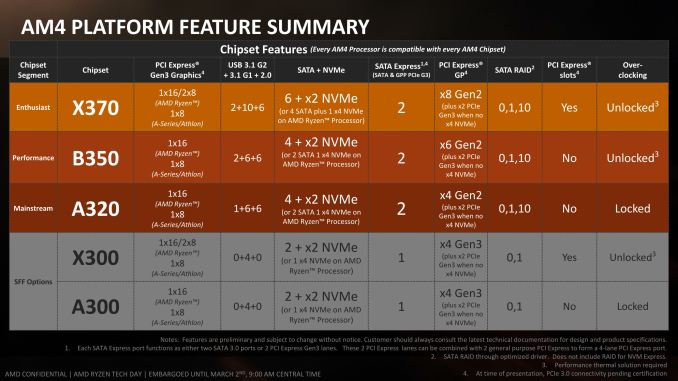
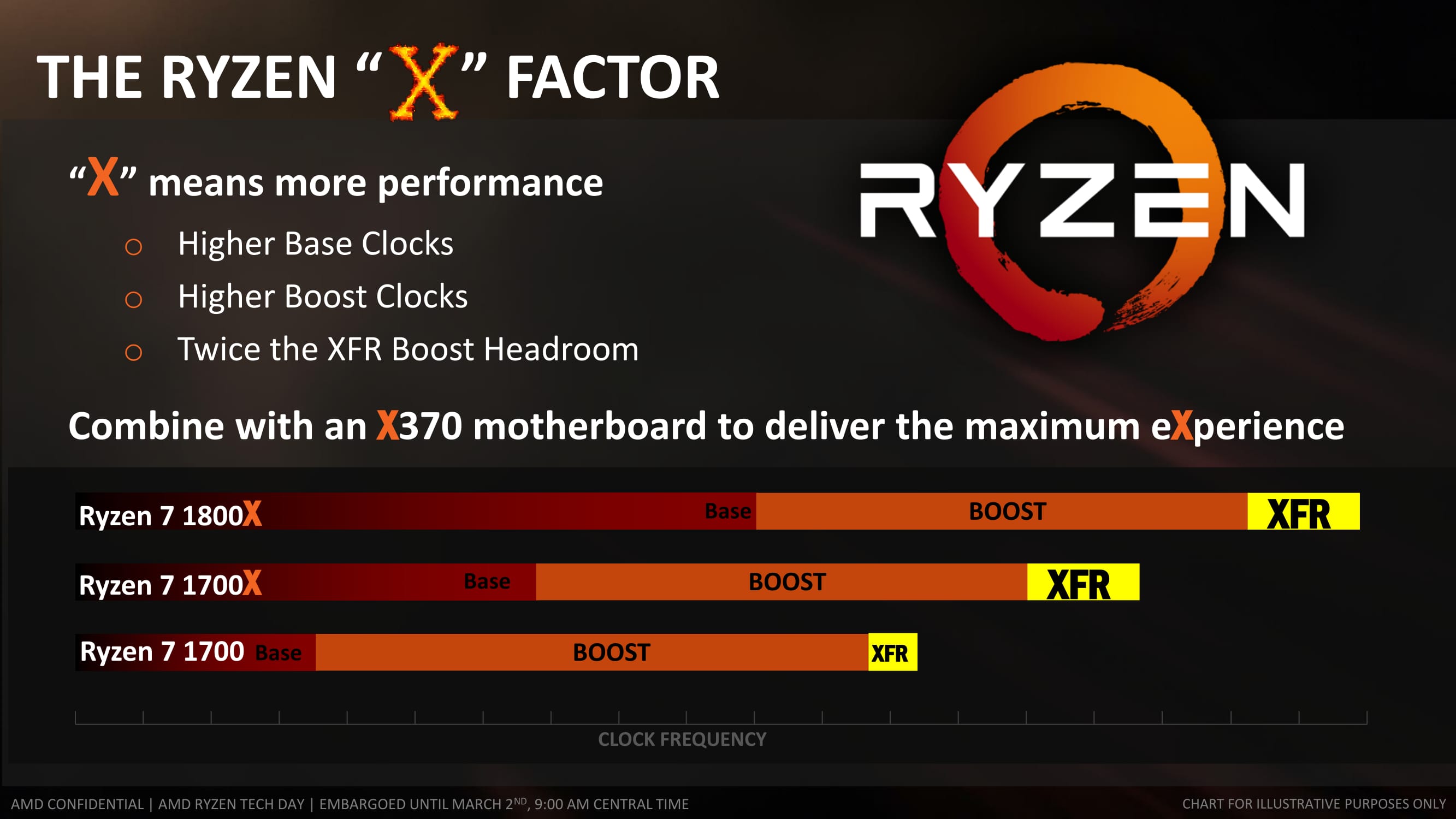
GIGABYTE has announced its first Mini-ITX motherboard for AMD’s AM4 processors. The GA-AB350N-Gaming WIFI (or simply AB350N-Gaming) Mini-ITX is based on AMD’s ‘performance-class’ B350 chipset and provides modern features like USB 3.1 Gen 2, support for PCIe 3.0 x4 SSDs, Wi-Fi 802.11ac connectivity and even LED lights and controls. In addition, the motherboard can support large CPU coolers such as AMD’s Wraith Max. The GIGABYTE GA-AB350N-Gaming WIFI runs AMD’s ‘performance’ B350 chipset that is very similar to the flagship X370, but has some minor differences for market segmentation. B350 still fully supports overclocking of CPUs with an unlocked multiplier, but it should be noted that it cannot take advantage of the XFR feature of the Ryzen X processors.
Given the fact that the AB350N-Gaming WIFI is a Mini-ITX motherboard, the vast majority of its owners are not going to need a PCIe 3.0 x1 slot for add-in-boards, whereas the PCIe 3.0 x16 for a graphics card is handled by the CPU. DRAM space is limited, so one DIMM per channel here.
Speaking of overclocking and CPU support in general, the motherboard comes with an advanced all-digital six-phase VRM that uses an International Rectifier controller, IR PowIRstage ICs and solid-state capacitors. The VRM can support all existing AMD Ryzen processors as well as AM4 APUs and has reportedly been designed to have headroom for overclocking. Furthermore, the GA-AB350N-Gaming WIFI comes with 4-pin hybrid fan headers that are specified to liquid cooling systems. As for DRAM, GIGABYTE claims that the motherboard supports up to 32 GB of ECC or non-ECC memory running at up to 3200 MT/s when overclocked.
Like many other Mini-ITX motherboards, the GIGABYTE GA-AB350N-Gaming WIFI is equipped with one PCIe 3.0 x16 slot, one M.2 slot for PCIe 3.0 x4 or SATA SSDs, as well as four SATA ports. When it comes to networking, the mainboard comes with a GbE port enabled by a Realtek controller (with cFosSpeed network traffic management app that aims to reduce network latency) as well as an 802.11ac Wi-Fi + Bluetooth 4.2 module from Intel. As for other I/O, everything seems to be pretty typical here: the motherboard has two display outputs (DP 1.2, HDMI 1.4), two USB 2.0 ports, four USB 3.0 headers, two USB 3.1 connectors (both Type-A) as well as a 7.1-channel audio sub-system powered by the Realtek ALC1220 codec. Finally, for users to make things look 'beautiful', the Mini-ITX AM4 mainboard has six RGB LEDs, as well as two 5-pin onboard headers for other RGB/UV LED strips. GIGABYTE’s GA-AB350N-Gaming WIFI is the fifth Mini-ITX motherboard in the industry that supports AMD Ryzen processors. The product will compete against ASRock’s X370 Gaming ITX/ac (as well as its B350-based brother) as well as Biostar’s Racing X370GTN and Racing B350GTN. Biostar’s motherboards do not have Wi-Fi (but have a DVI-D output), but GIGABYTE’s product is the only one that lacks USB-C (but has two USB 3.1 Type-A connectors). In the end, users are going to have five options (with their own strong and weak sides) to choose from and the only question is their actual availability timeframe because right now none are available.
GIGABYTE did not announce pricing or arrival date for its AB350N-Gaming WIFI motherboard. Common logic tells me that an AMD B350-based motherboard should cost less than an AMD X370-powered platform, but in reality, pricing will depend on supply, demand and willingness of resellers to capitalize on a nearly exclusive product. Ian says that in a perfect world, we'll have a round-up of said boards. Timeframe unknown. Gallery: GIGABYTE GA-AB350N-Gaming WIFI
      Related Reading: | ||||||||||||||||||||||||||||||||||||||||||||||||||||||||||||||||||||||||||
| 1:00p | Nokia 6 to Hit U.S. Market on July 10: 5.5-inch LCD, Snapdragon 430, $229
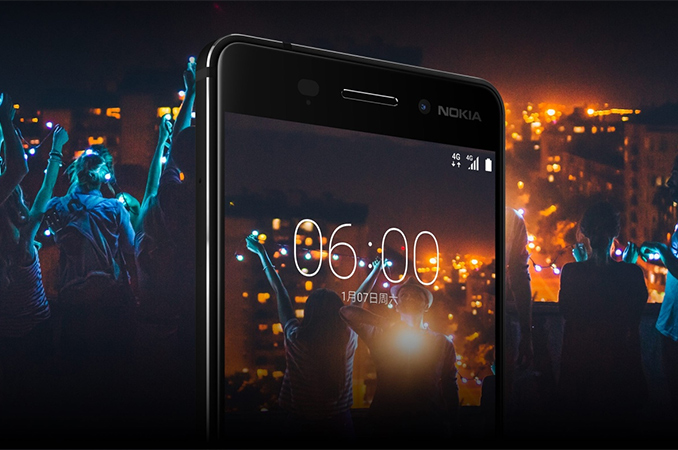
HMD Global has announced that it would begin sales of its Nokia 6 smartphone in the U.S. in early July. The product will be available in two colors and only from Amazon initially. The company plans to add two more colors to the lineup sold in the U.S. later this summer. It is noteworthy that the "official" Nokia 6 for the U.S. will cost less than it does in China, but will also come with a lower amount of RAM and NAND than on some other versions. The Nokia 6 is currently the most advanced smartphone offered by HMD Global, which owns rights to produce phones and tablets under the brand. HMD and FIH Mobile (a subsidiary of Foxconn) jointly designed the smartphone with some input from Nokia itself. For the time being, all Nokia smartphones run pure Google Android 7.1 OS with all the upgrades, but no enhancements from the developers. Visual aesthetics has always been a strong side of Nokia phones in the past and the Nokia 6 is not an exception. The handset comes in a 6000-series aluminum uni-body enclosure with flat edges that are milled using a CNC machine from a single brick of aluminum. To apply color, the chassis is anodized twice and then polished “no less than” five times to make everything smooth. At present, HMD Global offers the Nokia 6 in four colors: matte black, silver, blue and copper. As for the display, the handset is outfitted with a 5.5-inch FHD IPS display featuring 450 nits brightness, enhanced with a polarizer film and covered with round-edge 2.5D Gorilla Glass for protection.
At the heart of Nokia 6 there is the Qualcomm Snapdragon 430 SoC (eight ARM Cortex-A53 cores up to 1.4GHz, an Adreno 505 GPU, an integrated X6 LTE modem) equipped with 3 GB of LPDDR3 RAM and 32 GB of internal NAND flash memory (4GB/64GB for China and Global SKUs). For local connectivity, the phone uses 802.11ac Wi-Fi, Bluetooth 4.1 and a microUSB port. As for imaging capabilities, the smartphone is armed with a 16 MP sensor featuring f/2.0 aperture, autofocus and a dual LED flash on the back as well as an 8MP sensor with f/2.0 aperture on the front. An improvement over many inexpensive phones, the Nokia 6 has stereo speakers coupled with NXP TFA9891 amplifiers and Dolby Atmos software enhancement. The smartphone is powered by a 3000 mAh battery, which is in line with other smartphones in this class.
The Nokia 6 in matte black and silver will be available for $229.99 from Amazon starting July 10. The smartphones featuring blue and copper finishes will be on sale later this summer on August 18th. Amazon Prime members can pre-order Nokia 6 in various colors with Lockscreen Offers & Ads for $179.99. In addition, Amazon offers the Nokia 6 International model with 4 GB of RAM and 64 GB of NAND for $339 and without any warranty.
Related Reading: | ||||||||||||||||||||||||||||||||||||||||||||||||||||||||||||||||||||||||||
| 2:30p | Toshiba's 768Gb 3D QLC NAND Flash Memory: Matching TLC at 1000 P/E Cycles?
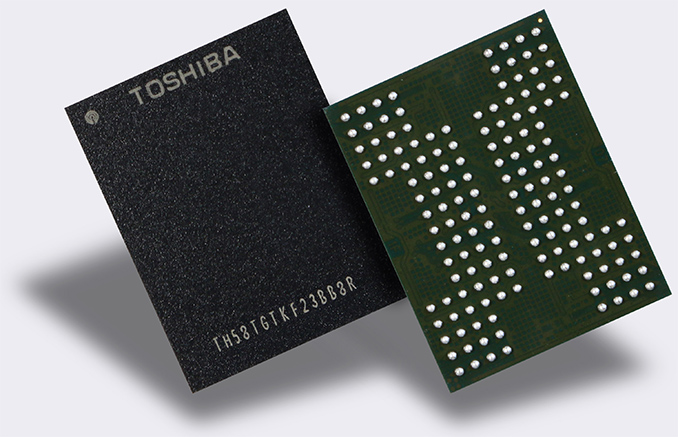
Toshiba last week announced its first 3D NAND flash memory chips featuring QLC (quadruple level cell) BiCS architecture. The new components feature 64 layers and developers of SSDs and SSD controller have already received samples of the devices, which Toshiba plans to use for various types of storage solutions. Toshiba’s first 3D QLC NAND chips feature 768 Gb (96 GB) capacity and uses 64 layers, just like the company’s BICS3 chips with 256 Gb and 512 Gb capacities launched in 2016 and 2017. Toshiba does not share further details about its 3D QLC NAND IC (integrated circuit), such as page size, the number of planes as well as interface data transfer rate, but expect the latter to be high enough to build competitive SSDs in late 2018 to early 2019 (that’s our assumption). Speaking of applications that Toshiba expects to use its 3D QLC NAND ICs, the maker of flash memory mentions enterprise and consumer SSDs, tablets and memory cards. Endurance++Besides intention to produce 768 Gb 3D QLC NAND flash for the aforementioned devices, the most interesting part of Toshiba’s announcement is endurance specification for the upcoming components. According to the company, its 3D QLC NAND is targeted for ~1000 program/erase cycles, which is close to TLC NAND flash. This is considerably higher than the amount of P/E cycles (100 – 150) expected for QLC by the industry over the years. At first thought, it comes across a typo - didn't they mean 100?. But the email we received was quite clear:
It is unclear how Toshiba managed to increase the endurance of its 3D QLC NAND by an order of magnitude versus initially predicted. What we do know is that signal processing is more challenging with QLC than it is with TLC, as each cell needs to accurately determine sixteen different voltage profiles (up from 2 in SLC, 4 in MLC, and 8 in TLC).
The easiest way to handle this would be to increase the cell size: by having more electrons per logic level, it is easier to maintain the data and also read from it / write to it. However, the industry is also in a density race, where bits per mm^2 is an issue. Also, to deal with read errors from QLC memory, controllers with very advanced ECC capabilities have to be used for QLC-based SSDs. Toshiba has its own QSBC (Quadruple Swing-By Codes) error correction technique, which it claims to be superior to LDPC (low-density parity-check) that is widely used today for TLC-powered drives. However, there are many LDPC implementations and it is unknown which of them Toshiba used for comparison against its QSBC. Moreover, there are more ECC methods that are often discussed at various industrial events (such as FMS), so Toshiba could be using any or none of them. The only thing that the company tells about its ECC now is that it is stronger than 120 bits/1 KB used today for TLC. In any case, if Toshiba’s statement about 1000 P/E cycles for QLC is correct, it means that that the company knows how to solve both endurance and signal processing challenges. The main advantage of QLC NAND is increased storage density when compared to TLC and MLC, assuming the same die size. As was perhaps expected, die size numbers were not provided. However, last year Toshiba and Facebook talked about a case study QLC-powered SSD with 100 TB of capacity for WORM (write once read many) applications and it looks like large-capacity custom drives and memory cards will be the first to use QLC for cold storage. P/E cycles and re-write endurance isn't a concern for WORM at this stage. Toshiba has begun to sample its 3D QLC NAND memory devices earlier this month to various parties to enable development of SSDs and SSD controllers. Taking into account development and qualification time, Toshiba plans to mass produce its BiCS3 768 Gb 3D QLC NAND chips around the same time it starts to make its the next generation BiCS4 ICs. The latter is set to hit mass production in 2018, but the exact timeframe is yet to be determined. Related Reading: | ||||||||||||||||||||||||||||||||||||||||||||||||||||||||||||||||||||||||||








| << Previous Day |
2017/07/03 [Calendar] |
Next Day >> |