[Most Recent Entries] [Calendar View]
Thursday, July 13th, 2017
- Will the ThreadRipper family have more than two parts in the future?
- Do both 16-core and 12-core parts have access to all 32MB of L3 cache?
- Can you reconfirm the 12-core part is using 3 cores per CCX?
- Is the Infinity Fabric bandwidth between the two dies the same as in EPYC (42 GB/s bidirectional)?
- This corresponds to an Infinity Fabric data rate of 10.4 GT/s? Or is it declocked to 9.6 GT/s or 8.0 GT/s?
- What is the official memory support for the TR CPUs? DDR4-2666?
Is that at 2 DIMMs per channel or 1 DIMM per channel? - What are the TDP numbers for both TR processors? (Edit: AMD's System Setups confirm 180W)
- Do they come with any pre-bundled coolers? If not, what coolers will AMD recommend?
- Are those prices 1k unit prices or MSRPs? If the former, what are the MSRPs?
- Can you confirm if XFR for these CPUs is +100 MHz?
- What are the largest DDR4 memory modules that TR supports? (e.g. 16GB UDIMM or up to 32/64/128GB RDIMM/LRDIMM?)
- Did AMD give the motherboard manufacturers any ball-park figures for motherboard pricing to aim for? At what pricing should we expect the entry/mid-range motherboards to appear at?
- What markets are AMD targeting with the ThreadRipper launch?
- Will both CPUs be available worldwide on the same day, or will there be a staggered regional launch?
- Can you confirm that ThreadRipper is using an Indium-Tin solder between the die and the heatspreader?
- For the 64 PCIe lanes (60+4), are there any limitations on any of the PCIe root complexes?
- If 3.4G/3.5G are the base frequencies, what are the all-core turbo frequencies?
- How many cores will TR sustain for the top turbo frequency? (e.g. 2 cores at 4 GHz, or 4 cores at 4 GHz?)
| Time | Event | |||||||||||||||||||||||||||||||||||||||||||||||||||||||||||||||||||||||||||||||||||||||||||||||||||||||||||||||||||||||||||||||||||||||||||||||||||||||||||||||||||||||||||||||||||||||||||||||||||||||||||||||||||||||||||||||||||||||||||||||||||||||||||||||||||||||||||||||||||||||||||||||||||||||||||
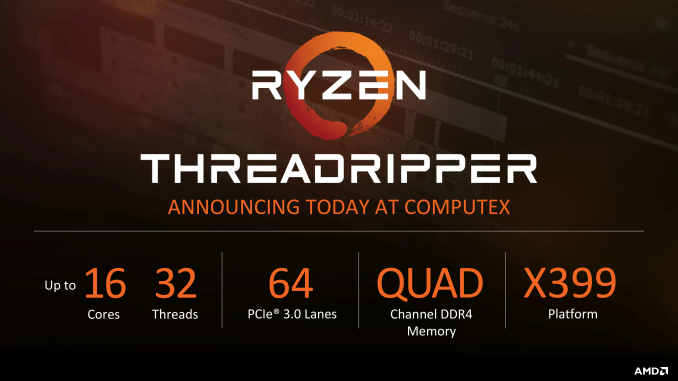
| 9:00a | AMD Threadripper 1920X and 1950X CPU Details: 12/16 Cores, 4 GHz Turbo, $799 and $999 Last night out of the blue, we received an email from AMD, sharing some of the specifications for the forthcoming Ryzen Threadripper CPUs to be announced today. Up until this point, we knew a few things – Threadripper would consist of two Zeppelin dies featuring AMD’s latest Zen core and microarchitecture, and would essentially double up on the HEDT Ryzen launch. Double dies means double pretty much everything: Threadripper would support up to 16 cores, up to 32 MB of L3 cache, quad-channel memory support, and would require a new socket/motherboard platform called X399, sporting a massive socket with 4094-pins (and also marking an LGA socket for AMD). By virtue of being sixteen cores, AMD is seemingly carving a new consumer category above HEDT/High-End Desktop, which we’ve coined the ‘Super High-End Desktop’, or SHED for short.
Today’s announcements, accompanied by a video from the CEO of AMD Dr. Lisa Su, shed some light on the new SHED processors: namely clock speeds and pricing, and a reaffirmed commitment to launching the new CPUs in August.
As you can see from the table, there are lots of question marks. We fired off a series of questions to AMD to fill in the blanks, so we can understand this product a bit better, but we were told to wait until closer to launch day. The only answer we could get was the styling on the naming. These are ‘Threadripper’ processors (rather than ThreadRipper), and are part of the Ryzen family, and the official SKU names are ‘Ryzen Threadripper 1950X’ and ‘Ryzen Threadripper 1920X’. We are likely to shorten these to ‘TR 1950X’ and ‘TR 1920X’ for expediency. *180W was confirmed after this article was originally posted. The AMD Ryzen Threadripper 1950XFrom what we do know, 16 Zen cores at $999 is about the ballpark price we were expecting. With the clock speeds of 3.4 GHz base and 4 GHz Turbo, this is essentially two Ryzen 7 1800X dies at $499 each stuck together, creating the $999 price (obviously it’s more complicated than this). Given the frequencies and the performance of these dies, the TDP is likely in the 180W range; seeing as how the Ryzen 7 1800X was a 95W CPU with slightly higher frequencies. The 1950X runs at 4.0 GHz turbo and also has access to AMD’s XFR – which will boost the processor when temperature and power allows – in jumps of +25 MHz: AMD would not comment on the maximum frequency boost of XFR, though given our experiences of the Ryzen silicon and previous Ryzen processor specifications, this is likely to be +100 MHz. We were not told if the CPUs would come with a bundled CPU cooler, although if our 180W prediction is in the right area, then substantial cooling would be needed. We expect AMD to use the same Indium-Tin solder as the Ryzen CPUs, although we were unable to get confirmation at this at this time.
Intel has already announced that they will be launching the 18-core Intel Core i9-7980XE processor later this year for $1999, although final specifications have yet to be announced. Given the launch this week of Intel’s Skylake-SP Xeon processors, there is one CPU in that line-up that would fit the bill for an i9-7980XE candidate: the Xeon Gold 6150, running at a 2.7 GHz Base and 3.7 GHz Turbo at 165W, but this part has a list price of $3358. If the Gold 6150 becomes with Core i9-7980XE, then the new SHED category of CPUs will be an exciting one to watch. Comparing the two, and what we know, AMD is going to battle on many fronts. Coming in at $999 is going to be aggressive, along with an all-core turbo at 3.4 GHz or above: Intel’s chip at $1999 will likely turbo below this. Both chips will have quad-channel DRAM, supporting DDR4-2666 in 1 DIMM per channel mode (and DDR4-2400 in 2 DPC), but there are some tradeoffs. Intel Core parts do not support ECC, and AMD Threadripper parts are expected to (awaiting confirmation). Intel has the better microarchitecture in terms of pure IPC, though it will be interesting to see the real-world difference if AMD is clocked higher. AMD Threadripper processors will have access to 60 lanes of PCIe for accelerators, such as GPUs, RAID cards and other functions, with another 4 reserved by the chipset: Intel will likely be limited to 44 for accelerators but have a much better chipset in the X299 for IO support and capabilities. We suspect AMD to run a 180W TDP, and Intel at 165W, giving a slight advantage to Intel perhaps (depending on workload), and Intel will also offer AVX512 support for its CPU whereas AMD has smaller FMA and AVX engines by comparison. The die-to-die latency of AMD’s MCM will also be an interesting element to the story, depending exactly where AMD is aiming this product.
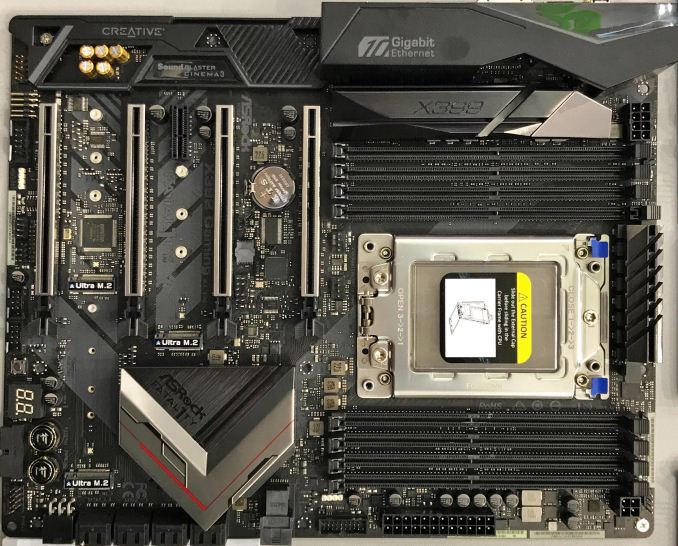
Meanwhile we have seen some of the X399 early-version motherboards back at Computex last month. With 60 PCIe lanes on each Threadripper CPU for accelerators, we are likely to see 32 or 48 used for PCIe slots (in x16/x16, x8/x8/x8/x8, x16/x16/x8/x8 or similar configurations) with up to three PCIe 3.0 x4 storage options. On the ASRock board above, there are two PCIe 3.0 x4 M.2 slots as well as a PCIe 3.0 x4 based U.2 connector for drives like Intel's SSD 750. Because these are aiming for the SHED market, features such as 10 Gigabit Ethernet ports from Aquantia are likely to feature on a number of boards as well. The AMD Ryzen Threadripper 1920XThe 12-core Threadripper 1920X is likely positioned directly against Intel’s 10-core Core i9-7900X or Core i7-7820X, which are both available today.
The 12-core part should use 3 cores per CCX if trends of Ryzen CPUs are followed, and should have access to all 64 MB of L3 cache (we are waiting for this to be confirmed). At $799, it falls half-way between the 7900X at $999 and the 7820X at $599, but beats them both in pure core count. The 1920X has all the 60+4 PCIe lanes that the 1950X does, while Intel’s chips have 44 and 28 respectively. Again, Intel does have access to AVX512, but only the 7900X has dual 512-bit FMA engines while the 7820X has one (and the 1920X has 128-bit FMAs). The 1920X will also take the new socket. In a series of tests AMD performed, to accompany the launch, they ran Cinebench R15 and got the following scores:
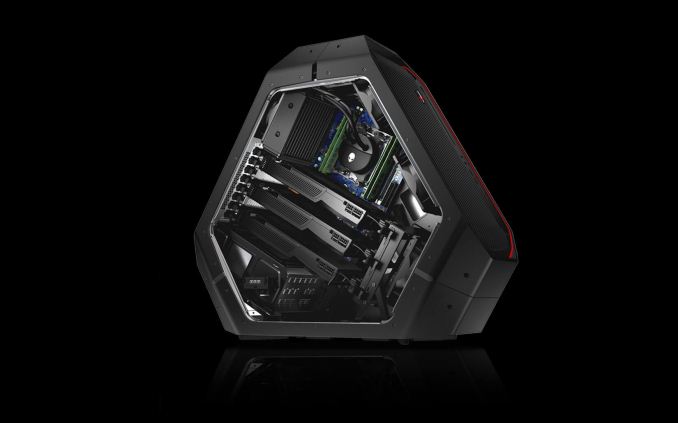
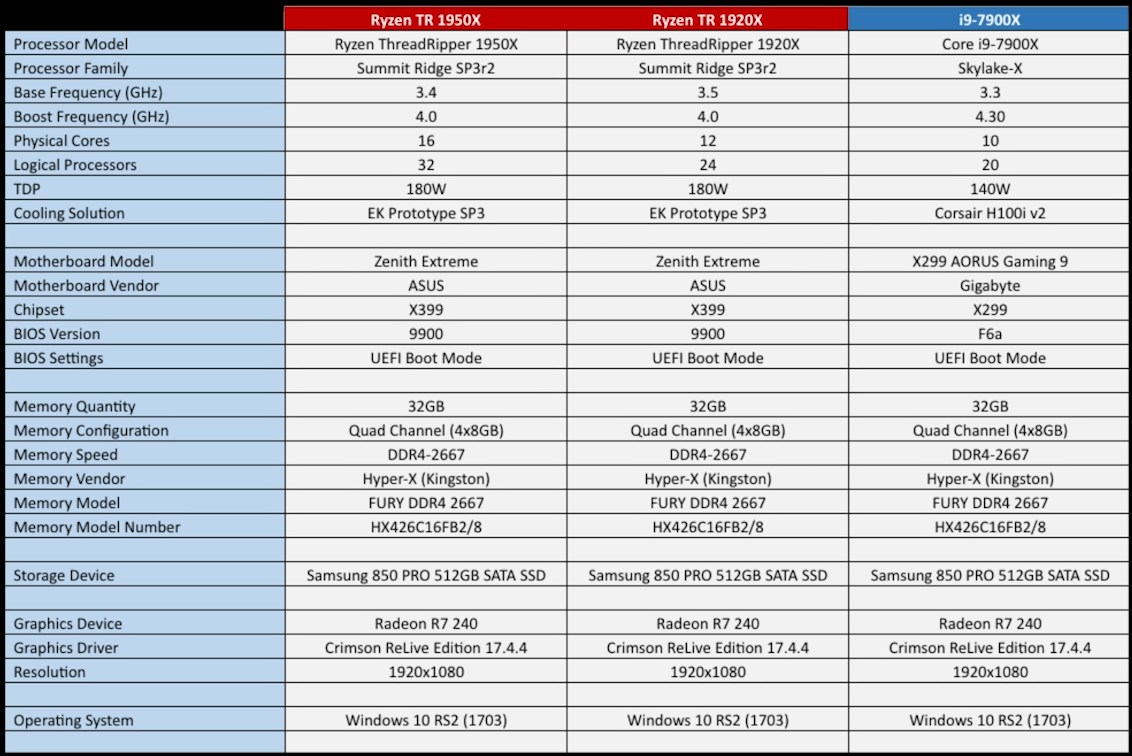
Test Setups from AMD can be found here. AMD is set to provide some interesting competition in the HEDT and SHED spaces, and we fully suspect AMD to go after the more traditional floating point crowd for these new processors. We will probably see some talk about gaming performance as well, just because of the draw of the news. We’ve still got a number of questions for AMD: Some of our readers might argue that some of these answers have been exposed in leaks – from our perspective, getting confirmation from AMD (even on the minor points) is critical here. We’re going to have to wait until nearer the launch to get the answers to these questions. AMD have reaffirmed they are aiming for an early August launch, with more info at SIGGRAPH in a couple of weeks. Dell's Area 51 ThreadripperA side note: Dell's Area 51 Threadripper desktop will be available for pre-order on July 27th – it would appear that Dell has an OEM launch day exclusive at this time, so we might see some more details then. The Area 51 will ship after the 27th; that is just the pre-order date.
There’s Some Ryzen 3 TooAlongside the Threadripper news, AMD gave some small hints about Ryzen 3 as well. Ryzen 3 is the quad-core versions of Ryzen using the same silicon as Ryzen 5 and Ryzen 7, but with cores disabled and selling at lower price points. We got a sneaky peak at some of the Ryzen 3 specifications when a different AMD department announced the equivalent Ryzen 3 PRO processors, but AMD gave us the following to chew on:
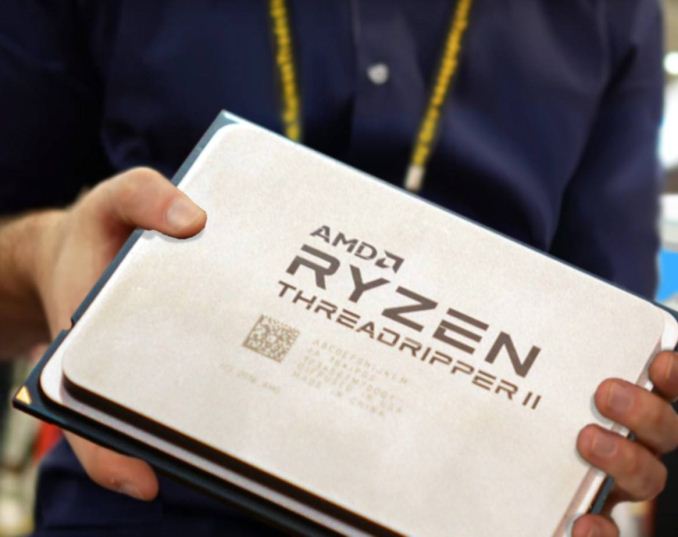
When we got our information from AMD, prices were still being decided, but the official launch day will be July 27th. One only one of the CPUs uses the full XFR, and AMD didn’t provide TDP numbers but we suspect they will be listed as 65W parts. AMD did not comment if these CPUs would have coolers bundled with them or not. Again, we’ll have to wait until closer to launch day/on launch day for this information. For users keen on Bristol Ridge information, I am still poking AMD. I’m still being told that it will be launched into the retail channel for consumers, but not at this time. Threadripper 2The future....
Perhaps not - just a clever photoshop. Source: Reddit Related Reading | |||||||||||||||||||||||||||||||||||||||||||||||||||||||||||||||||||||||||||||||||||||||||||||||||||||||||||||||||||||||||||||||||||||||||||||||||||||||||||||||||||||||||||||||||||||||||||||||||||||||||||||||||||||||||||||||||||||||||||||||||||||||||||||||||||||||||||||||||||||||||||||||||||||||||||
| 11:00a | Patriot Publishes List of AMD Ryzen Compatible DIMMs: Up to DDR4-3400, 64 GB
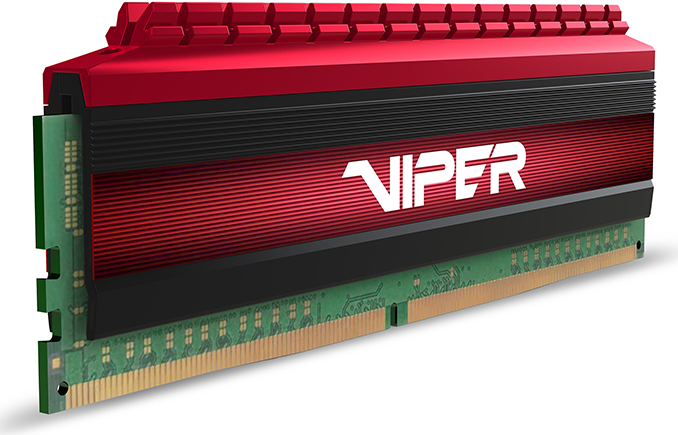
Patriot has published a list of its memory modules that are verified and compatible with AMD Ryzen processors. This includes the Viper 4 and Viper Elite modules that are already on the market, and the announcement was made after the company ran extensive tests of its DDR4 DIMMs on different platforms supporting AMD’s latest CPUs. As previously reported, with AMD’s release of its Zen based CPUs a few months ago, there were some growing pains in the new platform, particularly with RAM speed and compatibility. As it turned out, not all high-end DDR4 memory modules (at the time) would work with AMD Ryzen processors at their labeled data transfer rates. As a result, a number of DDR4 DIMM suppliers have released modules specifically qualified for enthusiast-grade AMD Ryzen-based systems and factory tested for compatibility. Moreover, AMD is working with motherboard makers to improve compatibility of its Ryzen platforms with memory modules via BIOS updates, recently promoting its AGESA 1.0.0.6 update. In the meantime, end users are advised to get DDR4 DIMMs that are labeled for AM4 to ensure compatibility - these modules should be factory-tested to be compatible with the AMD Ryzen. Patriot has tested dozens of its single unit DIMMs, and as dual-/quad channel kits, with multiple motherboards from ASUS, ASRock, GIGABYTE and MSI based on AMD’s X370, B350 and B320 chipsets (see the details in the table below) for compatibility with AMD Ryzen 7 and Ryzen 5 CPUs. Among the tested modules are Patriot’s Viper 4 and Viper Elite DIMMs with 4 GB, 8 GB and 16 GB capacities rated to operate at 2133-3400 MT/s with CL15 and CL16 timings. The company published its list of AMD Ryzen-compatible DDR4 DIMMs and we republish it below.
All of these modules are already on the market in single-, dual-, and quad-channel configurations using capacities from 8 GB to 64 GB. With this list, it should be easy to find out about compatibility of Patriot's Viper 4 and Viper Elite with AMD’s latest chips by checking out their model numbers.
Related Reading | |||||||||||||||||||||||||||||||||||||||||||||||||||||||||||||||||||||||||||||||||||||||||||||||||||||||||||||||||||||||||||||||||||||||||||||||||||||||||||||||||||||||||||||||||||||||||||||||||||||||||||||||||||||||||||||||||||||||||||||||||||||||||||||||||||||||||||||||||||||||||||||||||||||||||||
| 1:00p | TYAN Launches Latest Generation Skylake-SP Xeon Server Platforms
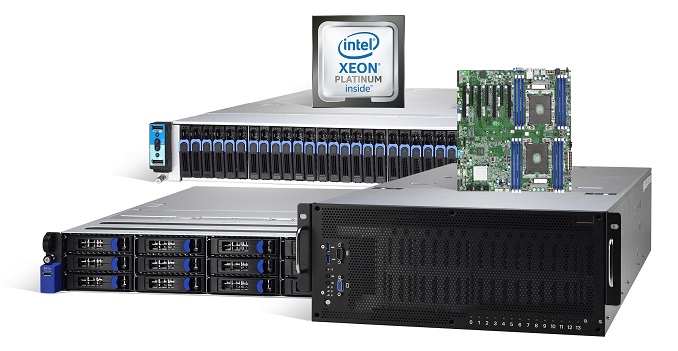
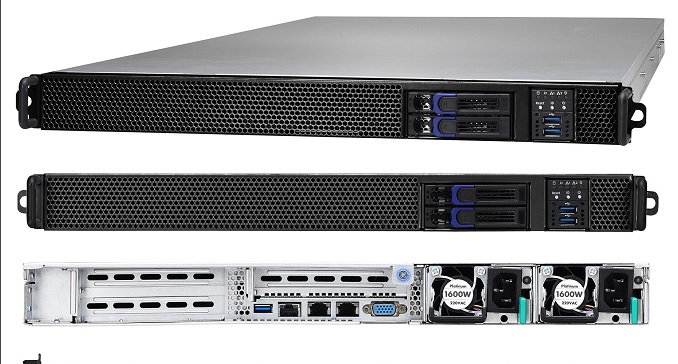
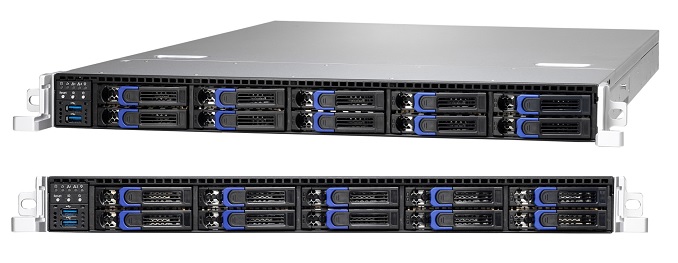
A few weeks ago we talked about Tyan’s demonstration of two new HPC servers for high-performance computing and deep workloads, the Tyan FT77D-B7109 and FT48B-B1700. Tyan looks to continue updating their HPC server platform using Intel's newly launched Skylake-SP Xeons, and this week have added the GA88-B5631, TN200-B7108-X4S, and GT62F-B5630 to their lineup. A peer-to-peer single root complex 1U server, the GA88-B5631 server platform can be used for cognitive computing workloads like AI and Machine Learning. This platform supports up to four Xeon Phi coprocessors and a full height / half length PCIe x16 card, allowing a networking adapter to reach speeds of up to 100 Gb/s with items like EDR InifinBand or 100 Gigabit Ethernet. The server has 12 DIMM slots (6 channels) supporting capacities up to 384GB with RDIMMs, or up to 1536GB using 3DS (3 Dimensional Stacked)/LRDIMMs. As for connectivity, the server has two 10 GbE ports utilizing Intel's X550-AT2 controller, and another for IPMI duties. On the storage side of things, the GA88-B5631 has two SATA3 and two SATA-DOM (Disk on Module) ports. It supports RAID 0/1/10/5 with four SATA devices.
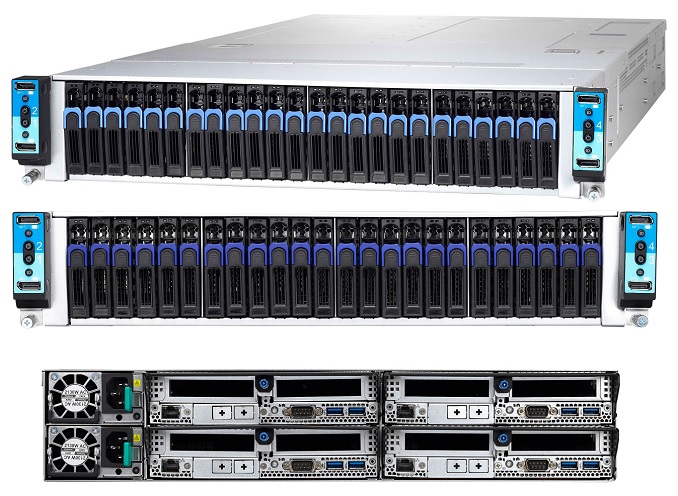
Tyan’s cloud computing and storage platforms continue to grow with the addition of the TN200-B7108-X4S. This dual-socket 2U 4 node all-flash server platform will support up to 24 2.5” NVMe U.2/SATA drives, with each node controlling eight NVMe devices setup across six PCIe x4 NVMe U.2 hot-swap drive bays (front) as well as a pair of integrated 2280/22110 NVMe M.2 ports. Totaling 16 DIMMs (per blade), users can have up to 512GB in RDIMMs, or 2048GB in LRDIMM 3DS. The platform has support for 100G Omni-Path Fabric as well. When using all four blades, users have a total of eight CPU sockets, 64 DIMM slots, and 32 NVMe devices with a total of 8192 GB of RAM. Tyan believes this is “an ideal platform for High Performance Computing workloads and hyper-converged all-flash storage applications."
The last new product, the GT62F-B5630, is a 1U server platform designed for hybrid NVMe/SATA cache data storage. The chassis supports up to eight hot-swap NVMe U.2 drives and an OCP v2.0 LAN Mezzanine slot, which in turn supports networking speeds up to 100 Gb/s. Tyan says the single CPU socket makes it ideal for platform workloads which operate best within a single NUMA domain (since it does not have to access another processor's memory) and require large amounts of high-speed flash. For example, media streaming applications.
Tyan did not supply the information on when these will be for sale, but expect to see these soon now that the Xeon Skylake-SP family has been released. Related Reading: | |||||||||||||||||||||||||||||||||||||||||||||||||||||||||||||||||||||||||||||||||||||||||||||||||||||||||||||||||||||||||||||||||||||||||||||||||||||||||||||||||||||||||||||||||||||||||||||||||||||||||||||||||||||||||||||||||||||||||||||||||||||||||||||||||||||||||||||||||||||||||||||||||||||||||||
| << Previous Day |
2017/07/13 [Calendar] |
Next Day >> |