[Most Recent Entries] [Calendar View]
Tuesday, July 18th, 2017
| Time | Event | ||||||||||||||||||||||||||||||||||||||||||||
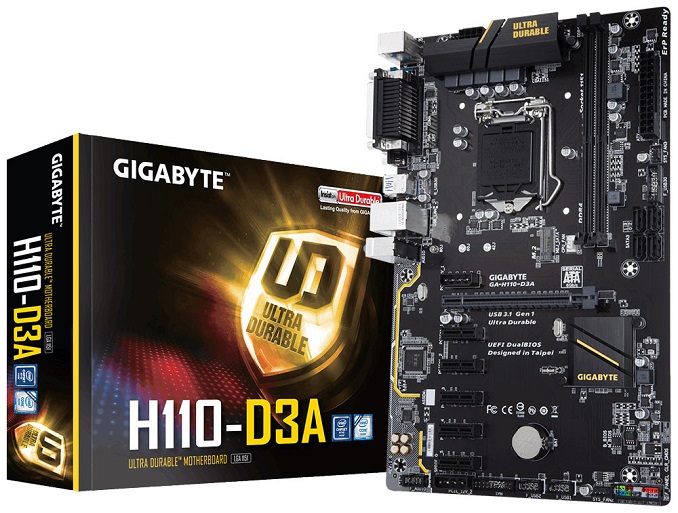
| 10:00a | Gigabyte Announces H110-D3A Motherboard for Mining Rigs: The Mining Cart Rolls on
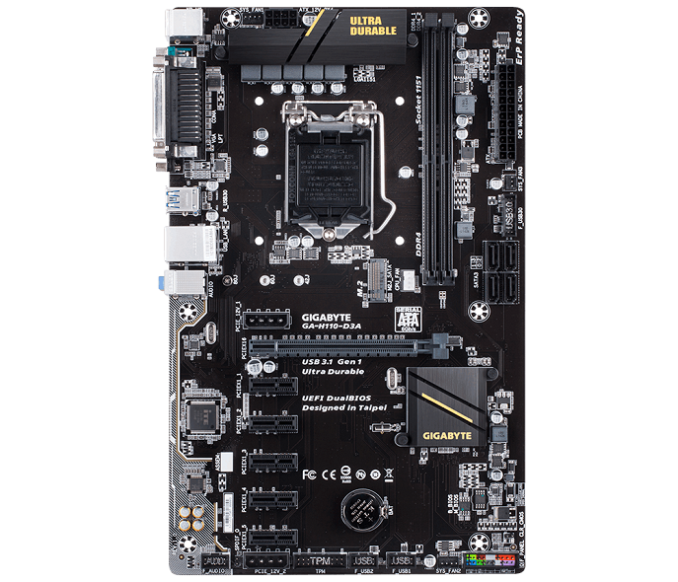
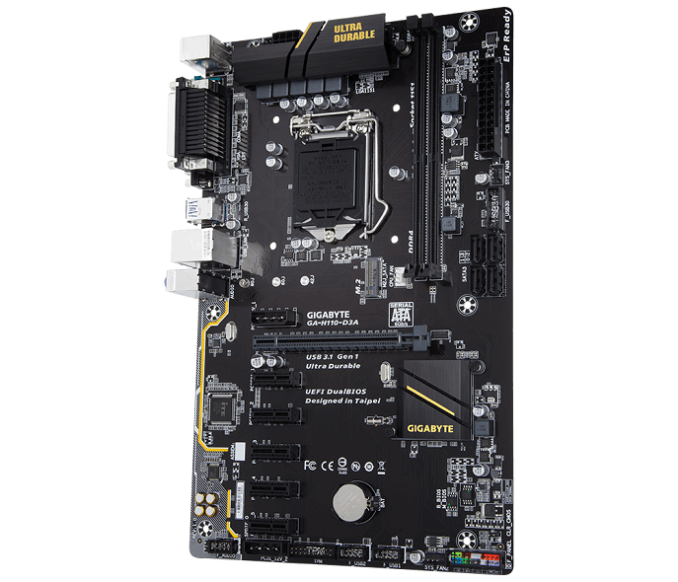
GIGABYTE this week has taken the wraps off of a new motherboard built specifically for the again popular cryptocurrency mining crowd: the H110-D3A. Like other boards targeted at mining, there are a plethora of PCIe x1 slots. Having several PCIe x1 slots on mining motherboards make it more cost effective to simply add more video cards into a single system, rather than expanding to additional systems. Despite this being a mining focused board, some more common features found in mainstream consumers boards are here, such as a Realtek ALC887 audio codec, although others are left out as well in an effort to reduce board prices for this cost-conscious and investment-oriented market.
Based on Intel's H110 chipset, the H110-D3A has five PCIe x1 slots from the PCH and a PCIe x16 slot from the CPU, giving a total of six slots for GPU mining. This is compared to a typical consumer motherboard board with three or four PCIe slots, so it is easy to see the value proposition for miners. Due to the socket/chipset combination, processor support is for both 6th and 7th generation Intel CPUs, while memory support is listed at DDR4-2133/2400 and 32GB for the two DIMM slots. It is pretty sparse on extra features, as are most boards aimed at mining, but it still offers a full PCIe 3.0 x4 M.2 slot and four SATA 6 Gbps ports. The board is built using GIGABYTE's “Ultra Durable” components, which GIGABYTE states are tested for extended operation. Power is fed to the board and CPU via the usual 24-Pin ATX and 8-Pin EPS sockets, which in turn is regulated by a 5-phase VRM setup. Two additional power headers, via 4-Pin Molex plugs, are located above the first PCIe (x16) slot and below the last (x1) slot to handle the additional power required for running several video cards through the multiple PCIe slots.
Connectivity on the rear panel is basic, but all the required elements are there. This consists of two PS/2 ports, one parallel port, one serial port, a VGA port, two USB 3.0 ports, two USB2 ports, a Realtek Gbe LAN RJ-45 port, and Realtek ALC887 based audio.
Pricing is currently $89 at Newegg.com, though the board is not in stock at the time of writing. Compared to the Biostar TB250-BTC (see in the links below). the cost is a few dollars less with a similar number of PCIe slots available for mining duties. The competition seems to be heating up around the sub $100 segment for mining boards as more boards hit the market and board partners attempt to cash in on the mining craze. Related Reading | ||||||||||||||||||||||||||||||||||||||||||||
| 10:45a | The Asus Prime Z270-A & GIGABYTE Z270X-Ultra Gaming Motherboard Review In this review we are having a look at two mainstream, Intel Z270 based gaming motherboards: the Asus Prime Z270-A and the GIGABYTE Z270X-Ultra Gaming. They look very similar on paper, with both retailing for the almost the same retail price and even using the same audio, LAN and USB chipsets, but each motherboard has its own strengths and weaknesses, which will examine in this review. | ||||||||||||||||||||||||||||||||||||||||||||
| 9:00p | Intel Releases Graphics Driver 15.46 for Windows
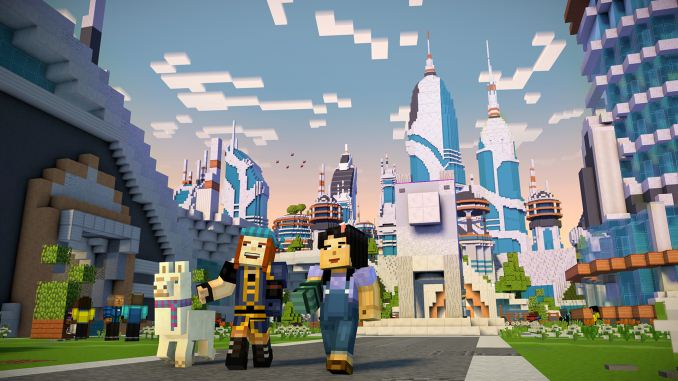
With last week’s release of Minecraft: Story Mode – Season Two, Intel has released their Graphics Driver 15.46 to provide launch support, as well as bugfixes, feature updates, Computer Vision and AI application development support, and support for Windows 10 Creator’s Update features. The driver is only for Windows 10 64-bit, and applies to Intel HD, Iris, and Iris Pro graphics on 6th and 7th generation processors (Skylake and Kaby Lake), Apollo Lake platforms, and Xeon E3-1200v5/E3-1500v5/E3-1200v6 product families.
Other than Minecraft: Story Mode, several other games have launch drivers or improvements included in 15.46 (Driver Version 15.46.02.4729, Windows Driver Store Version 22.20.16.4729): Fortnite, Gigantic, Pyre, Master x Master, Secret World Legends, and Pit People. Intel notes that all these optimizations only apply for processors with HD Graphics 620 or better.
In terms of key game bugs, Intel has corrected texture flickering in Halo 2 and other DX9 games. Intel has also resolved issues with graphical anomalies in Guilty Gear Xrd, Fallout 4, Euro Truck Simulator 2, Guild Wars 2, Deus Ex: Mankind Divided, Vikings – Wolves of Midgard, Rainbow Six Siege, For Honor, Watch Dogs 2, Lego Minifigures Online (DX12 mode), and other games. Finally, Intel has fixed intermittent crashes and hangs in Guild Wars 2, DOTA 2, and The Talos Principle (when resumed from suspend state in Vulkan mode), and others. Other non-game related issues were resolved in 15.46 as well. The HD Graphics Control Panel no longer displays the Panel Self Refresh (PSR) option for non-PSR panels, and now does not have issues with bezel correction in tri-display collage configurations. Additionally, Intel has resolved an issue with graphical anomalies for certain tablets when the panel is rotated 180 degrees through hardware during fullscreen video playback. Lastly, Intel has fixed incorrect resolution caps during virtual display auto-detection, and has brought general WebGL stability improvements.
The 15.46 driver also brings support for CV and AI workload acceleration on Intel integrated GPUs. This support ties in with Intel’s open source Compute Library for Deep Neural Networks (clDNN) and associated Computer Vision SDK and Deep Learning Deployment Toolkits. As for the Creators Update, Intel simply states in the release notes that Windows 10 Creators Update features are enabled in 7th generation Intel Core processors. Moving on, Intel has enabled additional OpenCL media extensions, as well as a few preview extensions. In addition, 15.46 brings support for OpenGL v4.5, Vulkan v1.0.38, and programmable sample positions in Direct3D12. Although this graphics driver update is not the usual AMD or NVIDIA news, it is important to note that Intel remains very important in the consumer graphics space, despite the cancellation of Larrabee for discrete consumer graphics some seven years ago. As of Q1 2017, Intel iGPUs hold over 70% share of the graphics market. Since 2010, Intel has kept marching on, enhancing their integrated graphics prowess with Iris to the extent that Intel themselves now consider their iGPUs equivalent to discrete GPUs for mainstream and casual gamers. As iGPUs and APUs become more and more powerful, lower-end discrete graphics may be supplanted entirely. Likewise, there is a machine learning element involved as well. In recent years, Intel has made a push towards deep learning in edge devices by utilizing their ubiquitous iGPUs, efforts of which are continuing in this very 15.46 driver. With Intel acquisitions like Nervana and Movidius, it was only a matter of time before the humble Intel IGP was hit with the AI and deep learning fever too. In that machine learning space, the competition is rapidly heating up with Google’s TPU, NVIDIA’s Tesla, and AMD’s Radeon Instinct among those in the mix, not to mention Intel’s own Knights Mill Xeon Phi and ARM’s own DynamIQ endeavors. As automotive, deep learning, and neural networking (as well as all the other related fields) applications grow, edge devices like Intel’s iGPUs can offer a method of democratization with respect to software development, and one to look out for in the future. Wrapping things up, the updated drivers for Intel products are available on their driver download page. More information on 15.46 and further issues can be found in the release notes or on the 15.46 download page. | ||||||||||||||||||||||||||||||||||||||||||||


| << Previous Day |
2017/07/18 [Calendar] |
Next Day >> |