[Most Recent Entries] [Calendar View]
Wednesday, July 19th, 2017
| Time | Event |
| 8:00a | Samsung Increases Production Volumes of 8 GB HBM2 Chips Due to Growing Demand
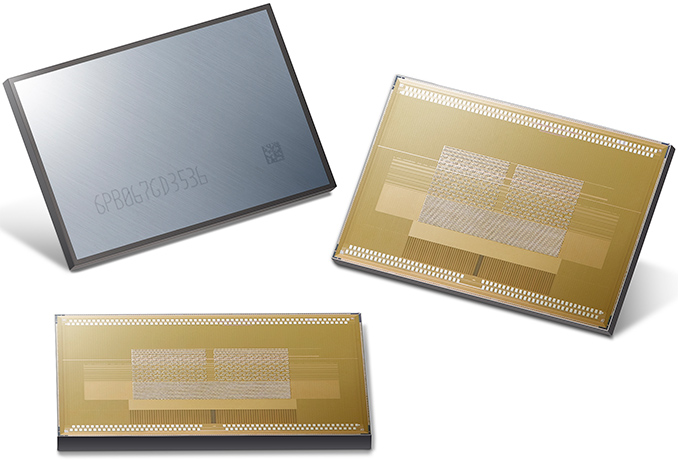
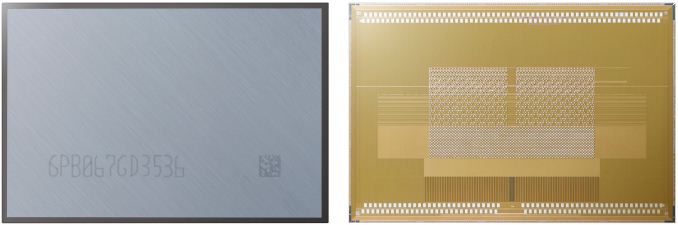
Samsung on Tuesday announced that it is increasing production volumes of its 8 GB, 8-Hi HBM2 DRAM stacks due to growing demand. In the coming months the company’s 8 GB HBM2 chips will be used for several applications, including those for consumers, professionals, AI, as well as for parallel computing. Meanwhile, AMD’s Radeon Vega graphics cards for professionals and gamers will likely be the largest consumers of HBM2 in terms of volume. And while AMD is traditionally a SK Hynix customer, the timing of this announcement with AMD's launches certainly suggests that AMD is likely a Samsung customer this round as well. Samsung’s 8 GB HBM Gen 2 memory KGSDs (known good stacked die) are based on eight 8-Gb DRAM devices in an 8-Hi stack configuration. The memory components are interconnected using TSVs and feature over 5,000 TSV interconnects each. Every KGSD has a 1024-bit bus and offers up to 2 Gbps data rate per pin, thus providing up to 256 GB/s of memory bandwidth per single 8-Hi stack. The company did not disclose power consumption and heat dissipation of its HBM memory components, but we have reached out Samsung for additional details. Samsung began mass production of 4-Hi HBM2 KGSDs with 4 GB capacity and 2 Gbps data rate per pin in early 2016. These chips have been used to build various solutions based on NVIDIA’s GP100 and later GV100 GPUs aimed at HPC and similar applications. The company also started to manufacture HBM2 KGSDs with 8 GB capacity in 2016 and so far, Samsung is the only company to publicly announce that they can mass-produce 8 GB HBM2 KGSDs.
Recently AMD launched its Radeon Vega Frontier Edition cards, the first commercial products featuring Vega and 8-Hi HBM2 stacks. To date we haven't been able to get confirmation of whose HBM2 AMD is using – frequent collaborator SK Hynix's or Samsung’s – however as Samsung is for now the only vendor to announce 8-Hi volume production, it's looking increasingly likely that AMD is using Samsung's HBM2. Meanwhile in the coming months AMD will expand the lineup of its graphics cards based on the Vega GPU with the RX Vega line for gamers, and considering that such devices are sold in mass quantities, Samsung has a very good reason for increasing HBM2 production.. Samsung expects 8 GB HBM2 KGSDs to account for over 50% of its HBM2 production by the first half of 2018. Related Reading: |
| 2:00p | Kontron Merges with S&T, Gets Access to Software, Manufacturing
Kontron and S&T Deutschland Holding on Monday announced that shareholders of both companies have agreed to merge the two companies. Kontron, which is known for its servers, small form-factor PCs, and other specialized hardware, will retain its brand, but will gain access to S&T’s software and contract manufacturing capabilities. Meanwhile, S&T will broaden its hardware portfolio. Combined, sales of the two companies are expected to hit the $1 billion mark in 2017. Kontron is one of the world’s largest makers of industrial rackmount servers and embedded systems, many of which are specialized and do not fall into traditional commodity categories. Last year was particularly tough for the company: its revenues decreased by 18% year-over-year to €385.1 million ($440 million), its gross margin dropped to 14.6% from 26.1% a year earlier, and its EBIT loss was €141.7 million ($161.7 million), reports LightReading. In the light of challenging financial situation, Kontron began talks with S&T regarding the merger late in 2016, which in turn concluded in June. The merger with S&T will give Kontron access to S&T’s software as well as to Ennoconn, a subsidiary of Foxconn that designs and produces motherboards and systems for specialized and embedded applications. Outsourcing of manufacturing will naturally shrink costs for the new company, whereas the ability to offer software, hardware, and services will help the newly established entity to better address needs of its customers and sustain strong margins. In general, the consolidation of hardware and software is what has been driving the merger trend on the sever market for many years. Kontron is one of a few suppliers of servers that have offered ARM-based servers. For example, at this year’s Mobile World Congress the company demonstrated the world’s first and only 1P server running Applied Micro/MACOM's X-Gene 3 processor with 32 custom ARMv8-A cores and 32 MB of cache. It will be interesting to see how the merger between Kontron and S&T affect the former’s ARM server plans. The two companies hope that the merger, combined with internal restructuring of Kontron, will result in faster decision-making and shorten development times and evolutionary cycles. From a financial point of view, Kontron and S&T expect their combined revenues to be between €860 and €890 million ($993 – $1028 million) in fiscal year 2017, and intend to break the €1 billion ($1.155 billion) sales milestone in 2018. |


| << Previous Day |
2017/07/19 [Calendar] |
Next Day >> |