[Most Recent Entries] [Calendar View]
Saturday, August 5th, 2017
- AKiTiO Displays Thunderbolt 3 to 10GBase-T Adapter
- LaCie Announces 2big Dock: 2-Bay TB3 DAS with Card Reader, USB-A and DisplayPort
- ASUS ZenBook 3 Deluxe UX490UA: Kaby Lake, 16 GB RAM, 1 TB SSD, TB3, 14" FHD, 2.4 lbs
- CES 2017: GIGABYTE’s Thunderbolt 3 to 8x USB 3 Dock
- LaCie Launches Rugged and d2 Thunderbolt 3 Storage Devices
- AKiTiO Introduces Node: Thunderbolt 3 eGFX Box for $299
| Time | Event | |||||||||||||||||||||||||||||||||||||||||||||||||||||||||||||||||
| 10:00a | Intel to Discontinue First-Generation Thunderbolt 3 Controllers
Intel this week announced plans to discontinue its first generation Thunderbolt 3 controllers it launched in 2015, coming as a consequence of an industry transition from leaded to lead-free components. The company has had newer controllers in its fleet for quite a while, so it should not be a problem for PC makers to switch to them as they migrate to newer Intel platforms, such as Cannon Lake or Coffee Lake. Intel on Thursday published plans to discontinue its DSL6340 and DSL6540 TB3 controllers it released in Q3 2015. Intel’s customers should place their orders on the chips by February 2, 2018, and the final shipments will be made by August 3, 2018. Replacing the DSL chips, Intel is advising its customers to instead use the JHL6340 and the JHL6540 controllers that were launched back in Q2 2016. At first glance, there is no difference between Intel's DSL- and JHL-series Thunderbolt 3 controllers: both belong to the Alpine Ridge family and even their power consumption is the same: 1.7 - 2.2 W depending on port configuration. Intel has also confirmed that the DSL- and JHL-series TB3 controllers are similar in terms of features and functionality: 6340 supports one Thunderbolt 3 port, whereas 6540 supports two Thunderbolt 3 ports, every TB3 chip carries two DP 1.2 streams and so on.
Meanwhile, there is a difference between how different families of Intel's Thunderbolt 3 controllers are made. The DSL-series controllers use a lead-containing solder alloy, whereas the JHL-series use a lead-free solder alloy based on tin, silver and copper (such alloys are called SAC - Sn, Ag, Cu). The European Union restricts the use of lead (as well as many other hazardous materials) because its fumes increase risk of lung and stomach cancer, along with the other known risks of lead exposure and heavy metals in general. So, as it appears, Intel is EOLing its first-gen Thunderbolt 3 controllers as part of the broader effort to phase out the use of lead in electronics products. Related Reading: | |||||||||||||||||||||||||||||||||||||||||||||||||||||||||||||||||
| 2:00p | Corsair’s ONE SFF PCs Get Upgraded: GeForce GTX 1080 Ti, 32 GB of RAM, NVMe SSD
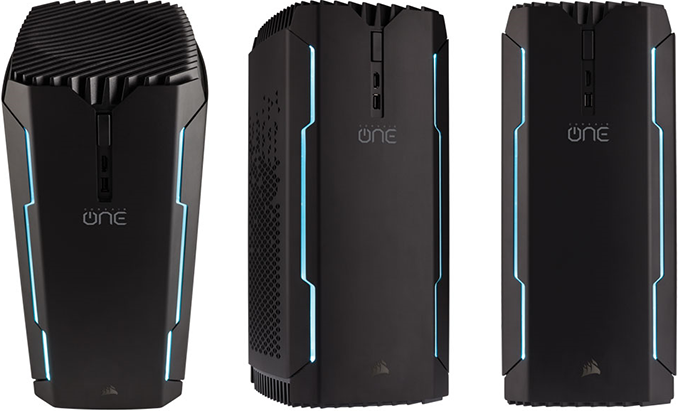
Corsair on Thursday upgraded its Corsair ONE small form-factor gaming PCs, giving the systems a solid mid-generation upgrade. Relative to the original Corsair ONE, the new Corsair ONE desktops feature more powerful NVIDIA GeForce GTX 1080 Ti graphics cards, up to 32 GB of DDR4-2400 memory, and NVMe SSDs paired with mechanical HDDs. Meanwhile, pricing of the new systems will be higher compared to that of predecessors with top-of-the-range model available for $2899.99. Corsair launched its SFF gaming PC this March, a bit later than many other producers of gaming hardware in this generation. To address a high end segment of the market and quickly gain market share, Corsair used everything it had up its sleeve into the Corsair ONE design, including its expertise in building computer cases with good ventilation, SFF PSUs, and custom liquid cooling. The use of an LCS and a properly vented PC case enabled Corsair to integrate rather powerful components inside: up to Intel’s Core i7-7700K as well as NVIDIA’s GeForce GTX 1080, with everything being overclocking-capable. Several months after the company began sales of its ONE-series desktops, the company is adding more powerful hardware options targeting an even higher-end segment of the market. The move puts Corsair’s ONE into the same category with boutique-built PCs, which is where some of Corsair’s rivals did not want to go. Up until recently, Corsair offered three models of the Corsair ONE priced between $1799.99 and $2399.99 (the more powerful models were branded ONE PRO). The two new Corsair ONE PRO models come with Intel’s Core i7-7700K, NVIDIA’s GeForce GTX 1080 Ti (made by Corsair’s partner MSI and running at up to 100 MHz higher when compared to NVIDIA’s reference design), Corsair’s 480 GB NVMe SSD (previously Corsair’s ONE came with only SATA drives), as well as a 500 W 80 Plus Gold PSU. The new ONE PRO versions are are available for $2699.99 (with 16 GB of DDR4) and $2899.99 (with 32 GB of Vengeance LPX DRAM). Meanwhile, the Corsair ONE PRO priced at $2299.99 also got an SSD upgrade: it now comes with an NVMe drive.
From an architecture point of view, the new Corsair ONE PRO models are exactly the same as as their predecessors: they come in the same 12L aluminum chassis with a liquid cooling system featuring two loops, a Mini-ITX motherboard based on Intel’s Z270 PCH, a custom SFX PSU and only one exhaust fan. The only things that have changed are performance and prices. Since all Corsair’s ONE PRO systems use a bunch of standard desktop components, all existing desktops can be upgraded with new SSDs or specially qualified Corsair Vengeance LPX DDR4 DIMMs. The new Corsair ONE systems are available in North America, Europe and Australia directly from the company or its partners. The upgrade kits for the existing Corsair ONE PCs will hit the market sometimes later. Related Reading: | |||||||||||||||||||||||||||||||||||||||||||||||||||||||||||||||||
| << Previous Day |
2017/08/05 [Calendar] |
Next Day >> |