[Most Recent Entries] [Calendar View]
Thursday, August 10th, 2017
| Time | Event | ||||||||||||||||||||||||||||||||||||||||||||||||||||||||||||||||||||||||||||||||||||||||||||||||||||||||||||||||||||||||||||||||||||||
| 9:00a | The AMD Ryzen Threadripper 1950X and 1920X Review: CPUs on Steroids In the early 2000s, we had the battle to high frequencies. The company that could force the most cycles through a processor could get a base performance advantage over the other, and it led to some rather hot chips, with the certain architectures being dropped for something that scaled better. Move on 10-15 years and we are now at the heart of the Core Wars: how many CPU cores with high IPC can you fit into a consumer processor? Up to today, the answer was 10, but now AMD is pushing the barrier to 16 with its new Threadripper processors. We got both of the launch CPUs for review and put them on the grill. | ||||||||||||||||||||||||||||||||||||||||||||||||||||||||||||||||||||||||||||||||||||||||||||||||||||||||||||||||||||||||||||||||||||||
| 11:00a | Enermax Launches LiqTech TR4 AIO LCS for AMD's Threadripper: 100% IHS Coverage, 500 W TDP
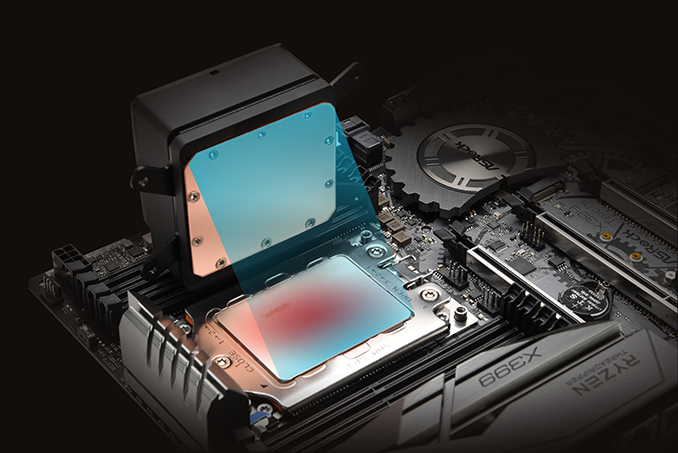
Enermax on Thursday introduced its new family of closed-loop liquid coolers designed specifically for AMD’s new Ryzen Threadripper CPUs. The new custom-made LiqTech TR4 AIO LCS feature waterblocks cover 100% of the CPU IHS (integrated heat spreader), a notable improvement over preexisting designs, which designed for smaller chips only partly cover TR4 chips.
High-end air and liquid coolers these days can dissipate huge amounts of heat that exceed TDP of even the most powerful CPUs, such as AMD’s Threadripper or Intel’s Core i7/i9. Manufacturers of coolers are eager to equip their devices with mounting brackets to make them compatible with the new 4094-pin TR4 and 2066-pin R4 sockets as well as the new microprocessors. However, since the coolers were not designed for the large TR4 IHS from the ground up, they cannot cover 100% of its surface. And even though many of them can enable reliable operation at stock frequencies and TDP, they may not be efficient enough during overclocking. Enermax equipped its LiqTech TR4 coolers with special waterblocks that cover 100% of the TR4 IHS to maximize thermal performance and overclocking potential of the new CPUs.
Waterblocks of the Enermax LiqTech TR4 240 and LiqTech TR4 360 AIO liquid coolers come with cold plates featuring the company’s micro-channel-based design with a shunt channel (the firm calls it SCT) that maximizes cooling performance. Both coolers use the same 3000 RPM pump with flow rate of 450 L/h and, as their names imply, are equipped with a 240 or a 360 mm radiator. Enermax claims that the LiqTech TR4 240 and 360 closed-loop LCS can dissipate over 500 W of heat, thus providing a lot of headroom for overclocking.
The oversized waterblocks of the LiqTech TR4 240 and 360 AIO LCS do not allow installation of the coolers on other sockets, which is a price of a custom-made design. As for reliability, just like other products of the kind they are rated for 100 thousand hours MTBF (pump) and come with a two-year warranty.
The Enermax LiqTech TR4 240 and 360 closed-loop LCS will be available in the U.S. in late August for $129.99 and $149.99, respectively. Pricing and availability in other countries may vary. Related Reading: | ||||||||||||||||||||||||||||||||||||||||||||||||||||||||||||||||||||||||||||||||||||||||||||||||||||||||||||||||||||||||||||||||||||||
| 1:00p | Intel EOLs Atom Chip Used for Microsoft HoloLens
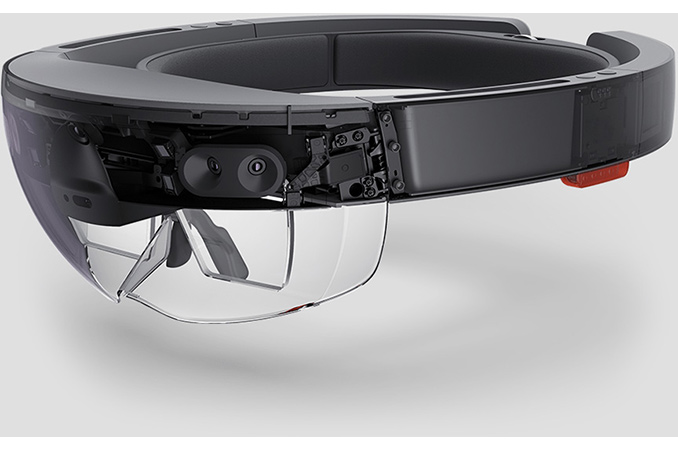
Intel is retiring its Atom x5-Z8100P SoC that is used inside Microsoft’s HoloLens augmented reality headset. With the last units shipped in late October, it looks like the software giant is on track with its next-generation HoloLens that is due to arrive in the coming quarters. Intel asks its customers to place their final orders on the Atom x5-Z8100P SoC (belonging to the Cherry Trail family) by September 30 and says that the final shipments will be made on October 30. Given the fact that Intel seems to have only one customer using the microprocessor, the short amount of time between the announcement of the product discontinuance and the actual EOL was probably negotiated before. Moreover, since we are talking about a semi-custom chip, Microsoft was probably the initiator of the EOL, which indicates that the company is on track with its next-gen HoloLens. The current-generation Microsoft HoloLens wearable augmented reality PC was released in 2016 and is based on Intel’s Atom x5-Z8100P SoC as well as a custom-designed Microsoft holographic processing unit (HPU) that processes data from various sensors. The HoloLens is equipped with over a dozen of sensors, including a 2 MP video camera, an inertial measurement unit (which means, a set of accelerometers, gyroscopes and maybe even a magnetometer), one depth camera, four environment understanding cameras, four microphones, an ambient light sensor as well as mixed reality capture IC.
The next-generation Microsoft HoloLens will be different compared to the existing augmented reality platform, Microsoft revealed recently. While the device will run Windows 10 and will be equipped with an HPU, it will also feature an AI co-processor integrated into the latter that will use neural networks to enable object and voice recognition skills without the need for an Internet connection. The HPU 2.0 with the programmable AI co-processor will be a self-sufficient device that will run on battery power of the next HoloLens (hence, its power consumption will not be too high). The HPU 2.0 and the AI co-processor were designed entirely in-house and therefore are tailored for usage model of the HoloLens. Given the differences in architecture of the HoloLens Next compared to the existing model, it remains to be seen what kind of CPU Microsoft decides to use for it. Microsoft demonstrated “an early spin of the second version of the HPU” running live code implementing hand segmentation at CVPR in late July. Therefore, while the chip is functional, it does not seem that the HoloLens Next is just around the corner and it is logical to expect it sometimes in 2018 or even in 2019. Related Reading: | ||||||||||||||||||||||||||||||||||||||||||||||||||||||||||||||||||||||||||||||||||||||||||||||||||||||||||||||||||||||||||||||||||||||
| 3:00p | Enermax Shrinks Depth of Platimax D.F. 80 Plus Platinum 1200 W PSU to 6.3”/16 cm
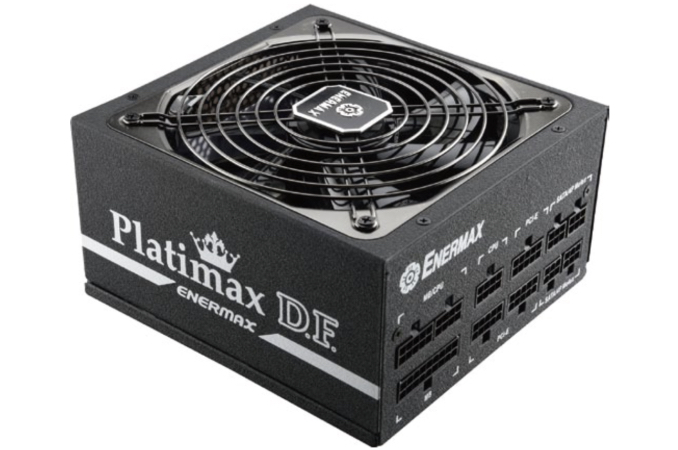
Enermax this week introduced its new family of 80 Plus Platinum PSUs for ATX desktop computers. The new PSUs are said to be able to clean themselves from dust, and more notable are only 160 mm (6.3”) deep. The flagship Platimax D.F. PSU is currently the world’s smallest 80 Plus Platinum PSU rated for 1200 W output and capable of supporting AMD Threadripper, Intel HEDT, and 2P systems. High-wattage PSUs are usually rather large because high-capacity capacitors and other components required for such power supplies are bigger than components used for lower-wattage PSUs. Besides, components of such power supplies require adequate cooling when used under high loads, so makers of PSUs increase length of their products to 180 – 225 mm in order to accommodate quality parts and ensure their long lifespan. Enermax has managed to find PSU components (most notably capacitors rated for 105°C/221°F) that are small enough to fit into a 160-mm deep enclosure, work at 50°C ambient temperature under load for prolonged amounts of time without degradation and handle 750 W – 1200 W loads. The Enermax Platimax D.F. family of PSUs consists of 750 W, 850 W, 1050 W and 1200 W models that are compliant with the ATX12V V2.4 spec and carry the 80 Plus Platinum badges. The power supplies feature modular design and come with two EPS12V connectors (one 4+4 and one 8-pin), thus ensuring compatibility not only with ultra-high-end desktop motherboards (such as those based on AMD’s X399 'Threadripper' and Intel’s X299 'Skylake-X' platforms), but also with 2P server- and workstation-class mainboards. In addition, the PSUs feature four (750 W model) or six 6-2-pin (8-pin) PCIe auxiliary power connectors for graphics cards, a dozen of SATA power plugs, four Molex power outputs and one FDD connector. All the cables are individually sleeved (Enermax calls them Sleemax), which will please modders and those looking to build very “tidy” systems.
Besides relatively small dimensions and powerful specifications, the Enermax Platimax D.F. power supplies feature the company’s proprietary DFR technology that can rotate integrated fans in an opposite direction in a bid to blow the dust away. While the DFR technology can help to clean the dust from the PSU, it should be noted that when activated, it essentially exhausts dust from the power supply into the case, which is not exactly helpful for the PC itself (unless the PC is then cleaned). Just like other high-end power supplies, the Platimax D.F. can shut down its fans when the PSU load drops to 30% (for 1050 W and 1200 W) or 40% (for 750 W and 850 W). Speaking of fans, the PSUs are equipped with Enermax’s 13.9 cm fans featuring the company’s twister bearing technology and rated for 160 thousand hours MTBF.
The Enermax Platimax D.F. will be covered with a five-year warranty, which is below warranties of other high-end power supplies, but it looks like the company wants to play it safe with its PSUs of reduced length.
Related Reading: | ||||||||||||||||||||||||||||||||||||||||||||||||||||||||||||||||||||||||||||||||||||||||||||||||||||||||||||||||||||||||||||||||||||||
| 6:20p | NVIDIA Announces Earnings Of $2.2 Billion For Q2 2018
NVIDIA announced its earnings this afternoon for the second quarter of their 2018 fiscal year (not a typo). As we’ve seen over the past several quarters, NVIDIA has been growing their business at a very brisk pace, and that growth was reflected in their earnings statement once again. For the second quarter, ending July 30, NVIDIA reported revenues of $2.23 billion, up 56% from a year ago. Gross margin was up half a percent as well to 58.4%. When revenue is up, and margins are up, it should perhaps not be a shock that operating income also jumped, in this case to $688 million, which is up 117% compared to Q2 2017. Net income was $583 million, up 123% year-over-year, and that resulted in earnings per share of $0.92, up 124% from the $0.41 a year ago. Sometimes these large jumps can be attributed to write-downs or other charges in the compared quarter, but in fact Q2 2017 was also a record for the company, after they took a write down charge for the Icera modem division two years ago.
NVIDIA’s gaming segment continues to be their largest source of revenue, even as they have diversified the company, and despite the contraction of the PC market, PC gaming still appears to be a strong business, and NVIDIA has taken advantage of that. For the quarter, NVIDIA had gaming revenue of $1.186 billion, compared to $781 million a year ago. They’ve not launched anything that’s completely new this quarter, but are still seeing success with their Pascal based GPUs. This growth can also likely be attributed to mining, but to NVIDIA, a GeForce sale goes in the gaming column. Professional visualization is likely still one of the higher margin divisions of NVIDIA, even as they’ve seen this group surpassed by several other divisions in the company. The Professional Visualization revenue grew 13.5%, which is actually pretty solid growth, but it can seem a bit diminutive compared to some of the other growth in the company. Datacenter has quickly become one of NVIDIA’s biggest sources of revenue. A year ago, it accounted for just under 11% of the company’s revenue, but for Q2 2018, revenue is up 175% to $416 million. This once small segment of NVIDIA now accounts for almost 19% of their revenue, and with the acceleration of AI and compute tasks in the datacenter, the company appears to be in a prime position to continue to capitalize on that trend. Automotive is the segment that emerged out of NVIDIA’s unsuccessful attempt to move into mobile. It continues to grow as well, with NVIDIA signing agreements with many of the largest automotive companies to include their technology in new vehicles. In May of this year, NVIDIA announced that Toyota will utilize their DRIVE PX platform, to join the party with other companies such as Volvo. Revenues for this segment grew 19.3% to $142 million this quarter, compared to Q2 2017. Finally, NVIDIA’s OEM and IP segment had a big jump in revenue as well, from $163 million a year ago to $251 million today. That’s a 54% increase.
Looking ahead to Q3 2018, NVIDIA sees their record year continuing, with expected revenues of $2.35 billion, plus or minus 2%, and margins between 58.1% and 59.1%. Source: NVIDIA Investor Relations | ||||||||||||||||||||||||||||||||||||||||||||||||||||||||||||||||||||||||||||||||||||||||||||||||||||||||||||||||||||||||||||||||||||||





| << Previous Day |
2017/08/10 [Calendar] |
Next Day >> |