[Most Recent Entries] [Calendar View]
Monday, August 14th, 2017
- Corsair’s ONE SFF PCs Get Upgraded: GeForce GTX 1080 Ti, 32 GB of RAM, NVMe SSD
- Zotac Unveils 2017 ZBox Magnus SFF Gaming PCs: Powered By Intel Core & AMD Ryzen
- ASUS VivoPC X Console Now Available: Core i5, GeForce GTX 1060 for $799
- MSI Upgrades Its Aegis and Nightblade PCs with Intel’s Kaby Lake CPUs
- MSI Trident 3 Announced: A Core i7 Console
- GIGABYTE's New Console: The 'Gaming GT' PC Launched with Core i7-K, GTX1080, TB3
- Corsair’s Bulldog 2.0 Gets Kaby Lake-Compatible Z270 Motherboard, New Cooler
- Enermax Launches LiqTech TR4 AIO LCS for AMD's Threadripper: 100% IHS Coverage, 500 W TDP
- G.Skill Unwraps Flare X 32 GB and 128 GB DDR4 Kits for AMD Threadripper: Up to 3600 MT/s
- The AMD Ryzen Threadripper 1950X and 1920X Review: CPUs on Steroids
- Unannounced AMD Ryzen Threadripper 1920 CPU in Motherboard Support Lists
- Patriot Publishes List of AMD Ryzen Compatible DIMMs: Up to DDR4-3400, 64 GB
- AMD Announces Ryzen AGESA 1.0.0.6 Update: Enables Memory Clocks Up To DDR4-4000
- The AMD Ryzen Threadripper 1950X and 1920X Review: CPUs on Steroids
- Unannounced AMD Ryzen Threadripper 1920 CPU in Motherboard Support Lists
- Enermax Launches LiqTech TR4 AIO LCS for AMD's Threadripper: 100% IHS Coverage, 500W TDP
- AMD Threadripper 1920X and 1950X CPU Details: 12/16 Cores, 4 GHz Turbo, $799 and $999
- EVGA Rolls Out SC17: High-End Gaming Laptop Designed for Overclocking
- EVGA Introduces the GTX 1080 Ti K|NGP|N Edition Video Card
- EVGA's New iCX Range: NVIDIA GPUs with More Control for Cooling
- Acer Announces Predator Triton 700 Gaming Laptop: Core i7, GeForce GTX 10 Series, & 1 TB SSD
- Acer Announces The Acer Predator 21 X: 21-Inch Curved Screen Gaming Notebook
- Razer Blade Gets Core i7-7700HQ, Adds 4K Touchscreen, 1 TB SSD Options
- Razer Re-Launches The Razer Blade Pro: GTX 1080 And 4K G-SYNC
- Dell Readies New XPS 15: 4K, Quad-Core Kaby Lake, GeForce GTX 1050
- The ASUS ROG Strix GL502VS Review: Mainstream GTX 1070 with G-SYNC
| Time | Event | ||||||||||||||||||||||||||||||||||||||||||||||||||||||||||||||||||||||||||||||||||||||||||||
| 8:30a | Shuttle’s X1 Now Available: NUC-Like PC With a GeForce GTX 1060 GPU
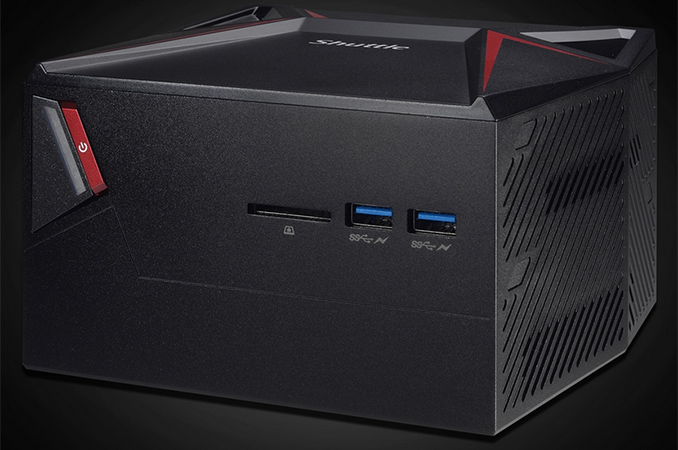
Shuttle has started to sell its new Gaming Nano family of small form-factor PCs. The miniature Shuttle X1 systems are barely larger than Intel’s NUCs, but they integrate Intel’s 45W high-end mobile Core i5/i7 HQ-series Kaby Lake CPUs with NVIDIA’s mobile GeForce GTX 1060 3 GB GPUs, which make them capable of running VR games. The combination of size and hardware leads to pricing from $1465 to $1709. Shuttle and Mini PCsShuttle was among the pioneers of modern small form-factor PCs for enthusiasts in the early 2000s. Back then, the company was the first to offer custom PC barebones that enabled users to build a PC without hassle on motherboard fitting and cooling. Shortly after, the company began to offer specialized versions of PC barebones designed for HTPC and gaming applications, essentially pioneering SFF gaming PCs. Shuttle was among the first PC makers who offered cube-sized (somewhere between ITX and mATX) PCs based on Intel’s X58 and X79, inventing a miniature enthusiast PC category (over two years before Falcon Northwest’s Tiki) and showing a new market for boutique PC makers, and eventually manufacturers of PC components. Intensified competition and other issues eventually forced Shuttle to focus on non-gaming specialized PCs and barebones for several years, but it looks like the company is plotting a comeback. Earlier this year Shuttle launched its SZ270R8 barebones, based on the Intel Z270 chipset and aimed it at the audience that buys Mini-ITX PCs. In June, the company formally announced the first member of the Gaming Nano family — the Shuttle X1, which is aimed at a slightly less crowded market of miniature gaming systems.
The Shuttle X1The Shuttle X1 is an extremely small desktop PC that fits in a palm of a hand and resembles higher-end Intel NUC computers and competitors. Just like the NUC, the Shuttle X1 is based on Intel’s mobile CPUs, going up to 45W versions of the Core i5-7300HQ and Core i7-7700 HQ. But unlike Intel's NUCs, the X1 also carries an NVIDIA GeForce GTX 1060 3GB MXM GPU module. The systems are equipped with 8 GB or 16 GB of DDR4 memory operating in dual-channel mode. As for storage, the entry-level X1 has a 128 GB M.2 SSD and a 1 TB HDD, whereas the more advanced X1 PCs feature 256 GB M.2 drives without HDDs.
When it comes to connectivity, the Shuttle X1 offer a rather typical set of I/O features, including 802.11ac Wi-Fi + Bluetooth, a GbE port, one USB 3.0 Type-C connector, four USB 3.0 Type-A headers (two on the front), four USB 2.0 ports, three HDMI outputs (one for a VR headset), one DisplayPort, one SD card reader as well as one 3.5-mm audio jack.
*For the GTX 1060, the desktop GPUs have different specifications for the 6GB (1280 cores) compared to the 3GB (1152 cores). The laptop versions of the GTX 1060 do not make this distinction - all the cards have 1280 cores, and there is no 1152 core variant for MXM. The Shuttle X1 chassis has a rather aggressive design with red elements and an unorthodox shape. A good thing about small dimensions is that the Shuttle X1 is easy to carry. A bad thing about the X1 is that it uses a number of custom components (chassis, motherboard, cooling, etc.) as well as mobile CPUs and GPUs, all of which are relatively expensive. As a result, the most affordable Shuttle X1 costs $1465 even with a discount, whereas the most advanced one is sold for $1709. All three Shuttle X1 systems are now available directly from the company and usually ship in one or two business days.
Related Reading: | ||||||||||||||||||||||||||||||||||||||||||||||||||||||||||||||||||||||||||||||||||||||||||||
| 9:00a | The AMD Radeon RX Vega 64 & RX Vega 56 Review: Vega Burning Bright We’ve seen the architecture. We’ve seen the teasers. We’ve seen the Frontier. And we’ve seen the specifications. Now the end game for AMD’s Radeon RX Vega release is finally upon us: the actual launch of the hardware. Today is AMD’s moment to shine, as for the first time in over a year, they are back in the high-end video card market. And whether their drip feeding marketing strategy has ultimately succeeded in building up consumer hype or burnt everyone out prematurely, I think it’s safe to say that everyone is eager to see what AMD can do with their best foot forward on the GPU front. Launching today is the AMD Radeon RX Vega 64, or just Vega 64 for short. Based on a fully enabled Vega 10 GPU, the Vega 64 will come in two physical variants: air cooled and liquid cooled. The air cooled card is your traditional blower-based design, and depending on the specific SKU, is either available in AMD’s traditional RX-style shroud, or a brushed-aluminum shroud for the aptly named Limited Edition. | ||||||||||||||||||||||||||||||||||||||||||||||||||||||||||||||||||||||||||||||||||||||||||||
| 11:00a | Arctic Announces the Freezer 33 TR: An Air Cooler Designed for AMD’s Threadripper
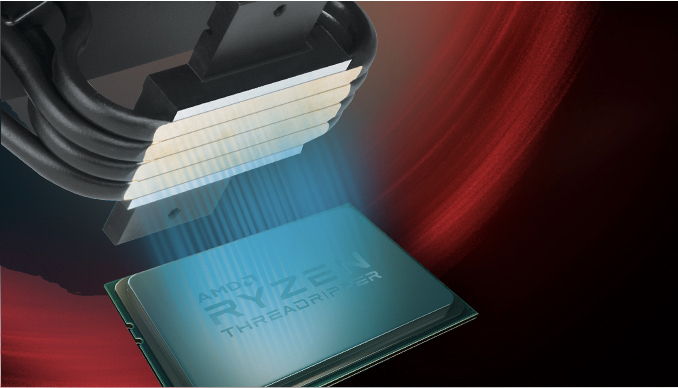
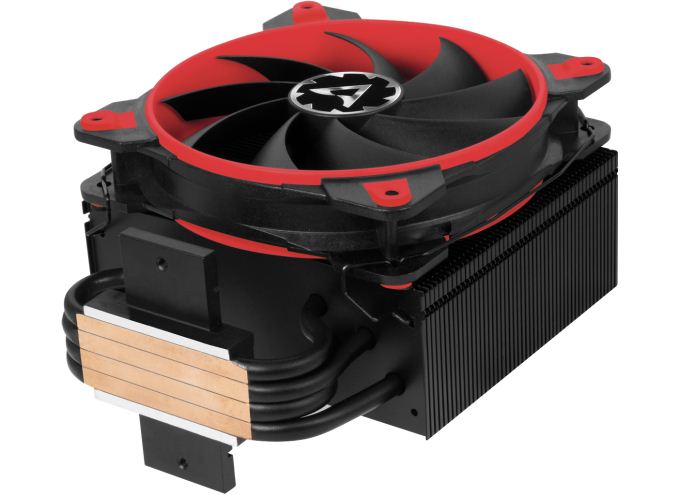
Arctic has announced a special version of its popular Freezer 33-series cooler, this time designed specifically for AMD’s Ryzen Threadripper microprocessor. The cooler is not only physically compatible with the Socket TR4 mounting mechanism, but the base has been extended to cover Threadripper’s integrated heatspreader (IHS) in order to improve cooling efficiency. The MCM architecture of AMD’s EPYC and Threadripper processors required AMD to design a CPU form-factor and socket that is explicitly rectangular rather than square-like. Since AMD’s Socket TR4 for the Threadripper CPUs derives from the Socket SP3r2 for servers, it has the same shape and dimensions. Most of the coolers on the market today were not designed for such a large rectangular contact like TR4 and they cannot cover 100% of its surface because they were developed for square-like CPUs. So while it is possible to use an existing cooler for AMD’s TR4 CPUs using special mounting brackets, its base does not cover part of the IHS and this is potentially going to lower its efficiency - cooling companies are now moving forward with larger TR4 specific designs to address this market.
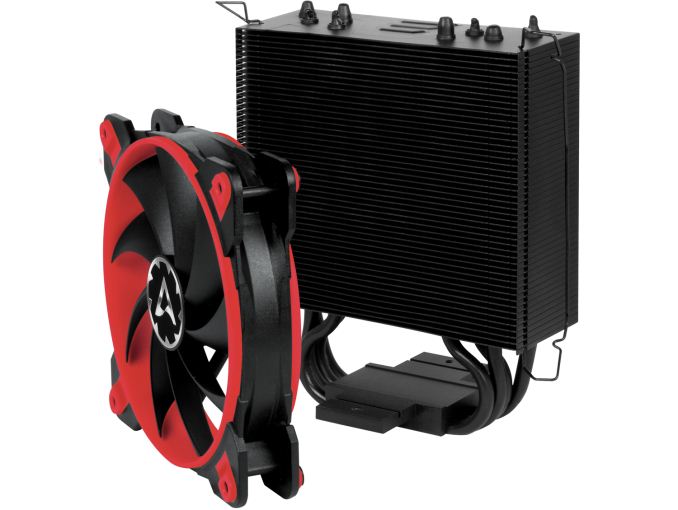
The Freezer 33 is currently the flagship air CPU cooler from Arctic. The device has four 6-mm copper heatpipes, 49 aluminum fins that are 0.4-mm thick, and a 120-mm fan. The main difference between the new Freezer 33 TR versus the regular Freezer 33 is a slightly longer copper base, as well as the black and red color scheme (black and white scheme is also available). Other than that, everything is the same. By redesigning the base of its Freezer 33 TR cooler for the sTR4, Arctic is aiming to enhance its thermal performance for AMD's new CPUs and potentially give some additional overclocking headroom for those who need it. Arctic claims that the Freezer 33 TR was developed to cool down CPUs with up to 200 W TDP, but its maximum cooling capacity is 320 W. The design of the cooler can support the installation of two fans (to maximize potential) as well as supporting the installation of memory modules of moderate height. Arctic’s fans for the Freezer 33 TR use fluid dynamic bearing motors, feature 200-1800 RPM speed and are PWM-controlled to minimize noise under light loads.
The redesign of the base of the cooler has affected the compatibility of the Freezer 33 TR cooler with mainstream Intel platforms. The new cooler is thus only compatible only with AMD’s TR4 and AM4, as well as Intel’s LGA2011-3 as well as LGA2066 sockets. The Arctic Freezer 33 TR is already available directly from the company and its resellers are set to get the cooler in the coming days or weeks. The product costs €47.99 and will be one the most affordable coolers designed specifically for AMD’s Ryzen Threadripper. Related Reading | ||||||||||||||||||||||||||||||||||||||||||||||||||||||||||||||||||||||||||||||||||||||||||||
| 2:00p | EKWB Unveils Threadripper Edition EK Supremacy EVO CPU Water Blocks
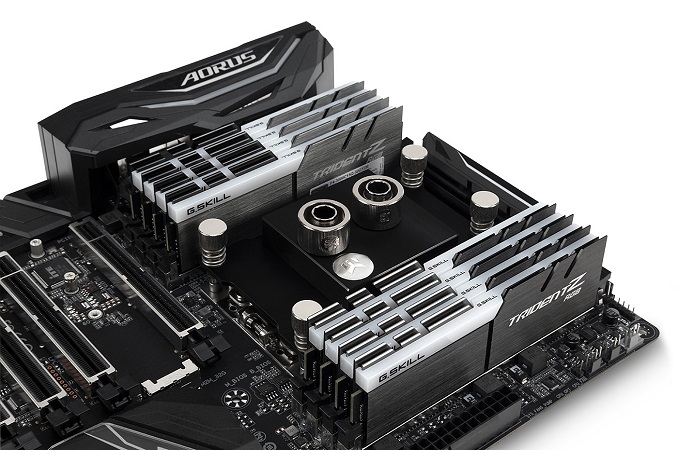
Since Threadripper was first spotted in the wild, enthusiasts interested in the CPU noticed just how big the CPU actually was. For the past several CPU generations, the size of the integrated heat spreader (IHS) on high-end platforms has not changed too much from either Intel nor AMD. Threadripper, however, is a game changer. It is nearly twice the size of an Intel LGA2066 CPU, and that much larger surface area is expected to have heatsink contact across the entire IHS for the best cooling results out of anything trying to cool it. A concern comes with existing heatsinks and their now diminutive base plates; they don’t cover the entire IHS. Heatsink and water-block makers are forced to update their designs or face potentially underwhelming performance due to the lack of complete coverage. EKWB has thus announced its new EK-Supremacy EVO Threadripper Edition CPU water block which covers the entire IHS.
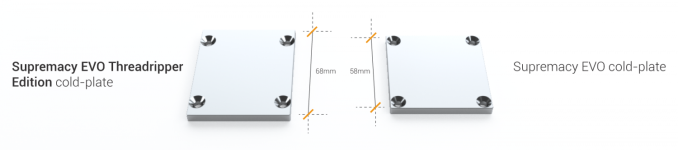
EK has redesigned the nickel plated machined copper base for a length of 68mm, which is up 10mm from the original Supremacy EVO. This small bump in size enables the cold plate to have complete coverage over the IHS. The Threadripper Edition Supremacy EVO comes pre-assembled and installs directly onto SocketTR4 motherboards, and is screwed down to the mounting holes surrounding the even bigger socket where Threadripper sits. As the block fits in the TR4 mounting holes, it should also compatible with AMD server socket SP3r2 motherboards. The TR Edition Supremacy EVO uses the EK-Supremacy EVO cooling engine, consisting of a specialized jet insert and jet plate combination. The water goes in through a standard G ¼” barb to the jet plate, then through a 52 groove micro-fin base (each 0.25mm apart). EKWB says the fins are oriented so the water inside the block is pushed up and down towards the CPU dies under the IHS.
EK Supremacy EVO Threadripper Edition has three different versions; Nickel, Acetal+Nickel, and Full Nickel. All three versions use a black steel mounting plate, with the thumb screws pre-installed, integrated into the block. The Nickel and Nickel+Acetal edition tops are CNC machined from POM high-grade acrylic glass. The 'plain' nickel version is transparent while the Nickel+Acetal has a black nickel coating around the acetal block top. The Full Nickel option is also CNC machined, but using nickel-plated brass as the base material. EK uses a pre-installed molded ABD polymer insert on all versions to 'ensure the optimal flow of water' through the block.
Prices range from $77.99 for the Nickel and Acetal+Nickel blocks to $99.99 for the Full Nickel.
The Supremacy EVO Threadripper Edition is available now for pre-order at the EKWB site. Shipments are expected to start on August 18th. Related Reading | ||||||||||||||||||||||||||||||||||||||||||||||||||||||||||||||||||||||||||||||||||||||||||||
| 4:00p | EVGA Launches SC17 1080 Laptop: Core i7-7820HK, GeForce GTX 1080, TB3
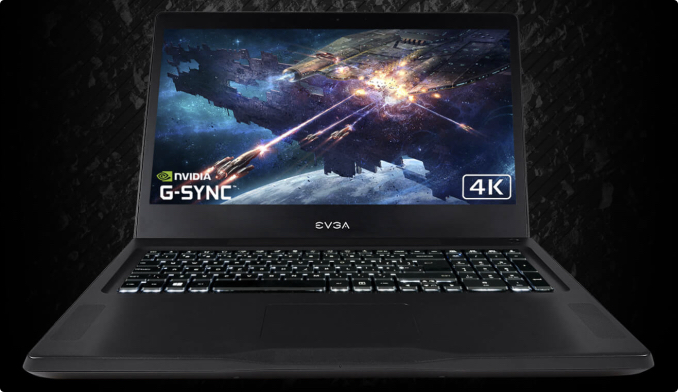
EVGA has launched its new flagship 17.3” laptop with a new CPU, a new GPU, and with Thunderbolt 3 support. The new SC17 1080 gaming notebook is thicker than its predecessors, but it features higher performance due to Intel’s latest Core i7-7820HK mobile CPU as well as NVIDIA’s flagship GeForce GTX 1080 graphics processor for laptops. Just like predecessors, the SC17 has a 4K display and allows its owners to overclock the CPU. EVGA introduced its first SC17 notebook in March 2016 with an aim to offer desktop-class performance and feature set in a clamshell chassis that is 1.05” (26.9 mm) thick: a 4K (3840×2160) display, an overclockable CPU, 32 GB of memory and a rather advanced storage sub-system are meant to serve this purpose. Earlier this year EVGA launched a new version of the SC17 with NVIDIA’s GeForce GTX 1070 GPU, bringing the performance of the system on par with other contemporary gaming laptops. This month, the company decided to increase the performance of its flagship notebook further and in a bid to do that, it had to introduce new chassis. The SC17 1080 laptop is 1.3” (30 mm) thick, but its weight is still around 4 kilograms, in line with many 17”-class gaming machines. The new enclosure enabled EVGA to equip the SC17 1080 with a new cooling system that can handle Intel’s new Core i7-7820HK CPU based on the Kaby Lake microarchitecture (4C/8T, 2.9G-3.90G) and NVIDIA’s GeForce GTX 1080 mobile GPU (2560 stream processors, 160 texture units, 64 ROPs) with 8 GB of GDDR5X memory. In addition, the flagship laptop now features a Thunderbolt 3 port to connect the system to various high-performance peripherals (such as external storage or displays).
Apart from the upgraded CPU and GPU, the new SC17 1080 has the same features and configuration as the original: it is equipped with 32 GB of G.Skill’s DDR4-2666 memory, a 256 GB M.2 NVMe SSD (PCIe 3.0 x4 interface) and a 1 TB hard drive with 7200 RPM spindle speed. When it comes to connectivity, the SC17 1080 is almost identical to its predecessors: it has an 802.11ac Wi-Fi + Bluetooth 4.2 module, a gigabit ethernet RJ-45 connector, one Thunderbolt 3/USB 3.1 Type-C port, three USB-A 3.0 ports, two mDP headers, an HDMI output, an FHD webcam and so on. Just like on the previous SC17 models, the SC17 1080 allows the user to fine-tune CPU voltages in a bid to maximize overclocking potential, as well as to overclock the GPU. If something goes wrong, there is a CMOS clear button on the chassis.
By making its SC17 1080 thicker than its predecessors, EVGA is going against the industry's recent trend to make gaming laptops thinner. EVGA's rivals Acer and ASUS have embraced NVIDIA's MaxQ initiative that enables notebook manufacturers to make their GeForce GTX 1080-based PCs thinner and lighter at the expense of performance in games (which is still very high, especially for a mobile PC). By contrast, EVGA wants its SC17 1080 to offer the highest performance possible (but without going extreme with add-on liquid cooling, etc.) and have an additional overclocking headroom both for the CPU and GPU. The new EVGA SC17 1080 laptop is not only thicker and faster than its predecessors, but it is also more expensive too due to the updates. The new gaming laptop costs $2999.99, up from $2549.99 for the SC17 1070. Related Reading | ||||||||||||||||||||||||||||||||||||||||||||||||||||||||||||||||||||||||||||||||||||||||||||









| << Previous Day |
2017/08/14 [Calendar] |
Next Day >> |