[Most Recent Entries] [Calendar View]
Monday, August 21st, 2017
- Unannounced 8th Generation Core 15W U-Series CPUs Appear on Intel’s Public Price List
- Intel to Announce 8th Generation Core Processors on August 21st
- Coffee Lake Not Supported by Intel’s 200-Series Motherboards
- Intel Officially Reveals Post-8th Generation Core Architecture Code Name: Ice Lake, Built on 10nm+
| Time | Event | ||||||||||||||||||||||||||||||||||||||||||||||||||||||||||||||||||||||||||||||||||||||||||||||||||||||||||||||
| 3:01a | Intel Launches 8th Generation Core CPUs, Starting with Kaby Lake Refresh for 15W Mobile This year has been enjoyably eventful for processor releases. Intel launched their 7th Generation processors, Kaby Lake, in January. Then we had AMD release their new high-performance microarchitecture in Ryzen, EPYC and Threadripper. Intel then launched their Skylake-SP Xeon Scalable Platform, based on an upgraded 6th Generation core design, and we’re expecting new AMD APUs for mobile later this year. And adding to that list this morning is once again is Intel. Today the company is launching its new 8th Generation family of processors, starting with four CPUs for the 15W mobile family. The launch of these processors was perhaps spoiled by Intel jumping the gun a few days ago and listing the processors on its own public price list, but also we have started to see laptop and mobile designs being listed at various retailers before the official announcement. There are two elements that make the launch of these 8th Gen processors different. First is that the 8th Gen is at a high enough level, running basically the same microarchitecture as the 7th Gen – more on this below. But the key element is that, at the same price and power where a user would get a dual core i5-U or i7-U in their laptop, Intel will now be bumping those product lines up to quad-cores with hyperthreading. This gives a 100% gain in cores and 100% gain in threads.
Obviously nothing is for free, so despite Intel stating that they’ve made minor tweaks to the microarchitecture and manufacturing to get better performing silicon, the base frequencies are down slightly. Turbo modes are still high, ensuring a similar user experience in most computing tasks. Memory support is similar – DDR4 and LPDDR3 are supported, but not LPDDR4 – although DDR4 moves up to DDR4-2400 from DDR4-2133.
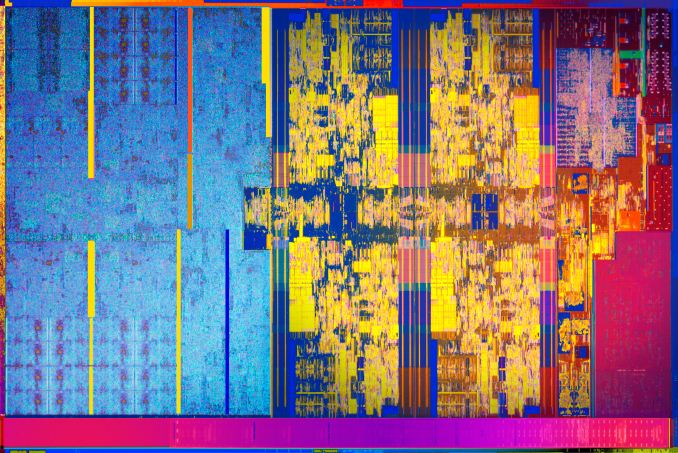
Another change from 7th Gen to 8th Gen will be in the graphics. Intel is upgrading the nomenclature of the integrated graphics from HD 620 to UHD 620, indicating that the silicon is suited for 4K playback and processing. During our pre-briefing it was categorically stated several times that there was no change between the two, however we have since confirmed that the new chips will come with HDMI 2.0/HDCP 2.2 support as standard, removing the need for an external LSPCON for this feature. Other than this display controller change however, it appears that these new UHD iGPUs are architecturally the same as their HD predecessors. Fundamentally these are what Intel calls a ‘4+2’ silicon design, featuring four cores and GT2 integrated graphics, whereas the last generation used 2+2 designs. The 4+2 design was also used in the mainstream desktop processors, suggesting that Intel is using those dies now for their 15W products rather than their 45W+ products. That being said, Intel is likely to have created new masks and revisions for this silicon to account for the lower power window as well as implementing HDCP 2.2 support and other minor fixes.
Now by having quad-core parts in the 15W form factor, performance on the new chips is expected to excel beyond what has been available from the previous generation of Core i5-U and Core i7-U processors. However Intel and its OEMs have a tight balancing act to walk here, as 15W is not a lot of thermal headroom for a two core CPU, let alone a four core one. At the same time we have started to see the 15W U-series parts find their way into smaller and even fanless notebook designs, which are more prone to throttling under sustained workloads, and quad core CPUs in this segment could exacerbate the issue. However, for the larger 13-15-inch designs with active cooling, moving down from a 35W-45W quad core processor down to 15W will likely offer substantially better battery life during intense loading, should OEMs swap out H-series chips for the new U-series chips in their designs. Intel’s big aim with the new processors is, as always, to tackle the growing market of 3-5+ year old devices still being used today, quoting better performance, a better user experience, longer battery life, and fundamentally new experiences when using newer hardware. Two years ago Intel quoted 300 million units fit into this 3-5+ year window; now that number is 450 million.
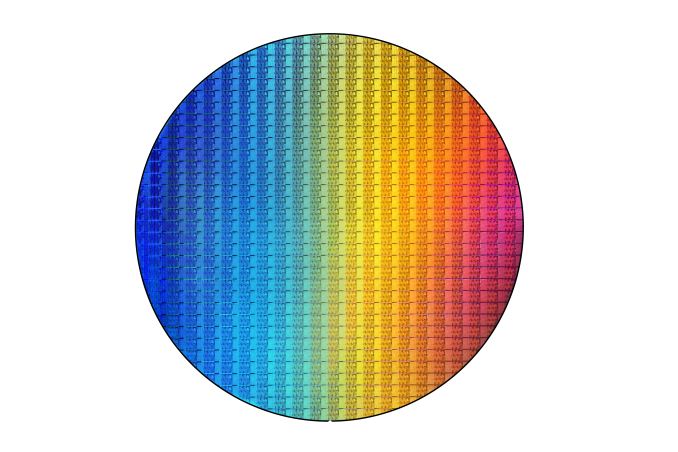
Intel provided this shot of a wafer containing these new refresh dies, which by my math gives 22 x 32.7 dies per wafer. Giving some margin for die spacing, this correlates to a 13.6 x 9.1 mm die, at 124 mm2 and 478 full dies per wafer. At a tray cost of $409 per Core i7, and running at ~124mm2 per die, that makes an interesting metric of $3.30 per square millimeter. Intel no longer officially provides die sizes or transistor counts, though a list of $/mm2 would be interesting to compile - for reference some of the high-end Xeons push north of $19/mm2. Kaby Lake Refresh? 14+? Where’s my Coffee (Lake)?So despite Intel launching its 7th Generation family in January, today Intel is formally launching the 8th Generation only eight months later. To explain why Intel is breaking the usual 12-18 month cadence for the generation product, it comes down to product positioning. In the past we are used to a new numbered generation to come with a new core microarchitecture design. But this time Intel is improving a core design, calling it a refresh, and only releasing a few processors for the mobile family. We expect that Intel’s 8th Generation will eventually contain three core designs of product on three different process design nodes: the launch today is Kaby Lake Refresh on 14+, and in the future we will see Coffee Lake on 14++ become part of the 8th Gen, as well as Cannon Lake on 10nm.
Now the Generation name is no longer in direct correlation with underlying core microarchitecture or lithography process. This is going to confuse some users and anger others, although Intel’s official line is along the lines of the fact that lithography process nodes are harder to optimize, smaller nodes benefit in yield from smaller cores and as such their product portfolio has to expand beyond traditional naming in order to provide the appropriate product and the appropriate price point. In our pre-briefings, Intel only mentioned Coffee Lake in the context of the fact that today’s launch is not Coffee Lake. Because media were expecting this to be Coffee Lake (and expecting it to be a desktop processor launch), the question ‘is this Coffee Lake’ was actually asked several times, and the answer had to be repeated. These four new CPUs are still Kaby Lake CPUs built on the same 14+ technology, with minor updates, and bringing quad cores to 15W.
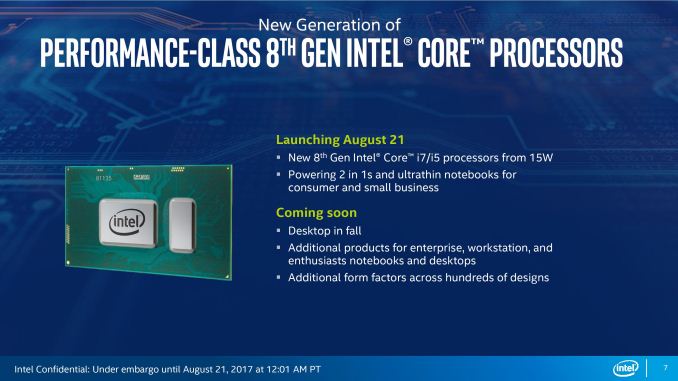
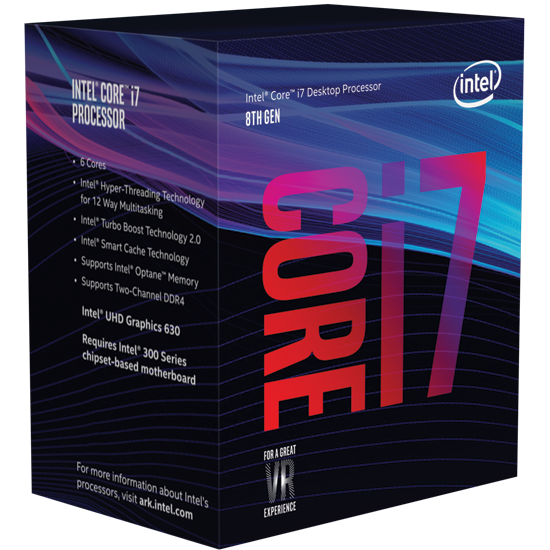
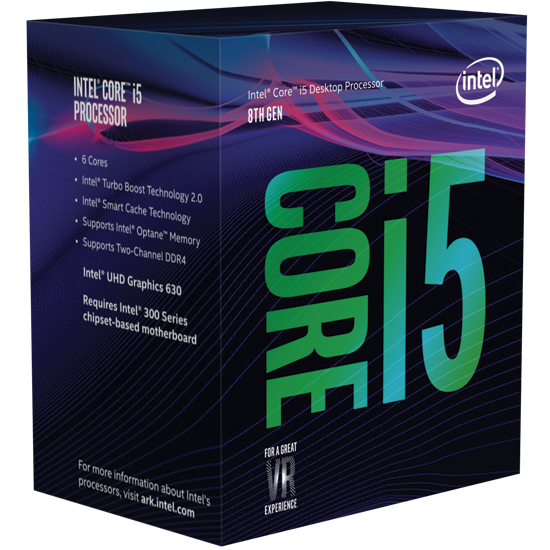
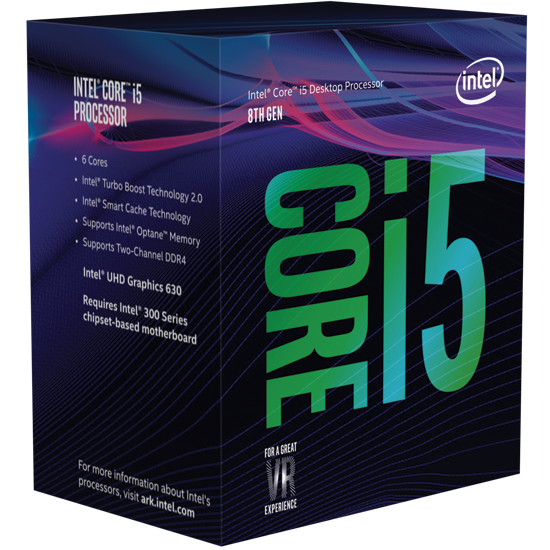
So when is Coffee Lake on 14++ (or Cannon Lake) coming? Intel only stated that other members of the 8th Generation family (which contains Kaby Lake Refresh, Coffee Lake and Cannon Lake) are coming later this year. Desktop will come in the autumn, and additional products for enterprise, workstation and enthusiast notebooks will also happen. As for today's 8th Generation U-series announcement, Intel tells us that we should start seeing laptops using the new CPUs hit the market in September. Update: Along with the product specs for the new mobile SKUs, Intel has also uploaded the new box art for the desktop 8th Gen Core parts to their website. The boxes confirm, among other things, that once these desktop parts will launch they'll have 6 cores (with HT for the i7) and require 300 series motherboards. Related Reading | ||||||||||||||||||||||||||||||||||||||||||||||||||||||||||||||||||||||||||||||||||||||||||||||||||||||||||||||
| 12:01p | Hot Chips: Microsoft Xbox One X Scorpio Engine Live Blog (9:30am PT, 4:30pm UTC) This week it's the Hot Chips conference in Cupertino. We're sat nice and early, with the first talk today from Microsoft. John Sell, a Microsoft hardware veteran, is set to talk about the Scorpio Engine, found in the Xbox One X. It's practically the only talk this week where the slides were not given out early, so I wonder what will be discussed, especially given the large amount of interest in what the Scorpio Engine is. So never mind the eclipse, let's talk consoles.
| ||||||||||||||||||||||||||||||||||||||||||||||||||||||||||||||||||||||||||||||||||||||||||||||||||||||||||||||
| 6:45p | Hot Chips: Intel Knights Mill Live Blog (4:45pm PT, 11:45pm UTC) Another talk from Hot Chips, this time on Intel's Knights Mill (KNM). The Intel Knights family stems from their Xeon Phi product line, although KNM is a bit different, with machine learning specific changes. It's not a completely new Xeon Phi design, but Intel wants to go after the machine learning market. Today's talk will go into some of those changes. (We're battling some wifi here, so pictures may come later). | ||||||||||||||||||||||||||||||||||||||||||||||||||||||||||||||||||||||||||||||||||||||||||||||||||||||||||||||
| 8:30p | Silverstone Launches TOB03 ODD: 9.5-mm CD/DVD/BD/BDXL Burner
SilverStone has introduced its first ultra-slim ODD that can read and record CD, DVD, Blu-ray and BDXL media. The drive is not a technological breakthrough, but it is going to be one of a few 9.5-mm BD/BDXL-supporting ODDs on the market. Of course, SilverStone is primarily known for its cases, PSUs and coolers, so the launch of the TOB03 ODD demonstrates that the company sees demand for such products from those who buy its SFF chassis. Optical discs have been losing popularity for years. Nowadays the vast majority of audio-visual content (games, music, movies, etc.) is distributed digitally via services like iTunes, Netflix, Origin and Steam. Due to the shrinking market of drives and discs, a number of ODD makers and optical media manufacturers ceased production and focused on other markets. However, a lot of people still own large collections of CDs, DVDs and Blu-ray discs which need something to access the media. Moreover, Blu-ray and Ultra HD Blu-ray formats still offer the highest quality 1080p and 4K movies due to massive bitrates that streaming or digital download services do not offer, due to network restrictions for most. As a result, while demand for ODDs in general is not high, it exists and there are people willing to pay for such drives.
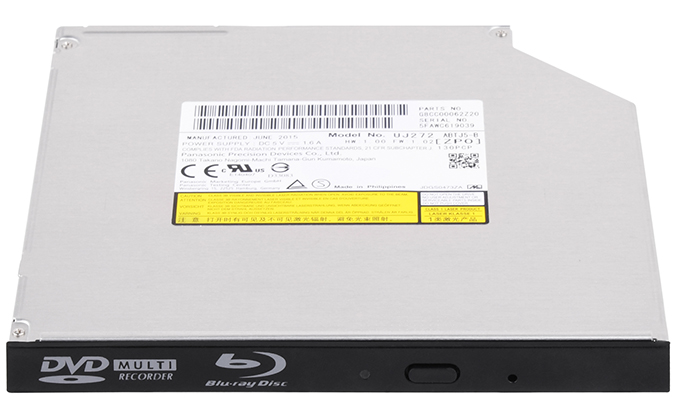
From SilverStone’s point of view, these are people who buy its SFF PC cases, SFX PSUs and coolers for home theater PCs and then go to other suppliers for optical drives. From a business perspective, it makes a lot of sense for SilverStone to offer its customers premium ODDs in addition to what it already sells them. However, there is a problem. While SilverStone makes various products in-house, producing optical drives is not what it does and sourcing lasers, motors and other ODD components is sometimes tricky in a world where only a few companies produce them. Therefore, SilverStone had to find an OEM to manufacture the hardware. Apparently, there are only two companies on the planet that make 9.5-mm Blu-ray/BDXL burners: one is LG and another is Panasonic. The latter is the maker of the TOB03 and this is something that SilverStone does not seem to hide: the official photos of the drive clearly reflect that this is indeed the Panasonic/Matshita UJ272. The drive has been around for a while, but given the relatively slow evolution of ODDs in general, this is hardly a problem. Moreover, when it comes to availability of ultra-slim BD/BDXL burners, the more the merrier as right now their choice and supply are very limited. SilverStone's offering does not expand the former, but it clearly boosts the supply by making the drive available from the company's usual channels.
The SilverStone TOB03 (aka Panasonic UJ272) uses the SATA 3.0 interface (with a Slimline SATA connector) and can read and record CD (CD, CD-R, CD-RW, HS-RW, US-RW), DVD (DVD, DVD±R, DVD±R DL, DVD±RW, DVD-RAM) and Blu-ray (BD, BD-R SL/DL/TL/QL, BD-RE SL/DL/TL) discs. The drive has a 2 MB buffer underrun protection (which is lower compared to other high-end ODDs) and supports 6x CAV burning speed for popular BD-R SL/DL (25 GB/50 GB) media as well as 4x PCAV burning speed for BR-R TL/QL (100 GB/128 GB) discs. As for supported Blu-ray formats, both SilverStone and Panasonic declare Blu-ray and Blu-ray 3D, but not UHD Blu-ray (at least for now). Since SilverStone’s TOB03 comes in retail packaging only, the ODD always comes with a 12.7 mm bezel to be compatible with cases that support slim drives as well as a slimline SATA adapter featuring a flexible braided cable for easier installation (which contrasts to OEM drives from renowned makers that come without any cables in some regions).
SilverStone’s TOB03 ODD burner will be available from the company’s partners in the coming weeks. The company does not disclose anything about pricing, but since Panasonic’s UJ272 is available for $70 to $90 depending on the retailer, expect the TOB03 to be priced in the same ballpark. Related Reading: | ||||||||||||||||||||||||||||||||||||||||||||||||||||||||||||||||||||||||||||||||||||||||||||||||||||||||||||||
| 9:00p | NVIDIA Brings Back Destiny 2 Bundle for GeForce GTX 1080 & 1080 Ti Cards
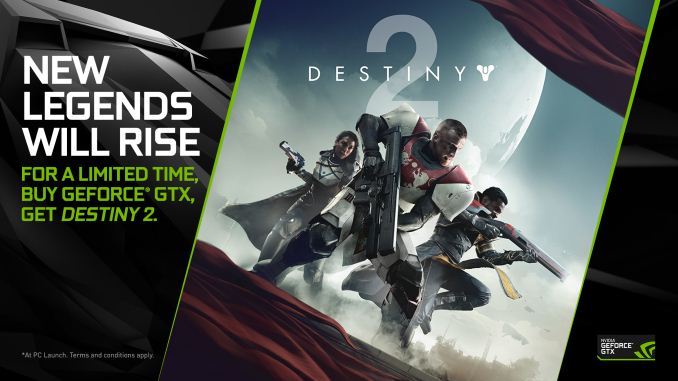
From today to September 5th (or while supplies last), NVIDIA is bringing back June’s Destiny 2 bundle for GTX 1080 and 1080 Ti cards, systems, and laptops, a week ahead of Destiny 2’s PC Beta launch on August 28th. As a reminder, eligible systems include NVIDIA’s own GeForce GTX Battlebox products. The bundle includes Destiny 2 at its October 24th launch date, as well as three in-game items: the Coldheart Exotic Rifle, Kill Tracker Ghost, and Salute emote. These items may also be redeemed by people who purchased the bundle in June. The upcoming massively multiplayer online sci-fi first-person shooter, a concept Bungie previously described as a “shared world shooter”, will be preceded by an August 24th NVIDIA Game Ready driver. Additionally, Destiny 2 will support High Dynamic Range (HDR) and SLI, a result of NVIDIA's collaboration with Activision and Bungie. HDR itself will available to test during the PC Beta.
This latest iteration of the bundle does not mention Early Access codes for the PC Beta, although Bungie does state that Destiny 2 preorders through the Blizzard store come with Early Access. In context, Destiny 2 has an exclusive Early Access PC Beta on August 28th, with the general Open Beta running from the 29th to 31st. In any case, NVIDIA is also giving away Early Access codes in celebration of Gamescom, and will announce winners through GeForce Experience on August 25th. As of August 2017, this is the only active NVIDIA promotional bundle. As before, Destiny 2 game codes may only be redeemed until 30 days after PC launch date. Codes must be redeemed through GeForce Experience (3.2.2 or higher). After redeeming through GeForce Experience, Destiny 2 must be subsequently redeemed with a Blizzard account. Be sure to verify the participation of any vendors purchased from as NVIDIA likely will not give codes for purchases made from sellers that are not participating. | ||||||||||||||||||||||||||||||||||||||||||||||||||||||||||||||||||||||||||||||||||||||||||||||||||||||||||||||
| 10:05p | AMD Releases Radeon Software Crimson ReLive Edition 17.8.1
Today, AMD has released Radeon Software Crimson ReLive Edition 17.8.1, a unified driver supporting older products as well as RX Vega cards. This update follows last Monday’s RX Vega64 launch and accompanying RX Vega specific beta driver. In addition to unifying the Radeon Software driverset, 17.8.1 brings game support and a slew of bug fixes. Featuring Driver Version 17.30.1051 (Windows Driver Store Version 22.19.666.1), Radeon Software 17.8.1 brings support for Agents of Mayhem, launched last week, and Bethesda’s Quake Champions Early Access, which starts on August 22nd. On the topic of Bethesda, 17.8.1 also includes a new optional component, unchecked by default: a download link to the Bethesda.net launcher. If selected, a Bethesda.net homepage link will be created in the Radeon Software Gaming tab, under the “Show Partner Programs” button.
Moving on to bug fixes, AMD has addressed a few FreeSync matters: stuttering in FreeSync displays when watching fullscreen video content, and flickering/brightness issues with certain Samsung FreeSync monitors. Similarly, AMD has resolved other playback-related bugs: HDCP error codes in certain protected content applications while playing Blu-ray content, and tearing or choppy playback when Enhanced Sync was enabled for video playback on desktop or YouTube playback in Google Chrome. Lastly, AMD has resolved intermittent HDMI signal loss in certain HDR enabled TVs. Moving on to game fixes, AMD has resolved intermittent Grand Theft Auto V crashes, as well as extended load times in Forza Horizon 3. RX 380 crashes in Chapter 13 of Tekken 7 were also fixed. A few known issues for RX Vega remain: WattMan still may not reach applied overclock states, and the Radeon Settings Gaming tab “Reset” option may enable “HBCC Memory Segment” instead of setting it to the default disabled state. The updated drivers for AMD’s desktop, mobile, and integrated GPUs are available through the Radeon Settings tab or online at the AMD driver download page. More information on this update and further issues can be found in the Radeon Software Crimson ReLive Edition 17.8.1 release notes. | ||||||||||||||||||||||||||||||||||||||||||||||||||||||||||||||||||||||||||||||||||||||||||||||||||||||||||||||








| << Previous Day |
2017/08/21 [Calendar] |
Next Day >> |