[Most Recent Entries] [Calendar View]
Saturday, August 26th, 2017
- AOC Launches the AG352QCX: 35-Inch 200 Hz 2560×1080 Curved Display with Adaptive-Sync
- AOC Expands AGON Family with Curved AG322QCX and AG272FCX 144 Hz Displays
- ASUS ROG Strix XG27VQ Available: 27” Curved, FHD@144Hz & FreeSync w/ELMB
- BenQ Announces ZOWIE XL2546 ‘eSports’ Display: 24'', FHD, 240 Hz, DyAc ULMB Tech
- Samsung Announces First Freesync 2 Monitors: CHG70 & CHG90 - Quantum Dots, Up to 49”, 144 Hz, DCI-P3
- Acer Predator Z35P Available for Order: Curved 35" with 3440×1440@120 Hz and G-Sync
- HP and MAINGEAR Team Up for Omen X High-End Gaming PC
- ASUS Reveals The Ultra-Slim ROG Zephyrus Laptop With GTX 1080 Max-Q
- Acer Announces Predator Triton 700 Gaming Laptop: Core i7, GeForce GTX 10 Series, & 1 TB SSD
- Razer Blade Gets Core i7-7700HQ, Adds 4K Touchscreen, 1 TB SSD Options
- Razer Re-Launches The Razer Blade Pro: GTX 1080 And 4K G-SYNC
- Lenovo Launches Legion Branded Gaming Laptops
| Time | Event | |||||||||||||||||||||||||||||||||||||||||||||||||||||||||||||||||||||||||||||||||||||
| 9:00a | AOC to Launch Curved QHD Displays with 0.5 ms Response Time in 2018
In a surprising move, AOC has announced plans to launch a new series of AGON gaming displays with a 0.5 ms response time in Q2 of next year. The displays will be curved, will feature a QHD resolution and will rely on a new TN panel from AU Optronics. The monitors will support adaptive refresh rate technologies from AMD and NVIDIA and will certainly not be cheap. The big question with this announcement is of course how exactly did AUO and AOC manage to decrease the GtG response time of a TN panel to 0.5 ms? So far, AUO has not publicly announced this panel. Moreover, given the striking similarity of the panel used for the AG273QCX/AG273QCG and Acer's Predator Z271UV (same size, curvature, brightness, ‘wide gamut’, up to 165 Hz refresh rate, etc.), it is possible that the panels are close relatives, but the one used by AOC features a technique that cuts GtG response time from 1 ms to 0.5 ms. Either way, details are unfortunately slim at this time, but given AOC's bold claim, this bears further watching. Otherwise, AOC’s AGON AG273QCX and AGON AG273QCG have a lot in common: both are based on the same 27” curved display panel from AUO featuring a 2560×1440 resolution, a wide color gamut (more on that below), very high refresh rates of 144 and 165 Hz, 400 nits brightness, as well as the aforementioned 0.5 ms response time. The key differences between the AG273QCX and the AG273QCG are different adaptive refresh rate technologies: the former supports AMD’s FreeSync 2 with HDR, the latter features a bit higher refresh rate and NVIDIA’s G-Sync (sans HDR). The lack of HDR on the G-Sync model presumably being due to the fact that NVIDIA mandates at least 1000 nits for its G-Sync HDR platform.
Unfortunately, AOC does not specify what exactly the “Wide Color Gamut” support mentioned in its slides means. But given that we have seen a degree of DCI-P3 support on the TN-based Acer Predator Z271UV, this is a distinct possibility for the new AOC displays as well. Along those lines, one of AOC’s representatives said in a conversation with PCGamesN website that the new TN panel from AUO is not only fast and relatively bright, but also has a considerably improved color quality, which the rep compared to IPS-based displays. The official for AOC confirmed that the panel still has TN’s traditional 170°/170° viewing angles, but argued that gamers would not feel it due to their usage model. AOC promises that the AGON AG273QCX featuring the FreeSync 2 with HDR will hit the market in April 2018 and will cost €599 ($706). The G-Sync-supporting AGON AG273QCG is expected to be available in May 2018 for the price of €699 ($824). Keep in mind that since displays are based on brand new panels, their MSRPs and ETAs at the moment are preliminary and they may change.
The actual slide demonstrated by AOC at Gamescon has a typo: both displays are based on a TN panel. Sources: PCGamesN (via TechPowerUp). | |||||||||||||||||||||||||||||||||||||||||||||||||||||||||||||||||||||||||||||||||||||
| 12:00p | Lian-Li Reveals PC-V3000: Full-Tower Aluminum Chassis
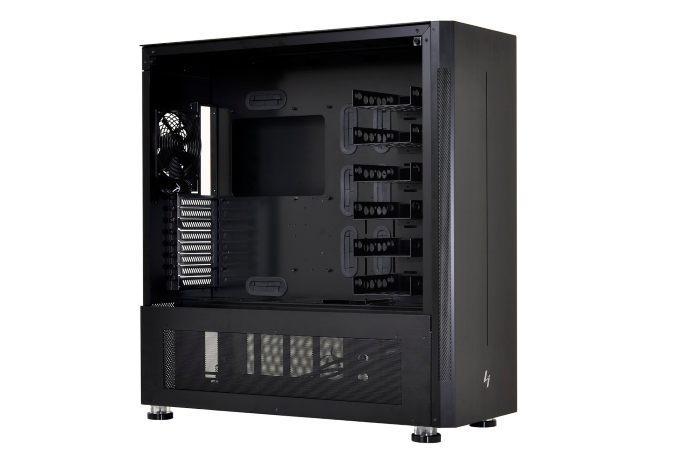
Lian-Li has been rather busy over the past couple of months announcing and releasing new or updated computer chassis. Cases like the diminutive Mini-ITX tower in the PC-Q39, the PC-T70 open air test bench, PC-01 Mid-Tower, all the way up to their Motorized Adjustable PC Desk in the DK-05, have been made public over that time. Continuing not to rest on their laurels, Lian-Li announced their latest product in the full-tower PC-V3000. First spotted in late 2016, the PC-V3000 is a continuation of their flagship line of full-tower PC cases, with the goal of “being the ultimate Aluminum and tempered glass full-tower PC.” Internally, the case is constructed of high-quality steel that's said to improve the case's structural rigidity, durability, and acoustic performance. The external panels are made of Lian-Li's signature brushed aluminum and use their rivet locking mechanism for easy removal or installation. The angled sides of the front fascia are where air comes into the top two compartments. The tempered glass panel is on the left side of the case allowing owners to show off the hardware inside in the first chamber.
The full-tower chassis was designed for "massive liquid cooling radiators" and is Lian-Li’s first case capable of holding four radiators. A 480mm radiator can fit at the bottom of the case, while the top is able to house up to a 420mm radiator. The front panel supports up to either a 360 or 280mm radiator, with a final 120mm radiator at the rear. There is quite a bit of cooling power available if users stuff this case full of radiators. Inside the case, all nine 3.5” drive bays are removable, with six in the main chamber, and three in the bottom chamber. Two additional 2.5” drives can be mounted on the rear of the motherboard tray, for a total of ten 2.5” (when only 2.5” are used). Those mount positions can be used for “flexible mounting” of up to four pump/reservoir mounts. Lian-Li also includes two individual supports to prevent GPU bending on long and heavy cards. The case supports ATX PSUs up to 300mm long, GPUs up to 170mm tall and 360mm long, and CPU coolers can be up to 170mm in height as well. Pretty spacious, but always check the specifications for compatibility.
The case integrates subtle RGB lighting with an included front panel LED strip running vertically in the brushed aluminum panel (the line you see above the Lian-Li symbol). There are dials to control them hidden behind the front panel. The I/O panel, located on the top, has a single USB 3.1 Type-C connector, two USB3.0 ports, and an HDMI port (good for VR systems). Additionally, there are front panel audio jacks for a microphone and headphones rounding out I/O connectivity.
Below is listed the full specifications from the Lian-Li website:
We can expect to see these on store shelves and websites in the US around the middle of September. The case is priced at $449.99. Gallery: Lian-Li PC-V3000 Full-Tower Chassis
      Related Reading: | |||||||||||||||||||||||||||||||||||||||||||||||||||||||||||||||||||||||||||||||||||||
| 3:00p | HP Announces Omen X Laptop: 17.3” LCD, Core i7 + GeForce GTX with Overclocking
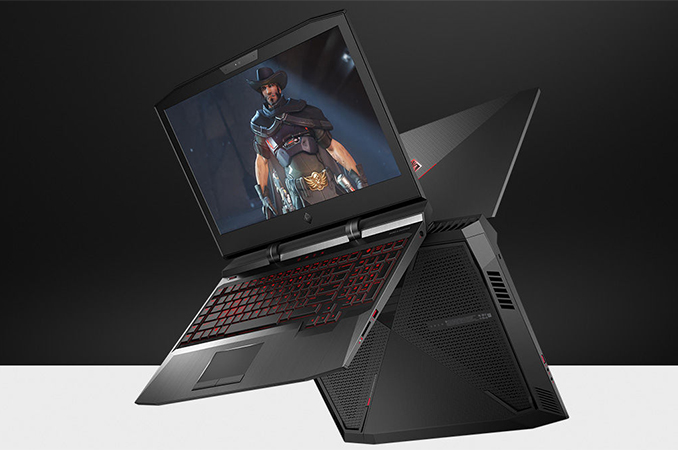
HP has announced its first Omen X gaming notebook targeting the most demanding segment of the market — customers seeking for maximum performance and not afraid of overclocking. The new systems will feature ultra-high-end mobile components, such as Intel’s unlocked Core i7 mobile CPUs, NVIDIA’s GeForce GTX 1070/1080 GPUs, high-end DIMMs, advanced SSDs, and will be user-upgradeable, just like the existing Omen X desktops. The Omen X laptops will be available later this year in multiple configurations. Unlike some of its rivals on the market of gaming PCs in general, HP has not addressed the ultra-high-end of the gaming market either with desktops (the company does not offer any HEDT-based machines) or with laptops for quite some time. HP’s Omen gaming notebooks available today are rather powerful and up-to-date, but they don’t offer overclocking and voltage tweaking capabilities to those who want to push their PCs to the limits. With the new Omen X laptop, HP is changing its approach and getting to a new segment of the market, which can hardly boast to be high volume, but promises to be lucrative.
Like many other enthusiast-class systems, the HP Omen X laptop will be all about customization and choice. The PC will feature a 17.3” display and HP will offer to selection of two panels: a 4Kp60 panel and a FHD panel with a 120 Hz refresh rate. Such a choice makes a lot of sense since some may consider 3840×2160 resolution too high for a 17.3” screen, but find a 1920×1080@120 Hz especially suitable for gaming. Both panels are expected to support NVIDIA’s G-Sync adaptive refresh rate technology. HP does not want to disclose all the specifications of the Omen X just now, but it says that select models will be come with unlocked/overclockable processors, which means Intel’s Core i7-7820HK CPU — the only overclocking-friendly mobile Kaby Lake processor in Intel’s arsenal (at present). The CPU will be paired with DDR4 memory operating at up to 2800 MT/s (i.e., overclocked). As for graphics, HP will use NVIDIA’s GeForce GTX 1070 and 1080 notebook GPUs, which will be overclockable and/or factory-overclocked. HP says that select Omen X configurations will be equipped with a cooling system featuring a vapor chamber and four 3.5-mm heat pipes that transfer heat to four radiators. As for storage sub-system, HP says that the Omen X laptop will be able to accommodate two SSDs in RAID 0 as well as a 2.5” HDD with 7200 RPM spindle speed for bulk storage, wedding performance and capacity. HP promises that memory and storage upgrades of the Omen X notebook will be easy because all components will be accessible by opening up a single bay.
Connectivity capabilities of the Omen X laptop will be rather rich: it will feature a 802.11ac Wi-Fi and Bluetooth module (with software that prioritizes packets from gaming applications), an Ethernet port, two Thunderbolt 3 (USB-C) headers, one HDMI 2.0a output, one Mini DisplayPort, three USB 3.0 Type-A connectors, an SD card reader as well as 3.5-mm audio connectors for headphones (supporting DTS Headphone:X enhancements) and a microphone. Speaking of audio, the PC will also feature an audio sub-system co-developed with Bang & Olufsen.
To top things off, the HP Omen X will come with a mechanical RGB LED-backlit keyboard with programmable keys and N-key rollover support. RGB lights will also be present on the backside of the display lid and across the chassis (eight zones in total). All RGB lights will be customozable using the Omen Command Center Software.
The HP Omen X laptop will hit the market sometimes in Q4. An entry-level configuration featuring NVIDIA’s GeForce GTX 1070 will cost $2,299, but the remaining specs are yet to be confirmed. One of the things that we can be sure about is that HP’s rather massive Omen X will not be easily transportable because of its 4.9 kilograms (10.8 lbs) weight. Related Reading: | |||||||||||||||||||||||||||||||||||||||||||||||||||||||||||||||||||||||||||||||||||||






| << Previous Day |
2017/08/26 [Calendar] |
Next Day >> |