[Most Recent Entries] [Calendar View]
Friday, September 8th, 2017
- HTC & Intel Partner on WiGig Wireless for Vive VR Headset
- AMD Acquires 60 GHz Wireless IP and Staff from Nitero
- Wi-Fi Alliance Begins to Certify 802.11ad WiGig Devices
- Netgear Launches 802.11ad-Enabled Nighthawk X10 (R9000) Wi-Fi Router
- Sirin Labs Solarin Launched: World’s First Commercial Smartphone with WiGig
- WiGig Startup Nitero Launches NT4600 802.11ad Solution for Mobile Platforms
- Samsung Announces First Freesync 2 Monitors: CHG70 & CHG90 - Quantum Dots, Up to 49”, 144 Hz, DCI-P3
- Samsung Investing in 3840x1080 and 3840x1200 Curved Displays at 144 Hz
- Philips Demos 328P8K: 8K UHD LCD with Webcam, Docking, Coming in 2018
- Philips Begins to Sell 43” 4K IPS BDM4350UC Display for $799
- Philips BDM4037UW Goes on Sale: 40 Inch 4K Curved Display for $800
- LG 43UD79-B Launched: 42.5-inch 4K IPS with FreeSync
- G.Skill Announces Quad-Channel DDR4-4200 Kit for Intel Skylake-X CPUs
- DRAM and Motherboard Makers Demonstrate Quad-Channel DDR4-4000+ Operation
- G.Skill Announces 16 GB DDR4-4333 Memory Kit for Intel Kaby Lake CPUs
- G.Skill Announces Trident Z RGB DDR4 Kits with 16 GB Modules, Up to 128 GB
- AMD Announces Ryzen AGESA 1.0.0.6 Update: Enables Memory Clocks Up To DDR4-4000
- Corsair Vengeance RGB DDR4 Memory Modules with LEDs Now on Sale
| Time | Event | |||||||||||||||||||||||||||||||||||||||||||||||||||||||||||||||||||||||||||||||||||
| 10:00a | Intel Discontinues WiGig Cards, Antenna and Sink, Set to Focus on WiGig for VR
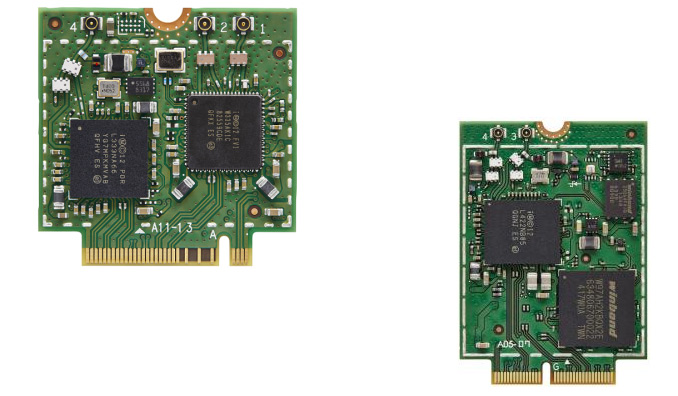
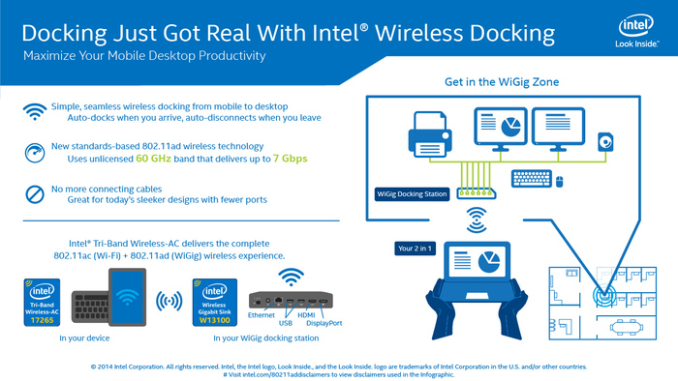
In a surprising move, Intel has announced plans to altogether discontinue their 802.11ad products. The company intends to cease shipments of all of its current-generation WiGig devices by late 2017. Intel has not announced any replacements for the 802.11ad parts and says that it would focus on WiGig solutions designed for VR applications. Intel is formally initiating the EOL program for the Wireless Gigabit 11000 and Tri Band Wireless-AC 18260 controllers, the Wireless Gigabit Antenna-M M100041 antenna and the Wireless Gigabit Sink W13100 sink today (September 8). Intel is asking its partners to place their final orders on its WiGig-supporting network cards, antenna and sink by September 29, 2017. The final shipments will be made by December 29, 2017. Typically, Intel continues to sell its products for at least several quarters after it initiates its product discontinuance plan. Four months is a relatively short period between the start of the EOL program and its finish, which may indicate that the company has a relatively limited amount of customers using the WiGig products and it does not expect them to be interested in the devices in 2018 and onwards. Last year Intel already announced EOL plan for its Tri Band Wireless-AC 17265 controllers and select W13100 dock SKUs. Coincidentally, the company stops their shipments on December 29, 2017, as well.
The WiGig short range communication standard enables compatible devices to communicate at up to 7–8 Gb/s data rates and with minimal latencies, using the 60 GHz spectrum at distances of up to ten meters. WiGig cannot replace Wi-Fi or Bluetooth because 60 GHz signals cannot penetrate walls, but it can enable devices like wireless docking stations, wireless AR/VR head-mounted displays, wireless storage devices, wireless displays, and others that are in direct line of sight. Intel’s current-generation WiGig products were designed primarily for notebook dockings. A number of PC makers released laptops featuring Intel’s Tri Band Wireless-AC 18260/17265 controllers and supporting docks featuring Intel’s Wireless Gigabit Sink W13100. These WiGig-enabled solutions were primarily targeted at their B2B customers in business and enterprise segments. However, WiGig has never seen any adoption in mass-market laptops, displays and other devices. The vast majority of advanced notebooks these days come with either USB 3.1 Gen 2 Type-C or Thunderbolt 3 ports supporting up to 10 or 40 Gb/s data transfer rates (respectively), DisplayPort 1.2 and other protocols, thus providing far better performance and functionality than WiGig, albeit at the cost of a tethered connection. Meanwhile, the WiGig ecosystem has so far failed to become truly comprehensive, which is why the technology in general has never actually competed against Thunderbolt 3 or even USB 3.1 Gen 2. Therefore, Intel is pulling the plug on the current-gen WiGig products. They have never become popular and they are not going to, which is why Intel does not see any reasons to continue selling them. Meanwhile, this does not mean that the company intends to stop supporting them: the chip giant will continue offering drivers and support for its WiGig products in accordance with requirements.
What is interesting is that Intel is not disclosing whether they have plans to introduce any new WiGig products for laptops or tablets, byt they say they will be continuing their 802.11ad work with a focus on VR headsets. Earlier this year HTC and Intel already demonstrated a wireless HTC Vive operating using the WiGig technology, but didn't reveal whether it used its off-the-shelf WiGig silicon or custom yet-unannounced solutions for the project. Intel and HTC are not the only firms trying to use WiGig for VR gear. A number of companies (DisplayLink, TPCast, etc.) have been trying to use the millimeter wave radio technology to build wireless VR headsets and some of them even demonstrated their devices at MWC 2017 earlier this year. AMD acquired Nitero for its millimeter wave radio tech and Facebook’s Oculus VR is working on wireless Project Santa Cruz HMD. All-in-all, while WiGig has not become popular in laptops, it may well power next generations of AR/VR headsets. Related Reading: | |||||||||||||||||||||||||||||||||||||||||||||||||||||||||||||||||||||||||||||||||||
| 12:00p | Dell Latitude 12 Updated: Rugged Tablet Gets Faster CPU, FHD LCD, Lower Weight, USB-C
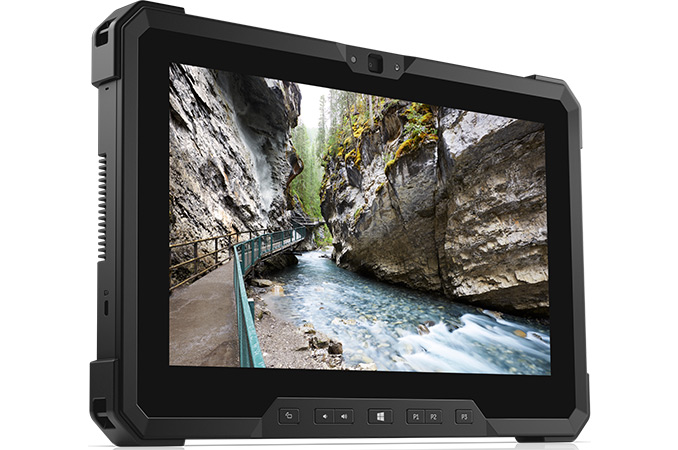
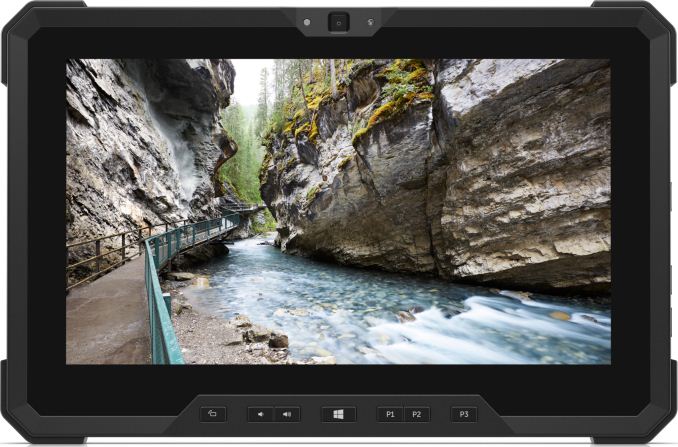
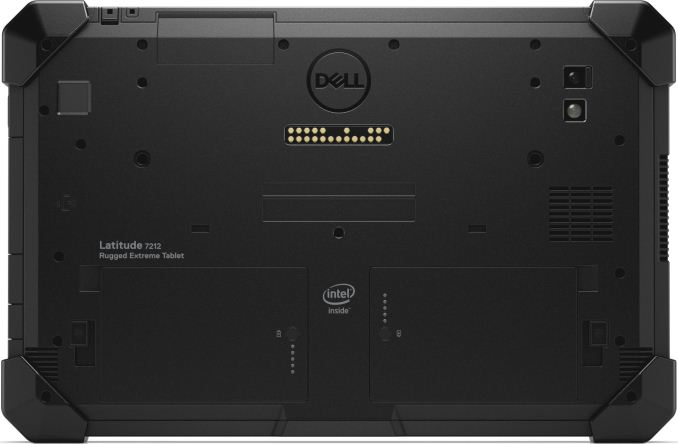
Dell has updated its rugged Latitude 12 tablet designed to operate in extreme conditions. The new Latitude 12 model 7212 is getting faster CPUs featuring the Skylake and Kaby Lake microarchitecture, a new 11.6” FHD display with an improved cover glass, a USB-C connector, a higher-capacity SSD option, and other improvements. Dell launched its original Latitude 12 model 7202 rugged extreme tablet back in 2015. The unit was based on Intel’s Core M (Broadwell-Y) SoC and a set of mobile PC components capable of working in extreme conditions, but its main features were reinforced chassis, security technologies, vast communication capabilities as well as compatibility with various strengthened peripherals and special-purpose equipment. The new Latitude 12 model 7212 inherits virtually everything from the predecessor, but swaps internal hardware, changes the display and adds a couple of other things.
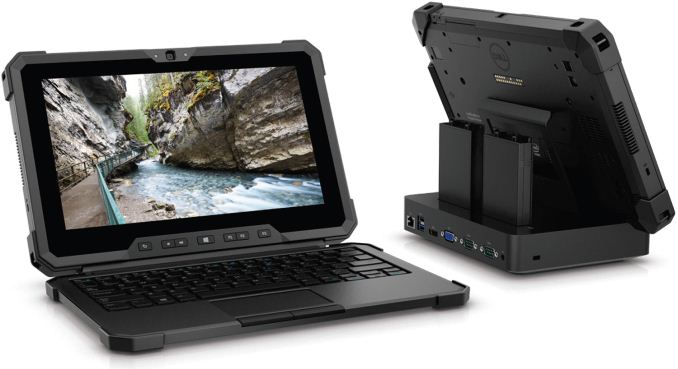
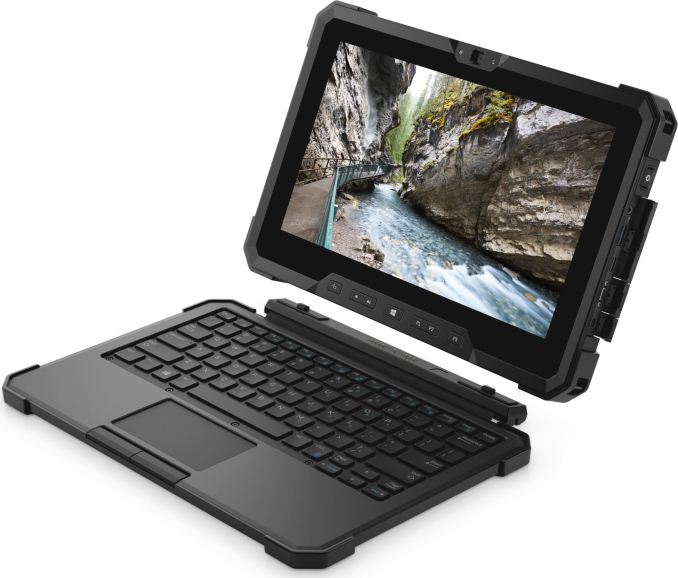
The Dell Latitude 12 tablet comes in the MIL-STD-810G-certified 24-mm thick enclosure made to withstand operating drops, thermal extremes, dust, sand, humidity, blowing rain, vibration, functional shock and all other kinds of physical impact. The slate has operating thermal range from -29°C to 63°C (20°F to 145°F), it can work in hazardous locations and withstand electromagnetic interference (MIL-STD-461F certified). In short, the Latitude 12 can work safely almost everywhere and in almost any circumstances — from a construction site, to a drilling site in the desert, to a battlefield. Obviously, the rugged tablet is rather heavy (but not that heavy): the new Latitude 12 model 7212 weighs 1.27 kilograms with a 2-cell battery, like a full-fledged laptop. Dell says that the weight of the model 7212 is 27% lower compared to the original model 7202, but does not say how it managed to reduce the weight. Visually, the systems are similar and the new model is compatible with all of its predecessor's accessories. Yet, the Latitude 12 7202 and the Latitude 12 7212 are not completely identical: the new model has a new rigid handle option, it comes with new handles and straps that are easier to install and has a number of other advantages over the previous-gen model. Meanwhile, the optional RGB-backlit keyboard cover with kickstand for the Latitude 12 (also rugged, sealed and made for extremes) will further add weight and cost, if used. As mentioned above, the Dell Latitude 12 model 7212 is based on Intel’s latest CPUs featuring their Skylake and Kaby Lake microarchitectures. In fact, Dell decided to use dual-core Core i-series Skylake-U and Kaby Lake-U SoCs instead of low-power Broadwell-Y to offer higher performance. Depending on exact SKU, the Latitude 12 7212 will come with 8 GB or 16 GB of LPDDR3 memory, Class 20 or 40 SSDs with 128 GB, 256 GB, 512 GB or 1 TB capacity, optional encryption capabilities,, as well as a 26 Wh or 34 Wh internal battery. All new systems are equipped with 11.6” FHD displays featuring gloved multi-touch, AG/AR/AS/polarizer and etched Gorilla Glass. Meanwhile the communication capabilities of the Latitude 12 model 7212 are vast. By default, the rugged tablet has an Intel 8265 802.11ac Wi-Fi controller with Bluetooth 4.2, a Qualcomm Snapdragon X7 LTE modem as well as NFC capability. Optionally, the slates can be equipped with a GPS card, Bluetooth 4.2 can be removed and a different LTE modem installed. Wired I/O features of the Latitude 7212 rugged extreme tablet include USB 3.1 Type-C connector that can be used for charging and external display connectivity, a USB 3.0 Type-A connector, an optional micro RS-232 port, a universal audio jack and so on. The system is also equipped with optional rear and front cameras, a contactless smart card reader as well as a touch fingerprint sensor. For backwards compatibility, the model 7212 also has a regular 4.5-mm power connector. Finally, an optional dock station adds batteries, GbE, two USB 3.0 Type-A ports, an HDMI connector, a D-Sub output, as well as two more RS-232 ports.
When it comes to security, Dell seems to have everything covered too. The system features a fingerprint reader, Dell’s ControlVault advanced authentication, Intel vPro remote management, a TPM 2.0 module, optional SED option for SSDs, NIST SP800-147 secure platform and so on.
Dell’s Latitude 12 7212 will be available shortly starting at $1,899. Rugged tablet dock, keyboard cover with kickstand as well as rugged battery charger will be available separately.
Gallery: Dell Latitude 12 Model 7212
      Related Reading: | |||||||||||||||||||||||||||||||||||||||||||||||||||||||||||||||||||||||||||||||||||
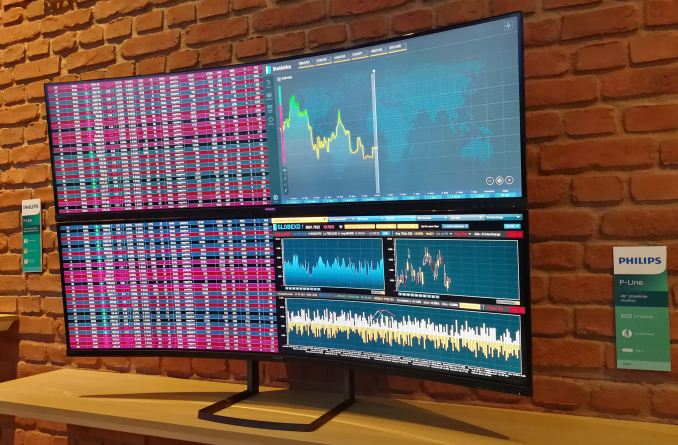
| 2:00p | Philips Readies Curved Ultra-Wide 492P8 Display: 49”, 32:9, USB-C, Sub-$1100
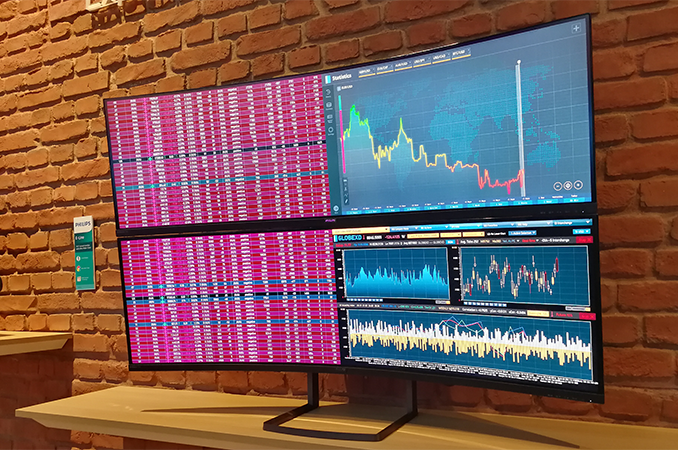
Wrapping up our IFA coverage, at least week's trade show TPV demonstrated a preproduction version of its upcoming ultra-wide (32:9 aspect ratio) 49” Philips display. The 492P8 monitor will have something in common with Samsung’s C49HG90 introduced earlier this year, but it will lack quantum dots and a number of other features. A good news is that it will cost less, at a little over $1000. Over the past few quarters companies like Philips, LG, Samsung, JapanNext and some other have introduced computer displays with diagonals significantly exceeding 30” – 34”, setting a new trend for ultra large monitors. Separately, ASUS, Dell, Samsung, LG and other have launched LCDs with a 21:9 aspect ratio, setting another trend, this time for ultra-wide monitors. Different suppliers of monitors target their ultra-large LCDs at different audiences, but it is clear that these wide and/or huge displays are not niche products, but represent new market trends. Being one of the largest maker of LCD panels in the world, Samsung recognized both trends early enough and this year introduced the world’s first mass-market monitor with a 49” diagonal and an ultra-wide 32:9 aspect ratio. Samsung gave the backlighting on its C49HG90 a quantum dot treatment to expand its color space to 95% of the DCI-P3, while also equipping it with AMD’s FreeSync 2 technology and increasing its maximum refresh rate to 144 Hz in order to address the high end of the gaming market. At present, the display is indeed one of the most advanced and expensive ($1499) gaming monitors in the industry. Meanwhile, gamers are not the only category of users, who can benefit from a massive ultra-wide screen. There are users of multi-monitor configurations in finance, engineering, design, audio/video production and other industries, who would gladly swap two displays for one ultra-wide one or four LCDs for two. Apparently, Philips plans to address these industries with its upcoming 492P8 monitor. The company confirms that Samsung is the supplier of its 49" 32:9 panel, but given the fact that this is a rather niche product (there are not a lot of people who have enough space for a 49" monitor on their desks at home or in office), it is highly likely that Samsung will remain the only producer of such panels for a while.
As the name implies, the Philips 492P8 belongs to the brand’s P-line offerings aimed at professionals. Although Philips has demonstrated the 492P8 in action at IFA, the company is not releasing the monitor's complete specifications just yet, as some things may change between the current prototype and the final product. Nonetheless, the basic details about the display panel itself are already known: a 3840x1080 resolution, up to 600 nits brightness, up to 5000:1 contrast ratio, 178º/178º vertical/horizontal viewing angles, 1800R curvature and so on. Unlike Samsung, Philips will not be using QLED backlighting to improve color gamut, citing the different target audiences. For the same reason, peak brightness could be limited and since we do not have the final specs of the 492P8 at hand, we'd rather not speculate about the specifications of the monitor itself.
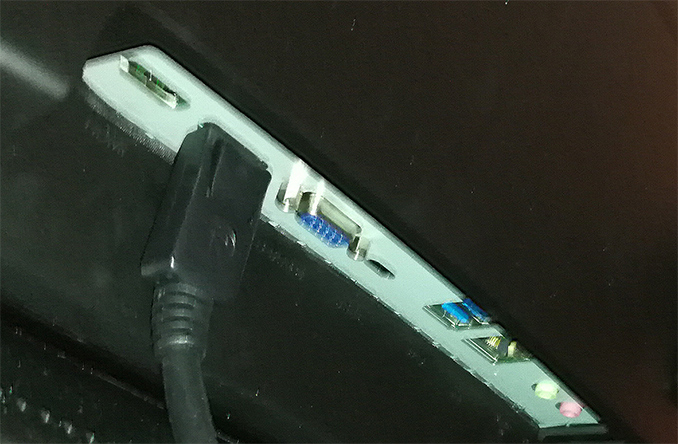
Connectivity capabilities of the Philips 492P8 look rather good: the monitor has a DisplayPort, an HDMI port, a USB Type-C input, a D-Sub connector, as well as a built-in dual-port USB 3.0 and an Ethernet hub (the USB-C acts like an upstream port for both). The presence of the D-Sub looks a bit odd, but it could be used to connect an additional computer and display its output in picture-by-picture (PBP) or picture-in-picture (PiP) mode. In addition, there are two 3.5-mm audio connectors for headphones and a microphone.
Philips plans to bring the 492P8 to the market sometimes in Q2 next year and intends to sell the unit for about €899 ($1077). Keeping in mind that we are at least a half of a year away from the launch of the 492P8, some specs and/or MSRP may change due to various circumstances. Related Reading: | |||||||||||||||||||||||||||||||||||||||||||||||||||||||||||||||||||||||||||||||||||
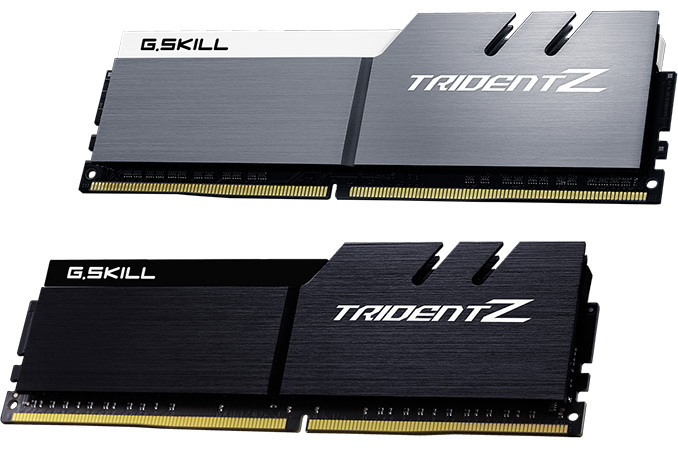
| 4:00p | G.Skill Ups the Ante on Memory Speed and Voltage: 16 GB DDR4-4600 1.5v Kit for Kaby Lake-X
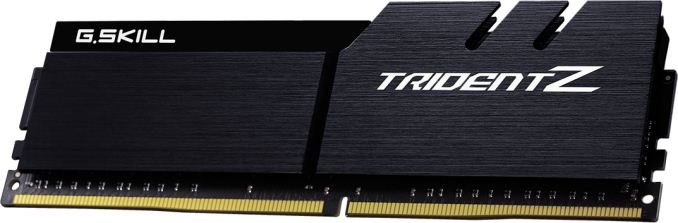
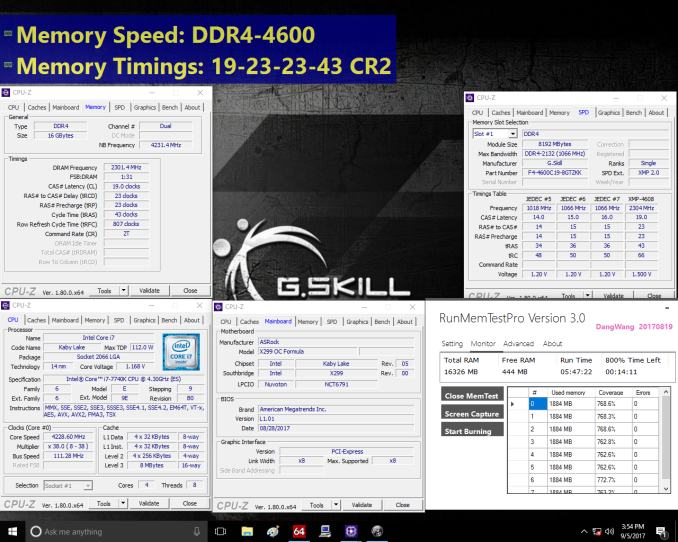
G.Skill on Friday introduced its fastest dual-channel memory kit designed specifically for Intel’s Kaby Lake-X processors and Intel’s X299 HEDT platforms. The new Trident Z DDR4-4600 DIMMs not only boast the highest officially supported DDR4 transfer rate in the industry to date, but are also among the first to use 1.5 Volts to hit that milestone. The new extreme Trident Z DDR4 memory modules, as G.Skill calls them, are based on Samsung’s famous 8 Gb B-die memory ICs produced on their 20 nm fabrication process. G.Skill says that to build its DDR4-4600 CL19 DIMMs, it had to cherry pick DRAM chips with the highest frequency potential and increase the voltage of the memory modules all the way to 1.5 Volts. This is a whopping 25% increase over DDR4 standard's default voltage of 1.2v, and in AT's collective memory we can't recall the last time we saw a memory kit ship with a voltage so far over the standard. To G.Skill's credit they are now pushing DDR4 well above the specification's original maximum 3200 MT/sec transfer rate, so the payoff is clearly there, but it's also clear that the company is pushing current DDR4 technology and Samsung's B-dies to their limits. Such a high voltage is (obviously) not impossible to work with, but it does come with some challenges both for users and the manufacturer. The biggest is sheer power consumption – remember that power consumption increases with the square of the voltage – so a 25% voltage increase will increase the power consumption of these DIMMs by even more than that. G.Skill claims that the DIMMs do not have any overheating issues and it had run loads of burn-in tests to ensure stability and reliability, but these are top-of-the-range enthusiast-class products that will need sufficient cooling. Meanwhile on the manufacturing side, G.Skill not only needs to heavily bin chips to find those that can operate at these speeds, but then build a complete DIMM that can handle the frequency and the power delivery needs. Similarly, a solid motherboard is necessary to handle these speeds on its end, as well as the higher power delivery.
G.Skill has validated stable operation of its “extreme” Trident Z dual-channel kit at 4600 MT/s on Intel’s Core i7-7740X (Kaby Lake-X) CPU and ASRock’s X299 OC Formula motherboard. The latter was designed by ASRock in cooperation with Nick Shih, a well-known overclocker, and it only has four memory slots in order to minimize interference and ensure a “clean” power supply. The modules come with XMP 2.0 SPD profiles that will simplify their set up on all Intel X299 platforms, but keep in mind that the kit is intended only for dual-channel operation and G.Skill tested it using a particular hardware config.
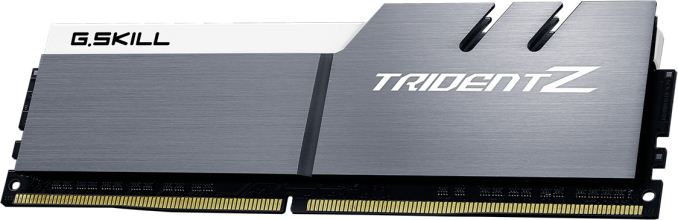
G.Skill will offer its DDR4-4600/CL19 kit with all black and grey with white aluminum heatsinks. The company is not going to offer an RGB LED-equipped version of these DDR4-4600 modules (at least initially) because installing LEDs would affect power supply of the modules and therefore their frequency potential.
G.Skill plans to start selling its 16 GB (8 GB×2) DDR4-4600 CL19 23-23-43 memory kit late this month. The company traditionally does not touch upon pricing of the set, but since this is an exclusive and heavily binned product, it is logical to expect it to be expensive.
Related Reading: | |||||||||||||||||||||||||||||||||||||||||||||||||||||||||||||||||||||||||||||||||||

| << Previous Day |
2017/09/08 [Calendar] |
Next Day >> |