[Most Recent Entries] [Calendar View]
Monday, September 11th, 2017
- The Intel Skylake-X Review: Core i9 7900X, i7 7820X, and i7 7800X tested
- The Intel Kaby Lake-X i7 7740X and i5 7640X Review: The New Single-Threaded Champion, OC to 5GHz
- MSI Announces the X299 XPower Gaming AC Motherboard: Five M.2 Slots
- ASRock Announces X299 Professional Gaming i8 with 3-Way Multi-GPU, 10Gb Ethernet, & Wi-Fi
- Logitech Launches G603 ‘Lightspeed’: 12,000 DPI Hero Sensor, 1 ms Polling, 500 Hrs Battery
- Logitech Launches G203 Prodigy Gaming Mouse with A New 6000 DPI Sensor
- Logitech Announces The Ambidextrous G900 Chaos Spectrum Gaming Mouse
- Logitech Announces The CRAFT Keyboard With Creative Dial Integration
- Interacting with HTPCs: IOGEAR and SIIG Options Reviewed
- Interacting with HTPCs: Adesso Keyboard Options Reviewed
- Interacting with HTPCs: Logitech and Perixx Options Reviewed
| Time | Event | ||||||||||||||||||||||||||||||||||||||||||||
| 9:00a | ASRock Announces the X299 OC Formula Motherboard
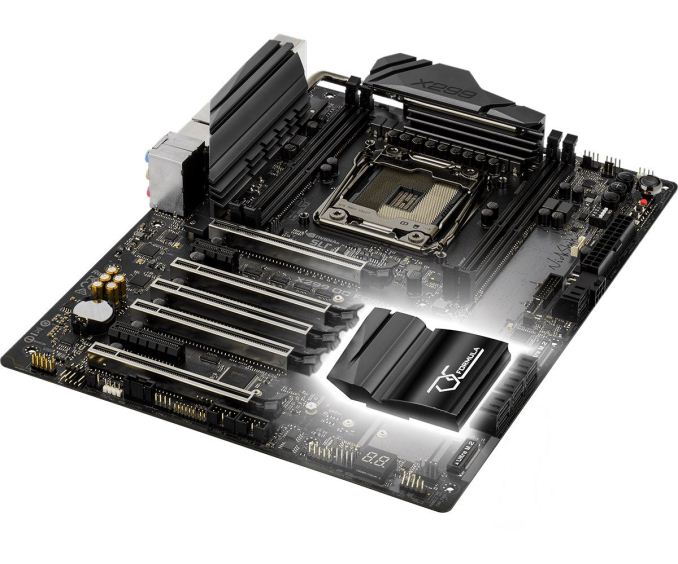
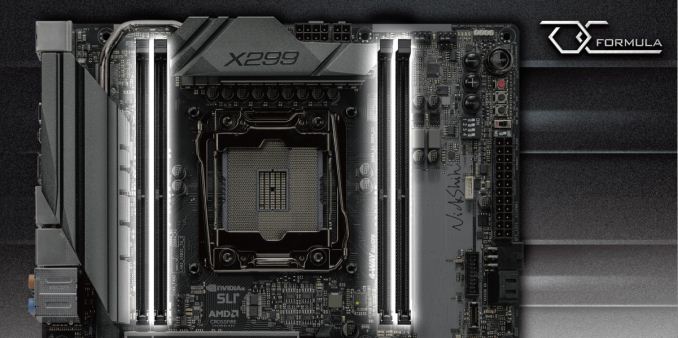
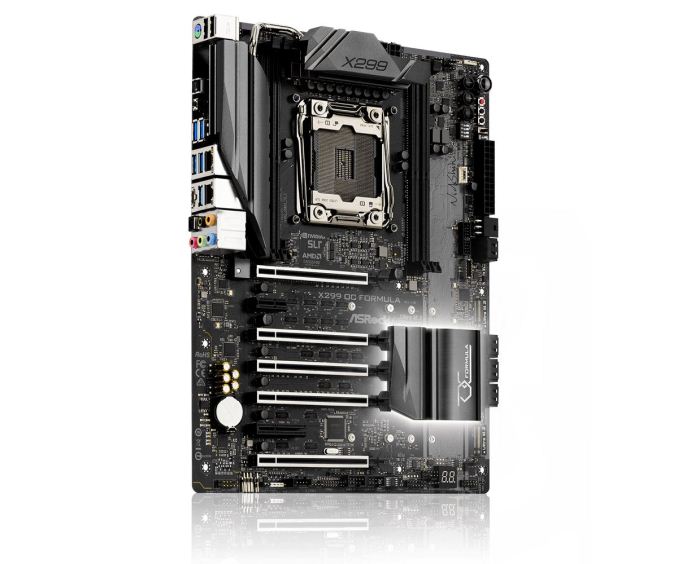
Back in May of this year, we saw our first glimpse of the X299 OC Formula, ASRock’s to-be high-end overclocking focused motherboard. In the past couple of generations, the OC Formula line was black and yellow. For X299 it has changed to black with some gray. Though it looks like most other X299 boards on the shelves, ASRock positions it as “…ideally focused on overclocking exclusively, without any other useless features, designs or gimmicks.”
One major change to previous OC Formula (OCF) boards of the past is the reduction down to one memory slot per channel. Most X299 based boards have eight slots; while the X299 OCF has four. Since the board is aimed towards overclocking, previous boards have shown one memory slot per channel has overclocking benefits, so the transition is made on the X299 version. Most users aren’t looking for the full 128GB capacity anyway, as this can put a ceiling on how fast your ram runs. ASRock states the board design aids in stability and reaching higher memory speeds, with up to DDR4 4600 (OC) officially supported out of the box, which is among the highest we have seen so far for X299. ASRock’s own in-house overclocker Nick Shih, who has helped design the OCF line for many years, has achieved DDR4-4800 with only air cooling on some high-end premium and binned memory. The X299 OC Formula will also support soon-to-be-announced DDR4-4500 XMP profile modules that will appear on the market soon.
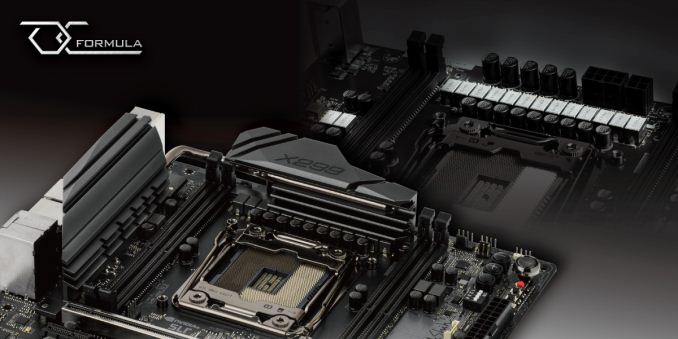
As with past OC Formula boards, the X299 version carries over the ASRock Formula Kits (Power Kit, Connector Kit, and Cooling Kit). The 'kits' are marketing speak for features found on the board. Items such as the all DigiPower VRM design with Dr. MOS MOSFETs, a Hi-Density power 8-pin EPS connector, 15µ gold contacts, 8-layer 2oz copper PCB and the heat pipe configuration for the large VRM heatsinks, are all part of that feature package. ASRock says this heat sink configuration can supports up to 450W from the VRMs with proper airflow. The same 13 phase VRM found on the X299 Taichi and the Gaming i9 makes its way to the OC Formula as well.
Other overclocking features include an LN2 mode switch (disables CPU thermal protection, enables additional OC features), Rapid OC buttons to manually adjust the CPU ratio, the BCLK frequency, or the CPU voltages directly on the board. There are also PCIe on/off switches to disable PCIe slots, and the retry/reset/BFG button set for quick access to different types of restarts and boots. These features are found in the upper right-hand corner of the board above the ATX power. For those not wanting to manually overclock and play, the UEFI also has several of Nick's preset overclocking profiles. These range from 4 GHz all the way to extreme overclocking (liquid nitrogen, LN2) profiles. If BCLK adjustment is needed, the X299 OCF also comes with an additional external base clock generator, the Hyper BCLK Engine III. It is designed to support PCIe frequency overclocking and a wider range of BCLK frequency adjustments.
Outside of overclocking centered features, the board supports 4-Way SLI and Crossfire in its five full-length PCIe slots, has dual PCIe 3.0 x4 M.2 slots supporting both PCIe and SATA based M.2 modules, eight SATA ports, dual Intel Gigabit LAN ports, and uses the latest Realtek ALC1220 audio codec with ASRock’s Purity Sound 4 software. For those looking for RGB LEDs, the X299 OCF does have them under the PCH heatsink only.
Pricing or details on availability were not listed at the time of publication. Gallery: ASRock X299 OC Formula
 _thumb.png) _thumb.png) Related Reading | ||||||||||||||||||||||||||||||||||||||||||||
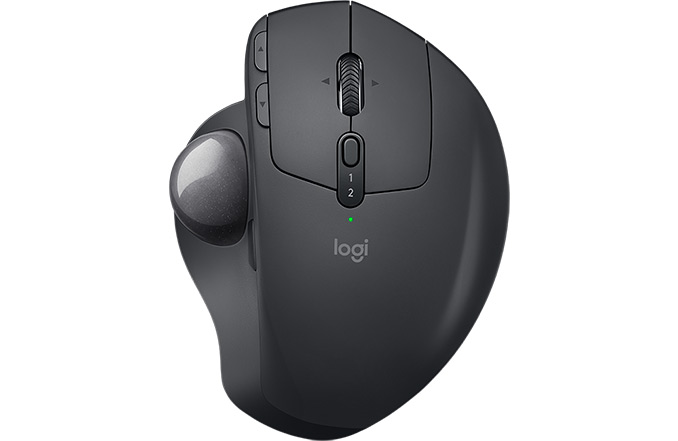
| 11:00a | Logitech Launches the MX Ergo Trackball: Bringing Trackballs into 2017
Logitech is introducing its first new trackball in years. The MX Ergo trackball claims improved precision compared to its predecessors, as well as eight buttons combining modern features with an older use model. The device is also one of the first products by Logitech that supports the company’s Flow technology that enables seamless switching and file sharing between different systems. Trackball History 101The trackball was invented in 1947, decades before mice and personal computers, for the British Royal Navy’s command, control, and coordination system known as Comprehensive Display System (CDS). In fact, a rolling ball along with four disks to pick up motion were used both for early trackballs and for early mice. However, mice were chosen by Apple, Microsoft, Xerox and others for their programs and computers featuring GUI in the late 1970s and the early 1980s possibly because of more intuitive design. Meanwhile, rolling balls inside mice were not always optimal for precision and other reasons, which is why trackballs became relatively popular in the eighties and the nineties primarily among graphics designers. After both mice and trackballs switched to optical tracking technology in the late 1990s to early 2000s, advantages of trackballs somewhat eroded and their adoption diminished. Nonetheless, there are loyal trackball users who continue to operate them instead of other tracking devices either for personal efficiency, comfort, or nostalgia. Only two main companies produce trackballs nowadays: Logitech and Kensington, with Logitech introducing its first new trackball in many years.
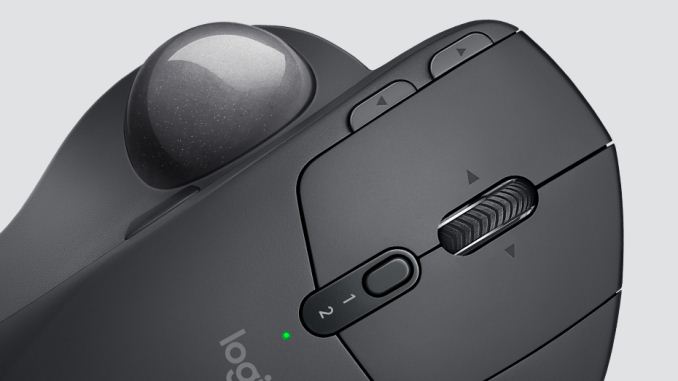
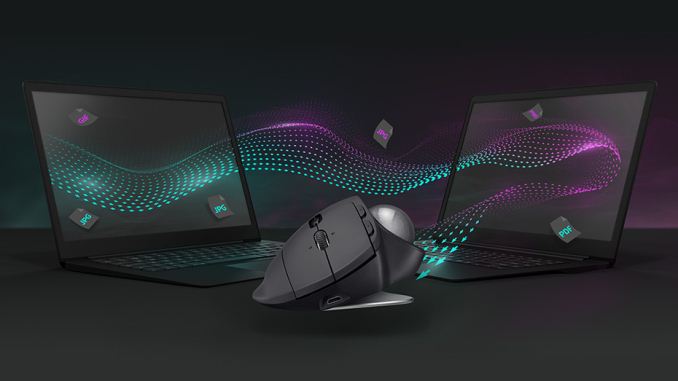
The Logitech MX Ergo (For Right-Handers)The Logitech MX Ergo looks like a huge mouse, except it has a ball which has to be rotated by a big digit. As the 'Ergo' name implies, the ergonomics of the trackball can be adjusted. This is achieved by increasing the angle of the device from 0 to 20 degrees, just like the precision of the optical tracking, which varies from 320 dpi to 440 dpi. The device has eight buttons, some of which can be reprogrammed. The latest trackball also comes with an integrated 500 mAh Li-Po battery that can work for 'days or months depending on usage model'. The new MX Ergo trackball from Logitech can use the company’s Unify wireless receiver (as well as Bluetooth) to connect to PCs. Moreover, just like Logitech’s latest mice, the MX Ergo supports the company’s Flow technology that allows to simultaneously control two computers (Macs and/or Windows) and automatically switch between them by moving the cursor to the edge of the screen. In addition, the Flow allows transferring files between two systems wirelessly using Wi-Fi or Ethernet networks.
The Logitech MX Ergo trackball mouse will be available in the U.S. directly from the company, and from its retail partners starting later this month, for $99.99. Pricing and availability in other countries will vary. No word if a left-handed version will enter the market. Gallery: Logitech MX Ergo Trackball
      Related Reading | ||||||||||||||||||||||||||||||||||||||||||||
_575px.png)
| << Previous Day |
2017/09/11 [Calendar] |
Next Day >> |