[Most Recent Entries] [Calendar View]
Wednesday, March 21st, 2018
- Toshiba Announces 14 TB PMR MG07ACA HDD: 9 Platters, Helium-Filled, 260 MB/s
- Western Digital Now Shipping 14 TB HDDs: HGST Ultrastar Hs14 with 1000 Gb/in2
- Western Digital Announces Ultrastar He12 12 TB and 14 TB HDDs
- Seagate Announces Enterprise Capacity 12 TB HDD: 2nd-Gen Helium-Filled Hard Drives
- Western Digital Ships 12 TB WD Gold HDD: 8 Platters and Helium
- Toshiba Unveils 10TB HDDs for Video Surveillance: Support for up to 64 HD Streams
- Logitech and HTC Team Up to Integrate Physical Keyboards Into VR Environments
- Logitech Launches G603 ‘Lightspeed’: 12,000 DPI Hero Sensor, 1 ms Polling, 500 Hrs Battery
- Logitech Announces The CRAFT Keyboard With Creative Dial Integration
- Logitech’s G613 "Lightspeed" Wireless Mechanical Keyboard Cuts Wires & Input Lag
- Logitech Launches MX Sound Bluetooth and PC Speakers
- Acer and ASUS Delay Their 4K 144 Hz G-Sync HDR Displays to 2018
- ASUS Demonstrates ROG Swift PG27UQ: 4K, 144 Hz, HDR, DCI-P3 and G-Sync
- Acer Announces Predator X27 Monitor: 4K@144 Hz with DCI-P3, HDR10, & G-Sync
- Samsung Announces First Freesync 2 Monitors: CHG70 & CHG90 - Quantum Dots, Up to 49”, 144 Hz, DCI-P3
| Time | Event | |||||||||||||||||||||||||||||||||||||||||||||||||||||||||||||||||||||||
| 11:00a | Seagate Announces Exos X14: a Helium-Filled 14 TB PMR HDD
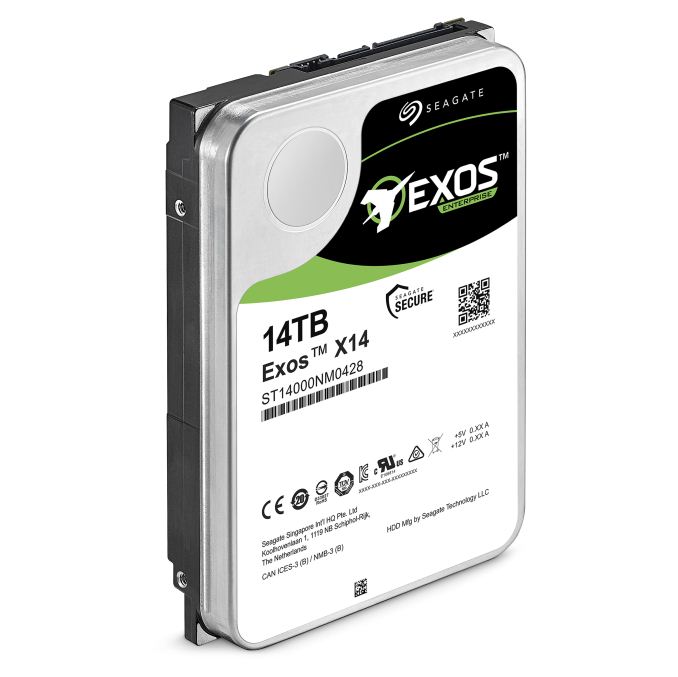
Seagate this week formally introduced its first hard drive with 14 TB capacity aimed at cloud datacenters that does not use shingled magnetic recording. The new Exos X14 HDDs are filed with helium and are based on the latest-generation PMR (perpendicular magnetic recording) platters, running at 7200 RPM. It is logical to expect the drive to rely on a brand-new platform that uses nine 1.55-TB platters, but Seagate has not officially confirmed this. Since the drive is filled with helium, helium drives can typically boast a relatively low power consumption, however we await further details. Similarly, because of increased areal density, the new drive should also offer higher sequential data transfer rate than its predecessors. Seagate does report that the drive has higher random I/O responsiveness than ancestors and rivals. In addition to higher capacity and performance, the Seagate Exos X14 features Seagate Secure hardware encryption technology. Also, the new HDD is FIPS 140-2/Level 2 and ISO/EIC 15408 certified, meeting governments’ requirements for secure storage of data. The Exos X14 is Seagate’s response to Toshiba’s MG07ACA HDD with 14 TB capacity announced last year, although until we recieve further information, we cannot do a direct comparison. The major benefit of both drives is their increased capacity that enables datacenter operators to store 3360 TB of data per rack (compared to 2440 TB with 10 TB HDDs), which is a key advantage for companies that need to maximize their storage capacity per square meter and per watt, while meeting other TCO objectives. Another indisputable win of 14 TB hard disks from Seagate and Toshiba (vs. HGST’s Ultrastar Hs14) is their conventional magnetic recording technology, which ensures predictable writing performance and permits drop in compatibility of the HDDs with existing storage applications.
Seagate’s Exos X14 is currently sampled with select customers, such as Baidu. The manufacturer plans to start volume shipments of the Exos X14 this summer, but does not disclose exact availability timeframe or approximate pricing. Keep in mind that Toshiba’s MG07ACA HDD with 14 TB capacity will ship in Q2, so Seagate’s Exos X14 will have at least one rival when it becomes available later this year. Related Reading | |||||||||||||||||||||||||||||||||||||||||||||||||||||||||||||||||||||||
| 12:02p | Best SSDs: Q1 2017
The industry-wide NAND flash shortage has not abated, so there's little good news for consumers since the holiday edition of this guide. The best deals are a few cents per GB worse than they were during the holiday season. Older SSD models are being withdrawn from the market and current models are often out of stock. At CES we noticed a pattern of companies being ready to launch new models and capacities, but many of them are holding off until they can launch with sensible pricing and volume. The situation should improve later this year when the next generation of 3D NAND hits the market. With 64 layers or more and up to 512Gb per die for TLC parts, we should finally see 3D NAND from all four major manufacturers making its way into retail SSDs. In the near term however, there's not much hope for improvement in prices and available drive capacities. As always, the prices shown are merely a snapshot at the time of writing. We make no attempt to predict when or where the best discounts will be. Instead, this guide should be treated as a baseline against which deals can be compared. All of the drives recommended here are models we have tested in at least one capacity or form factor, but in many cases we have not tested every capacity and form factor. For drives not mentioned in this guide, our SSD Bench database can provide performance information and comparisons. Premium SATA drives: Samsung 850 PRO
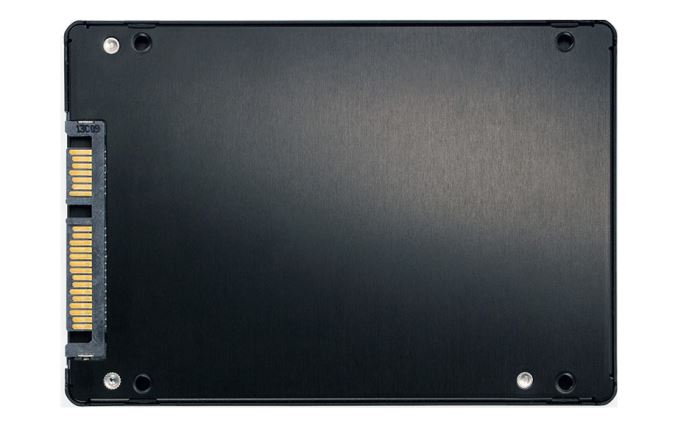
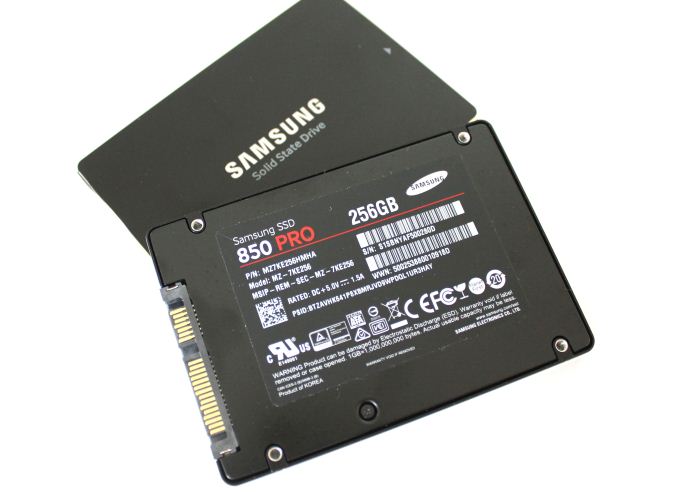
The SanDisk Extreme Pro has all but disappeared from the market, leaving the Samsung 850 PRO as the undisputed king of the SATA SSD market. No other consumer SATA SSD can match the 850 PRO's combination of performance and a ten-year warranty. For now, the only other SATA SSDs with 3D MLC NAND are ADATA's SU900 and XPG SX950, both based on Micron's 3D MLC. Those SSDs offer slightly higher endurance ratings but warranty periods of only 5 and 6 years, and we don't expect their performance to beat the 850 PRO. Even the slowest PCIe SSD will outperform the Samsung 850 PRO in most ordinary usage scenarios, and some of those PCIe SSDs are cheaper than the 850 PRO. There are several SATA SSDs that offer performance that is close to the 850 PRO for a substantially lower price, most notably the Samsung 850 EVO. The appeal of the 850 PRO is far narrower than it was when this product first launched. If a new competitor does not emerge for this segment, we may retire this recommendation category entirely as it no longer serves any common consumer use case.
Value & Mainstream SATA: Crucial MX300, Mushkin Reactor 1TB
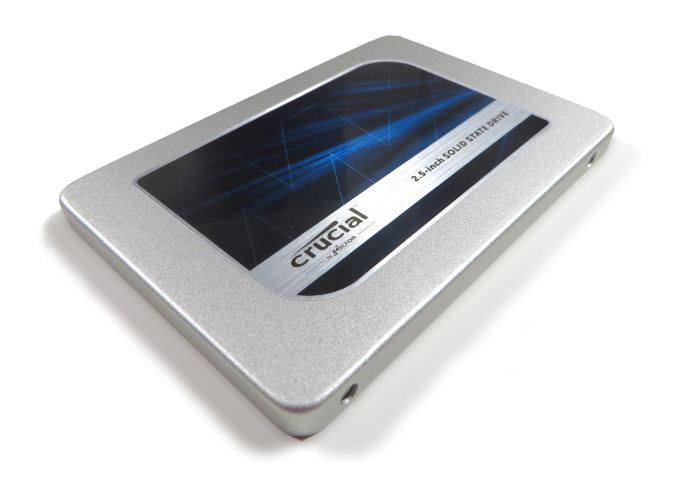
The value segment of the SSD market is where drives sacrifice performance and endurance to reach the lowest possible prices. Since SSD prices have tended to drop across the entire market, it is almost always possible to spend just a little more money to get a significant performance boost. The mid-range segment is a battleground between TLC drives with high enough performance, and any MLC drives that can get the price down without sacrificing their inherent performance advantage over TLC. The Crucial MX300 continues to be one of the most affordable SSDs on the market. Its combination of Micron 3D TLC and a great Marvell controller allows the the MX300 to deliver performance that is a clear step up from the cheapest planar TLC SSDs, and the MX300's power consumption is surprisingly low. MLC SSDs and the Samsung 850 EVO still perform much better under heavy sustained workloads, but the MX300 is good enough for most ordinary use.
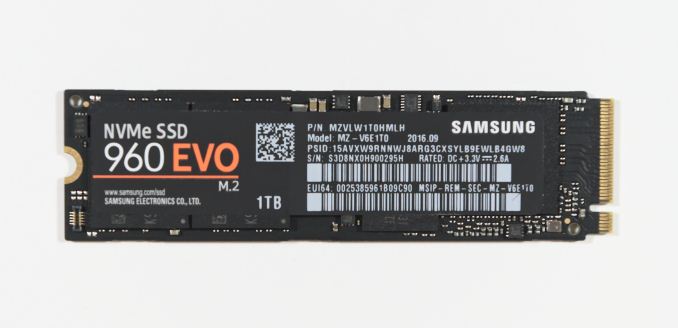
Standard & M.2 PCIe: Intel SSD 600p and Samsung 960 EVO
As they did in the SATA SSD market with the Samsung 850 EVO, Samsung's 960 EVO has shown that the combination of 3D TLC and a great controller can hold its own against most MLC-based competitors. Now that it is widely available, we think the 960 EVO offers a good balance of affordability and performance for the PCIe SSD segment. The Intel SSD 600p is the slowest PCIe SSD on the market, but also the cheapest by far. With pricing comparable to the Samsung 850 EVO, the Intel SSD 600p offers real-world performance that exceeds any SATA SSD. It won't hold up very well under very heavy sustained workloads, but its performance on ordinary desktop workloads is the reason we're not recommending the Samsung 850 EVO as a mid-range/mainstream SATA option.
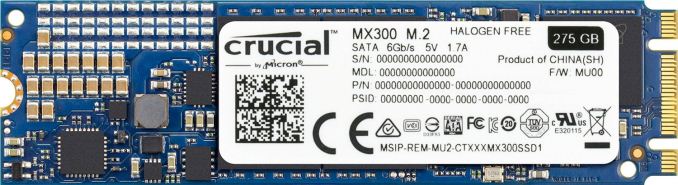
M.2 SATA: Samsung 850 EVO and Crucial MX300
M.2 has replaced mSATA as the small form factor of choice, and new product lines are no longer including mSATA variants. Selection of M.2 SATA SSDs is far more limited than 2.5" drives, but there are enough options to cover a reasonable range of prices and performance levels. The Samsung 850 EVO is the high-performance M.2 SATA drive of choice, and anyone wanting more performance should look to M.2 PCIe SSDs. The Crucial MX300 covers the low end of the market and carries only a slight premium over its 2.5" counterpart. ADATA and Western Digital offer M.2 versions of their latest entry-level SSDs, but they currently don't offer the value of the MX300.
| |||||||||||||||||||||||||||||||||||||||||||||||||||||||||||||||||||||||
| 2:00p | Logitech Unveils LightSync: Syncing RGB LEDs with G560 Speakers and G513 Keyboard
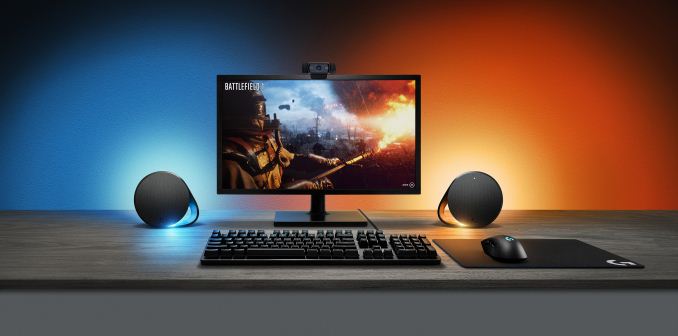
Logitech has introduced its new Lightsync technology designed to add immersion to games as well as to visualize music or movie audio using RGB LEDs inside peripherals. The first two products to feature Lightsync are the G560 speaker system as well as the G513 mechanical gaming keyboard. Synchronizing ambient lighting with on-screen actions is a way to add immersion to games or movies and is something that has been on the table for a while now. Technically there are several ways to sync ambient lighting with on-screen actions: giving developers a way to control ambient lighting using an API, to analyze colors displayed by on the screen, or to analyze audio and somehow match lighting with sounds. Various companies have either explored or are exploring ambient light synching with on-screen actions and/or audio (see Philips amBX, Razer Ariana, etc.), but today we are talking about the Lightsync from Logitech.
Logitech’s Lightsync uses two out of three aforementioned methods and therefore has two modes. One mode is called Audio Visualizer, it analyses currently played audio and produces appropriate effects: soft breathing in response to low frequency sounds, and lighting pulses to the beat. Another mode is called Lightsync and it has to be supported by game developers to produce lights that match colors displayed by a game. At present the list of games that support the Lightsync includes Battlefield 1, Civilization VI, Counter Strike: GO, Discord, Dota 2, Final Fantasy XIV Stormblood, Fortnite, Grand Theft Auto V, Killing Floor 2, Metronomicon, Tom Clancy’s: The Division, and Total War: Warhammer II.
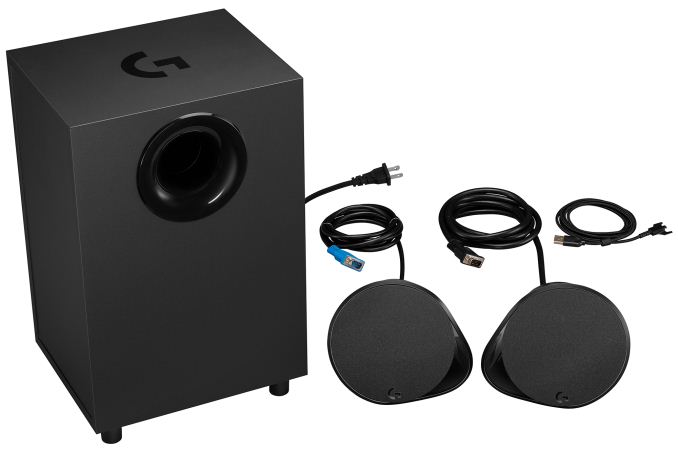
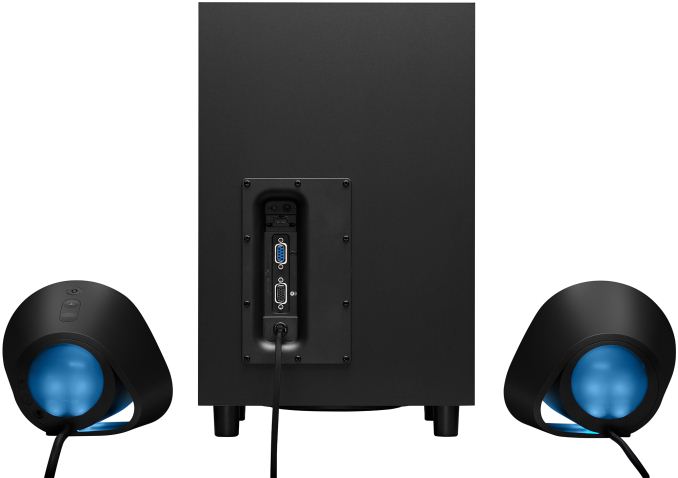
One of the first products to support the LightSync will be Logitech’s G560 gaming speaker system, featuring RGB LEDs in the satellites. The system itself consists of one large subwoofer as well as two satellites featuring LEDs on the front and on the back. The rear LEDs react to low-frequency sounds (bass), whereas the front LEDs react to mid- and high-frequency sounds. It is noteworthy that to support LEDs in satellites, Logitech had to use proprietary D-sub-like cables. Depending on application, the Logitech G560 works in either Audio Visualizer (should react to all sounds, but this mode is useful mostly for music), or Lightsync modes. In the latter case the Lightsync has to be supported by the particular program. At this point, it is only supported by select games, but going forward its support may get broader.
The Logitech G560 2.1 speaker system has a total output power of 120 W (RMS) and supports the DTS:X Ultra surround sound positional audio technology. The device can be connected to audio sources using a 3.5-mm audio jack, USB, or Bluetooth 4.1 technology. It is compatible with Microsoft Windows 7/8.1/10 as well as Mac OS X (DTS:X is not currently supported on Macs). The speaker system will hit the market next month at an MSRP of $199.99.
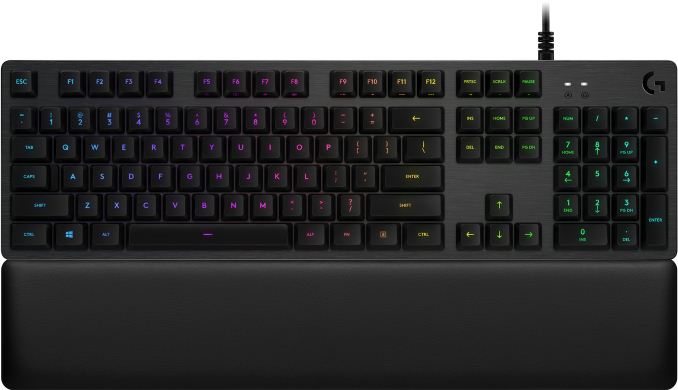
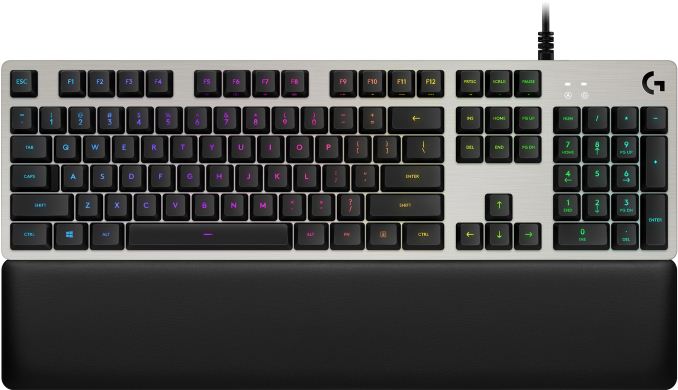
Logitech’s G513 mechanical gaming keyboard is another product to support the Lightsync technology. Since the keyboard does not produce any sounds, it does not offer the Audio Visualizer mode. Meanwhile, the G513 can work with compatible games that support the Lightsync, or display various patterns chosen by users.
The Logitech G513 keyboard features a brushed aluminum design and is equipped with either Romer-G Tactile (discernable) or Romer-G Linear (smooth) switches. The G513 comes with a leatherette palmrest and a USB 2.0 pass-through port for added comfort. As for compatibility, the keyboard can work with virtually all modern operating systems: Windows 8 or later, Mac OS X 10.10 or later, iOS 10 or later, and Android 3.2 or later. Just like the speaker system, the G513 keyboard will be available in April, it will cost $149.99. Related Reading | |||||||||||||||||||||||||||||||||||||||||||||||||||||||||||||||||||||||
| 6:35p | NVIDIA Expects 4K 144 Hz G-Sync HDR Displays to Launch in April
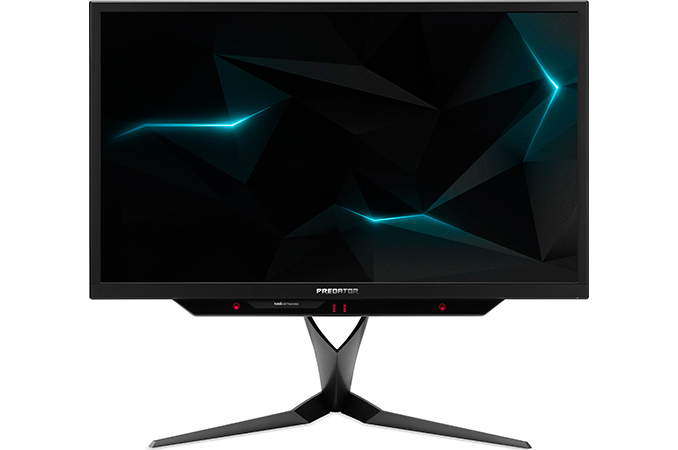
Acer and ASUS unveiled their prototype 27” 4K 144 Hz displays, featuring NVIDIA’s G-Sync HDR technology, at last year’s CES, with promises to release them sometime later in 2017. Both monitors relied on a reference design developed by NVIDIA and had similar specifications, albeit with some minor differences. Eventually, both companies had to delay commercial launches of their new products to 2018, missing the important holiday sales season. This week at GDC, NVIDIA has stated that it is confident that the G-Sync HDR-compatible displays will hit the market this April. Both the Acer Predator X27 and the ASUS ROG Swift PG27UQ are implementations of NVIDIA’s reference design for G-Sync HDR displays: they offer a 3840×2160 resolution, a 144 Hz refresh rate, a 1000-nits brightness, a direct LED backlighting system with 384 zones, and feature a quantum dot film to enable HDR10 and coverage of the DCI-P3 color gamut. The monitors announced last year were to be based on AU Optronics’ M270QAN02.2 AHVA panel, which was the only one to support the combination of features that NVIDIA wanted for G-Sync HDR displays.
Neither Acer, nor ASUS, disclosed the reasons why they had to delay their ultra-premium gaming monitors from late 2017 to 2018, but given a rather unique feature-set of both displays, a lot of possibilities come to mind: starting from a panel delay by AUO to reference design changes by NVIDIA. At GDC, NVIDIA has said that G-Sync HDR-supporting displays will finally ship in Q1, but noted that by Q1 it means its fiscal quarter, not calendar quarter. NVIDIA’s Q1 FY2019 (2019 because NV's fiscal year is one year ahead) ends on April 29, 2018, so it is logical to assume that the monitors will ship next month. What remains to be seen is the pricing as well as the final set of features and technologies. Related Reading | |||||||||||||||||||||||||||||||||||||||||||||||||||||||||||||||||||||||
| 7:15p | Intel Previews Optane Enterprise M.2 SSD
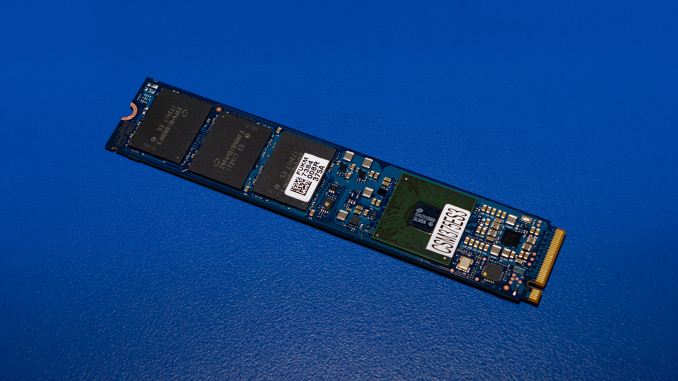
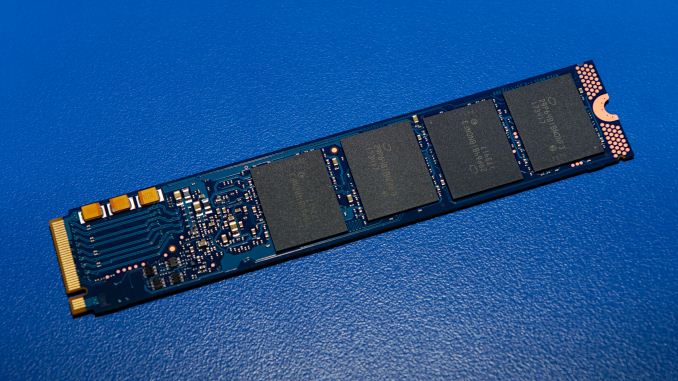
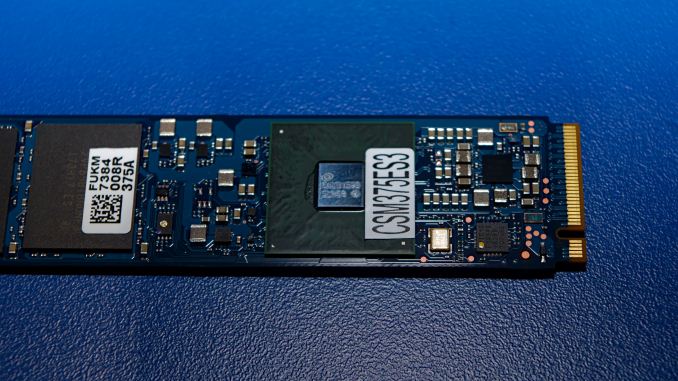
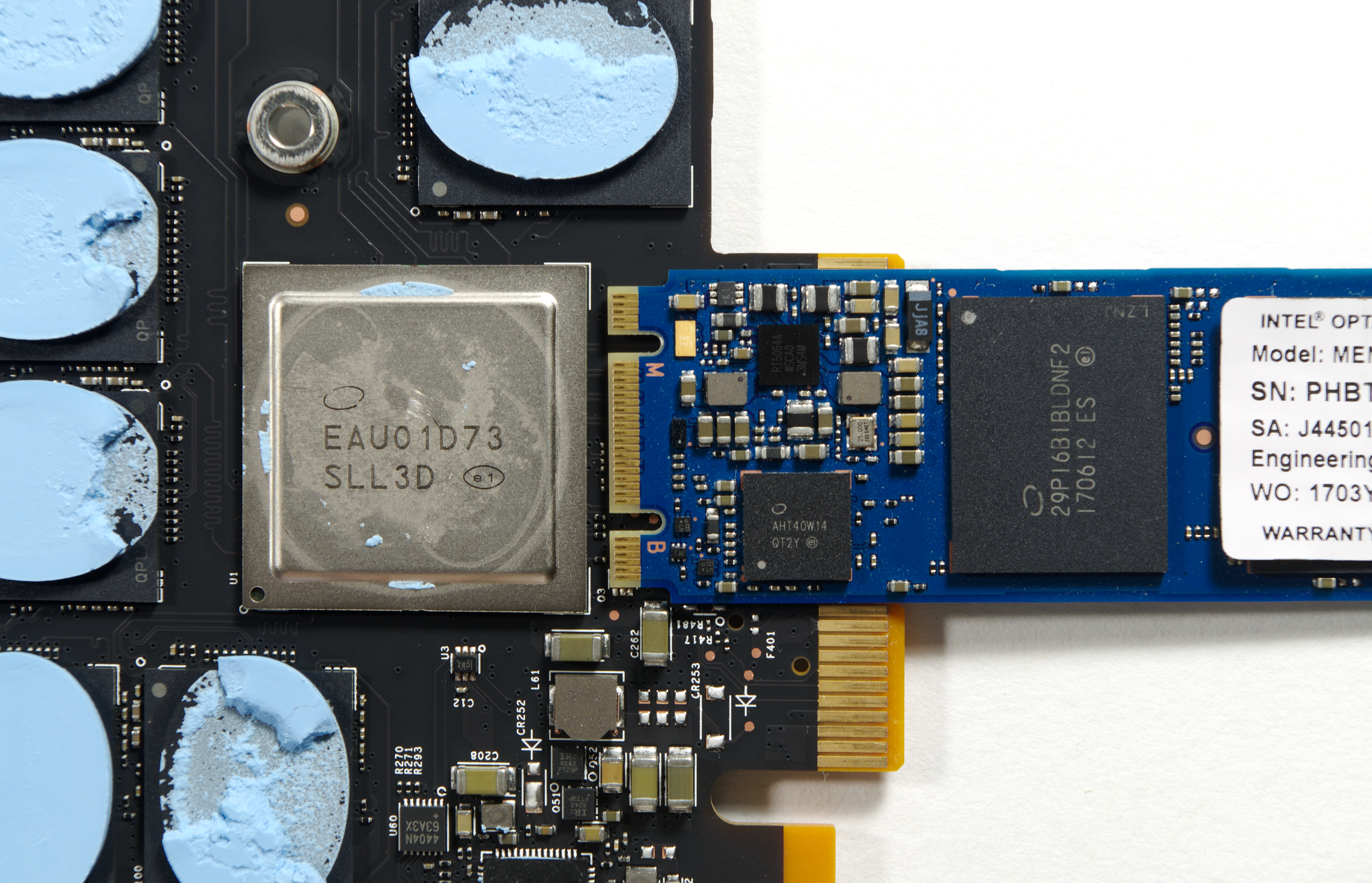
At the Open Compute Project Summit this week, Intel previewed their upcoming enterprise Optane SSD in the M.2 form factor, currently planned to be named the Optane SSD DC P4801X. Intel's current Optane product family includes the flagship Optane SSD DC P4800X in U.2 and PCIe add-in card form factors, the consumer derivative Optane SSD 900P, and the consumer Optane Memory and Optane SSD 800P M.2 drives. The P4800X and 900P are physically big and power-hungry drives while the Optane Memory and 800P use a tiny controller, don't fill the space available on a M.2 2280 card, and have very limited capacity. The limited performance and capacity of the Optane SSD 800P makes it a poor starting point for an enterprise Optane M.2 drive, but the controller on the P4800X and 900P is too large for an M.2 drive. Intel has previously faced similar challenges with their flash-based enterprise NVMe SSDs being ill-suited for the M.2 form factor, but their second generation controllers produced the low-power SSD DC P4501. Intel has now managed to scale down the packaging of their high-end Optane SSD controller to also fit on a M.2 SSD. The controller on the P4801X uses the same 7-channel architecture as the P4800X and 900P, but peak performance will be lower due to the power and thermal constraints of M.2 drives. The samples at Intel's booth were 375GB drives, matching the introductory capacity of the P4800X by using seven quad-die packages of 3D XPoint memory, where the first P4800X used 28 single-die packages spread across both sides of the half-height half-length add-in card.
This was not a full product announcement, so Intel has not released any performance or power specifications. The OCP Summit is an event focused entirely on datacenter products, so no consumer counterpart was discussed, but it is clear that Intel can easily release a consumer version. This can address the gap between the 118GB Optane SSD 800P M.2 SSD and the 280GB 900P that is only available in U.2 or add-in card form factors.
|





| << Previous Day |
2018/03/21 [Calendar] |
Next Day >> |