[Most Recent Entries] [Calendar View]
Friday, June 8th, 2018
- Arm Details "Project Trillium" Machine Learning Processor Architecture
- HiSilicon Kirin 970 - Android SoC Power & Performance Overview
- Imagination Joins the AI Party, Announces PowerVR Series 2NX Neural Network Accelerator
- CEVA Launches Fifth-Generation Machine Learning Image and Vision DSP Solution: CEVA-XM6
- CEVA Announces NeuPro Neural Network IP
- Windows 10
- NVIDIA GeForce GTX 1050 or higher (desktop GPUs may need firmware upgrade)
- R396 GA2 driver or higher (presumably 397.64 and higher)
- DisplayPort 1.4 driven directly by the GPU
- ASUS’ ROG Swift PG27UQ G-Sync HDR Display Due in Late June For $1999
- Acer’s Predator X27 G-Sync HDR Display Listed in the USA, to Ship on June 1
- NVIDIA Updates on G-Sync HDR: 4Kp144 Monitors On Sale at End of May, Other Models Coming Later This Year
- Acer and ASUS G-Sync HDR Displays Listed & Priced In Europe
- NVIDIA Expects 4K 144 Hz G-Sync HDR Displays to Launch in April
- Acer and ASUS Delay Their 4K 144 Hz G-Sync HDR Displays to 2018
- ASUS Demonstrates ROG Swift PG27UQ: 4K, 144 Hz, HDR, DCI-P3 and G-Sync
- Acer Announces Predator X27 Monitor: 4K@144 Hz with DCI-P3, HDR10, & G-Sync
| Time | Event | ||||||||||||||||||||||||||||||||||||||||||||||||||||||||||||
| 12:45a | Intel Confirms Some Details about 28-Core 5 GHz Demonstration When Intel demonstrated its 28-core system running at 5 GHz at the Computex 2018 keynote this week, there were many questions surrounding the hardware and what was required in order to showcase this. The presentation was relatively light on details – perhaps purposefully so – however Intel SVP and GM Gregory Bryant stated that the processor was set to come out during Q4. Now there were obviously a lot of questions about the demonstration. Was the CPU overclocked? What cooling was used? What platform did it run on? Which motherboard did it run on? What architecture is being used? What process node? What was the power consumption? We met with an Intel representative yesterday who answered some of these questions. | ||||||||||||||||||||||||||||||||||||||||||||||||||||||||||||
| 3:00a | Imagination Announces First PowerVR Series2NX Neural Network Accelerator Cores: AX2185 and AX2145
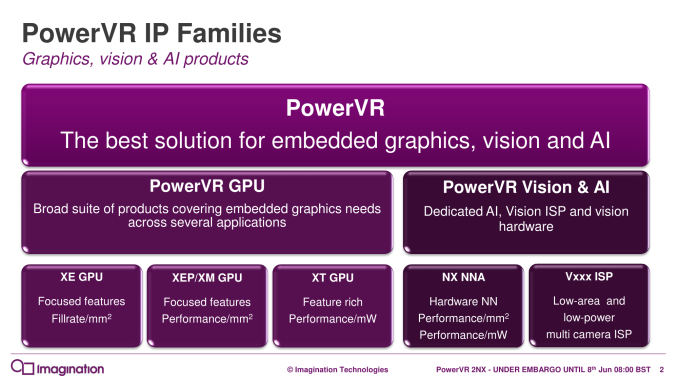
Since Imagination’s original announcement of the PowerVR Series2NX Neural Network Accelerator (NNA) last fall, the machine learning and AI “hype train” has not paused in the slightest. For the embedded and mobile space where the 2NX NNA competes in, there have been plenty of AI hardware developments in that time: CEVA’s NeuPro, Cambricon’s neural processing unit (NPU) in the Kirin 970, and yet more details of Arm’s “Project Trillium” machine learning processor, which has yet to be finalized. Today is Imagination’s turn, and the company is announcing the first products in the 2NX NNA family: the higher-performance AX2185 and lower-cost AX2145.
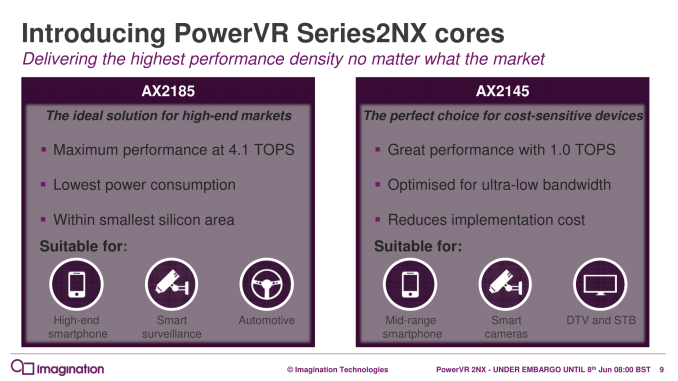
Given the traditional spectrum of embedded and mobile markets, Imagination is positioning the AX2185 for higher-end smartphones, smart surveillance systems, and automotive, while pushing the low-bandwidth-tuned AX2145 for lower-end applications, including DTV and set-top boxes (STB). For all these use-cases, particularly mobile and smart surveillance, Imagination sees these two new IP blocks as providing superior inferencing performance within a given power profile and silicon footprint. But as with their previous briefing, specific numbers were sparse.
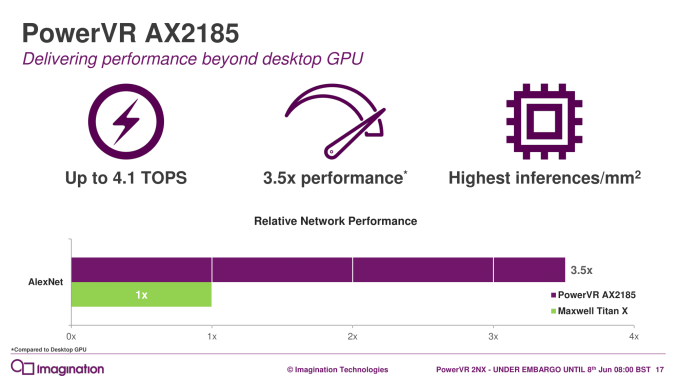
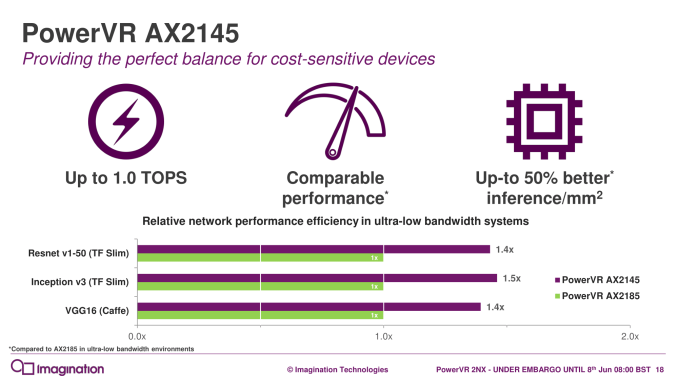
In any case, Imagination is claiming up to 4.1 TOPS on the AX2185 and 1 TOPS for the AX2145; these metrics seem based off of the maximum 2048 8-bit multiply-and-accumulate operations (MACs) per clock capability. It was noted that AX2185 comes equipped with eight full-width compute engines, but it is not clear if this is the same for the AX2145, which was optimized for ultra-low-bandwidth.
While Imagination stated that the AX2185 had already been delivered to select partners, Imagination considered the AX2185 and AX2145 more akin to 2nd generation NNA cores, noting an unannounced predecessor that was developed alongside lead customers. Details of the resulting optimizations, however, were not disclosed.
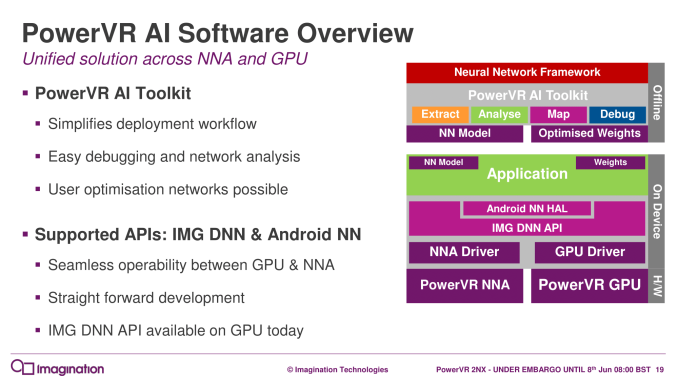
Architecturally, then, nothing has changed since the initial announcement last September, and the same highlights apply: flexible bit-depths for data and weights, variable internal precision, data format interoperability with other system components (ISP, GPU, CPU), and the software ecosystem. For the latter, Imagination reiterates its NNA oriented development tools such as the PowerVR AI Toolkit and Imagination DNN API, with both new IP cores supporting the Android NN API. Ultimately, Caffe and TensorFlow are largely the primary intended frameworks for the NNA. As we have mentioned throughout our ongoing coverage of neural network hardware IP, it is still too early to gauge competitiveness, particularly. Going forward though, Imagination’s natural integration opportunities with its own PowerVR GPUs will be something to keep an eye on. The AX2185 and AX2145 are available for licensing today, and interested parties may contact Imagination directly. Related Reading | ||||||||||||||||||||||||||||||||||||||||||||||||||||||||||||
| 9:00a | Be Quiet!, Threadripper: The Dark Rock Pro TR4 HSF Is Here
AMD’s Ryzen Threadripper made quite a splash in the industry with its massive core count and a server-class TDP. Building a system based on such a processor seems alluring to a creative professional because of multi-tasking performance, but a loud air cooling system, or necessity to go liquid could be a turnoff. Thankfully, be quiet! has a solution.
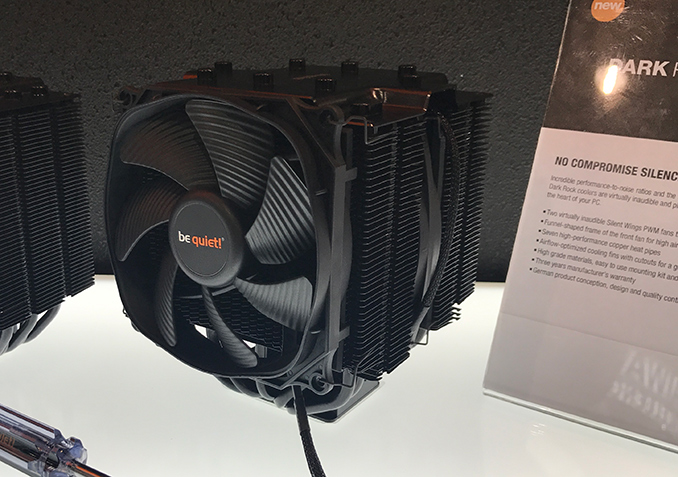
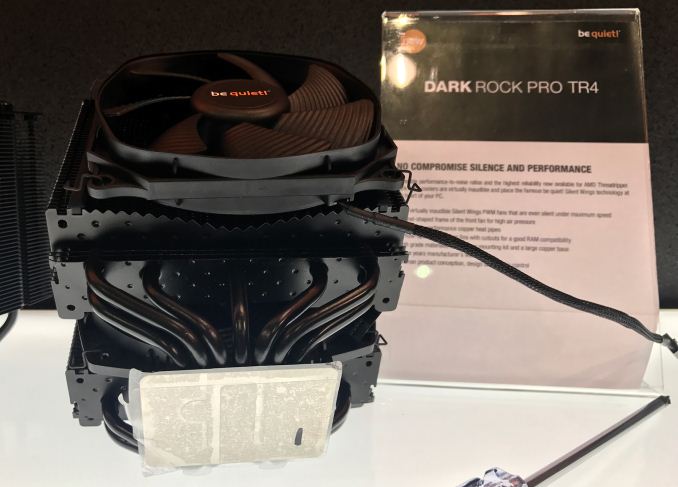
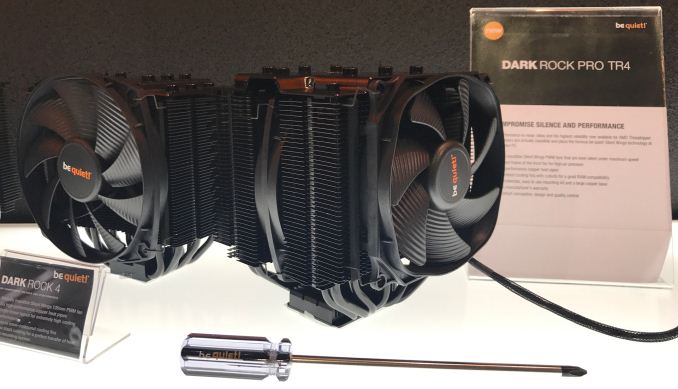
Be Quiet!’s Dark Rock Pro TR4 mega-cooler (or should I say hypercooler?) has a massive aluminum base (no copper, sorry), seven heat pipes, two large fans, and loads of fins. The cooler is rated for 240 W, so it can support all the existing AMD Ryzen Threadripper processors as well as the upcoming AMD Ryzen Threadripper 2 CPUs. Keep in mind that TR II’s 250 W TDP is a very conservative range and in most cases, these chips will dissipate much less).
Although high-end desktops are not meant to be silent, be quiet!’s Dark Rock Pro TR4 is here to prove otherwise: it is possible to wed performance and silence without using a liquid cooling system.
Be quiet! says that the Dark Rock Pro TR4 will be available in the coming weeks at around the same price point as the regular one, so think about ~$90 with a screwdriver included.
| ||||||||||||||||||||||||||||||||||||||||||||||||||||||||||||
| 10:00a | RGB LEDs Everywhere: HyperX Teases Fury SSD with Lights
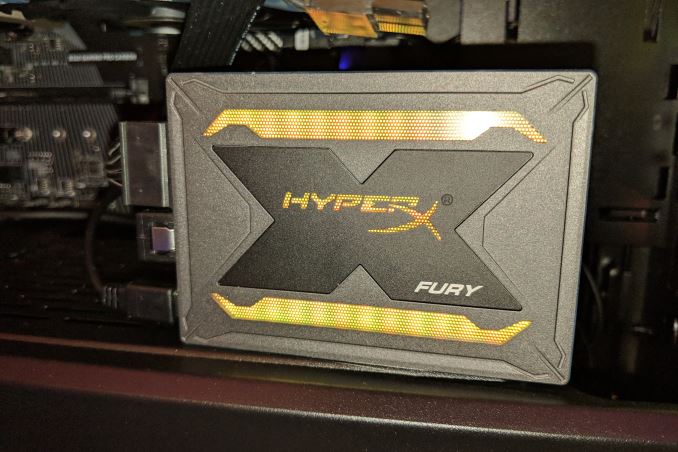
Kingston's HyperX teased a new Fury-branded RGB LED SSD at Computex. The company didn’t have set specifications for the new 2.5” SATA 6GB/s SSD (HyperX is still fine-tuning the product, according to the company rep), so we don't know much at the moment. However, the drive itself features standard SATA connectors (power and data) and an additional port that connects to the motherboard for RGB LED control. The micro-USB connection allows the SSD to use vendor-specific RGB LED software for control and allows the SSD to be daisy chained to multiple RGB devices. The company didn’t specify which motherboards would support the new RGB LED SSD.
The only viable specification HyperX provided were the sequential read and write speeds, rated at up to 500MB/s and 480MB/s, respectively (lower than what was mentioned during CES this year). This is well below the performance of the company's Savage-branded SSD, which is rated for 560MB/s and 530MB/s sequential read and write speeds using a Phison S10 controller with TLC NAND. With slower rated speeds, the new Fury RGB LED SSD may be less about performance and more about the bling, but the MSRP will undoubtedly determine the flashy storage's future. Full specifications and pricing for the new HyperX RGB LED SSD are currently unavailable, but if you're itching to add yet another piece to your PC that lights up (we’ve nearly seen it all – RGB LED PSU cables anyone?), the company said that it expects to start shipping this flashy flash storage drive in Q3 of 2018.
| ||||||||||||||||||||||||||||||||||||||||||||||||||||||||||||
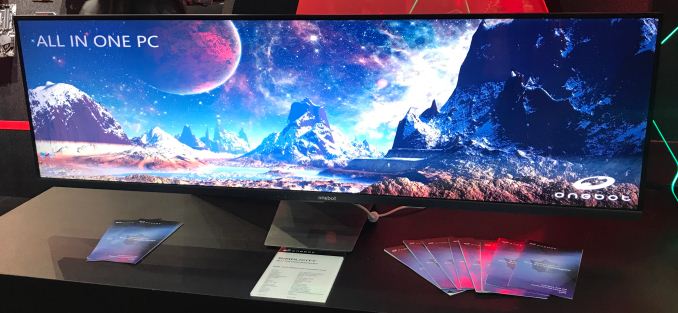
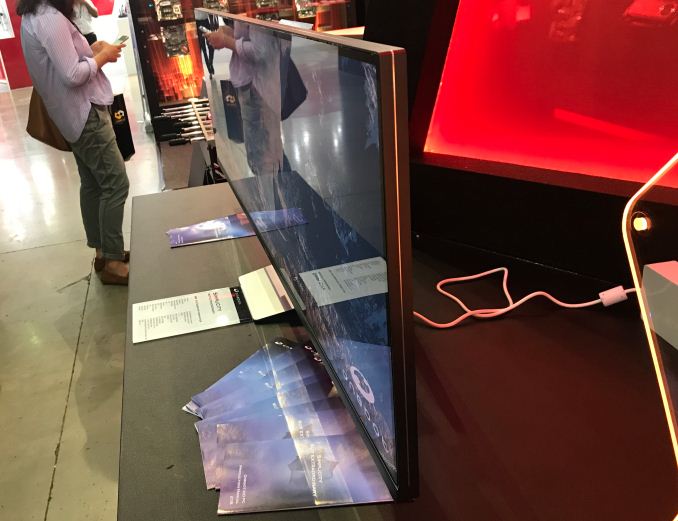
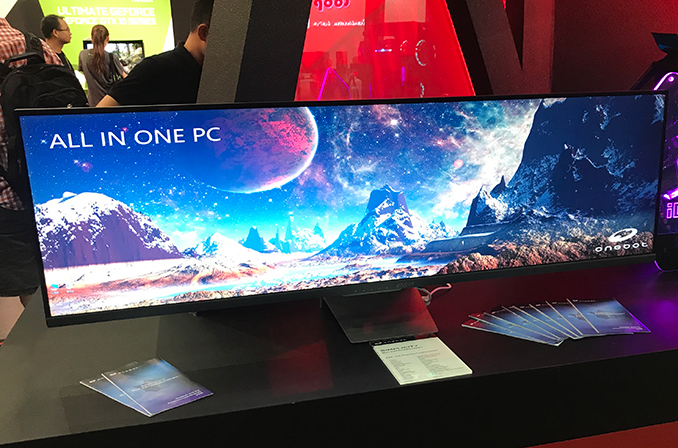
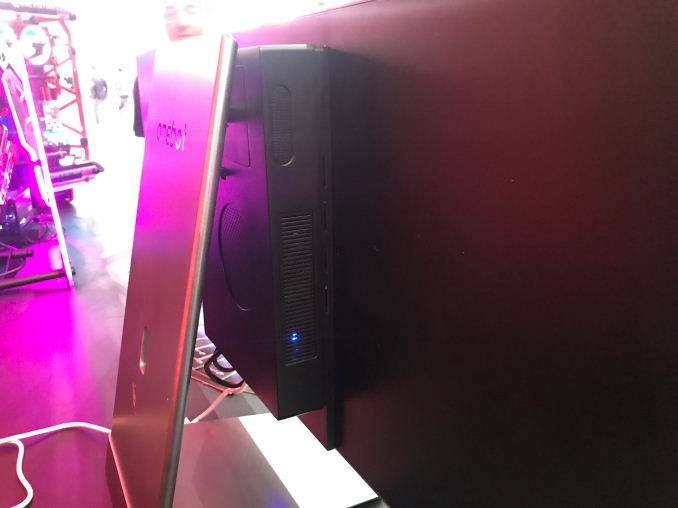
| 11:00a | Colorful Demonstrates a 49-Inch All-in-One PC
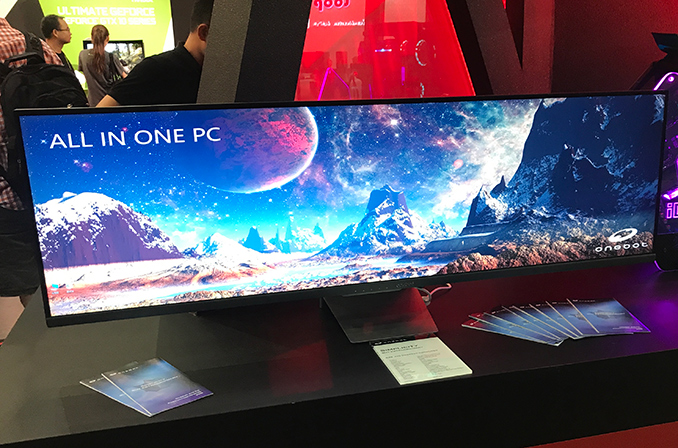
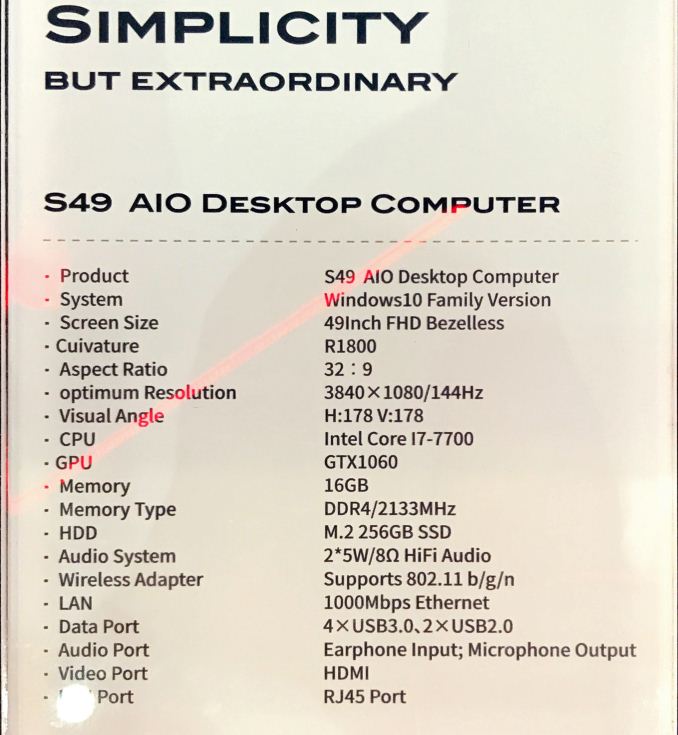
Colorful is showing off its prototype of an all-in-one computer with a 49-inch display. At present, the system is closer to a proof-of-concept than a real product, but if the company finds that there is enough interest in such a PC, an AIO featuring an ultrawide LCD will be released commercially. The Colorful Onebot S49 AIO PC is based on a standard (presumably Mini-ITX, but there is no formal confirmation for that) motherboard powered by Intel’s Core i7-7700 processor accompanied by NVIDIA’s GeForce GTX 1060 GPU, 16 GD of DDR4 memory and a 256 GB M.2 SSD. As expected, the system features all the connectivity options that a modern PC is supposed to have, including a GbE port, 802.11n Wi-Fi, four USB 3.0 Type-A ports, two USB 2.0 headers, an HDMI connector and so on.
The key feature of the Colorful S49 is, of course, its 49-inch monitor featuring a 32:9 aspect ratio, 3840×1080 resolution, and a 144 Hz refresh rate. This panel is made by Samsung (again, not confirmed officially) and along with it, the company supplies a scaler that supports AMD’s FreeSync. However, because Colorful is a loyal partner of NVIDIA, the AIO PC does not support FreeSync, whereas NVIDIA’s G-Sync is not supported by the scaler (at least right now).
The Colorful S49 clearly looks impressive. At present this is the only AIO system in the world that has a 49-inch screen. Colorful clearly positions the product as a solution for gamers, but it will be equally good for users of multi-display setups used for productivity applications.
As already noted, the Colorful S49 will hardly make it to the market, at least not in the Western countries, in its current form. If the company actually decides to produce it, it will likely upgrade the CPU and ensure that the platform has up-to-date communication capabilities, such as 802.11ac Wi-Fi, USB Type-C and so on.
| ||||||||||||||||||||||||||||||||||||||||||||||||||||||||||||
| 6:00p | Intel’s Core i7-8086K CPU Now on Sale
While Intel’s other 5GHz processor has turned out to be greatly exaggerated, Intel’s original 5GHz chip, the Coffee Lake-based Core i7-8086K, is very much real. And right on schedule, Intel has rolled it out to retail. As unexpectedly published in the Intel 8086K giveaway terms & conditions, the retail price on the chip is indeed $425. This makes for what’s essentially a $75 premium over Intel’s once and future king, the Core i7-8700K. As a reminder only 50,000 units of the 8086K are being released – minus 8,086 for the giveaway – so while this is technically Intel’s fastest 6-core CPU, it isn’t going to be a permanent fixture like the 8700K.
While we’re still waiting to get the individual per-core turbo levels of Intel’s special edition chip, officially its base clock and single-core turbo clock are both 300MHz higher than the 8700K, or about 6-8% faster than its non-special counterpart. And we expect the other turbo levels to be similar. Ostensibly the TDP remains at 95W, however as Intel defines this as power consumption under load at the base clock, power consumption with turbo – particularly multi-core enhancement, which I know you’re all going to run anyhow – will definitely be higher. The CPU is available from Amazon, Newegg, and a few other retailers while supplies last. | ||||||||||||||||||||||||||||||||||||||||||||||||||||||||||||
| 7:00p | NVIDIA Publishes Official G-Sync HDR System Requirements, Releases VBIOS Updater for DisplayPort 1.3 & 1.4
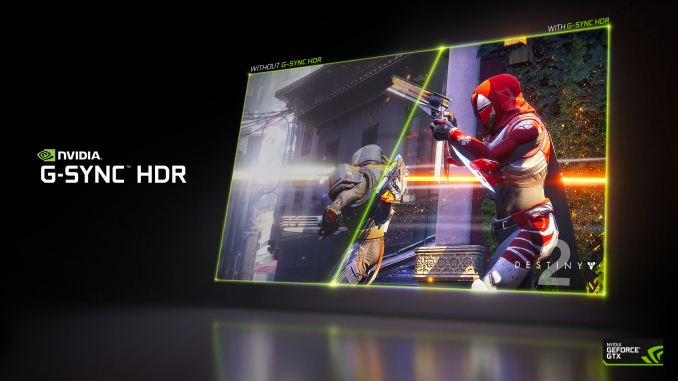
As the first week of June winds down, the long-awaited and even longer delayed G-Sync HDR monitors are just about here. For Acer's Predator X27, units are starting to finally make their way into the hands of consumers, while ASUS' ROG Swift PG27UQ is slated for late this month. In preparation for these new displays, towards the end of this week NVIDIA quietly published official G-Sync HDR System Requirements, which links to the newly-released Graphics Firmware Update Tool for DisplayPort 1.3 and 1.4 Displays. The latter applies to a range of Maxwell and desktop Pascal products, but more importantly is there to provide G-Sync HDR capability for older Pascal cards that shipped without an HDR-supporting VBIOS. The G-Sync HDR system requirements themselves are described rather minimally: None of these prerequisites are particularly surprising, but it does formally confirm the requirements that so far only manufacturers have detailed. A Windows 10 version was not specified, but presumably refers to the latest April 2018 Update, while the "GTX 1050" presumably includes the new GTX 1050 3GB with 96-bit memory bus.
As for the VBIOS update tool (32-bit and 64-bit), it will detect whether a VBIOS update is needed or not before prompting the user to flash to the latest firmware. Beyond compatibility with G-Sync HDR, the new VBIOS will resolve hanging on boot or blank screening until the OS loads, on systems connected to DP 1.3 or 1.4 monitors. The release notes also mention supporting the latest DP1.3 and 1.4 features, though specifics were not provided. To be clear, it is not intended for user customized VBIOS, and as far as Pascal goes the tool appears geared towards early Founders Edition models. Off the back of their 398.11 WHQL driver optimizations for HDR G-Sync, NVIDIA has also released a 398.18 hotfix, resolving black screening when booting to Windows after installing 397.93. And the support instructions for sending logs of display issues (DispDiag) has also been updated. Related Reading | ||||||||||||||||||||||||||||||||||||||||||||||||||||||||||||






| << Previous Day |
2018/06/08 [Calendar] |
Next Day >> |