[Most Recent Entries] [Calendar View]
Wednesday, June 13th, 2018
| Time | Event | |||||||||||||||||||||
| 8:00a | The BitFenix Formula Gold 650W PSU Review: Balanced Today we are taking a look at the Formula Gold 650W power supply from BitFenix, a high-performance unit that trades modular cables for a lower retail price. The CWT-made unit holds many surprises, both positive and negative, which we closely examine in this review. | |||||||||||||||||||||
| 9:00a | FSP’s Readies Cannon: a 2000 W PSU for Mining and Extreme Desktops
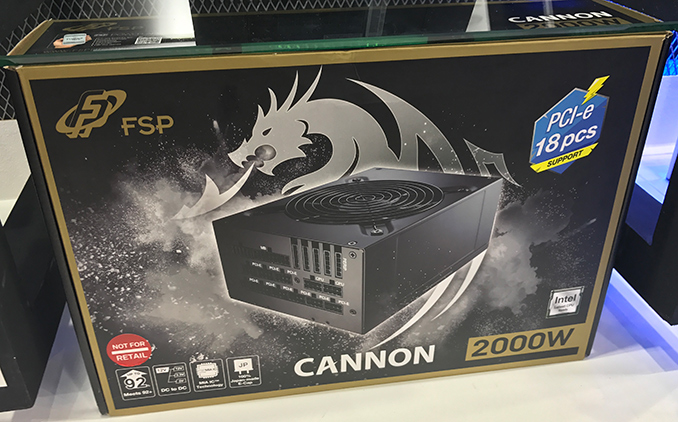
FSP is well-known for high-quality moderately-priced power supplies but is not particularly known for high-wattage units. At last year’s Computex the company demonstrated a PSU that could output 1400 W peak with liquid cooling for gamers and this year it showcased its first 2000 W PSU for other market segments. Cryptocurrency mining is opening up new business opportunities in general and for hardware makers in particular. Power supplies for mining are a good example of such new opportunities. Earlier this week we reported about a 3000 W mining PSU from Qdion, FSP’s entry-level brand. In addition to the 3 kW beast, FSP will offer a less extreme 2 kW PSU designed with mining in mind, but which will also appeal to owners of high-end desktops due to features it supports.
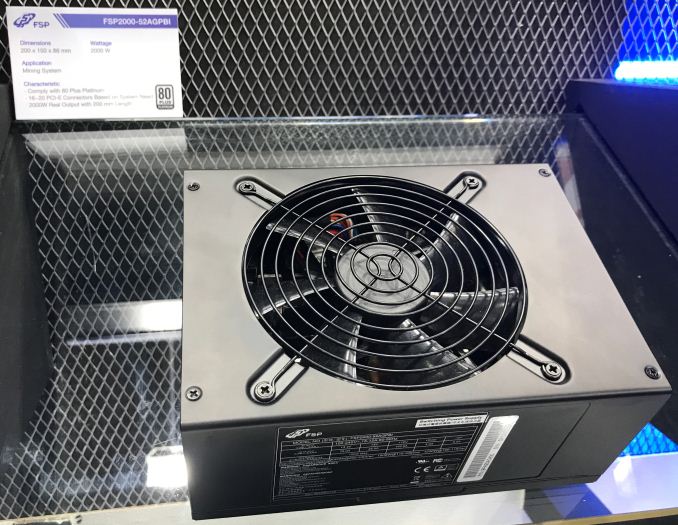
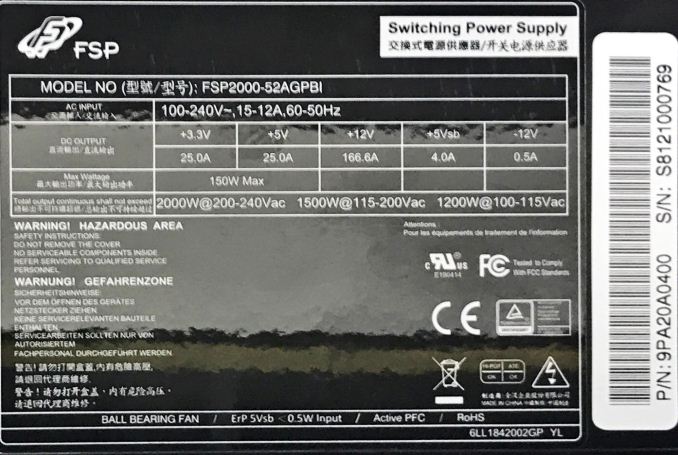
FSP’s Cannon 2000 W PSU (FSP2000-50AGPBI) comes in standard 200×150×86 mm enclosure and is compliant with the ATX 12V v2.4 as well as EPS v2.92 specifications. The power supply uses Japanese capacitors and has a 135 mm FDB fan with an “intelligent fan control,” something that is not usually found in PSUs for mining, but which is common for desktop/workstation systems. The PSU is also outfitted with two 4+4 CPU power connectors and thus can handle dual-socket systems (again, 2P motherboards are not used for mining). It is noteworthy that the FSP2000-50AGPBI does not carry any 80Plus badge, but FSP says that the unit complies with the 80Plus Platinum logo and is 92% efficient under high loads. If this is true and FSP can get the badge, this will be the world’s first 2000 W PSU to get it (in fact, there are no 2 kW PSUs that have any 80Plus badges). Unlike the aforementioned Qdion mining power supply, FSP’s 2 kW is equipped with all the standard protection mechanisms we usually on desktop PSUs, including protection against overcurrent, overvoltage, overpower, under voltage, short circuit, and over temperature.
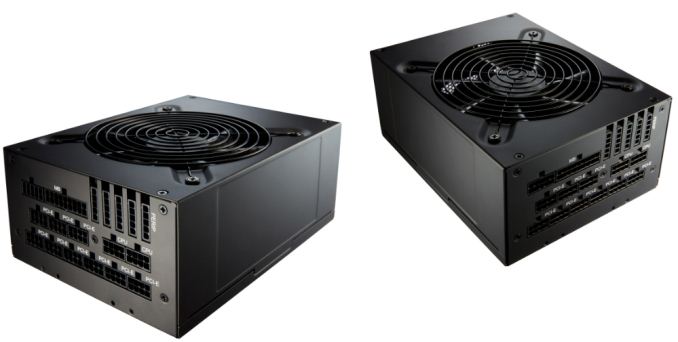
Moving on to connectors. FSP’s Cannon is equipped with 18 8-pin PCIe power connectors and can feed at least 9 graphics cards. Meanwhile, the unit also has 16 SATA power plugs, four Molex connectors, and even one 4-pin FDD connector. While it is obvious that no desktop will ever need 18 PCIe power plugs, no mining system will ever need 16 SATA power connectors, which once again proves ‘mining + HEDT’ nature of the PSU. To make the matters even more desktop friendly, the PSU is fully modular and the unnecessary PCIe cables will just not go into a desktop.
Having mentioned a number of times that FSP’s Cannon 2000 W is aimed not only at mining rigs but also on high-end desktops, it is worth describing what kind of HEDT might require a 2 kW PSU. Well, a heavily overclocked one featuring one of the upcoming Extreme Workstation-class CPUs from AMD or Intel (TDP grows exponentially with serious overclocking), two high-end graphics cards, loads of memory, a number of high-capacity PCIe 3.0 x4 SSDs (they are pretty power hungry when configured for performance), multiple hard drives, and all the other components. Even for such a system, a 2000 W PSU is going to offer a lot of headroom, but this is okay for a HEDT in general. FSP’s Cannon 2000 W PSU is already listed on the company’s website, so expect it to hit the market in the coming quarters (technically, it is available for order now, but there is a shortage of components + sea freight may take a couple of months). The price of the product is unknown, but 2 kW power supplies are far from cheap, think north of $500.
| |||||||||||||||||||||
| 9:30a | Intel’s First (Modern) Discrete GPU Set For 2020
In a very short tweet posted to their Twitter feed yesterday, Intel revealed/confirmed the launch date for their first discrete GPU developed under the company’s new dGPU initiative. The otherwise unnamed high-end GPU will be launching in 2020, a short two to two-and-a-half years from now.
The tweet was posted amidst reports that Intel had given the same details to a small group of analysts last week, with the tweet being released to confirm those reports. The nature of the meeting itself hasn’t been disclosed, but Intel regularly gives analysts extremely broad timelines for new technologies as part of outlining their plans to remain on top of the market. This new GPU would be the first GPU to come out of Intel’s revitalized GPU efforts, which kicked into high gear at the end of 2017 with the hiring of former AMD and Apple GPU boss Raja Koduri. Intel of course is in the midst of watching sometimes-ally and sometimes-rival NVIDIA grow at a nearly absurd pace thanks to the machine learning boom, so Intel’s third shot at dGPUs is ultimately an effort to establish themselves in a market for accelerators that is no longer niche but is increasingly splitting off customers who previously would have relied entirely on Intel CPUs. Interestingly, a 2020 launch date for the new discrete GPU is inside the estimate window we had seen for the project. But the long development cycle for a high-end GPU means that this project was undoubtedly started before Raja Koduri joined Intel in late 2017 – most likely it would have needed to kick off at the start of the year, if not in 2016 – so this implies that Koduri has indeed inherited an existing Intel project, rather than starting from scratch. Whether this is an evolution of Intel’s Gen GPU or an entirely new architecture remains to be seen, as there are good arguments for both sides. Intel isn’t saying anything else about the GPU at this time. Though we do know from Intel’s statements when they hired Koduri that they’re starting with high-end GPUs, a fitting choice given the accelerator market Intel is going after. This GPU is almost certainly aimed at compute users first and foremost – especially if Intel adopts a bleeding edge-like strategy that AMD and NVIDIA have started to favor – but Intel’s dGPU efforts are not entirely focused on professionals. Intel has also confirmed that they want to go after the gaming market as well, though what that would entail – and when – is another question entirely. | |||||||||||||||||||||
| 10:00a | UFS - USB Bridge Controllers for Card Readers, Hosts Incoming from JMicron & SMI
The JEDEC published the UFS Card 1.0 specification back in mid-2016, and shortly after that Samsung introduced its UFS cards with 32, 64, 128, and 256 GB capacities. In the meantime, neither Samsung nor any other maker of electronics has introduced a device supporting such cards. The situation may change in the coming quarters as at least two developers of controllers — JMicron and Silicon Motion — are about to launch their UFS to USB bridge solutions for card readers.
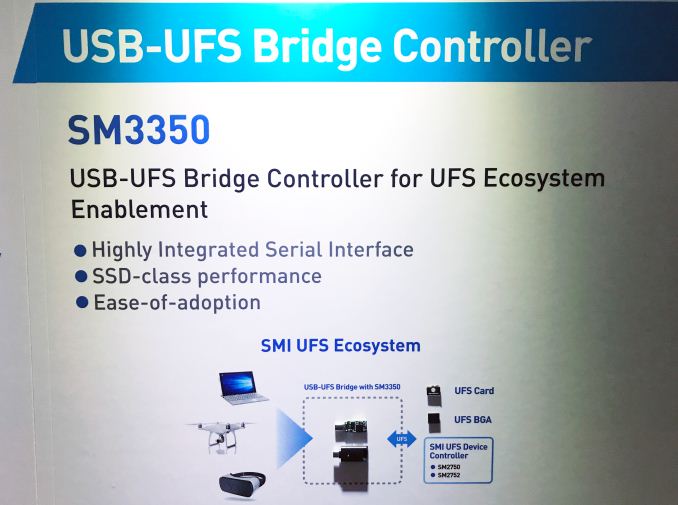
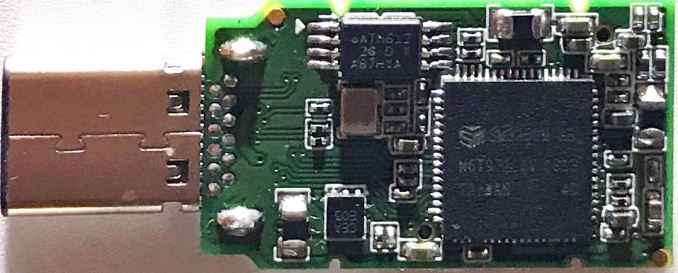
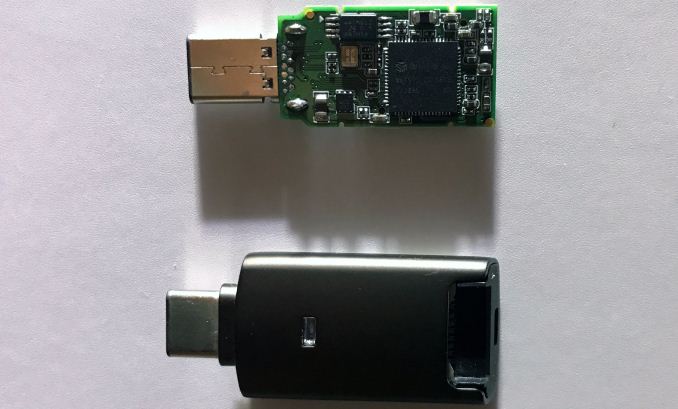
Silicon Motion already offers its clients the SM3350 USB 3.1 - UFS 2.1 bridge (UFS Card 1.0 is a part of the UFS 2.1 spec) as well as the SM2750 and SM2752 UFS 2.1 device controllers required to build UFS memory cards and embedded storage solutions. The SM3350 is still not listed on Silicon Motion’s website, but the company says that its customers can buy the said chips and build cards and card readers for PCs or other devices now. To prove its point, SMI demonstrates two USB card readers for UFS cards. In addition, the company has various UFS solutions for industrial/automotive applications, but they are beyond the scope of this news story.
Since SMI only sells controllers, it is uneasy to say when actual products on their base will be available. Meanwhile, the important thing is that the chips are here because back in 2017 SMI did not offer these ICs (integrated circuits) at all.
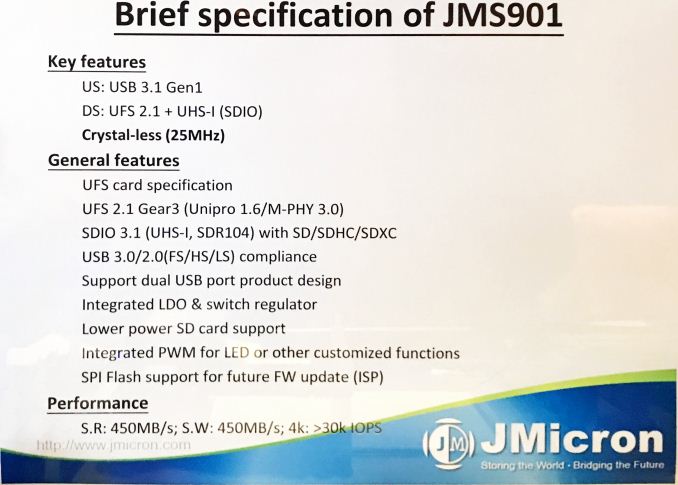
Moving on to JMicron. JMicron is prepping its JMS901 USB 3.1 - UFS 2.1 bridge that will also support UHS-I for backward compatibility with SD cards to enable manufacturers to build universal card readers. The company expects the controller to support sequential read/write speeds of up to 450 MB/s (because of the UFS 2.1 Gear3 interface) as well as up to 30K read/write random IOPS.
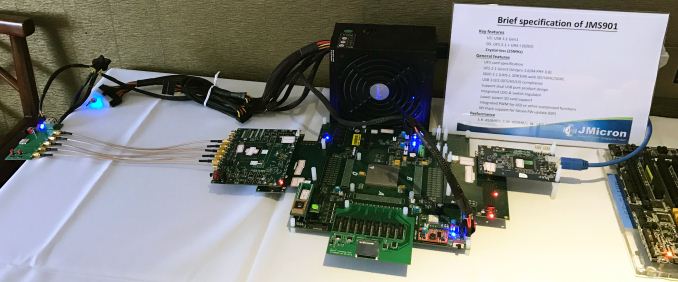
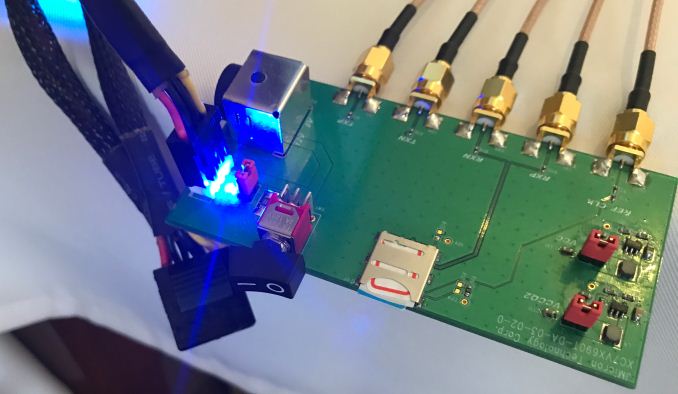
JMicron does not have the JMS901 silicon at hand just yet: at Computex the company demonstrated the project to select customers and press using a Xilinx Virtex-7 FPGA and custom PHY. JMicron expects to receive the chip from the fab in July and if all goes well, the JMS901 will be available to JMicron’s customers later this year. Considering the fact that there is nothing too complex about this bridge, it is likely that its very first revision will go into production.
Neither JMicron nor SMI discloses quotes for their UFS 2.1-supporting products, but since we are talking about really small consumer-grade chips, their prices are not supposed to be high. Meanwhile, a big question is whether makers of PCs and other hardware get interested to incorporate UFS card readers considering the fact that there are no mass-market smartphones or cameras that use such cards.
As reported, Samsung launched a lineup of UFS cards that offer an impressive sequential read performance of up to 530 MB/s and sequential write performance of up to 170 MB/s. As for random performance, then Samsung spec'd its 256 GB card for 40,000 read IOPS and 35,000 write IOPS for the 256GB version. Despite all the potential advantages that UFS cards can bring, even Samsung does not integrate UFS card readers into its Galaxy smartphones that are sold in hundreds of millions of units. A launch of a Samsung smartphone with a UFS card reader could skyrocket adoption of almost any technology, including UFS, but we will have to wait for one of such devices.
| |||||||||||||||||||||
| 11:00a | Streacom DA2 Fanless: The All-Aluminum Silent Chassis
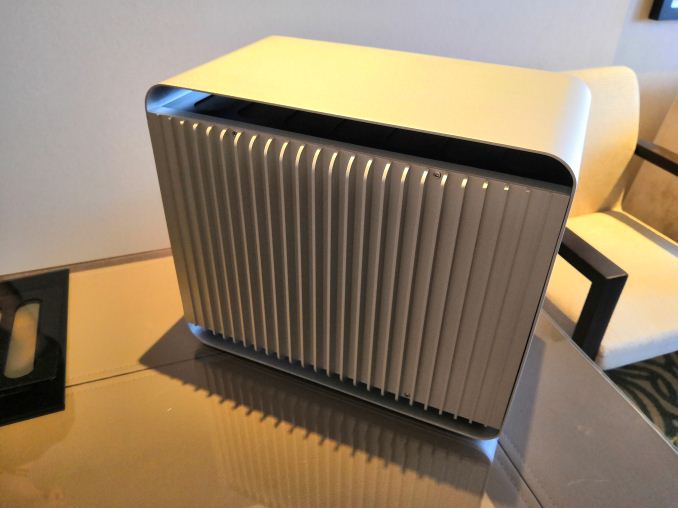
Before Computex we reported on Streacom’s latest creation, the DA2. This is an all-aluminium chassis aimed at small form factor systems but with a key twist – the rails on the inside allowed the system builder to orient all of the parts in the chassis in any direction and any location. Streacom’s rail design has been shown at Computex for a few years, and they say that the latest iteration is the easiest yet. The full ‘ring’ around the chassis is designed to be like a unibody component with a front panel bezel that is removable. The front panel switch has a custom LED light inside for system integrators to personalize, along with a USB Type-C connector (using a traditional 19-pin header).
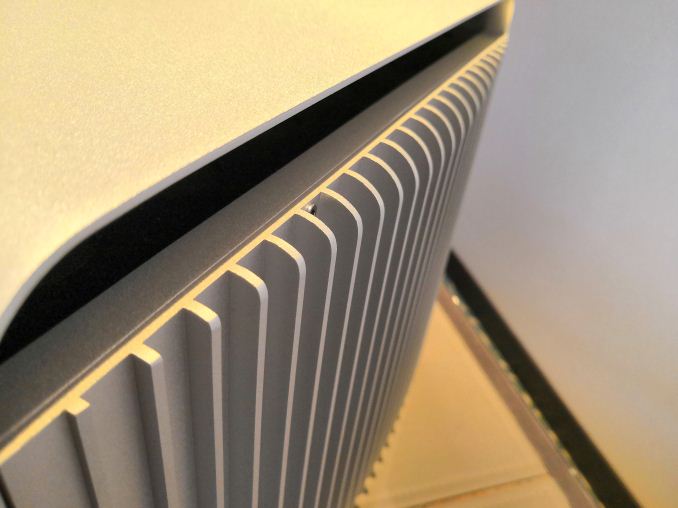
What Streacom was showing at Computex as a prototype was the fanless version of the DA2. Instead of having the meshed aluminium of the active cooling variant on the sides, the fanless version used side panels with fins to help dissipate heat, and will come with an integrated heatsink to use on the processor inside (they’re still working on how to do this). It is all still a prototype, particularly the fin placement and size, so the final product might have various differentiation options depending on the customer (such as a logo embedded into the fins).
Streacom is aiming to place the fanless version of the DA2 into the market in Q4. Pricing is TBD.
| |||||||||||||||||||||
| 12:00p | USB-IF and Fast Charging: New Standard Logo with Wattage Listed
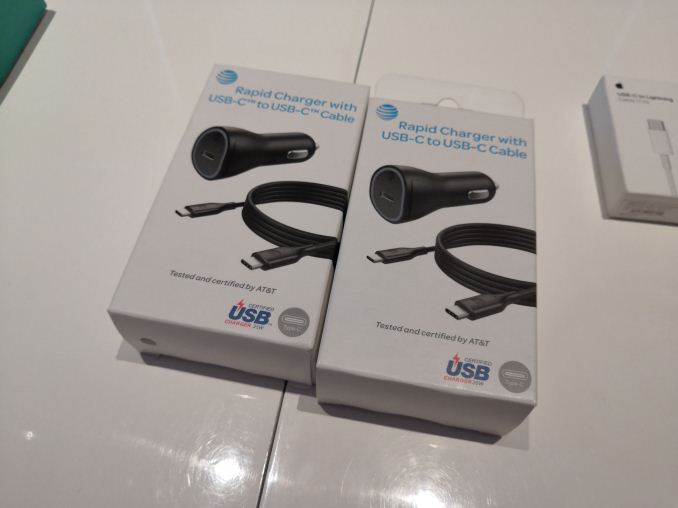
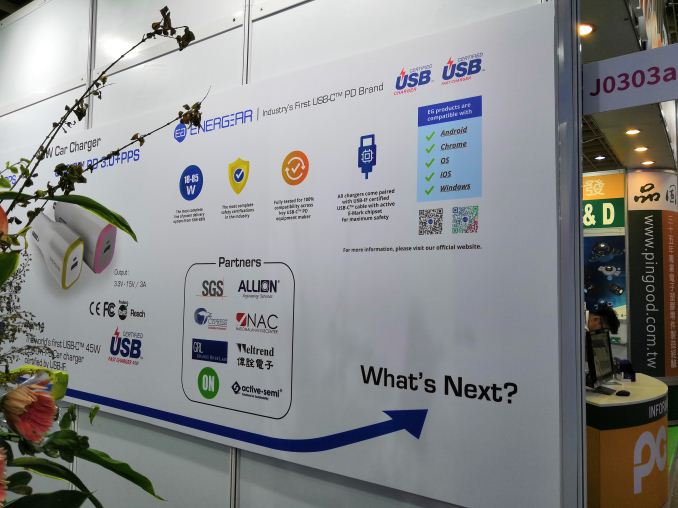
When discussing industry standards, the sexy ones are involved around performance: if you can breathe PCIe 4.0 or PCIe 5.0 into a sentence, people start listening. One of the standards we actually deal with day in and day out though is around charging and USB charging. Not only do we have a series of standards in play for chargers over USB, but there are also a ton of companies that do their own thing in the mix outside of those standards. It can be, if we’re honest, a bit of a mess. One of the new ways that the USB-IF is trying to fix this is with certified chargers and fast chargers. The new programs, previously announced in 2016 and back at CES 2018, are finally coming to fruition, and the USB-IF is showing off some of the new products released under the new standards. By using 11 certified test centers worldwide, the newest fast charging standards will enable wall chargers, car chargers, and other dedicated charging devices to carry a logo that states both that the unit adheres to the standards, but also the maximum power.
This listing of power is going to be a good thing. Users can know that if they need a 45W or a 65W charger, that what the logo says on the box is what the unit can handle. At the show we bumped into a company that already has chargers certified to 25W, 27W, 45W, and 65W. It was as clear as day which product was targeted for what sort of application. Meanwhile the fast charging standard, which implements the USB Power Delivery Porgrammable Power Supply standard, allows for devices and chargers to do finer-grained voltage negoriation between USB-PD's major power classes (5V, 12V, etc). This allows a device to request the highest voltage it can take, as opposed to having to drop down to a lower power class entirely.
USB-IF also spoke about USB 3.2, with ASMedia at the show having a prototype 2x2 PHY on display. Despite the standard being finalized in September 2017, the first products and controllers are unlikely to be available until 2019 at the earliest.
| |||||||||||||||||||||
| 1:00p | Building for Apache Pass: Why Some Skylake Servers Already have 8 DIMMs Per Socket
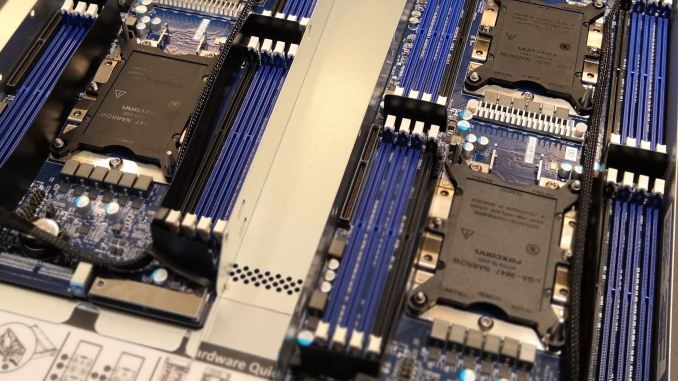
If you don’t have a hand in a server day in and day out, it was perhaps not obvious why some Skylake servers when launched had eight memory slots. The Skylake-SP based Xeon platform only had six memory channels, so each socket should have had six or twelve memory slots, but for some reason we saw systems with eight and didn’t know why at the time. Perhaps even more confusingly, none of the product managers I speak to on a regular basis could give me a straight answer as to why these systems had eight memory slots per socket. The best answer I was given was that previous generation processors were quad-channel, so by having eight DIMMs they could transfer expensive memory across systems. It would mean a situation where of the six channels in the new processors, two of those channels would run at two DIMMs per channel, and the others would be at one DIMM per channel. The configuration is odd, sure, but we’ve seen it in the past on motherboards like the EX58-UD3 that had a 3+1 for a tri-channel system.
When Intel formally showcased Apache Pass, or what is now known as Optane DC Persistent Memory (or Optane DIMMs), it became clear that these ‘extra’ slots were officially designed for it. At the Optane DIMM launch, Intel was coy about the adaptability of the new memory, deciding to hold back on the answer as to whether the new Optane DIMMs and DDR4 were interchangeable (as they are pin-compatible), although answers have been offered by Charlie from Semiaccurate. Earlier in the year, Paul over at Tom’s Hardware showcased a diagram of a Lenovo system that exhibited a block diagram of two DIMMs of Optane per socket, with each of those backed by another DDR4 module. Intel has clarified that the new Optane DC Persistent Memory will only be compatible with their next generation of processors, however we do know that Optane DIMMs were originally set for the Skylake-SP platform. The two processor families are still meant to be socket compatible, but server makers had system setups in place for Optane DIMMs back at Skylake-SP launch. If you’ve ever wondered what those extra colored memory slots are, there you go. GIGABYTE had some on display at their booth, hence a short update.
| |||||||||||||||||||||
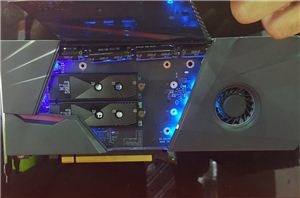
| 2:00p | GIGABYTE Aorus PCIe x16 M.2: For Four NVMe Drives, X399 Compatible
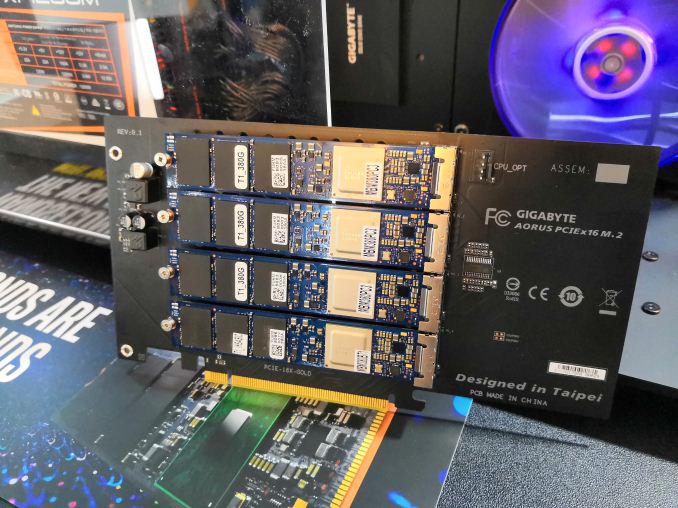
Everyone has spare NVMe SSDs, right? Or perhaps users want to buy four of them? Intel was on a big push recently with its newest 380 GB Intel Optane 905P SSD, with most of the main motherboard and system vendors showing them in action. To date we have seen both ASUS and ASRock show off their 4-in-1 M.2 to PCIe add-in cards, both of which should now be easily available, leaving GIGABYTE and MSI to come up with their own. Well in order to show off the Optane drives, GIGABYTE put together a quick something that they're calling the Aorus PCIe x16 M.2. Currently standing at revision 0.1, GIGABYTE was being coy about whether it was going to come to market. It was made specifically to run the Optane demonstrations we were told, but more time would need to be spent if it were to be a retail product.
This isn’t really that big of a news piece, especially when other PCIe add-in cards exist. What we were told however is that this add-in card works with X399 and AMD’s Threadripper motherboards. Before the show, I was pinged by Wendell over at Level1Techs about this cards, and I took it upon myself to investigate if/when these companies would supported all HEDT platforms with the additional bifurcation and clock gens needed. The same issues occur with AMD and Intel, making it a compound issue. GIGABYTE explicitly stated that their card has no trouble working on X399 motherboards, although they did state that they had only tested one in a board at a time. I spoke to the PM, and although it was unsaid, it was clear that they only built the product to show off the Optane drives for the show. However I did make an effort to explain that if marketed as a four-way M.2 to PCIe card that has explicit AMD X399 support, it would capture a corner of the market. It will be interesting to see how it turns out.
| |||||||||||||||||||||






| << Previous Day |
2018/06/13 [Calendar] |
Next Day >> |