[Most Recent Entries] [Calendar View]
Wednesday, June 27th, 2018
- ADATA Launches XPG SX6000 SSDs: 3D TLC, M.2, 512GB for $200
- ADATA Announces The XPG SX7000 Series SSDs: Up to 1 TB, M.2, PCIe 3.0 x4
| Time | Event | ||||||||||||||||||||||||||||||||
| 5:00a | Qualcomm Announces Snapdragon 2500 Wearable Platform For Kids Watches
Today among the announcements of then new mid- and low-end SoC lineup Qualcomm also announced a new wearable platform dubbed the Snapdragon Wear 2500. We don’t have many details on the platform so we're just interpreting what’s on the press release – but what seems to be happening here is that we’re looking at a new platform combining an existing SoC with a new supporting IC, rather than an entirely new SoC succeeding the Snapdragon 2100. In terms of disclosed specifications, the SW2500 matches the SW2100 as it uses a quad-core Cortex A7 CPU cluster as well as an X5 modem.
The interesting thing about the Wear 2500 is the way that Qualcomm describes the improvements – notably the 14% improved battery life of the platform. This seems to have been achieved by a new PMIC that reduces the quiescent current of the system when the SoC is sleeping. The new power amplifiers are said to improve peak power efficiency by 20%. The new power delivery system is also noted to be 38% smaller than the predecessor which should allow vendors to optimise in terms of system PCB size and thus device dimensions. The BSP (Board support package) provided by Qualcomm notably doesn’t outright run Android Wear, but rather an optimised version of Android O that is aimed at fitting into a lower 512MB footprint, while it also also has further software optimisations in terms of power management to shut off software components when not needed. Overall, Qualcomm is pitching the new wearable platform at the kid watch market, which is a very similar direction to what we saw from them with last year's Snapdragon Wear 1200 launch. This is a quickly growing market, especially in Asia, where parents are keen to equip their kids with these limited-functionality wearables to keep in contact with and tabs on their most valuable assets. The Wear 2500, by extension, would represent the next step up from the 1200 for more powerful devices, gaining a much more powerful CPU cluster (quad core versus single core), a real Adreno GPU, etc. Given that Qualcomm is marketing this new platform for the kid watch segment, it’s likely that this is not the overdue “true” successor to the Snapdragon Wear 2100 that we’d be hoping for. While we’re awaiting confirmation, it also seems that the SoC on the new platform is the same one used in the 2100 so naturally the improvements are solely on the side of the supporting ICs such as the PMIC and RFFE, which would be a bit disappointing given the new naming for the platform. The Snapdragon Wear 2500 is sampling right now and expected to come to market in the coming quarter, with Huawei expected to be the first company to come to market with a kids watch based on the platform. | ||||||||||||||||||||||||||||||||
| 8:00a | The Huawei MateBook X Pro Review: Calling Out The Competition Huawei has not been in the PC game very long, but in just a short couple of years they certainly raised the bar for the competition in the Ultrabook category. Today we’re taking a look at the latest Huawei MateBook X Pro, and with this release, the traditional PC makers need to stand up and take notice. | ||||||||||||||||||||||||||||||||
| 10:30a | ASMedia Preps ASM2824 PCIe 3.0 Switch
Back in 2016 Avago/Broadcom greatly increased the prices of its PLX-branded PCIe switches, which caused many motherboard manufacturers to cease using them. Avago’s motivation was rather obvious — PCIe switches are needed primarily in servers and should be priced accordingly. Meanwhile, there is still demand for such devices in desktops as well, so other manufacturers are vying to enter the PCIe switch space.
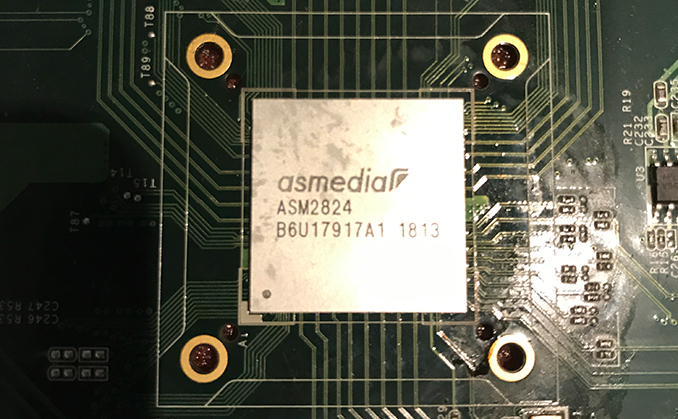
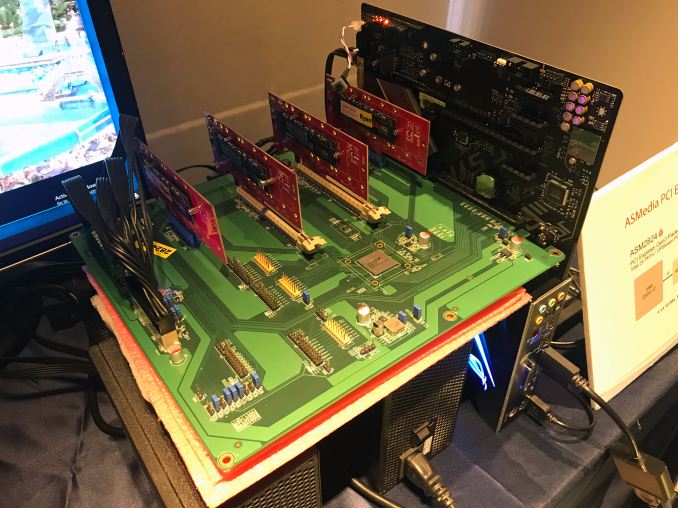
Apparently, both ASMedia and Marvell are preparing their own PCIe switches. We already reported about Marvell’s 88NR2241 PCIe 3.0 x8 to two PCIe 3.0 x4 ports switch in our Plextor coverage earlier this month. Meanwhile ASMedia’s ASM2824 is in the final stages of development: the company has received the chip back from the fab and is currently testing it both internally and with its partners.
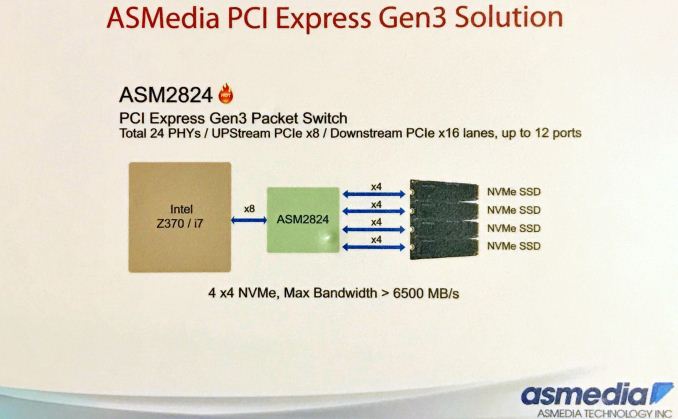
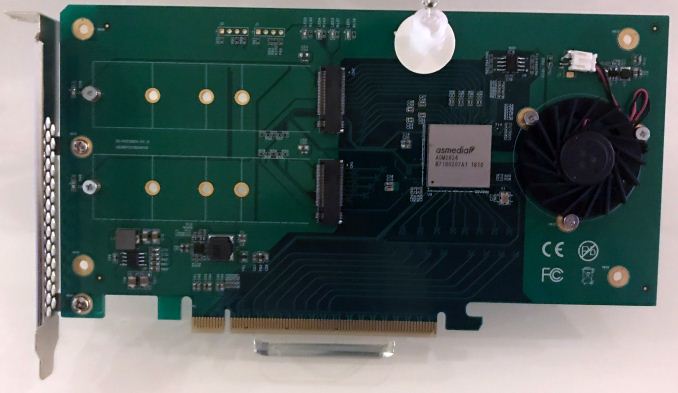
ASMedia’s ASM2824 has a PCIe 3.0 x8 upstream port as well as four PCIe 3.0 x4 downstream ports. The switch is designed primarily for storage devices, enabling installation of four NVMe drives on a single card.
ASMedia does not disclose pricing of its PCIe switch, but keeping in mind that it will have competitors from Avago/Broadcom as well as Marvell, I'm hopeful that ASMedia will not be charging too much for its switch. As for availability, expect ASMedia to launch the ASM2824 in the coming months .
| ||||||||||||||||||||||||||||||||
| 12:00p | Giveaway: Toshiba OCZ RC100 M.2 & SX700 USB-C 240GB SSDs
In the mood for some free hardware? Well then you're in luck: our awesome community team in conjunction with Toshiba is holding a giveaway for a quartet of the company’s SSDs. Altogether we have two 240GB OCZ XS700s – Toshiba’s new line of SATA-based USB-C portable drives – along with a pair of literally tiny 240GB OCZ RC100 M.2 SSDs.
As far as the RC100 goes, our SSD-meister, Billy Tallis, took a look at the new drive earlier this month. The tiny drives are aimed at a small but none the less important niche for M.2 storage: drives shorter than the standard 2280 form factor. The resulting 2242 form factor RC100 is on a bit more than half the length of a standard drive, making it one of a handful of drives suitable for certain laptops and other small form factors where a physically smaller drive is preferable. Under the hood, the RC100 is based on a completely self-contained BGA SSD design, meaning the entire controller + NAND stack is on a single package. The resulting performance, while not record-setting due to the compromises made, is none the less a generation ahead of the rest of the market, which is composed of older SATA-based designs. As for the SX700, this is a new external drive we haven’t reviewed yet. Toshiba has disclosed that like their other current-generation products it’s using their 64 layer 3D NAND, meanwhile Billy reckons it’s based on the TR200 SSD platform. TR200 is a basic drive but should be well suited for the highly sequential workloads most external SSDs are used for. As a result, the bottleneck here is the SATA interface; the USB-C 3.1 Gen 2 connection actually outpaces SATA here with its 10Gbps transfer rate. So it should be possible to hit the drive’s full transfer rate. In any case, the giveaway is running through July 9th and is open to all US residents. You can find the full details for entering the giveaway over on the storage section of our forums. | ||||||||||||||||||||||||||||||||
| 2:00p | ADATA Readies XPG SX7100 Realtek RTS5763DL-Based SSD
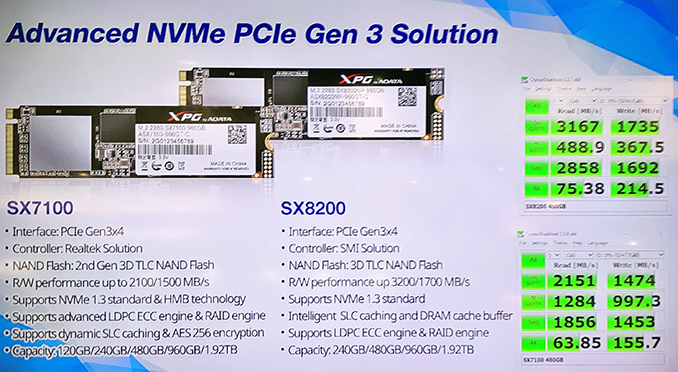
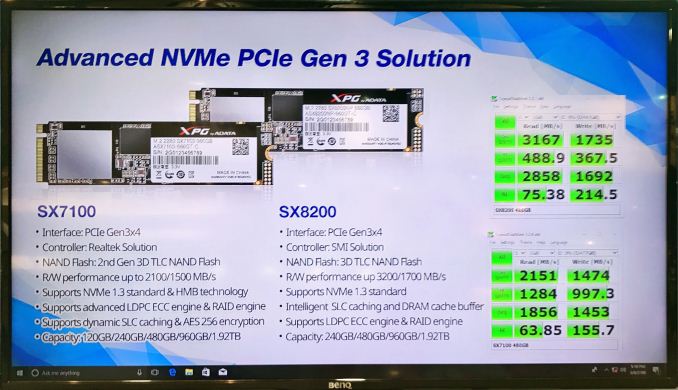
While the number of companies participating in the SSD market is booming, ADATA ended up being only large SSD vendor that adopted Realtek’s first-generation RST5760 SSD controller for its entry-level drives. Fittingly, at Computex the company revealed that it is working on a new Realtek-based storage device, this time based on the next-generation Realtek RTS5763DL controller that promises considerably higher performance. ADATA’s upcoming XPG SX7100 family of SSDs powered by the RTS5763DL will rely on 3D TLC NAND flash memory, so nothing too exotic here. The manufacturer expects to ship these drives in 120 GB, 240 GB, 480 GB, 960 GB, and 1.92 TB configurations, targeting gaming PCs that require various amounts of flash storage. The XPG SX7100 SSDs will be NVMe 1.3 compatible, will support a robust LDPC-based ECC and RAID engines, dynamic SLC caching, and AES256 encryption. When it comes to performance, the XPG SX7100 is slated beat its immediate predecessor (the SX7000) by a significant margin and will outperform the previous-generation Realtek-based SSD (the SX6000) by two times. ADATA expects higher-capacity flavors of the XPG SX7100 to offer up to 2100 MB/s sequential read speeds as well as up to 1500 MB/s sequential write speeds (when pSLC is enabled).
ADATA did not show its XPG SX7100 live at Computex, but only published a presentation slide (which incorrectly depicted an RTS5763DL-based SSD since the controller does not have a metallic heat spreader) with performance numbers from Realtek. Therefore, it is unclear whether the drives are in an early stage of development, or have already proceeded to prototyping and testing. Though regardless of the current situation, given the fact that ADATA was the only significant adopter of the RTS5760, it is highly likely that it has a close relationship with Realtek and will be able to offer its RTS5763DL-based drives ahead of the competition. Related Reading:
| ||||||||||||||||||||||||||||||||
| 4:00p | Comino Crypto Mining Rigs: Liquid-Cooled 16 GPUs in a 4U Server
Cryptocurrency mining has made quite a dent in the hardware industry in the last couple of years. Motherboard manufacturers have built special platforms for mining rigs, video card vendors have put together specially-designed "mining edition" video cards, and even chassis & PSUs vendors have gotten into the game with mining-focused designs. Obviously, not everyone wants to build mining rigs themselves, hence there is a meaningful market for companies who offer turnkey mining solutions. One of such companies is Comino, a multi-national firm registered in Cyprus with offices in China, Latvia, and Russia, which produces liquid-cooled turnkey mining rigs that look to be quite unique.
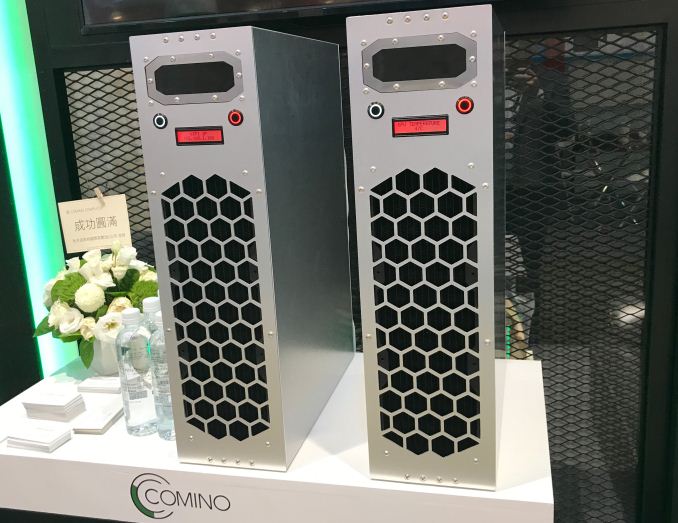
The company brought two of its key products to Computex — the Comino Object N1 designed for homes and offices, and 4U systems aimed at large cryptomining farms and offered for remote rent by Comino itself. Both types of machines use the company’s own liquid-cooled solutions and run proprietary software to ensure stable operation, predictable power consumption, and a guaranteed hash rate.
The Comino Object N1 is a factory-built system that looks like a regular desktop (taking some pages from the Voodoo Omen), yet packs eight NVIDIA GP106-based graphics cards from GIGABYTE. The mining rig is a completely sealed solution that only needs to be plugged to a power outlet and connected to the Internet. The Object N1 does not need to be set up, as all the management can be done using a special program for smartphones. Similarly, since Comino is focusing on a low-impact/low-hassle design, the Object N1 is also designed to be rather quiet despite the TDP, with the idea being that it can run 24/7 without disturbing anyone around (pictures over at Comino’s web site depict cats sitting on a working N1 machine). It is noteworthy that while the Object N1 uses a proprietary cooling system and software, it is actually based on off-the-shelf components, which is understandable as this was the first product by Comino and the company did not have access to custom hardware last year.
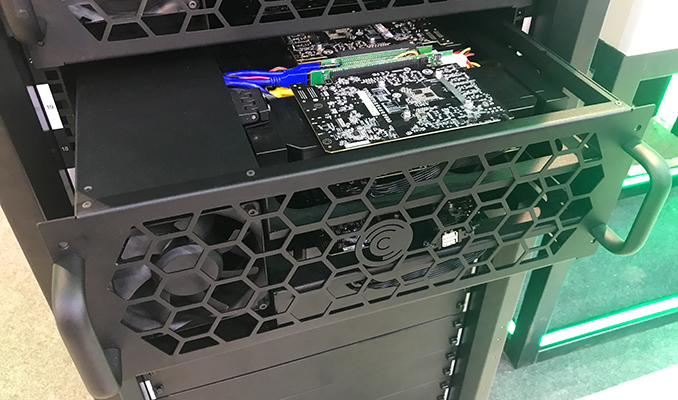
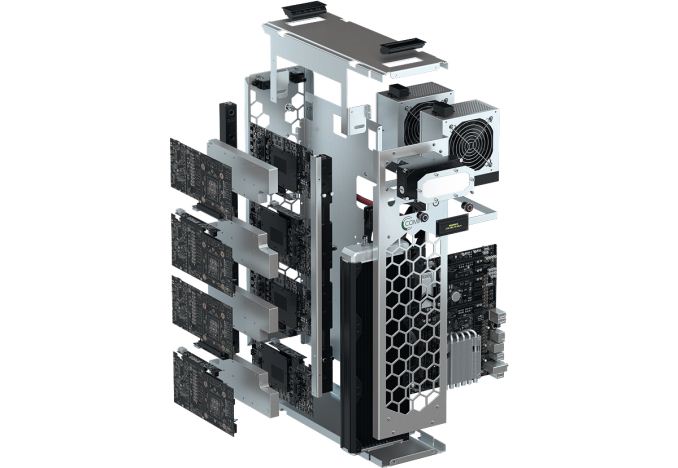
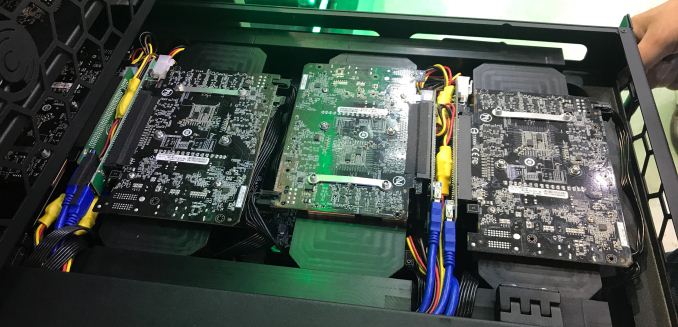
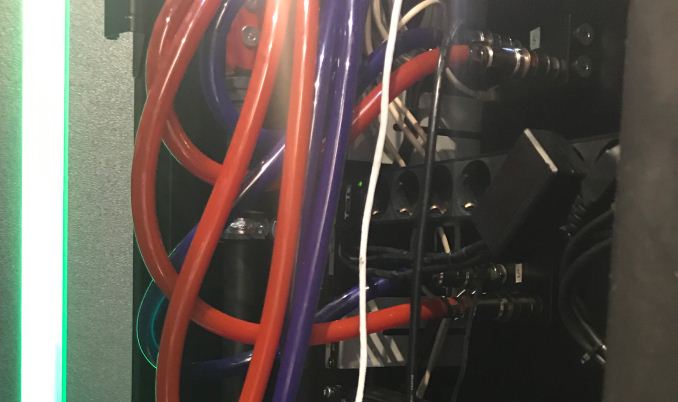
Meanwhile the 4U machine from Comino is a completely different thing aimed at large mining farms. Each 4U system is based on a custom ASUS motherboard, custom PCIe risers and packs 16 of the earlier mentioned GP106 GIGABYTE cards. One of the key features of this rig is Comino’s liquid cooling system comprising of proprietary water blocks, an external heat exchanger, and special tubing that allows technicians to remove just one 4U system from a rack without leaks if a GPU fails. Each water block can take away up to 450 W of heat, meaning that one block can handle two 220 W GPUs. Right now the GP106 GPUs that Comino uses dissipate up to 120 W, but if it manages to obtain more powerful GPUs, it will be able to install them without changing the cooling setup.
The 4U systems from Comino will be available for purchase by owners of large mining farms. Meanwhile, the company is also operating a cloud hosting program that rents out time on these servers to everyone interested in mining. For example, a 40 MH/s system costs €644 a year. For customers willing to take financial risks and unwilling to invest in hardware, Comino’s cloud mining program offers a potential alternative.
| ||||||||||||||||||||||||||||||||



| << Previous Day |
2018/06/27 [Calendar] |
Next Day >> |